
BAR-228 · Lesson 1 of 12 · 20 min
Becoming a lawyer in Nebraska
▶ Video coming soon A video version of this lesson is on the way.
Jace Overholt grew up on a cow-calf operation outside Broken Bow, in Custer County, where the nearest stoplight was a long drive away and the county courthouse was the most impressive building he knew. He finished his J.D. in May 2026 at an ABA-approved Nebraska law school and spent the summer back on the ranch while his older brother was away on a National Guard deployment. In September he started as a law clerk at Sato & Brekke, a four-lawyer firm in Kearney that handles farm and ranch matters, car crashes on rural highways, divorces and estates. He filed his application for the February 2027 Nebraska bar exam on October 6, 2026.
His first one-on-one video session with Hollis Marchetti, the bar-prep coach who runs the Tuesday evening study group, began with a question he had been afraid to ask anyone at the firm. 'Who actually decides whether I get to be a lawyer here? The bar association? The law school? The people who write the test?'
Marchetti smiled. 'Almost everyone asks that, and almost everyone guesses wrong. In Nebraska the answer is the Nebraska Supreme Court. Everyone else helps.' This lesson maps the people and institutions involved in Nebraska admission, the different routes into practice, and the plan for the rest of this course.
Admission is a judicial function
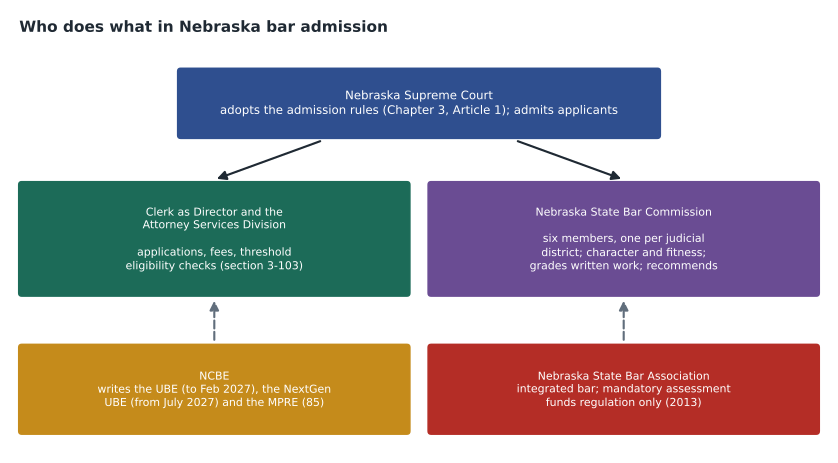
In Nebraska, as in nearly every American jurisdiction, regulating who may practice law belongs to the highest court. The Nebraska Supreme Court adopts the rules that govern admission, which appear in Chapter 3, Article 1 of the Nebraska Supreme Court Rules, beginning at section 3-101. Those rules set the education requirement, the character and fitness standards, the examination and its passing score, the conditions for admission without examination and the oath every new lawyer takes. When a candidate passes and is found qualified, it is the Court that admits the candidate.
The Court does not do the day-to-day work itself. Under section 3-103, the Clerk of the Nebraska Supreme Court serves as the Director of admissions. The Director runs the administrative side of admission through the Court's Attorney Services Division, which receives applications through the Court's online attorney portal, collects fees, checks that each application is complete and makes initial determinations about eligibility. If an application lacks the required degree or, for a motion applicant, the required years of practice, the Director rejects it at the threshold.
The Nebraska State Bar Commission
The Nebraska State Bar Commission is the body that evaluates applicants. Under section 3-102, the Supreme Court appoints six members of the Nebraska State Bar Association to the Commission, one from each of the state's six Supreme Court judicial districts. Members serve six-year terms and may serve no more than two full terms. The Commission reviews applications, orders further investigation when it needs more information, decides character and fitness questions in the first instance, grades the written portions of the exam that Nebraska grades, and makes the final recommendation to the Court about each applicant.
Marchetti pointed out that the Commission's name trips up many candidates. 'It sounds like part of the bar association. It is not. The Commission is an arm of the Court. The bar association is the professional organization you will join after you are admitted.'
NCBE and the exam itself
The National Conference of Bar Examiners writes the tests Nebraska uses. Through the February 2027 exam, Nebraska gives the Uniform Bar Examination, made up of three NCBE components: the Multistate Essay Examination, the Multistate Performance Test and the Multistate Bar Examination. Nebraska has given the UBE since 2013. Beginning with the July 2027 exam, Nebraska will give the NextGen Uniform Bar Examination, NCBE's new integrated test. NCBE also writes the Multistate Professional Responsibility Examination, the separate ethics test that every Nebraska applicant must pass.
Nebraska does not write any of its own exam questions, and it has no separate Nebraska law test or course for exam applicants. The exam is given twice a year in Lincoln. NCBE scores the multiple-choice portion and supplies grading materials for the written portions, while the Commission's graders grade the essays and performance tests under NCBE's procedures. Lesson 4 explains the format and the 270 passing score in detail, and Lesson 5 covers the NextGen change.
The Nebraska State Bar Association
Every lawyer admitted in Nebraska becomes a member of the Nebraska State Bar Association. Nebraska has an integrated, or unified, bar: membership is required by Supreme Court rule as a condition of practicing law. In 2013 a lawyer petitioned the Court to make the bar voluntary. In In re Petition for a Rule Change to Create a Voluntary State Bar of Nebraska, 286 Neb. 1018 (2013), the Court refused to abolish mandatory membership but narrowed what compulsory payments could fund.
Relying on the United States Supreme Court's decision in Keller v. State Bar of California, the Nebraska court reasoned that compelled payments may support only activities germane to regulating the profession and improving legal services. It amended its rules so that the required payment, now called a mandatory membership assessment, funds regulatory work such as admissions, membership records, enforcement of the ethics rules, regulation of continuing legal education, trust account records and enforcement against the unauthorized practice of law. The bar association may ask members for voluntary dues to support other work, including legislative analysis and member services, and a member may decline to pay voluntary dues without losing membership.
'So I pay the mandatory assessment no matter what,' Jace said, 'and the rest is my choice.' Marchetti nodded. 'Exactly. Lesson 11 covers what membership requires of you once you are in.'
The routes into Nebraska practice
Nebraska's rules offer several distinct routes to admission. Choosing the right one matters because each has its own requirements, fees and deadlines, and an application filed under the wrong route wastes months.
| Route | Who it fits | Core requirements |
|---|---|---|
| Admission by examination | Most new graduates | ABA-approved J.D. or LL.B., character and fitness, passing the Nebraska exam (UBE through February 2027; NextGen from July 2027) and an MPRE score of 85 |
| UBE or NextGen score transfer (section 3-119(A)) | Candidates who passed the UBE or NextGen elsewhere | A score at least equal to Nebraska's passing score, released within the past 5 years, plus the MPRE and character and fitness |
| Non-UBE score (section 3-119(B)) | Candidates who took another bar exam | A score at least equivalent to Nebraska's passing standard on an exam with essay, performance and MBE components, within 5 years, plus the MPRE |
| Practice-time motion (section 3-119(C)) | Experienced lawyers admitted elsewhere | Passing a bar exam where licensed, active and substantial practice for 3 of the past 5 years, and the MPRE score required where licensed |
| Military spouse (section 3-119(D)) | Spouses of service members stationed in Nebraska | Admission and good standing elsewhere, no discipline, residence or intent to reside in Nebraska, and other listed conditions; half the usual motion fee |
Who can apply at all
The education rule is strict and simple. Under section 3-101 and section 3-113, every applicant must hold a J.D. or LL.B. from a law school that was approved by the American Bar Association at the time the applicant graduated. NCBE's information for Nebraska confirms that graduates of foreign law schools are not eligible. Unlike some states, Nebraska has no route for law office study and no separate path for foreign-educated lawyers who earn an American LL.M. A lawyer trained abroad who wants to practice in Nebraska generally needs an ABA-approved J.D.
The degree must be shown by the time of the exam or, for a motion applicant, by the time of the motion application. A student still in law school may file an early application for a character and fitness determination alone under section 3-116, but that early application does not replace the regular application to sit for the exam. Lesson 2 covers deadlines and fees, and Lesson 3 covers the early character and fitness option in more detail.
From passing to practicing
Passing the exam is not the end of the process. After each exam, the Commission sends the Court a written report with its recommendations. When an applicant has met every eligibility requirement, passed the exam and passed the MPRE, the Commission recommends that the Court find the applicant eligible for admission. The Court then notifies each applicant in writing.
Under section 3-128, exam applicants are sworn in at Supreme Court admission ceremonies held in April for those who passed the February exam and in September for those who passed the July exam. Motion applicants may take the oath before a judge or clerk. The oath must be taken within 120 days of the Court's approval, and the executed oath card must be returned to the Attorney Services Division within 120 days. An applicant who lets those deadlines pass is not admitted.
'So if everything goes well in February,' Jace said, 'I could be sworn in at an April ceremony.' Marchetti added a caution she gives every candidate: 'Could. Plan your firm's expectations around results and the ceremony, and do not promise a client a court date before you have taken the oath.'
Worked problem
Picking the right route
Jace's law school classmate, Marisa, took and passed the July 2026 UBE in Colorado with a score of 284 because her fiance had a job there. The job fell through, and she now wants to move to Omaha. She has an MPRE score of 98 from 2025. Which Nebraska route should she use?
Show solution
- Marisa passed the UBE in another jurisdiction, so the score transfer route under section 3-119(A) is the natural fit.
- Her score of 284 is above Nebraska's 270 passing score, and it was released in 2026, well within the 5-year window.
- Her MPRE score of 98 exceeds Nebraska's 85 and is within 5 years.
- She files a motion application through the Court's portal, pays the motion fee and goes through Nebraska's character and fitness review. She does not need to sit for the Nebraska exam or practice for three years first.
Answer: Marisa should apply by UBE score transfer under section 3-119(A), not by examination or practice time.
How this course is organized
The rest of the course follows the order in which a Nebraska candidate meets each requirement. Lesson 2 covers eligibility, the filing windows and fees. Lesson 3 covers character and fitness and the MPRE. Lesson 4 explains the exam format, the weighting of the three UBE components and the 270 passing score. Lesson 5 covers the NextGen change in July 2027 and what it means for candidates who might sit more than once. Lesson 6 explains how Nebraska law fits an exam that tests general principles.
Lessons 7 through 10 turn to Nebraska law that new lawyers use in their first months of practice: Nebraska's courts and civil procedure, its tort rules (including the constitutional bar on punitive damages and the claims statutes for suing government), its family law and probate code, and the places where the Nebraska Rules of Professional Conduct differ from the ABA Model Rules. Lesson 11 covers score transfer, admission on motion, continuing legal education and bar membership. Lesson 12 is a capstone with original practice questions and an exam-day plan.
At the end of the session, Marchetti asked Jace to write a one-page map of his own admission: route, deadline, fee, MPRE status, disclosures and target ceremony. 'Pin it above your desk,' she said. 'Every lesson from here fills in one line of it.'
Common mistakes
MistakeThe Nebraska State Bar Association decides who is admitted.
InsteadThe Nebraska Supreme Court admits lawyers; the Nebraska State Bar Commission, an arm of the Court, evaluates applicants and recommends admission.
MistakeNebraska has a Nebraska law test that exam applicants must pass.
InsteadNebraska uses only NCBE tests and has no jurisdiction-drafted component for exam applicants.
MistakeA foreign-trained lawyer can qualify in Nebraska with an American LL.M.
InsteadNebraska requires a J.D. or LL.B. from an ABA-approved law school; foreign law graduates are not eligible.
MistakePassing the exam makes you a Nebraska lawyer.
InsteadYou must also be approved by the Court, take the oath within 120 days of approval and return the oath card within 120 days.
A note on Nebraska's size
Marchetti added one practical observation. Nebraska's bar is small enough that reputations travel fast. The same judges, clerks and opposing lawyers will see a new lawyer again and again across a career, and the people who serve on the Commission and the nominating commissions are practicing lawyers from every part of the state. Candor in the admission process, courtesy to court staff and reliability on deadlines are not only ethical duties; in a state where Kearney lawyers try cases against Grand Island lawyers in front of the same district judges for decades, they are the foundation of a practice. 'Start building that reputation now,' she told Jace, 'with the application itself.'
Summary and key terms
- The Nebraska Supreme Court adopts the admission rules (Chapter 3, Article 1) and admits lawyers.
- The Clerk of the Supreme Court serves as Director, and the Attorney Services Division handles applications.
- The six-member Nebraska State Bar Commission, one member from each judicial district, evaluates applicants and recommends admission.
- Nebraska gives the UBE through February 2027 and the NextGen UBE from July 2027, in Lincoln, with no Nebraska-drafted component.
- Nebraska has an integrated bar; since the 2013 decision, mandatory assessments fund only regulatory functions.
- Routes include examination, UBE or NextGen score transfer, non-UBE scores, practice-time motion and the military spouse route.
- Applicants need an ABA-approved J.D. or LL.B.; new lawyers take the oath within 120 days of approval.
- 0
- Nebraska State Bar Commission
- 1
- Director of admissions
- 2
- Attorney Services Division
- 3
- integrated bar
- 4
- mandatory membership assessment
- 5
- admission on motion
- 6
- oath card
Practice problems
Work each problem on paper first, then reveal the answer to check.
Who serves as the Director of admissions in Nebraska?
Show answer
The Clerk of the Nebraska Supreme Court, under section 3-103.
How many members does the Nebraska State Bar Commission have, and how are they chosen?
Show answer
Six, appointed by the Supreme Court from among bar members, one from each judicial district, for six-year terms with a two-term limit.
What did the Nebraska Supreme Court decide in its 2013 decision on a voluntary bar?
Show answer
It kept mandatory membership but limited mandatory assessments to regulatory functions, with voluntary dues for other activities.
When are exam applicants sworn in?
Show answer
At Supreme Court ceremonies in April (February exam) and September (July exam), within 120 days of approval.
Lesson quiz · 5 questions
Score 60% or more to complete this lesson.
Create a free account to save your progress, take quizzes and earn a certificate.