
BAR-228 · Lesson 9 of 12 · 20 min
Nebraska family law, wills and estates
▶ Video coming soon A video version of this lesson is on the way.
Two files landed on Jace's desk in the same week. The first was a divorce: a couple from near Elm Creek, married eighteen years, with two children, a house in town and 320 acres of farmland that the husband had inherited from his grandmother. The second was an estate: a retired schoolteacher from Gibbon had died in October 2026 leaving a handwritten document, signed and dated, that gave her house to a niece and 'everything else to the church.' Her husband of three years had expected to inherit most of her property.
'Neither of these subjects is on the MEE anymore,' Jace told Marchetti, half joking. 'So why do I have both of them in one week?' She laughed. 'Because family law and estates are most of what a small-town practice does. This lesson is the Nebraska law you need to open those files.'
Dissolution of marriage
Nebraska calls divorce dissolution of marriage, and dissolution cases are heard in the district court. Nebraska is a no-fault state: under section 42-361, the question for the court is whether the marriage is irretrievably broken. Fault grounds such as adultery or cruelty do not exist as separate grounds, although conduct can matter to issues such as custody.
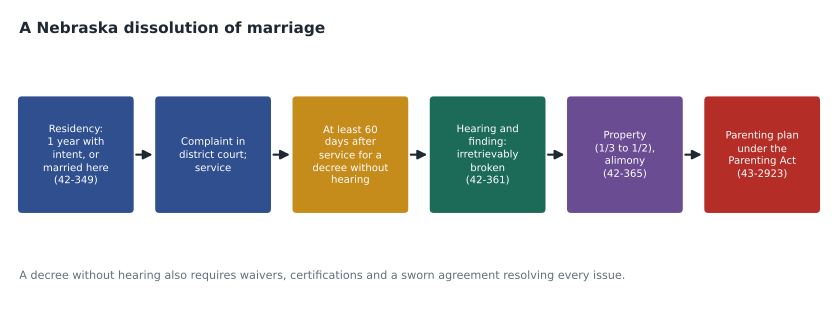
Jurisdiction depends on residence. Under section 42-349, a dissolution action may be filed if one spouse has resided in Nebraska with a bona fide intention of making the state a permanent home for at least one year before filing, or if the marriage was solemnized in Nebraska and either spouse has resided in Nebraska continuously from the wedding until filing. Members of the armed forces stationed continuously in Nebraska for a year, or married in Nebraska and stationed there since, are treated as residents. The Nebraska courts have described residence for this purpose as domicile: physical presence plus an intention to remain.
The irretrievably broken finding and the 60-day wait
Even when both spouses state under oath that the marriage is irretrievably broken, section 42-361 requires the court to make its own finding after a hearing. If one spouse denies that the marriage is irretrievably broken, the court considers all relevant factors, including the circumstances that led to the filing and the prospect of reconciliation, before deciding.
Nebraska also allows a decree without a hearing, but only under strict conditions. Both spouses must waive the hearing; the court must have jurisdiction over the case and both parties; both must certify that the marriage is irretrievably broken and that they made reasonable efforts at reconciliation; all required documents must be filed; and both must sign a sworn written agreement resolving every issue. Even then, the court may not enter the decree until at least 60 days after service of process was completed.
Property division
Nebraska is an equitable distribution state, not a community property state. Section 42-365 authorizes the court to divide the parties' property equitably and to award alimony, considering the circumstances of the parties, the duration of the marriage, each spouse's contributions to the marriage, including contributions to the care and education of the children, and any interruption of a spouse's career or education. The court may require security to ensure payment.
The Nebraska Supreme Court has given the division a working guideline. As it restated in Seemann v. Seemann, 316 Neb. 671 (2024), as a general rule a spouse should be awarded one-third to one-half of the marital estate, the polestar being fairness and reasonableness as determined by the facts of each case. Nebraska courts generally approach the task by first classifying property as marital or nonmarital, then valuing the marital property, and then dividing it. Property one spouse brought into the marriage or received by gift or inheritance is generally treated as nonmarital and set aside to that spouse, so long as it can be identified and traced, but the burden of proving that property is nonmarital falls on the spouse who claims it.
That rule framed the Elm Creek file. The 320 acres the husband inherited were presumptively his separate property if he could trace them, and the parties' records showed the land had stayed titled in his name alone. The house in town, bought during the marriage, and the retirement accounts built during the marriage were marital property to be divided within the one-third to one-half guideline.
| Issue | Nebraska rule |
|---|---|
| Residency | One year with intent to remain, or married in Nebraska with continuous residence (section 42-349) |
| Ground | Marriage irretrievably broken (section 42-361) |
| Waiting period for a decree without hearing | At least 60 days after service, with waiver, certification and a sworn agreement |
| Property | Equitable division; generally one-third to one-half of the marital estate to each spouse |
| Alimony factors | Circumstances, length of marriage, contributions, interrupted careers and ability to work while caring for children (section 42-365) |
| End of alimony | On either party's death or the recipient's remarriage, unless the parties agree otherwise in writing or the court orders otherwise |
Alimony
Alimony in Nebraska is awarded on the same factors as property division, together with the ability of the supported spouse to work without interfering with the interests of minor children in that spouse's custody. Under section 42-365, alimony terminates on the death of either party or the remarriage of the recipient unless the parties agree otherwise in writing or the court orders otherwise. A party seeking modification must file a complaint to modify and show good cause. Installments that came due before the complaint was filed cannot be changed, alimony cannot be added by modification if the decree did not award it, and additional alimony cannot be granted after the full amount originally awarded has come due.
Custody and the Parenting Act
Custody and parenting time are governed by the Nebraska Parenting Act, which begins at section 43-2920. The court must approve a parenting plan that serves the best interests of the child. Section 43-2923 lists the considerations: the child's safety, emotional growth, health, stability and physical care; regular school attendance and progress; the child's relationship with each parent; the desires and wishes of a child of sufficient age and reasoning; the child's general health, welfare and social behavior; and credible evidence of abuse, neglect or domestic intimate partner abuse. If a preponderance of the evidence shows domestic intimate partner abuse, the plan must provide for the safety of the victim parent.
Courts must consider joint legal and physical custody when devising a parenting plan, but the Nebraska Supreme Court has said that equal parenting time is not required when it is not in the child's best interests. In 2026 the Legislature passed LB965, which amended the Parenting Act, effective July 18, 2026, to require courts to consider credible evidence concerning the effects on children of having equal access to both parents, along with research incorporated from LB908. The amendment adds a factor to weigh; it does not create a presumption of equal time.
Child support is calculated under the Nebraska Child Support Guidelines, which the Supreme Court adopts by rule and which base support on the parents' combined incomes and the parenting time arrangement. Support issues arise in nearly every dissolution with minor children, and new lawyers should become familiar with the guideline worksheets early.
The Nebraska Probate Code
Nebraska adopted a version of the Uniform Probate Code as the Nebraska Probate Code, in chapter 30 of the Nebraska Revised Statutes. Probate matters, including the administration of estates, guardianships and conservatorships, are heard in the county courts. Many estates can be handled informally, and small estates may be collected by affidavit; the Legislature has adjusted the affidavit procedure in recent sessions, so a new lawyer should check the current version of the statute before using it.
Holographic wills
Nebraska recognizes holographic wills. Under section 30-2328, a will is valid without witnesses if the signature, the material provisions and the date are in the testator's handwriting. If the date is missing, the will may still be valid if it is the only such document or does not conflict with another, or if the date can be established from its contents, the circumstances or other evidence. The Nebraska courts have accepted initials as a signature in some cases and a month and year as substantially sufficient for the date. The handwritten material provisions must show testamentary intent and identify the property and the persons who take it.
The Gibbon schoolteacher's document met each requirement on its face: it was entirely in her handwriting, signed and dated, and it named who would receive what. The question was what her husband could claim despite it.
The surviving spouse's protections
A Nebraska surviving spouse cannot be completely disinherited. Under section 30-2313, the surviving spouse of a decedent domiciled in Nebraska may elect to take up to one-half of the augmented estate. The augmented estate is broader than the probate estate; it adds back certain transfers the decedent made during life, so that a spouse cannot be defeated by lifetime transfers designed to avoid the elective share. If the decedent was domiciled elsewhere, the law of the domicile governs the spouse's elective share in Nebraska property.
The surviving spouse also receives allowances that come ahead of most claims. Under section 30-2322, the homestead allowance for a decedent who died in 2011 or later is 20,000 dollars, payable to the surviving spouse or, if there is none, divided among minor and dependent children. It takes priority over nearly all claims except administration costs and is in addition to anything passing by will, intestacy or elective share unless the will provides otherwise. Exempt property and a family allowance provide further protection.
Nebraska's inheritance tax
Nebraska is one of only a few states with an inheritance tax, and it is administered at the county level. The tax falls on the person who receives property, at rates that depend on the relationship to the decedent. For decedents who died on or after January 1, 2023, the rates are:
| Recipient | Rate | Exempt amount per recipient |
|---|---|---|
| Surviving spouse | Not taxed | All |
| Immediate relatives: parents, grandparents, siblings, children and other lineal descendants, and their spouses (section 77-2004) | 1 percent | 100,000 dollars |
| Remote relatives: aunts, uncles, nieces, nephews and their descendants and spouses (section 77-2005) | 11 percent | 40,000 dollars |
| All others, such as friends (section 77-2006) | 15 percent | 25,000 dollars |
Interests passing to any recipient under the age of 22 are exempt, as are the homestead allowance, exempt property and family allowance. Transfers to qualifying charities are generally exempt under other provisions. In the Gibbon estate, the niece, as a remote relative, would pay 11 percent on the value of the house above 40,000 dollars. The surviving husband's interests would not be taxed.
Worked problem
Advising the surviving husband
The Gibbon schoolteacher died domiciled in Nebraska. Her holographic will leaves the house to her niece and everything else to her church. Her husband of three years wants to know what he can receive.
Show solution
- The will appears valid under section 30-2328: signature, material provisions and date are in her handwriting.
- He is entitled to the 20,000-dollar homestead allowance under section 30-2322, plus exempt property and any family allowance.
- He may elect to take up to one-half of the augmented estate under section 30-2313, which may include certain lifetime transfers she made.
- Anything he receives as surviving spouse is not subject to Nebraska inheritance tax under section 77-2004.
- The firm should calculate the augmented estate before advising whether the election produces more than the allowances alone, and calendar the deadline for making the election.
Answer: He cannot be disinherited: he has the allowances and an elective share of up to one-half of the augmented estate.
Common mistakes
MistakeNebraska is a community property state.
InsteadNebraska divides property equitably; generally one-third to one-half of the marital estate to each spouse.
MistakeIf both spouses swear the marriage is broken, no hearing is ever needed.
InsteadA hearing is required unless all conditions for a decree without hearing are met, including the 60-day wait after service.
MistakeAn unwitnessed will is always invalid.
InsteadNebraska accepts holographic wills with the signature, material provisions and date in the testator's handwriting.
MistakeA surviving spouse who is left out of a will gets nothing.
InsteadThe spouse may elect up to one-half of the augmented estate and receives allowances.
Where these cases are heard
Remember the court split from Lesson 7. Dissolution cases, with their property division, alimony and custody issues, are heard in the district court. Probate, guardianship and conservatorship matters are heard in the county court. A family whose divorce is pending in district court and whose parent's estate is being probated in county court has two cases in two courts, with two sets of deadlines, and a new lawyer should calendar both.
Summary and key terms
- Dissolution requires one year of residence with intent to remain, or a Nebraska marriage with continuous residence (section 42-349).
- The ground is irretrievable breakdown; a decree without hearing requires waivers, a sworn agreement and at least 60 days after service.
- Property is divided equitably, generally one-third to one-half of the marital estate to each spouse (Seemann, 2024).
- Alimony ends on death or the recipient's remarriage unless agreed or ordered otherwise.
- The Parenting Act requires a best-interests parenting plan; LB965, effective July 18, 2026, adds consideration of evidence about equal access to both parents.
- Holographic wills are valid with handwritten signature, material provisions and date (section 30-2328).
- A surviving spouse may elect up to one-half of the augmented estate and receives a 20,000-dollar homestead allowance.
- Nebraska's county inheritance tax spares surviving spouses and taxes others at 1, 11 or 15 percent above exemptions.
- 0
- dissolution of marriage
- 1
- irretrievably broken
- 2
- equitable distribution
- 3
- marital estate
- 4
- parenting plan
- 5
- holographic will
- 6
- augmented estate
- 7
- elective share
- 8
- homestead allowance
- 9
- inheritance tax
Practice problems
Work each problem on paper first, then reveal the answer to check.
What residency does a Nebraska dissolution require?
Show answer
One spouse's residence in Nebraska for one year with intent to remain, or a Nebraska marriage with continuous residence since.
What is the Nebraska guideline for dividing the marital estate?
Show answer
Generally one-third to one-half to a spouse, based on fairness and reasonableness.
What must be handwritten for a Nebraska holographic will?
Show answer
The signature, the material provisions and the date (with limited exceptions for the date).
What elective share can a Nebraska surviving spouse claim?
Show answer
Up to one-half of the augmented estate.
Lesson quiz · 5 questions
Score 60% or more to complete this lesson.
Create a free account to save your progress, take quizzes and earn a certificate.