
BAR-228 · Lesson 7 of 12 · 20 min
Nebraska courts and civil procedure
▶ Video coming soon A video version of this lesson is on the way.
Dale Brekke, the younger partner at Sato & Brekke, handed Jace a file on his first Monday and said, 'Find out where this goes and when everything is due.' The file concerned a Gibbon farmer whose pickup had been struck by a grain truck on a county road in Buffalo County. The truck's owner was a private company; the crash had happened at an intersection where a stop sign had been knocked down weeks earlier. Jace spent the morning trying to work out which court heard what, how long the firm had to serve the complaint and when an appeal would be due.
When he described the morning to Marchetti, she said it was the best possible introduction to Nebraska procedure. 'The bar exam tests federal procedure,' she said, 'and Nebraska has moved its rules closer to the federal model. But the court structure, the service deadline and the appeal deadline are Nebraska's own, and they catch new lawyers every year.' This lesson maps Nebraska's courts, how judges are chosen, the 2025 pleading rules and the key deadlines.
The courts
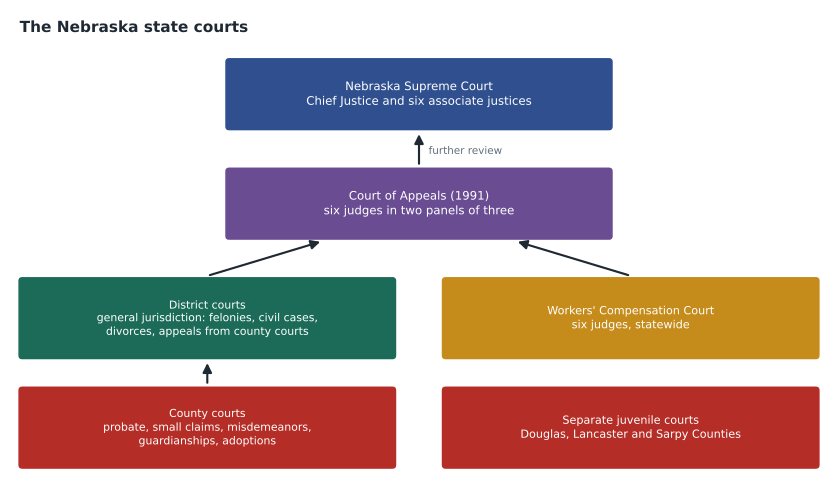
Nebraska has a unified court system under the administrative direction of the Nebraska Supreme Court. At the top is the Supreme Court itself, made up of a Chief Justice and six associate justices. The Chief Justice represents the state at large, and each associate justice represents one of six Supreme Court judicial districts. The Supreme Court hears appeals in the most serious matters, including cases with a sentence of life imprisonment, cases involving the constitutionality of a statute, and matters it moves to its own docket, and it regulates the practice of law.
Below it is the Nebraska Court of Appeals, established in 1991. It has six judges who sit in two panels of three, so the court can decide cases in two places at once. Most appeals go first to the Court of Appeals, and a party may then petition the Supreme Court for further review. A chief judge leads the court for a renewable two-year term.
The district courts are Nebraska's trial courts of general jurisdiction. They hear felony cases, civil cases of any size, domestic relations cases such as divorces, and appeals from county courts and many administrative agencies. Each county has a clerk of the district court. The county courts are courts of limited jurisdiction that handle small claims, probate, guardianships and conservatorships, adoptions, misdemeanors and municipal ordinance violations, and preliminary hearings in felony cases, among other matters. In Douglas, Lancaster and Sarpy Counties, separate juvenile courts hear juvenile cases; elsewhere county courts sitting as juvenile courts hear them.
Nebraska also has a statewide Workers' Compensation Court with six judges, which hears workers' compensation claims. Its decisions are appealed to the Court of Appeals.
How judges are chosen
Nebraska selects judges through a merit plan, adopted by constitutional amendment in 1962. When a vacancy occurs, a judicial nominating commission reviews applicants and sends the Governor at least two nominees. The commission has four lawyers chosen by members of the state bar, four nonlawyers appointed by the Governor, and a Supreme Court justice who chairs it without a vote. The Governor appoints from the list; if the Governor does not act within 60 days, the Chief Justice makes the appointment.
Judges then stand for retention. A judge first appears on the ballot at the first general election more than three years after appointment and every six years after that. Voters answer only whether the judge should be retained; there is no opponent. A judge is removed if more than half the voters vote against retention.
Commencing an action and the 180-day service rule
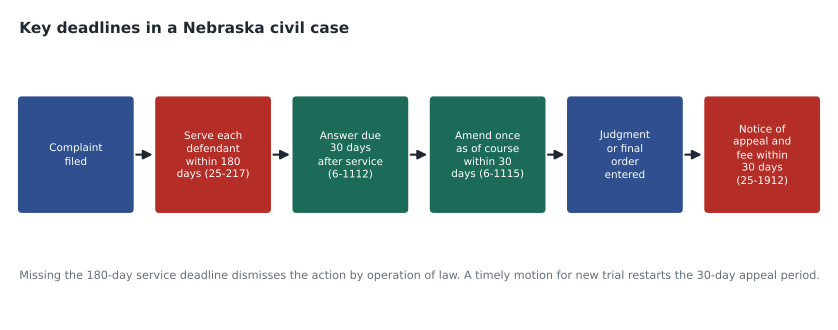
A civil action in Nebraska begins when the complaint is filed with the court. Section 25-217 of the Nebraska Revised Statutes then sets a strict deadline: each defendant must be served within 180 days after the complaint is filed. If a court stays or enjoins the case during that period, the plaintiff has 90 days after the stay or injunction ends to serve an unserved defendant. If a defendant is not served in time, the action against that defendant is dismissed by operation of law, without prejudice, on the day after the deadline.
The phrase by operation of law is the danger. No motion is needed and no order is entered; the dismissal simply happens. A plaintiff who files near the end of the limitations period and then fails to serve within 180 days may find the action dismissed and the limitations period expired, leaving nothing to refile. Jace put a 120-day reminder on the firm's calendar for every new filing, so the firm would have time to fix a failed service.
The pleading rules after January 1, 2025
Nebraska abandoned old-style code pleading in 2003, when the Supreme Court adopted the Nebraska Court Rules of Pleading in Civil Cases, modeled on the Federal Rules. In November 2024 the Court adopted a major revision, effective January 1, 2025. The revised rules appear in Chapter 6, Article 11 of the Supreme Court Rules as sections 6-1101 through 6-1116, numbered so that the last two digits match the corresponding Federal Rule. Former Nebraska rule 12 is now section 6-1112, and former rule 15 is now section 6-1115. Sections that have no Nebraska counterpart are reserved, keeping the numbering parallel. The revised rules apply to cases filed on or after January 1, 2025 and to cases pending on that date, although a trial court may apply the prior version where fairness requires.
Several changes affect daily practice. Section 6-1101 now says the rules should be applied to secure the just, speedy and inexpensive determination of every action without undue cost, borrowing language from the 2015 federal amendment. Counterclaims and cross-claims are stated in the answer, and a response to a counterclaim is now called an answer rather than a reply. The list of affirmative defenses in section 6-1108 now includes absolute or qualified immunity and describes res judicata as claim or issue preclusion.
| Step | Rule after January 1, 2025 |
|---|---|
| Answer to a complaint | 30 days after service of the summons and complaint (section 6-1112(a)(1)(A)) |
| Responsive pleading after a motion is denied or postponed | 21 days |
| Compliance with an order for a more definite statement | 14 days |
| Amendment once as of course | Within 30 days after serving a pleading that requires a response; otherwise within 14 days after a responsive pleading or certain motions (section 6-1115) |
| Response to an amended pleading | The longer of the time remaining or 14 days |
| New Rule 12 defense | Pendency of another action between the same parties (section 6-1112(b)(3)) |
| Matters outside the pleadings | Conversion of a Rule 12 motion to summary judgment under new section 6-1112(d) |
The time to answer remains 30 days, longer than the federal 21 days. Other periods were reset to multiples of seven, matching federal practice. A new Nebraska lawyer who learned federal deadlines for the bar exam must remember that the answer deadline is the one important number that is different.
The plausibility standard
In Doe v. Board of Regents of the University of Nebraska, decided in August 2010, the Nebraska Supreme Court adopted the plausibility standard that the United States Supreme Court announced in Bell Atlantic Corp. v. Twombly and Ashcroft v. Iqbal. The Court replaced Nebraska's earlier test, under which a complaint survived unless the plaintiff could prove no set of facts entitling him to relief. Now a plaintiff must allege enough facts, accepted as true, to state a claim to relief that is plausible on its face.
For exam purposes, this means the federal and Nebraska standards for a motion to dismiss for failure to state a claim are essentially the same. In practice, a Nebraska complaint should plead facts rather than conclusions: who did what, when, and how it caused the injury.
Statutes of limitations
New lawyers should memorize a few Nebraska limitations periods, because a missed period cannot be fixed. Under section 25-207, actions for trespass on real property, for taking or injuring personal property, for injury to the rights of the plaintiff not arising on contract and not otherwise listed, and for relief on the ground of fraud must be brought within four years; a fraud claim does not accrue until the fraud is discovered. Ordinary negligence claims for personal injury therefore generally carry a four-year period in Nebraska. Under section 25-208, libel and slander must be brought within one year, and the Nebraska courts have applied the one-year period to assault and battery.
Professional negligence has its own rule. Under section 44-2828, a malpractice or professional negligence action must be brought within two years after the act or omission. If the claim could not reasonably have been discovered within two years, the plaintiff has one year from discovery, whichever is earlier, but no action may be brought more than ten years after the service at issue. Claims against the state and its political subdivisions follow the shorter claim deadlines in the tort claims acts covered in Lesson 8.
Appeals and the 30-day rule
Section 25-1912 governs appeals from the district court. To appeal a judgment, decree or final order, the appellant must, within 30 days after its entry, file a notice of intent to appeal with the clerk of the district court that entered it and pay the docket fee required by statute to that same clerk. A notice filed after the court announces its decision but before the judgment is entered is treated as filed on the date of entry. A timely motion for new trial, to alter or amend the judgment or to set aside the verdict stops the 30-day clock, and the full period starts again when the court rules on the motion. A notice of appeal filed while such a motion is pending has no effect, so the appellant must file a new notice after the ruling.
Two traps follow. First, both the notice and the docket fee are due within 30 days; paying the fee late can defeat the appeal. Second, the appellate court's jurisdiction depends on a final order. Nebraska courts regularly dismiss appeals from orders that do not finally resolve the case or that otherwise fall outside the statutory definition of a final order, so a new lawyer should confirm finality before filing.
Worked problem
Mapping the pickup crash
The Gibbon farmer's pickup was hit on March 30, 2026 by a grain truck owned by a private company, at a Buffalo County intersection where a downed stop sign had not been replaced. He suffered a broken wrist and his pickup was totaled. Sato & Brekke plans to sue the trucking company and to make a claim against the county. What are the key procedural points?
Show solution
- The claim against the trucking company is ordinary negligence. Under section 25-207 the four-year limitations period runs to March 30, 2030.
- The suit belongs in the district court for Buffalo County, which has general jurisdiction over civil claims of any size.
- Once the complaint is filed, the company must be served within 180 days under section 25-217, or the action is dismissed by operation of law.
- The company will have 30 days after service to answer under section 6-1112.
- The claim against the county is governed by the Political Subdivisions Tort Claims Act, which requires a written claim within one year, so the county claim is due by March 30, 2027 (Lesson 8).
Answer: Calendar the four-year limitations period, the one-year county claim deadline, the 180-day service deadline after filing and the 30-day answer and appeal periods.
Marchetti finished the session with her favorite advice for new associates: 'Calendar the deadline the day you see it, and calendar a warning well before it. Nebraska will dismiss your client's case without anyone filing a motion.'
Common mistakes
MistakeNebraska defendants have 21 days to answer, as in federal court.
InsteadUnder section 6-1112(a)(1)(A) the answer is due 30 days after service.
MistakeA case not served within 180 days stays open until the defendant moves to dismiss.
InsteadSection 25-217 dismisses the action by operation of law, without prejudice, the day after the deadline.
MistakeNebraska still uses the no set of facts pleading test.
InsteadDoe v. Board of Regents (2010) adopted the Twombly and Iqbal plausibility standard.
MistakeA notice of appeal filed while a motion for new trial is pending preserves the appeal.
InsteadIt has no effect; a new notice must be filed within 30 days after the ruling on the motion.
Federal court in Nebraska
Some of the firm's cases will belong in federal court instead. The United States District Court for the District of Nebraska sits principally in Omaha and Lincoln and applies the Federal Rules of Civil Procedure, including the 21-day answer period the bar exam tests. A case against the trucking company might be removed there if the parties are from different states and the amount in controversy exceeds 75,000 dollars. A new associate should never assume which rules apply; the first question on any file is which court the case is in.
Summary and key terms
- The Supreme Court has seven justices; the Court of Appeals, created in 1991, has six judges in two panels.
- District courts have general jurisdiction; county courts handle probate, small claims, misdemeanors and more; separate juvenile courts sit in Douglas, Lancaster and Sarpy Counties.
- Judges are chosen by merit selection and stand for retention after more than three years and then every six years.
- Defendants must be served within 180 days of filing or the action is dismissed by operation of law (section 25-217).
- The pleading rules were renumbered as sections 6-1101 to 6-1116 effective January 1, 2025; answers remain due in 30 days.
- Nebraska follows the plausibility pleading standard.
- Ordinary tort claims generally have four years (section 25-207); professional negligence two years (section 44-2828); appeals require a notice and fee within 30 days (section 25-1912).
- 0
- Court of Appeals
- 1
- district court
- 2
- county court
- 3
- merit selection
- 4
- retention election
- 5
- operation of law
- 6
- plausibility standard
- 7
- final order
Practice problems
Work each problem on paper first, then reveal the answer to check.
How many justices sit on the Nebraska Supreme Court?
Show answer
Seven: a Chief Justice and six associate justices.
What happens if a defendant is not served within 180 days of filing?
Show answer
The action against that defendant is dismissed by operation of law, without prejudice, under section 25-217.
How long does a Nebraska defendant have to answer?
Show answer
30 days after service, under section 6-1112(a)(1)(A).
What must an appellant do within 30 days of entry of a district court judgment?
Show answer
File a notice of appeal with the district court clerk and pay the docket fee.
Lesson quiz · 5 questions
Score 60% or more to complete this lesson.
Create a free account to save your progress, take quizzes and earn a certificate.