
BAR-228 · Lesson 6 of 12 · 20 min
What the exam tests and how Nebraska law appears
▶ Video coming soon A video version of this lesson is on the way.
In his second week at Sato & Brekke, Jace drafted a demand letter for a client who had sold sixty bred heifers to a buyer who paid with a bad check and then resold the cattle. In the last paragraph he wrote that the client would seek punitive damages for the buyer's fraud. Miriam Sato, the firm's senior partner, handed the draft back with one line circled in red. 'Not in Nebraska,' she wrote in the margin. 'Look up article VII, section 5.'
Jace told Marchetti the story at their next session, a little embarrassed. 'I learned punitive damages in torts. They were on my practice MBE questions last week.' Marchetti laughed. 'And you will see them again on the exam. That is the point of this lesson. The bar exam tests one body of law. Your Nebraska practice uses another. You need both, and you need to know which one you are using at any moment.'
No Nebraska component
Nebraska gives the Uniform Bar Examination without any Nebraska-drafted questions, Nebraska law course or Nebraska law test for exam applicants. NCBE's jurisdiction information confirms that Nebraska has no jurisdiction-specific component, and the Court's rules require only the UBE (through February 2027) or the NextGen UBE (from July 2027), plus the MPRE. Some UBE jurisdictions require new admittees to complete an online course or test on state law. Nebraska does not.
That makes the Nebraska exam, in one sense, simpler than the exams in states with their own essays. Candidates do not memorize Nebraska statutes for the exam. But it also creates a trap. A candidate who spends the months before the exam working at a Nebraska firm, as Jace is, absorbs Nebraska rules every day, and some of those rules differ from what the exam expects.
What the exam actually tests
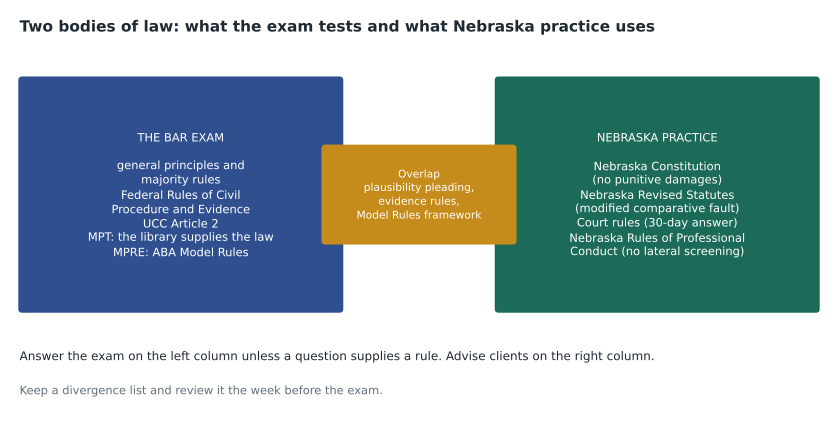
The MBE tests general principles of law. NCBE's instructions tell candidates to answer according to generally accepted fundamental legal principles unless a question specifies otherwise, and to apply the Federal Rules of Civil Procedure and the Federal Rules of Evidence where those rules govern. Contracts questions on sales apply Article 2 of the Uniform Commercial Code. Constitutional law and federal civil procedure are federal law everywhere. In torts, property and criminal law, the MBE generally tests the majority rule or the rule stated in the question.
The MEE is set in fictional jurisdictions, often called State A or State B, and the grading materials reward knowledge of general principles, the Uniform Commercial Code, the federal rules and widely adopted uniform acts. When the law is genuinely split, good MEE answers identify the majority and minority positions and explain how the outcome would differ. The MPT is closed-universe: the library supplies the law, which may be fictional, and the candidate is graded on using it, not on knowing it in advance.
Where Nebraska law and the exam diverge
Most of the time, Nebraska follows the general rule and the distinction does not matter. But a handful of Nebraska rules depart sharply from what the exam expects. Marchetti asked Jace to keep a two-column list, exam rule on the left, Nebraska rule on the right, and to review it the week before the exam so the Nebraska rules would not leak into his answers.
| Topic | What the exam generally expects | Nebraska rule |
|---|---|---|
| Punitive damages | Available for malicious, willful or wanton conduct in most jurisdictions | Not allowed; they violate Neb. Const. art. VII, section 5 (Distinctive Printing and Packaging Co. v. Cox, 1989) |
| Comparative negligence | Pure comparative negligence unless the question states otherwise | Modified: a claimant whose negligence equals or exceeds the defendants' combined negligence is barred (section 25-21,185.09) |
| Joint and several liability | Often joint and several at common law | Joint and several for economic damages; several only for noneconomic damages, unless defendants acted in concert (section 25-21,185.10) |
| Medical malpractice damages | No cap unless stated | Total recovery capped at 2.25 million dollars for occurrences after 2014 for providers qualified under the Hospital-Medical Liability Act (section 44-2825) |
| Claims against local government | Sovereign immunity principles generally | Political Subdivisions Tort Claims Act: written claim within one year, bench trial, caps of 1 million dollars per person and 5 million dollars per occurrence |
| Professional conduct | ABA Model Rules on the MPRE | Nebraska Rules of Professional Conduct, with variations such as no screening of lateral lawyers under Rule 1.10 |
The table is not a list of things to write on the exam. It is a list of things to keep off the exam. If an MBE torts question involves a defendant's malicious conduct and asks about available damages, the expected answer includes punitive damages, because the exam tests the general rule. Writing 'punitive damages are unconstitutional' would be correct in a Nebraska courtroom and wrong on the MBE.
When a question tells you the jurisdiction's rule
Some questions specify the governing rule. An MBE question may say that the jurisdiction has adopted modified comparative negligence or that a statute provides a particular limitations period. When the question supplies the rule, use it, even if it differs from both the general rule and Nebraska's rule. MEE questions sometimes include a statute in the question or say that State A follows a specified approach. The instruction in the question always controls.
Federal law in Nebraska
Some of what the exam tests is the law Nebraska lawyers use directly. Federal civil procedure governs cases in the United States District Court for the District of Nebraska, whose appeals go to the United States Court of Appeals for the Eighth Circuit. Federal constitutional law applies in every Nebraska courtroom. The Federal Rules of Evidence are the model for the Nebraska Evidence Rules, which Nebraska adopted by statute in chapter 27 of the Nebraska Revised Statutes, and the two sets track each other closely on most points that appear on the exam.
Nebraska's civil pleading rules also follow the federal model in important respects. As Lesson 7 explains, the Nebraska Supreme Court adopted the federal plausibility standard for pleadings in 2010, and its 2024 amendments to the pleading rules, effective January 1, 2025, renumbered the rules to track the Federal Rules. For many civil procedure questions, the federal answer and the Nebraska answer coincide.
Subjects that left the MEE
Family law and trusts and estates left the MEE in July 2026, along with conflict of laws and secured transactions. Nebraska candidates sometimes conclude that they can ignore Nebraska family law and probate until after admission. For the exam, that is largely true; these subjects can appear only as an MPT task, where the library supplies the law. For practice, it is not. Divorces and estates are among the most common matters a new Nebraska lawyer handles, especially outside Omaha and Lincoln, and Lesson 9 covers the Nebraska rules a new lawyer needs in the first weeks.
How to keep the two bodies of law apart
Marchetti suggested three habits. First, when doing practice questions, answer on the general rule and then, separately, ask what Nebraska would do. That builds the habit of switching deliberately rather than by accident. Second, in the final two weeks before the exam, reduce time at the firm on matters that involve the rules on the divergence list, if the firm allows it, so that Nebraska rules are not freshest in mind on exam day. Third, for every MBE miss, ask whether the wrong answer came from a Nebraska rule. A pattern of misses in one area, such as comparative fault, usually means a Nebraska rule is leaking in.
Jace asked Miriam Sato whether he could cut back on the firm's injury files in the last weeks of January. She agreed immediately. 'I took the exam too,' she said. 'I still remember answering a question with the Nebraska comparative fault rule and realizing afterward that the question was asking for pure comparative fault.'
Worked problem
Exam answer or Nebraska answer?
An MBE question describes a driver who was 40 percent at fault and a defendant who was 60 percent at fault in a collision causing 100,000 dollars in damages. It does not say what comparative fault rule applies. What does the driver recover on the exam, and what would she recover in a Nebraska negligence case?
Show solution
- On the exam, with no rule specified, apply pure comparative negligence: damages are reduced by the plaintiff's share of fault.
- The driver recovers 60,000 dollars on the exam answer.
- In Nebraska, section 25-21,185.09 bars a claimant only if her negligence equals or exceeds the defendants' combined negligence. At 40 percent, she is not barred.
- Her recovery is reduced in proportion to her fault, so she also recovers 60,000 dollars in Nebraska.
- The answers diverge only when the claimant's fault reaches 50 percent or more: on the exam she would still recover a reduced amount; in Nebraska she would recover nothing.
Answer: Here both answers give 60,000 dollars, but the rules differ at 50 percent and above, which is exactly where exam questions like to test.
The MPRE and Nebraska's ethics rules
The same split applies to professional responsibility. The MPRE tests the ABA Model Rules of Professional Conduct and generally accepted principles of lawyer regulation. Nebraska lawyers are bound by the Nebraska Rules of Professional Conduct, adopted by the Nebraska Supreme Court in Chapter 3, Article 5 of its rules. The two sets are largely the same, but Lesson 10 identifies places where Nebraska's version differs. For the MPRE, use the Model Rules. For a client in Kearney, use the Nebraska rules.
Why Nebraska law still belongs in this course
If the exam does not test Nebraska law, why spend four lessons on it? Because the gap between passing the exam and practicing competently is where new lawyers get hurt. The deadlines in the Political Subdivisions Tort Claims Act, the 180-day service rule in section 25-217, the 30-day appeal deadline in section 25-1912, the bar on punitive damages and Nebraska's version of the conflicts rules are things a new associate must know in the first month. Lessons 7 through 10 give a working map of that law, and Lesson 12 tests both bodies of law, clearly labeled, so candidates practice switching between them.
Jace rewrote the demand letter that evening. The new last paragraph demanded the unpaid purchase price, interest and the client's costs of tracing the resold cattle, and said nothing about punitive damages. Miriam Sato initialed it without comment.
Common mistakes
MistakeNebraska law should be used on the MBE because the exam is given in Nebraska.
InsteadThe UBE tests general principles; Nebraska law appears only where a question supplies it.
MistakePunitive damages are never a correct MBE answer for a Nebraska candidate.
InsteadThe MBE tests the general rule, under which punitive damages are often available; Nebraska's bar applies only in practice.
MistakeNebraska has a state law course required for new admittees.
InsteadNebraska has no jurisdiction-specific component for exam applicants.
MistakeFamily law and probate can be ignored until years into practice.
InsteadThey left the MEE, but they are among the most common matters new Nebraska lawyers handle.
A divergence list in practice
Jace's divergence list grew over the fall. Next to punitive damages and comparative fault he added the answer deadline, 21 days in federal court and on the exam but 30 days in Nebraska state court; the medical malpractice cap; the bench trial for claims against counties and the state; and the absence of lateral screening under Nebraska's Rule 1.10. For estates, which no longer appear on the MEE, he noted Nebraska's acceptance of holographic wills and its county inheritance tax, because both could appear in an MPT library or in a client's question the week after admission.
Marchetti looked over the list and added one heading of her own: rules that are the same. 'It is just as important to know where Nebraska agrees with the exam,' she said, 'so you do not second-guess a correct answer.' Under that heading Jace listed the plausibility pleading standard, the general structure of the Nebraska Evidence Rules and the Model Rules framework of the Nebraska Rules of Professional Conduct.
How the MPT uses state law
The MPT occasionally presents a library that looks like the law of a real state. Candidates should resist the urge to supplement it. If the library's wills statute does not recognize unwitnessed handwritten wills, the answer applies that statute, not Nebraska's section 30-2328. Graders reward candidates who use the library precisely, cite its authorities and note where its rules leave a question open. A candidate who imports outside law, even correct outside law, risks missing what the task was designed to test.
After the exam
Once the exam is over, the divergence list becomes a practice checklist. In the first weeks of practice, a new Nebraska lawyer should reread it with a different purpose: not to keep Nebraska rules out of answers, but to make sure the exam's general rules do not creep into client advice. The comparative fault rule that earned points on the MBE could cost a client a case in a Nebraska courtroom.
Summary and key terms
- Nebraska has no Nebraska-drafted component; the exam tests general principles, federal rules and uniform acts.
- When a question supplies a rule, use it; otherwise use the general or majority rule.
- Key divergences include punitive damages, modified comparative negligence, several liability for noneconomic damages, the malpractice cap and government claims statutes.
- Nebraska's pleading and evidence rules closely track the federal models.
- Family law and trusts and estates are no longer MEE subjects but matter in practice.
- Use the Model Rules for the MPRE and the Nebraska Rules of Professional Conduct in practice.
- 0
- general principles
- 1
- majority rule
- 2
- jurisdiction-specific component
- 3
- closed-universe
- 4
- Nebraska Evidence Rules
- 5
- Eighth Circuit
Practice problems
Work each problem on paper first, then reveal the answer to check.
Does Nebraska require a Nebraska law course or test for exam applicants?
Show answer
No; it uses only the UBE (and from July 2027 the NextGen UBE) and the MPRE.
On the MBE, which comparative fault rule applies if the question is silent?
Show answer
Pure comparative negligence, the general rule tested.
Why should a Nebraska candidate not write that punitive damages are unavailable on the MBE?
Show answer
The exam tests the general rule; Nebraska's constitutional bar applies only in Nebraska practice.
Which federal appellate court hears appeals from the District of Nebraska?
Show answer
The Eighth Circuit.
Lesson quiz · 5 questions
Score 60% or more to complete this lesson.
Create a free account to save your progress, take quizzes and earn a certificate.