
BAR-228 · Lesson 11 of 12 · 20 min
Score transfer, admission on motion and practice after admission
▶ Video coming soon A video version of this lesson is on the way.
Kearney sits on Interstate 80 in the middle of the state, and Sato & Brekke's clients do not stop at state lines. A rancher with land in Nebraska and Kansas, a trucking company based in Colorado, a family whose grandparents retired to Iowa: in his first two months Jace had seen all three. 'Will I need to be admitted in other states eventually?' he asked Marchetti. 'And once I am admitted here, what do I have to keep doing to stay admitted?'
'Two good questions for the same lesson,' she said. This lesson covers how lawyers and candidates come into Nebraska without taking the Nebraska exam, how a Nebraska score travels elsewhere, and the continuing duties of a Nebraska lawyer after admission: continuing legal education, bar membership and the rules that keep a license in good standing.
Admission by motion in Nebraska
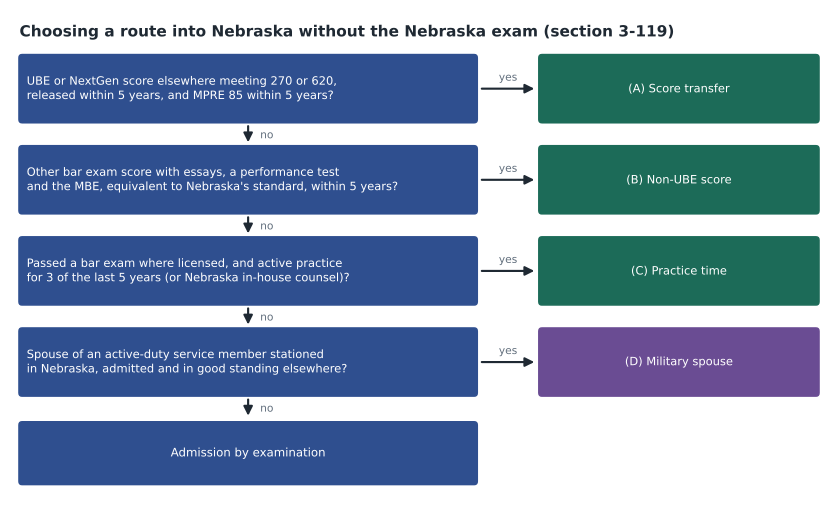
Section 3-119 of the admission rules governs every route into Nebraska without the Nebraska exam. All motion applicants must meet the minimum requirements of section 3-113, including the ABA-approved J.D. or LL.B., and must file a sworn, detailed application with an authorization and release, fingerprints and the fee. The Commission may set a due date for additional information, and an applicant who does not respond in time may have the application administratively withdrawn. The motion application fee is 950 dollars, and motion applicants receive no refunds.
| Route | Score or experience required | Score age limit | MPRE |
|---|---|---|---|
| (A) UBE or NextGen score transfer | A UBE score of at least 270 or a NextGen score of at least 620 earned in another jurisdiction | Released within 5 years | 85 or higher, released within 5 years |
| (B) Non-UBE score | A score on another bar exam at least equivalent to Nebraska's passing standard | Released within 5 years | 85 or higher, released within 5 years |
| (C) Practice time | Passed a bar exam where licensed, and active, substantial practice (or registered in-house counsel status in Nebraska) for 3 of the 5 years before applying | Any age | The score required where licensed |
| (D) Military spouse | Admitted and in good standing elsewhere; spouse stationed in Nebraska; further conditions | Not applicable | Check the current rule |
Transferring a UBE or NextGen score into Nebraska
A candidate who passed the UBE or the NextGen UBE elsewhere may transfer the score into Nebraska under section 3-119(A), if it meets Nebraska's passing score under section 3-117 and was released within five years. The Commission does not process score transfers itself. The applicant requests that NCBE send the score through its UBE score transcript service, and the Commission receives it from NCBE. Nebraska does not accept transferred MBE scores standing alone, so a candidate who took the MBE elsewhere but not the full UBE cannot use that MBE score to sit for only the written portions in Nebraska.
The five-year window is measured from the date the score was released, and motion applicants must file within five years of their score's publication. A candidate who passed the UBE in Colorado in July 2022 must file a Nebraska motion application before the five-year anniversary of the release of that score. After the window closes, the candidate can still come in under the practice-time route if the candidate has practiced long enough, but not on the score alone.
Non-UBE scores
Nebraska also accepts scores from bar exams other than the UBE under section 3-119(B), if the score is at least equivalent to Nebraska's passing standard. The Court's guidance explains that, to be equivalent, the exam must include at least three hours of performance testing, at least three hours of essay questions on substantive law and the MBE. A candidate who passed an exam that lacked a performance test, for example, would not meet the equivalence standard. Questions about equivalence go to the Attorney Services Division before filing.
Practice-time admission
Experienced lawyers use section 3-119(C). The applicant must have passed a UBE, NextGen UBE or other bar exam with the score required in the jurisdiction where the applicant was licensed, must have been actively and substantially engaged in the practice of law in another United States state, territory or the District of Columbia for at least three of the five years before applying, or registered as in-house counsel in Nebraska under sections 3-1201 to 3-1204 for that period, and must have passed the MPRE with the score required where licensed. Scores used for this route are accepted regardless of their age.
The definitions in section 3-101 explain what counts as being substantially engaged in the practice of law, which includes employment as in-house counsel for a corporation or other entity. A lawyer who has spent the qualifying years in a role that does not meet the definition, such as a business position that only occasionally used legal training, may not qualify. The Director checks the practice years at the threshold under section 3-113 and rejects applications that do not show them.
The military spouse route
Section 3-119(D) gives a separate route to spouses of active-duty members of the armed forces stationed in Nebraska. The applicant must be admitted and in good standing in another state, territory or the District of Columbia; hold a J.D. or LL.B. from an approved law school; have no history of suspension, disbarment or license loss for discipline and no pending discipline; have the character and fitness to practice in Nebraska; reside or work in Nebraska or intend to within six months; not have failed the Nebraska exam within the past five years; not have been denied admission in Nebraska before; and certify familiarity with the Nebraska Rules of Professional Conduct. The fee is reduced by half, to 487.50 dollars, and the Commission makes best efforts to expedite these applications. The license remains in effect until the lawyer resigns or the Court orders otherwise.
Taking a Nebraska score elsewhere
A candidate who passes the UBE in Nebraska in February 2027 has a portable UBE score. Other UBE jurisdictions will accept it on their own terms: each sets its own minimum score, its own time limit for score age and its own additional requirements, such as a state law course or test. Because Nebraska's 270 is higher than the passing score in many UBE jurisdictions, a passing Nebraska score usually clears the minimum elsewhere. Candidates should check each target jurisdiction's current rules on NCBE's site and the jurisdiction's own admission site before relying on a transfer.
Jace asked about Kansas specifically, because of the rancher with land on both sides of the border. Marchetti explained the general approach without guessing at Kansas's current numbers: confirm that the receiving state accepts UBE scores, check its minimum score and time limit, check any state-specific course or test, and apply well within the time limit. 'Your Nebraska score is a passport with an expiration date,' she said. 'Use it before it runs out.'
Continuing legal education
Nebraska's Mandatory Continuing Legal Education rules, in Chapter 3, Article 4 of the Supreme Court Rules, require 10 credit hours each calendar year, of which at least two must be in professional responsibility, under section 3-401.4(A). Professional responsibility topics include legal ethics, professionalism, diversity in the legal profession, malpractice prevention, substance abuse and mental health in the profession, wellness, attorney discipline rules, law firm management ethics, technology risks and information security. These count only as professional responsibility credit; Nebraska has no separate mandatory hours for those topics.
| MCLE rule | Requirement |
|---|---|
| Annual hours | 10 credit hours each calendar year, including at least 2 professional responsibility hours |
| New lawyers | Exempt in the year of admission; requirement begins January 1 of the following year; up to 5 in-person hours earned in the admission year carry over |
| Computer-based and distance learning | Up to 5 hours per year |
| Carryover (credits earned from 2024) | Excess hours carry into the next year, up to the next year's annual requirement; professional responsibility hours do not carry over |
| Report | Filed electronically by January 31 after the reporting year; the Director sends a reminder by October 1 |
| Late report | 125-dollar penalty |
| Extensions and waivers | Requested by December 1; extensions up to six months; waivers up to one year or 10 hours; press of business is not a ground |
For a newly admitted lawyer, the timing is generous. Under section 3-401.5(E), a lawyer admitted in 2027 is exempt for 2027, and the requirement begins on January 1, 2028. Up to five in-person credit hours earned during the admission year may be carried into the first reporting year. A lawyer who fails to comply must cure the deficiency by March 1 after notice, and continued noncompliance can lead to an order to show cause and suspension of the right to practice. A lawyer who has not filed a compliant report cannot transfer to inactive status.
Other exemptions cover inactive lawyers, lawyers on extended active military duty and judges and others subject to the judicial branch education requirements. A lawyer returning from inactive status must show 10 hours, including two in professional responsibility, completed in the prior 12 months.
Bar membership and good standing
As Lesson 1 explained, every Nebraska lawyer belongs to the Nebraska State Bar Association and pays the mandatory membership assessment, which funds regulatory functions. Voluntary dues support the bar's other work. Lawyers choose between active and inactive status; active status is required to practice law in Nebraska. Lawyers must keep their contact information current with the Court, maintain trust account records as Lesson 10 described, and comply with the MCLE rules.
Admission is also a commitment to the discipline system. A Nebraska lawyer who is disciplined elsewhere, convicted of a serious crime or the subject of a grievance answers to the Counsel for Discipline and ultimately to the Supreme Court. Admission by motion in another state does not loosen these obligations; it adds a second set.
Worked problem
Planning Jace's first years
Assume Jace passes the February 2027 Nebraska UBE with a 281 and is sworn in at the April 2027 ceremony. In 2029 the rancher client may need him admitted in a neighboring UBE state. What should he track?
Show solution
- MCLE: exempt for 2027; 10 hours, including 2 professional responsibility hours, each year from 2028, with the first report due January 31, 2029.
- In-person CLE he attends in 2027 can carry into 2028, up to 5 hours.
- His UBE score was released in spring 2027. He should check the neighboring state's score age limit; if it is shorter than five years, he must apply before it expires.
- If his score expires before he applies elsewhere, he may qualify later through practice time once he has the required years.
- Every year he pays Nebraska's mandatory membership assessment and keeps his trust account records for five years after each matter ends.
Answer: Calendar his first MCLE report for January 31, 2029, and check the neighboring state's score age limit before 2029.
Common mistakes
MistakeNebraska accepts MBE scores transferred from another state.
InsteadNebraska does not accept transferred MBE scores; it accepts full UBE or NextGen scores and equivalent non-UBE scores.
MistakeA UBE score can be transferred into Nebraska at any time.
InsteadScores used under section 3-119(A) or (B) must have been released within 5 years.
MistakeNew Nebraska lawyers must complete 10 hours of CLE in their first year.
InsteadThe requirement begins January 1 of the year after admission.
MistakeExtra professional responsibility hours carry forward.
InsteadProfessional responsibility hours do not carry over; other excess hours do, within limits.
Choosing CLE that helps
For a new lawyer, CLE is an opportunity as much as a requirement. Marchetti suggested that Jace spend his first years' hours on practical programs in the areas he handles most: trial skills, workers' compensation, agricultural law, family law and probate, along with the professional responsibility hours he needs each year. The Nebraska State Bar Association and the state's law schools offer programs throughout the year, in cities across the state and online, and in-person programs count without the five-hour limit that applies to computer-based and distance learning.
Keeping records
Lawyers report their own compliance through the online MCLE system, and a lawyer who claims credit should keep certificates of attendance and program materials in case of a question. Teaching an approved program can earn credit too, up to five hours a year under section 3-401.8. Credit for an activity that is not already approved requires a written report and the Director's approval, so a lawyer planning to attend an unusual program, such as an out-of-state conference, should confirm in advance how it will be treated.
Inactive status and returning
A lawyer who leaves practice for a time, for example to care for family or to take a nonlegal job, may move to inactive status, which is exempt from MCLE. Before moving, the lawyer must have filed a compliant report for the current period. Returning to active status requires 10 hours of CLE, including two in professional responsibility, completed during the prior 12 months. Lawyers considering a break should plan the return in advance so that the hours are complete before they need to practice again.
Summary and key terms
- Section 3-119 provides UBE or NextGen score transfer, non-UBE scores, practice-time motion and the military spouse route.
- Scores used under (A) or (B) must be released within 5 years; practice-time scores may be any age.
- Practice-time applicants need active, substantial practice for 3 of the past 5 years.
- The motion fee is 950 dollars (487.50 for military spouses), with no refunds.
- Nebraska does not accept transferred MBE scores; non-UBE exams must include essays, a performance test and the MBE.
- MCLE requires 10 hours a year, including 2 in professional responsibility, reported by January 31; new lawyers start the year after admission.
- Lawyers pay the mandatory membership assessment and stay subject to the Counsel for Discipline.
- 0
- score transfer
- 1
- non-UBE score
- 2
- practice-time admission
- 3
- substantially engaged in the practice of law
- 4
- military spouse admission
- 5
- MCLE
- 6
- professional responsibility credit
Practice problems
Work each problem on paper first, then reveal the answer to check.
What score age limit applies to UBE scores transferred into Nebraska?
Show answer
Five years from release, under section 3-119.
How many years of practice does Nebraska require for practice-time admission?
Show answer
Three of the five years before applying.
How many CLE hours must a Nebraska lawyer complete each year?
Show answer
10, including at least 2 in professional responsibility.
When must a Nebraska lawyer file the annual MCLE report?
Show answer
By January 31 after the reporting year.
Lesson quiz · 5 questions
Score 60% or more to complete this lesson.
Create a free account to save your progress, take quizzes and earn a certificate.