
BAR-228 · Lesson 8 of 12 · 20 min
Nebraska torts: comparative fault, no punitive damages and the tort claims acts
▶ Video coming soon A video version of this lesson is on the way.
The Gibbon pickup crash from Lesson 7 had two possible defendants: the grain hauling company whose driver ran the intersection and Buffalo County, whose road crew had not replaced a stop sign that a snowplow knocked down weeks earlier. Dale Brekke asked Jace to write a memo answering four questions. Could the farmer's own speed reduce or bar his recovery? Could the firm ask for punitive damages against the trucking company, whose driver had been on duty for fifteen hours? How would liability be split between the company and the county? And what did the firm have to do, and by when, to preserve the claim against the county?
'Every one of those questions has a Nebraska answer that differs from the bar exam answer,' Marchetti said when Jace read her the list. This lesson covers the Nebraska tort rules behind each question: modified comparative negligence, the division of joint and several liability, the constitutional bar on punitive damages, the medical malpractice cap, and the claims statutes for suing local governments and the state.
Modified comparative negligence
Nebraska abandoned contributory negligence as a complete bar decades ago, but it did not adopt pure comparative negligence. Section 25-21,185.09 of the Nebraska Revised Statutes provides that a claimant's contributory negligence does not bar recovery unless it is equal to or greater than the total negligence of all persons against whom recovery is sought. If the claimant is not barred, the damages are diminished in proportion to the claimant's share of the negligence.
Two features stand out. First, the comparison is between the claimant and all the defendants combined, not each defendant individually. A claimant who is 30 percent at fault can recover against two defendants who are each 35 percent at fault, even though the claimant's fault is close to each defendant's. Second, the bar applies at equality. A claimant who is exactly 50 percent at fault, facing a single defendant who is 50 percent at fault, recovers nothing.
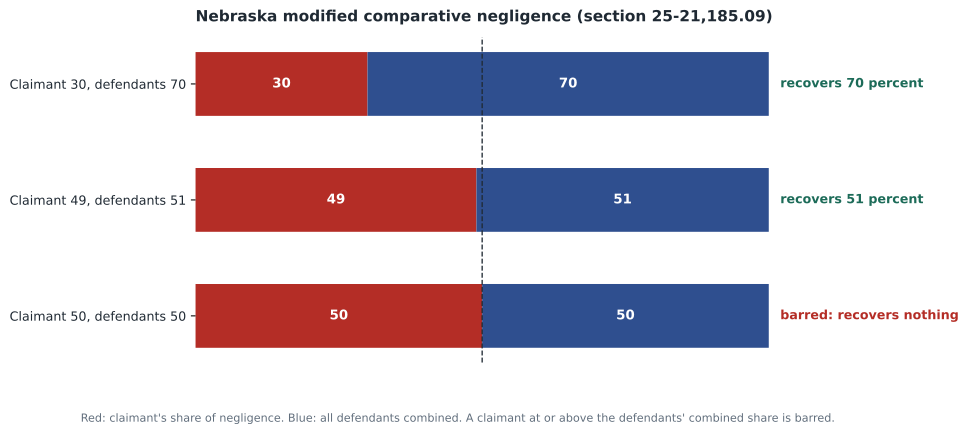
The statute also requires the court to instruct the jury on the effect of its allocation, so the jurors understand that a finding of 50 percent fault or more for the claimant means no recovery. A verdict form alone is not enough, and the Nebraska courts have treated the failure to give the instruction as prejudicial error. The comparison applies to negligence claims; the Nebraska Supreme Court has held that a claimant's ordinary negligence is not compared in the same way in a strict products liability claim.
Joint and several liability
Section 25-21,185.10 divides damages into two types when there are multiple defendants. For economic damages, such as medical bills, lost wages and property damage, the liability of each defendant is joint and several: the claimant may collect the full amount of economic damages from any one of them, leaving that defendant to seek contribution from the others. For noneconomic damages, such as pain and suffering, the liability of each defendant is several only, in proportion to that defendant's percentage of negligence, and the court enters a separate judgment against each defendant for that share. The exception is concerted action: if defendants acted together as part of a common enterprise or plan, each is jointly and severally liable for both kinds of damages.
| Kind of damages | Liability among multiple defendants | Practical effect |
|---|---|---|
| Economic | Joint and several | Any defendant can be made to pay the full amount; collect from the solvent or insured defendant |
| Noneconomic | Several only, by percentage of negligence | Each defendant pays only its own share; an insolvent defendant's share is lost |
| Either, where defendants acted in concert | Joint and several | Each defendant is liable for the whole |
The split affects how a plaintiff's lawyer evaluates a case. If one defendant is well insured and the other is not, the economic damages can be collected in full from the insured defendant, but only that defendant's percentage of the noneconomic damages. Allocating fault therefore matters even when the plaintiff is plainly free of fault.
No punitive damages
Nebraska is one of a small number of states that do not allow punitive damages at all. The rule rests on the state constitution, not on a statute. Article VII, section 5 of the Nebraska Constitution directs that fines, penalties and license money be appropriated to the common schools. In Distinctive Printing and Packaging Co. v. Cox, 232 Neb. 846, 443 N.W.2d 566 (1989), the Nebraska Supreme Court stated that punitive, vindictive or exemplary damages contravene article VII, section 5, following its earlier decisions in Abel v. Conover (1960) and Miller v. Kingsley (1975). Nebraska damages are measured by compensation for the actual injury.
The case itself involved Nebraska's parental liability statute, which makes parents liable for property damage caused by their minor children. The Court upheld that statute because it measured recovery by actual injury and so imposed no penalty. The principle has broad practical consequences. A Nebraska complaint should not request punitive damages, a demand letter should not threaten them, and a lawyer evaluating a case of outrageous conduct must find the value in compensatory damages, including noneconomic damages where the law allows them.
That answered the second question in Jace's memo. However egregious the driver's fifteen-hour shift, the farmer could not recover punitive damages from the trucking company in a Nebraska court. The driver's fatigue would still matter, because it bears on negligence and on the allocation of fault.
The medical malpractice cap
The Nebraska Hospital-Medical Liability Act caps the total amount recoverable for injury or death caused by the professional negligence of a health care provider who has qualified under the Act. Under section 44-2825, the cap depends on when the occurrence happened. For occurrences after December 31, 2014, the total recoverable from all providers and the state's Excess Liability Fund is 2,250,000 dollars. A qualified provider's own liability is limited to 800,000 dollars per occurrence, and amounts above the providers' combined liability are paid by the Excess Liability Fund, up to the overall cap.
| Date of occurrence | Total cap |
|---|---|
| On or before December 31, 1984 | 500,000 dollars |
| 1985 through 1992 | 1,000,000 dollars |
| 1993 through 2003 | 1,250,000 dollars |
| 2004 through 2014 | 1,750,000 dollars |
| After December 31, 2014 | 2,250,000 dollars |
The cap is unusual in two ways. It caps total damages, economic and noneconomic together, rather than only noneconomic damages, and it applies only to providers who have qualified under the Act by meeting its insurance and surcharge requirements. In Gourley v. Nebraska Methodist Health System, 265 Neb. 918, 663 N.W.2d 43 (2003), the Nebraska Supreme Court upheld the cap against constitutional challenges. The Act also offers a medical review panel; a request for review under section 44-2840 affects the timing of suit, as the claims statutes discussed below recognize.
Suing local government: the Political Subdivisions Tort Claims Act
Counties, cities, school districts and other political subdivisions are immune from tort suits except as the Legislature has waived immunity. The Political Subdivisions Tort Claims Act, sections 13-901 through 13-928, provides that waiver, with strict conditions. The steps are:
| Step | Rule |
|---|---|
| Written claim | Filed with the subdivision's clerk, secretary or other official responsible for records (or its law department if the governing body allows), stating the time and place of the incident and other known facts (section 13-905) |
| Deadline for the claim | Within one year after the claim accrues, or it is forever barred (section 13-919) |
| Waiting period | No suit until the governing body makes a final disposition; if it has not done so within six months, the claimant may withdraw the claim in writing and sue (section 13-906) |
| Deadline for suit | Within two years after the claim accrues, extended to six months after the mailing of a final disposition or the withdrawal if that is later (section 13-919) |
| Trial | In the appropriate court under ordinary rules, but without a jury (section 13-907) |
| Limits | 1 million dollars per person and 5 million dollars per occurrence for occurrences after November 16, 1985 (section 13-926) |
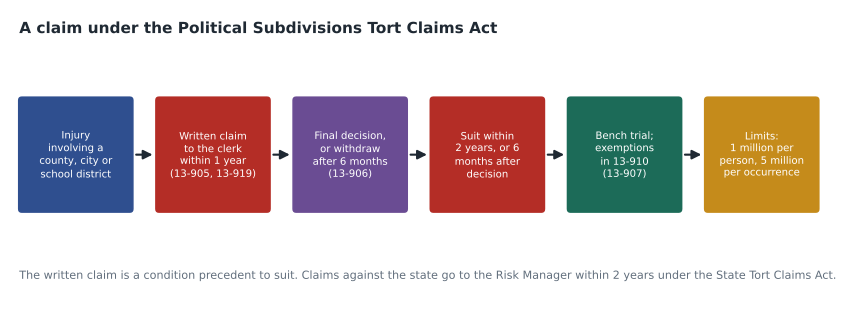
The claim requirement is a condition precedent to suit. The Nebraska courts have held that filing the written claim with the governing body is required even when another statute, such as the Hospital-Medical Liability Act, also applies, and that the one-year and two-year periods generally begin when the claimant discovers, or reasonably should discover, the subdivision's negligence. A claim filed too late, or with the wrong person, can end the case.
The exemptions
Section 13-910 lists claims to which the Act does not apply, and the subdivision must plead and prove an exemption as an affirmative defense. They include claims based on the exercise of a discretionary function, whether or not the discretion was abused; claims arising from intentional torts such as assault, battery, false arrest, malicious prosecution, misrepresentation and deceit; claims based on the malfunction, destruction or unauthorized removal of a traffic sign or signal, unless the subdivision failed to correct it within a reasonable time after notice; claims arising from snow, ice or other temporary weather conditions on public roads, except for an employee's negligent driving; claims based on approved highway designs; claims about the general condition of a road rather than a spot or localized defect of which the subdivision had notice; and certain claims arising from recreational activities on public property.
The intentional tort exemption has been politically contested. In 2024 the Legislature passed LB25, which would have allowed certain claims against political subdivisions for child abuse or sexual assault resulting from a failure to supervise or protect. The Governor returned the bill without approval on April 24, 2024, and it did not become law. Similar bills introduced in the 2025 and 2026 sessions were indefinitely postponed. As of November 2026, the intentional tort exemption remains in its existing form.
Suing the state: the State Tort Claims Act
Claims against the State of Nebraska follow a parallel statute, the State Tort Claims Act, which begins at section 81-8,209. The claim must be submitted in writing to the state's Risk Manager within two years after it accrues, under section 81-8,227. As with the political subdivisions act, the suit deadline is extended to six months after the Risk Manager or State Claims Board mails notice of a final disposition, or after the claimant withdraws the claim, if that is later. Suits are tried without a jury, and the Act excludes discretionary functions and most intentional torts. Smaller claims are decided administratively within the Department of Administrative Services, and the largest approved claims also require approval by the Legislature.
Worked problem
Answering Dale Brekke's memo
The farmer was driving 10 miles per hour over the limit on the county road; the grain truck driver ran the intersection where the stop sign was down. The county road crew had received a report about the downed sign 12 days before the crash. Assume a jury or judge would allocate fault at 20 percent to the farmer, 60 percent to the trucking company and 20 percent to the county.
Show solution
- Comparative fault: the farmer's 20 percent is less than the defendants' combined 80 percent, so he is not barred, and his damages are reduced by 20 percent.
- Punitive damages: unavailable in Nebraska; the driver's fatigue goes to negligence and allocation of fault.
- Economic damages are joint and several, so the farmer can collect all of the reduced economic damages from the trucking company; noneconomic damages are several, so each defendant pays only its own percentage.
- The county may argue the traffic sign exemption, but section 13-910 removes the exemption when the subdivision fails to correct the problem within a reasonable time after notice; 12 days after a report is a fact question.
- Preserve the county claim by filing a written claim with the county clerk within one year of the March 30, 2026 crash, then sue within two years (or within six months of the county's decision or a withdrawal), in a bench trial subject to the 1 million dollar per-person limit.
Answer: The farmer can recover reduced compensatory damages from both defendants, but only if the county claim is filed with the county clerk by March 30, 2027.
Jace filed the claim with the Buffalo County Clerk on November 9, 2026, well ahead of the deadline, with a cover letter describing the time and place of the crash and the downed sign. Brekke read the memo and asked only one question: 'Did you calendar the six-month date?' Jace had.
Common mistakes
MistakeA Nebraska plaintiff who is 50 percent at fault recovers half of the damages.
InsteadUnder section 25-21,185.09 a claimant whose negligence equals or exceeds the defendants' combined negligence recovers nothing.
MistakeAll defendants are jointly and severally liable for all damages.
InsteadEconomic damages are joint and several; noneconomic damages are several only unless defendants acted in concert.
MistakePunitive damages are available in Nebraska for willful and wanton conduct.
InsteadThey contravene article VII, section 5 of the Nebraska Constitution.
MistakeA claim against a county can be filed in court within the ordinary four-year period.
InsteadA written claim must first be filed with the county within one year, and suit must follow within the Act's periods.
Summary and key terms
- Section 25-21,185.09 bars a claimant whose negligence equals or exceeds the combined negligence of the defendants; otherwise damages are reduced proportionally.
- Section 25-21,185.10 makes economic damages joint and several and noneconomic damages several, except for concerted action.
- Punitive damages are unavailable because they contravene Neb. Const. art. VII, section 5 (Distinctive Printing, 1989).
- The Hospital-Medical Liability Act caps total recovery at 2.25 million dollars for occurrences after 2014; Gourley (2003) upheld the cap.
- Political Subdivisions Tort Claims Act: written claim within one year, suit within two years, bench trial, limits of 1 million and 5 million dollars, and exemptions in section 13-910.
- State Tort Claims Act: written claim to the Risk Manager within two years, bench trial and similar exemptions.
- 0
- modified comparative negligence
- 1
- joint and several liability
- 2
- several liability
- 3
- punitive damages
- 4
- Excess Liability Fund
- 5
- political subdivision
- 6
- discretionary function
- 7
- condition precedent
Practice problems
Work each problem on paper first, then reveal the answer to check.
Under section 25-21,185.09, when is a claimant barred?
Show answer
When the claimant's negligence equals or exceeds the total negligence of all persons against whom recovery is sought.
Which damages are joint and several in Nebraska?
Show answer
Economic damages; noneconomic damages are several unless the defendants acted in concert.
What constitutional provision bars punitive damages in Nebraska?
Show answer
Article VII, section 5, which directs fines and penalties to the common schools.
What are the per-person and per-occurrence limits under the Political Subdivisions Tort Claims Act?
Show answer
1 million dollars per person and 5 million dollars per occurrence.
Lesson quiz · 5 questions
Score 60% or more to complete this lesson.
Create a free account to save your progress, take quizzes and earn a certificate.