
BAR-230 · Lesson 11 of 12 · 20 min
Score transfer, admission on motion, the Daniel Webster Scholar program and practice after admission
▶ Video coming soon A video version of this lesson is on the way.
Margaret Caswell's firm has a partner-to-be problem. Joan Thayer's former law school roommate, Signe Ilves, has practiced in Burlington, Vermont, for nine years and wants to join Caswell and Thayer. A second candidate, a young lawyer from Boston, passed the UBE in Massachusetts in July 2025 and wants to move to Concord. And Ezra's friend Wyatt Fiske, the Daniel Webster Scholar, is already admitted and practicing at a Manchester firm. 'Three people, three routes,' Caswell said to Ezra over coffee. 'You should understand all of them. Someday you will be the one answering a recruit's questions.'
This lesson covers the routes to admission other than sitting the New Hampshire exam: admission by transferred UBE score, admission by motion without examination including the special rules for Vermont and Maine lawyers, and the Daniel Webster Scholar Honors Program. It then turns to what every new New Hampshire lawyer must do after admission: the Practical Skills Course, continuing legal education, bar membership and dues, and keeping information current.
Admission by transferred UBE score
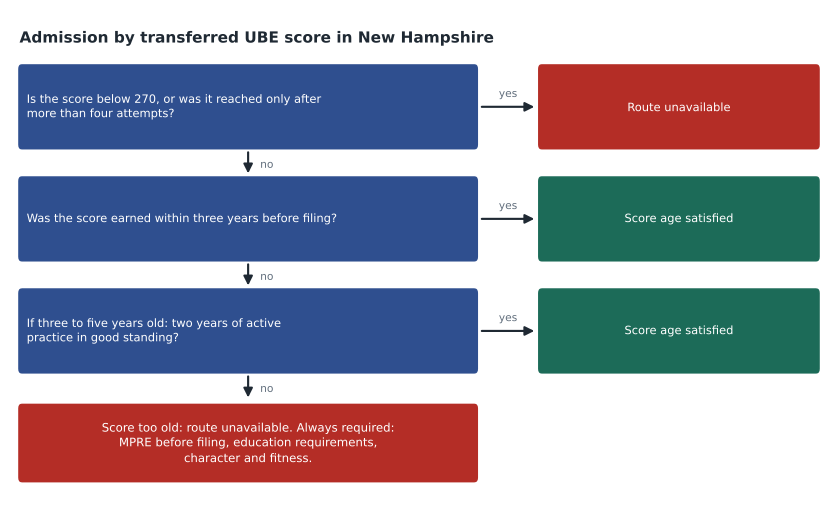
An applicant who earned a UBE score in another jurisdiction may seek admission in New Hampshire by transferring that score, under Rule 42's transferred-score provision. The score must meet New Hampshire's minimum of 270. The score's age matters: it must have been earned within three years before the motion is filed, or, if it is between three and five years old, the applicant must show that he or she was primarily engaged in the active practice of law for at least two years in a jurisdiction where the applicant was a member in good standing and authorized to practice throughout that period.
The applicant must also meet Rule 42's general requirements, its education requirements and the character and fitness requirements, and must pass the MPRE before filing the motion. The applicant must have reached the minimum score in no more than four attempts. The packet includes the Petition and Questionnaire for Admission, the court's motion form for transferred scores and an official UBE score transcript sent by NCBE. The fee is nonrefundable, except that one-half of the character and fitness investigation fee is refunded if the motion is denied before the investigation begins.
The Boston recruit fits this route. Her July 2025 Massachusetts UBE score of 284 is well above 270 and will be less than three years old when she files in early 2027. She passed the MPRE during law school. She needs only to file the packet, request that NCBE send her score transcript and complete the character and fitness review. If she files after July 2028, when her score is more than three years old, she will need to show two years of active practice in Massachusetts.
Applicants can also use the transferred-score route concurrently with an exam elsewhere. The court's FAQs explain that an applicant who sits for the UBE in another jurisdiction may apply in New Hampshire by motion for admission by transferred score, and the application is processed when NCBE sends the score. The fee is not refunded if the score turns out to be below 270.
Admission by motion without examination
Experienced lawyers may be admitted without any examination under Rule 42's motion provision. The general requirements are demanding. The applicant must have been admitted by bar examination in another state, territory or the District of Columbia; lawyers first admitted by diploma privilege are not eligible. The applicant must have been primarily engaged in the active practice of law for five of the seven years immediately before filing. And the reciprocity requirement must be met: the applicant must have passed the bar exam in a reciprocal jurisdiction or practiced in reciprocal jurisdictions for five of those seven years. The applicant must be in good standing everywhere admitted, must not be subject to discipline or have a disciplinary matter pending, and must designate the clerk of the New Hampshire Supreme Court as agent for service of process.
Active practice includes private practice, government service including military service, teaching law at an ABA-approved law school, service as a judge of a court of record, judicial clerkships and work as corporate counsel, with a supporting affidavit in the corporate counsel case. Practice that was itself unauthorized does not count. Rule 42 also disqualifies two groups: an applicant who failed the New Hampshire bar exam within five years before filing, and a lawyer who resigned from the New Hampshire bar, who must instead seek readmission under the court's readmission rule.
NCBE's 2026 chart lists the motion fee as 2,500 dollars, and the fee is nonrefundable except for a possible partial refund if the motion is denied before the character and fitness investigation begins.
Special rules for Vermont and Maine lawyers
New Hampshire's close ties with its neighbors are reflected in a special provision for lawyers licensed in Vermont and Maine. Instead of five of the last seven years, a lawyer actively licensed in Vermont or Maine who has practiced there for at least three years before filing can qualify. The lawyer must also complete at least 900 minutes, or fifteen hours, of New Hampshire-specific continuing legal education within the year before filing, certified by the New Hampshire Minimum Continuing Legal Education Board. Vermont applicants must also satisfy the reciprocity condition in the rule.
Signe Ilves, from Burlington, fits this route easily: she has practiced in Vermont for nine years. She might also qualify under the general five-of-seven rule if Vermont satisfies the reciprocity requirement, but the Vermont provision lets lawyers with only three years qualify, and its New Hampshire CLE requirement makes sure they know something about local practice. Signe has registered for a series of New Hampshire practice programs this winter to complete the 900 minutes before she files in the spring.
| Route | Practice requirement | Other key conditions |
|---|---|---|
| Transferred UBE score | None if score is under three years old; two years if three to five years old | Score of 270 or more; four or fewer attempts; MPRE before filing |
| Motion, general | Five of the last seven years | Admitted by exam; reciprocity; no New Hampshire exam failure within five years |
| Motion, Vermont or Maine | Three years in that state | 900 minutes of New Hampshire CLE within one year; reciprocity for Vermont |
| Daniel Webster Scholar | None; completed during law school | Selected students at the law school in Concord; assessed by bar examiners |
The Daniel Webster Scholar Honors Program
The Daniel Webster Scholar Honors Program is New Hampshire's best-known contribution to licensing reform. The New Hampshire Supreme Court approved it after years of discussion that began in the 1990s, and it launched in 2005 as a pilot. The first cohort began in January 2006 and graduated in May 2008. The New Hampshire Bar Association reported in 2025 that more than 350 lawyers had been admitted through the program, which it described as the first and only competency-based bar admission pathway in the United States. Class size has grown over the years, from fifteen students to twenty in 2011 and twenty-four in 2013.
The program is open to students at the University of New Hampshire's law school in Concord. A committee of faculty and graduated scholars selects each class in June. Students may be invited to apply early when they are admitted to law school, and first-year students may apply in the spring of their first year. Selection is holistic, considering academic, professional and interpersonal strengths and the likelihood that the student will practice in New Hampshire.
Scholars spend their second and third years in a practice-based curriculum of simulation courses, clinics and externships. The program's requirements include no grade below a B-minus in its own courses, a cumulative grade point average of at least 3.0 at graduation, and at least six credits of clinic or legal residency work. Each scholar builds a portfolio of written and oral work, which bar examiners review each semester, and gives performances before judges, lawyers, examiners, faculty and classmates. A standing oversight committee includes members of the Supreme Court and the Board of Bar Examiners. Successful scholars pass what Rule 42 describes as a variant of the bar exam, involving more than twelve hours of testing, during the program, and are admitted to the New Hampshire bar the day before graduation.
Wyatt Fiske's experience is typical. He was sworn in in May 2026, the day before he received his law degree, and began work at a Manchester firm the following week. Like every new admittee, he must attend the Practical Skills Course within two years. And because Daniel Webster scholars hold an ABA-accredited law degree, he could sit for the bar exam in another state if he later wanted to practice there; the program's graduates have been admitted to more than a dozen other state bars.
After admission: the Practical Skills Course
Every new admittee, on every route, must attend the Bar Association's Practical Skills Course within two years of being sworn in, as Lesson 6 described. The requirement applies even to lawyers with years of experience elsewhere, such as Signe and the Boston recruit. The course must be attended in person, and failure to complete it leads to suspension. Lawyers usually attend the December session in their first or second year.
Continuing legal education
New Hampshire's continuing legal education rule, Supreme Court Rule 53, requires every lawyer in active status to complete 720 minutes, or twelve hours, of continuing legal education in each reporting year. At least 120 minutes, or two hours, must be in legal ethics, professionalism or the prevention of malpractice, substance abuse or attorney-client disputes. The reporting year runs from June 1 to May 31, and lawyers file an annual affidavit of compliance between June 1 and July 1 after the year ends, using the Bar Association's online attorney reporting tool.
Minutes earned beyond the 720 required can be carried forward to the next reporting year only. Ethics minutes carry forward only if they were not needed to meet the minimum in the year earned. Active lawyers who take pro bono cases through specified legal services and disability organizations can claim up to 360 general minutes per reporting period for their service, at a rate set in the rule, but pro bono work cannot earn ethics minutes. Lawyers returning to active status after more than two consecutive reporting years of inactive status or suspension must complete an additional 360 minutes.
The Practical Skills Course earns substantial credit: according to the Bar Association, attending both days earns 405 general minutes and 150 ethics and professionalism minutes, which count toward the annual requirement but do not fully satisfy it.
Worked problem
Planning Ezra's first CLE year
Suppose Ezra is sworn in during May 2027 and becomes active immediately. He plans to attend the Practical Skills Course in December 2027.
Show solution
- Identify the reporting year: June 1, 2027 to May 31, 2028.
- Requirement: 720 minutes, including 120 ethics minutes.
- Practical Skills Course: both days give 405 general and 150 ethics minutes, 555 in total, meeting the ethics minimum.
- Remaining: at least 165 more minutes before May 31, 2028.
- Reporting: file the affidavit between June 1 and July 1, 2028.
Answer: With the Practical Skills Course in December 2027, Ezra needs about three more hours of CLE before May 31, 2028, and must report by July 1, 2028.
Bar membership, dues and keeping information current
A new admittee's first invoice from the New Hampshire Bar Association arrives by email at the beginning of the month after admission. It combines Bar Association dues and the Supreme Court's annual fees into a single bill, prorated for the remainder of the license year, which runs from June 1 to May 31. The lawyer has thirty days to pay, a delinquency fee applies to late payment, and continued nonpayment can lead to proceedings before the court. A lawyer who wants to change membership status, for example to inactive status, has a limited time to do so and receive an updated invoice.
Rule 42 requires admitted lawyers to notify the Bar Association immediately and in writing of changes to their residence or principal office address. Court notices and hearing dates go to the address on file, and a lawyer who misses a notice because an address was not updated has no one to blame but himself.
Practicing across state lines
Many New Hampshire lawyers practice in more than one state, especially in the Seacoast and the Nashua area, where clients and courts in Massachusetts and Maine are close by. A New Hampshire lawyer who wants to appear in a single case in another state applies there for admission pro hac vice under that state's rules, usually with local counsel. A lawyer licensed elsewhere who wants to appear in a single New Hampshire case does the same under the New Hampshire court rules. Lawyers who want full admission in a second state use that state's motion or transferred-score rules, and the portability of the UBE score makes the second route attractive to recent graduates.
Common mistakes
MistakeAny UBE score can be transferred to New Hampshire.
InsteadThe score must be at least 270, earned within three years or within five with two years of practice, in no more than four attempts, with the MPRE passed before filing.
MistakeA lawyer admitted by diploma privilege in another state can be admitted on motion.
InsteadRule 42 requires prior admission by bar examination.
MistakeVermont and Maine lawyers need five years of practice.
InsteadThey can qualify with three years in that state plus 900 minutes of New Hampshire CLE within a year before filing.
MistakeDaniel Webster Scholars are exempt from the MPRE and the Practical Skills Course.
InsteadRule 42's general requirements, including the MPRE, apply, and all new admittees must attend the course.
MistakeExtra CLE minutes carry forward indefinitely.
InsteadExcess minutes carry forward to the next reporting year only.
Summary and key terms
- Transferred UBE scores must be 270 or more and within three years, or three to five years with two years of practice, with the MPRE passed before filing.
- Motion admission requires prior admission by exam, five of the last seven years of active practice and reciprocity.
- Vermont and Maine lawyers can qualify after three years of practice there plus 900 minutes of New Hampshire CLE.
- The Daniel Webster Scholar program admits selected students the day before graduation after two years of assessed practice-based study.
- New Hampshire CLE requires 720 minutes a year, including 120 ethics minutes, for the June 1 to May 31 reporting year.
- New lawyers pay combined dues and court fees, attend the Practical Skills Course within two years and report address changes immediately.
- 0
- transferred UBE score
- 1
- admission on motion
- 2
- reciprocity
- 3
- active practice
- 4
- Daniel Webster Scholar
- 5
- NHMCLE
- 6
- reporting year
- 7
- pro hac vice
Practice problems
Work each problem on paper first, then reveal the answer to check.
A lawyer passed the UBE in Maine four years ago with 276 and has practiced in Maine since. Can she transfer the score?
Show answer
Yes, if she has at least two years of active practice in good standing, meets the other requirements and has passed the MPRE before filing.
What special requirement applies to Maine and Vermont lawyers seeking admission on motion?
Show answer
Three years of practice in that state and at least 900 minutes of New Hampshire CLE within one year before filing.
When are Daniel Webster Scholars admitted?
Show answer
The day before graduation, after completing the program and its variant bar exam.
How many CLE minutes does a New Hampshire lawyer need each year?
Show answer
720 minutes, including at least 120 minutes of ethics or professionalism.
Lesson quiz · 5 questions
Score 60% or more to complete this lesson.
Create a free account to save your progress, take quizzes and earn a certificate.