
BAR-230 · Lesson 5 of 12 · 20 min
Exam changes ahead: the legacy UBE through February 2028 and NextGen from July 2028
▶ Video coming soon A video version of this lesson is on the way.
Ezra's cousin Lila started law school in Concord in August 2026. At a family dinner in Laconia in early November, between the pot roast and the apple crisp, she asked him which bar exam she would take. 'Some of my classmates say the UBE, some say NextGen, and one of them says nobody in New Hampshire takes the bar exam anyway because of the Webster program,' she said. Ezra realized he only knew part of the answer, and he brought the question to his next session with Marchetti.
'Your cousin will almost certainly take NextGen, unless she becomes a Daniel Webster Scholar,' Marchetti said. 'If she graduates in May 2029 on the usual schedule, her first New Hampshire exam would be July 2029, and New Hampshire switches to NextGen in July 2028. You are on the other side of the line, and you have more room than candidates in some other states. New Hampshire keeps giving the current UBE through February 2028, so even if February 2027 did not go well, you would have two more chances on the same exam.'
This lesson explains New Hampshire's timeline for moving to NextGen, what NextGen is, the questions New Hampshire had not settled as of November 2026, and what the change means for candidates at different points in the pipeline, including the comparison with states that switch earlier.
New Hampshire's announcement
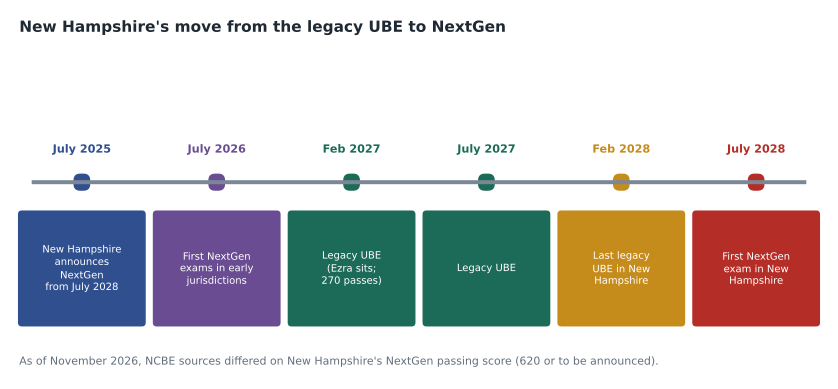
On July 10, 2025, NCBE announced that New Hampshire would administer the NextGen bar examination beginning in July 2028. The New Hampshire Supreme Court made the decision after a review by the Board of Bar Examiners. In NCBE's announcement, Chief Justice Gordon J. MacDonald described New Hampshire as having long been a leader in bar admissions innovation and reform and called NextGen, with its greater emphasis on practical skills, an important step forward. Those remarks connect the change to New Hampshire's history with the Daniel Webster Scholar program, which has assessed practical skills since 2006.
Rule 42 now reflects the timeline: the current Uniform Bar Examination is used for administrations before July 2028, and the NextGen exam from July 2028. NCBE's chart lists February 2028 as New Hampshire's final legacy UBE administration. That gives New Hampshire candidates six more legacy administrations after the announcement, from July 2025 through February 2028, and three of them, February 2027, July 2027 and February 2028, remain ahead of the study group.
The national rollout
NextGen is being introduced in waves. The first NextGen exam anywhere was given in July 2026 in a small group of early jurisdictions; Marcus Bell from the study group took it in Missouri and passed. More jurisdictions begin in 2027, and a large group, including New Hampshire, begins in July 2028. NCBE has said that the legacy UBE will be offered for the last time in February 2028, so New Hampshire is switching at the point when the legacy exam ends nationally.
Timing matters because the two exams are not interchangeable. A New Hampshire candidate who sits in February 2028 or earlier takes the legacy UBE. A candidate who sits in July 2028 or later takes NextGen. Because New Hampshire stays on the legacy exam until it ends nationally, its candidates do not face the problem that candidates in early-switching states face, where a candidate who fails the last local legacy exam might need to find another state still giving it.
What NextGen is
NextGen is a new exam, not a revision of the UBE. NCBE designed it after a nationwide practice analysis that asked newly licensed lawyers what they actually do in their first years. The study concluded that the bar exam should test fewer subjects in less depth, test lawyering skills more directly and integrate knowledge with skills in the same questions rather than separating them into a multiple-choice day and an essay day.
The content has two parts. The foundational concepts and principles cover civil procedure, contract law, evidence, torts, business associations, constitutional law, criminal law and procedure, real property, and limited portions of family law and trusts and estates. The foundational skills are legal research, legal writing, issue spotting and analysis, investigation and evaluation, client counseling and advising, negotiation and dispute resolution, and client relationship and management.
The formats change too. NextGen uses standalone multiple-choice questions, some of which ask for more than one correct answer; integrated question sets built around a single fact pattern, mixing multiple-choice and short written answers; and longer performance tasks in which candidates complete realistic work from a file and a library, including some research within the exam materials. The exam is computer-based and given over about a day and a half.
| Feature | Legacy UBE (New Hampshire through February 2028) | NextGen (New Hampshire from July 2028) |
|---|---|---|
| Structure | MPT and MEE on Tuesday; MBE on Wednesday | Integrated sessions over about a day and a half |
| Subjects | Seven MBE subjects plus business associations on the MEE | Foundational concepts tested in less depth, with limited family law and trusts and estates |
| Skills | Tested mostly through the MPT | Tested throughout, including research and counseling |
| Question types | Single-answer MBE questions, long essays, MPT tasks | Standalone questions, integrated sets, short answers, performance tasks |
| Score scale | 400 points; New Hampshire passes 270 | A new NextGen scale; see the open questions below |
| Delivery | Paper MBE; laptop or handwriting for written parts | Computer-based |
What New Hampshire had not settled
The most important open question is New Hampshire's NextGen passing score. As of November 2026 the published sources did not agree. NCBE's printable jurisdiction summary listed New Hampshire's minimum NextGen passing score as 620, while NCBE's help-center page for New Hampshire listed it as to be announced. A candidate planning for July 2028 should treat the number as unconfirmed until the court or the Board announces it officially, and should check the Office of Bar Admissions' page rather than relying on a summary.
A related question is when New Hampshire begins accepting NextGen scores earned in other jurisdictions. The same two NCBE sources differed: one listed July 2026 as the first NextGen administration whose scores New Hampshire accepts, the other listed the date as to be announced. This matters to lawyers and graduates who took NextGen in an early-adopting state and want to transfer the score to New Hampshire before New Hampshire gives the exam itself. Until the Office confirms the rule, such a candidate should ask the Office directly before relying on a transfer.
A third question is how long legacy UBE scores remain transferable into New Hampshire after the switch. The current transferred-score rule accepts UBE scores earned within three years, or within five years with two years of practice. Rule 42 will need to address both kinds of score side by side, and candidates who earn legacy scores in 2027 and 2028 should watch for transition provisions.
Worked problem
Placing candidates on the timeline
Marchetti asks Ezra to say which exam each of four people would take in New Hampshire: himself in February 2027; a classmate retaking in July 2027; a candidate who fails in February 2028; and his cousin Lila, graduating in May 2029.
Show solution
- Ezra, February 2027: legacy UBE, 270 to pass.
- Classmate, July 2027: legacy UBE, still before July 2028.
- Candidate who fails in February 2028: the next New Hampshire exam is July 2028, which is NextGen, so the retake is on a different exam with a different passing standard.
- Lila, July 2029: NextGen, unless she is admitted through the Daniel Webster Scholar program.
Answer: Everyone through February 2028 takes the legacy UBE; anyone sitting in New Hampshire from July 2028 takes NextGen.
NextGen and the Daniel Webster Scholar program
NextGen does not replace the Daniel Webster Scholar Honors Program. Rule 42 lists the program as a separate route to admission, and nothing in the NextGen announcement changes that. Daniel Webster Scholars are evaluated throughout their last two years of law school by bar examiners, using portfolios, performances and assessments, and they pass a variant of the bar exam within the program. The NextGen exam and the Daniel Webster program share a philosophy, that licensing should measure what new lawyers actually do, but they remain different routes.
For students like Lila, the practical question is whether to apply to the program, which selects its classes each June from first-year students and newly admitted students who express early interest. Students who are not selected, or who choose a different path, will take NextGen.
What Marcus learned from the first NextGen exam
At one of the group's Sunday sessions on NextGen, Marcus described his July 2026 exam in Missouri. The biggest adjustment, he said, was the integrated question sets. One fact pattern would generate several questions in different formats, and the candidate had to keep the facts straight while switching from a multiple-choice question to a short written answer. The performance tasks felt familiar to anyone who had practiced MPTs, but the research component required more careful reading and judgment about which sources mattered.
'Practice the tasks under time until the file and library feel routine,' Marcus told the group. 'The rule knowledge is real, but it is narrower than the old exam. The skills are where people lose points.' Ezra wrote that down for Lila.
What the change means for preparation now
For Ezra, nothing about February 2027 changes. The study materials, the MEE subject list as revised in July 2026 and the 270 passing score all apply. Marchetti's warning is about practice materials. As commercial bar courses shift toward NextGen during 2027 and 2028, a legacy UBE candidate must make sure every practice set is a legacy set. A NextGen practice question may test a skill or format that will not appear on the legacy exam, and a legacy candidate who spends hours on NextGen-style integrated sets is not spending them on MBE questions.
For candidates who expect to sit in July 2028 or later, the advice is the opposite. They should use NCBE's NextGen content outlines and sample questions, practice with the computer-based format and treat legal research and client counseling as skills to train, not topics to memorize. Because July 2028 will be New Hampshire's first NextGen administration, candidates should also expect new instructions from the Office of Bar Admissions about logistics, timing and the exam platform, and should read them carefully.
Candidates on the legacy side who may need a retake
New Hampshire's long runway gives legacy candidates a cushion that candidates in early-switching states lack. A candidate who fails in February 2027 can retake in July 2027 or February 2028 on the same exam. Only a candidate who fails in February 2028 and retakes in New Hampshire faces NextGen. That candidate's retake would require learning new formats, and the four-attempt limit in Rule 42 would continue to count earlier failed UBE attempts.
Marchetti's planning advice is to treat February 2028 as a hard boundary. A candidate who expects to need more than one attempt should start early enough that any retake falls on or before February 2028, or should plan from the beginning for the possibility of switching to NextGen preparation.
Common mistakes
MistakeNew Hampshire switched to NextGen in 2026 with the early states.
InsteadNew Hampshire's first NextGen exam is July 2028; the legacy UBE continues through February 2028.
MistakeNew Hampshire's NextGen passing score is settled at 620.
InsteadAs of November 2026 NCBE sources differed, one listing 620 and another listing it as to be announced. Confirm with the Office.
MistakeNextGen replaces the Daniel Webster Scholar program.
InsteadRule 42 keeps the program as a separate route.
MistakeAny bar review practice question is fine for February 2027.
InsteadLegacy candidates should use legacy UBE materials; NextGen materials test different formats.
Reading official sources during a transition
Ezra's question at that family dinner taught him something about research as well as about exams. During a transition, information goes out of date quickly and unevenly. A law school orientation slide from 2024 may describe the old MEE subjects. A bar review company's state page may describe NextGen dates for a different state. Even official sources can disagree for a time, as NCBE's two New Hampshire pages did in November 2026 on the NextGen passing score.
Marchetti gave the group a simple order of authority for transition questions. First comes Rule 42 itself and any order of the New Hampshire Supreme Court amending it, because those are the law. Second come the Office of Bar Admissions' current instructions for a specific administration, such as the packet checklist and the exam-day notice, because they apply the rule to that exam. Third come NCBE's materials, which are authoritative on the content and format of its own exams but only summarize each jurisdiction's choices. Last come secondary sources, including bar review companies, law school pages and classmates, which are useful for orientation and should never be relied on for a deadline, a fee or a score.
When two sources disagree, the practical step is to write to the Office of Bar Admissions, describe the discrepancy briefly and ask which is current. Keeping the reply in the admission folder protects the candidate if the question ever matters later. Lila, Ezra's cousin, has more than two years before any of this affects her, but she started a folder of her own after hearing his story.
What legacy candidates can learn from NextGen
Although Ezra will never sit for NextGen, the reasoning behind it is useful to him. NextGen's designers found that new lawyers spend much of their time reading facts carefully, identifying what matters, researching a narrow question and explaining the answer to a client or supervisor. Those are exactly the skills the MPT rewards on the legacy exam, and they are the skills Ezra will use at Caswell and Thayer in his first month. Treating the MPT as a rehearsal for practice, rather than as a chore at the end of the study day, improves both his score and his readiness.
Summary and key terms
- New Hampshire announced in July 2025 that NextGen begins with the July 2028 exam.
- The legacy UBE, with its 270 passing score, continues through February 2028.
- NextGen tests foundational concepts and skills in integrated, computer-based formats over about a day and a half.
- As of November 2026, New Hampshire's NextGen passing score and the date it begins accepting NextGen scores were listed differently in NCBE sources.
- The Daniel Webster Scholar program remains a separate route.
- Only a candidate who fails in February 2028 and retakes in New Hampshire faces the switch mid-stream.
- 0
- NextGen bar examination
- 1
- legacy UBE
- 2
- foundational concepts and principles
- 3
- foundational skills
- 4
- integrated question set
- 5
- performance task
- 6
- transition rules
Practice problems
Work each problem on paper first, then reveal the answer to check.
When is New Hampshire's first NextGen exam?
Show answer
July 2028.
What is the last legacy UBE administration in New Hampshire?
Show answer
February 2028.
What did NCBE's sources say about New Hampshire's NextGen passing score in November 2026?
Show answer
They differed: one listed 620 and another listed it as to be announced.
Does NextGen affect the Daniel Webster Scholar program?
Show answer
No. Rule 42 keeps the program as a separate route to admission.
Lesson quiz · 5 questions
Score 60% or more to complete this lesson.
Create a free account to save your progress, take quizzes and earn a certificate.