
BAR-230 · Lesson 8 of 12 · 20 min
New Hampshire torts: comparative fault, apportionment, damages and claims against government
▶ Video coming soon A video version of this lesson is on the way.
Most of Caswell and Thayer's litigation is tort work, and Margaret Caswell gave Ezra a file in his first week that taught him more New Hampshire tort law than a semester could. A delivery driver, backing a box truck into a loading dock behind a Concord restaurant, pinned a kitchen worker against a dumpster. The worker's leg was broken in two places. The restaurant's owner had been told twice that the dock's lighting was out. The delivery company argued that the worker had stepped behind a reversing truck. And the city, which owned the alley and had removed a warning sign during repaving the month before, was also a possible defendant.
'Every hard question in New Hampshire tort practice is in that file,' Caswell told him. 'How fault is compared, how it is apportioned among several defendants and people who are not defendants, what damages are available, and what happens when one of the defendants is a city.' Marchetti asked Ezra to use the file as the backbone for this lesson's practice. None of it is tested on the February exam, but it is the law Ezra will apply in March.
Comparative fault under RSA 507:7-d
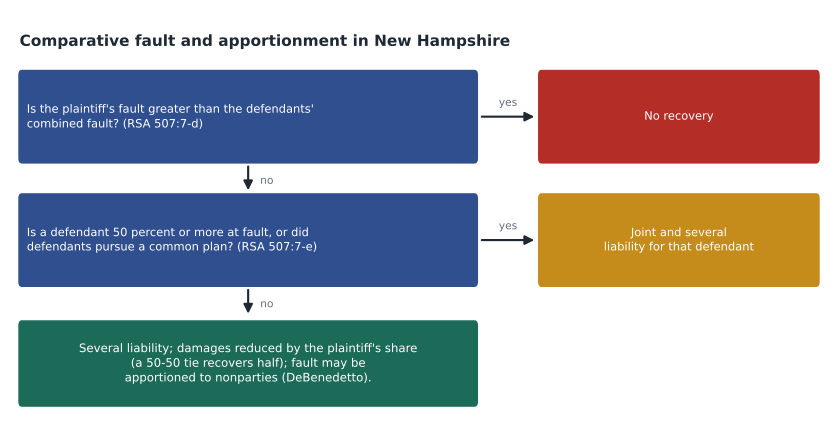
New Hampshire replaced contributory negligence with a modified form of comparative fault by statute. Under RSA 507:7-d, a plaintiff's own fault does not bar recovery if it was not greater than the fault of the defendant, or of the defendants in the aggregate when recovery is sought against more than one defendant. The plaintiff's damages are reduced in proportion to the plaintiff's share of the fault. A plaintiff who is exactly as much at fault as the defendants combined, fifty percent against fifty percent, still recovers half of the damages. A plaintiff whose fault is greater than the defendants' combined fault recovers nothing.
This is sometimes called the fifty percent rule, to distinguish it from systems that bar a plaintiff whose fault equals the defendant's. The key words are not greater than. In New Hampshire, a tie goes to the plaintiff. And the comparison is between the plaintiff and the defendants in the aggregate, not between the plaintiff and each defendant one at a time. A plaintiff who is thirty percent at fault can recover against two defendants each found thirty-five percent at fault, even though the plaintiff is close to each of them individually.
Apportionment under RSA 507:7-e
Once the jury decides that the plaintiff may recover, RSA 507:7-e governs how the judgment is divided among the defendants. The general rule is several liability: each defendant pays only its proportionate share of the damages, measured by its percentage of fault. The statute makes two important exceptions. A defendant whose fault is fifty percent or more is jointly and severally liable, meaning the plaintiff can collect the whole judgment from that defendant, who must then seek contribution from the others. And defendants who knowingly pursued a common plan or design resulting in the harm are jointly and severally liable for the damages caused by acts within that plan.
The practical difference is significant. Under several liability, a plaintiff bears the risk that one defendant cannot pay its share. Under joint and several liability, the paying defendant bears that risk. The fifty percent threshold therefore matters as much to defendants as the comparative fault threshold matters to plaintiffs.
Apportioning fault to people who are not defendants
A recurring question is whether the jury may assign fault to people who are not defendants in the case: a settling defendant, a person immune from suit, such as an employer protected by workers' compensation, or a person the plaintiff chose not to sue. In DeBenedetto v. CLD Consulting Engineers, decided in 2006, the New Hampshire Supreme Court read RSA 507:7-e to allow fault to be apportioned among all parties who contributed to the occurrence, including those who are not defendants at trial, provided the defendant who seeks apportionment proves the nonparty's fault with evidence. The decision means a defendant can reduce its own share by proving that someone outside the courtroom was also at fault.
Apportionment to nonparties has made New Hampshire trials more complicated. Defendants plead the nonparties they intend to blame, the parties develop evidence about absent actors, and juries receive verdict forms with lines for people who are not there. Plaintiffs' lawyers respond by suing every plausible defendant they can, so that any share assigned to a solvent actor can be collected.
Worked problem
Applying comparative fault and apportionment
In the loading dock case, suppose the jury assigns fault as follows: the kitchen worker 20 percent, the delivery company 45 percent, the restaurant owner 25 percent and the city 10 percent. Damages are 400,000 dollars.
Show solution
- Comparative fault: the worker's 20 percent is not greater than the defendants' aggregate 80 percent, so he recovers.
- Reduction: his damages are reduced by 20 percent, to 320,000 dollars.
- Apportionment: no defendant reaches 50 percent, so liability is several. The delivery company owes 45 percent of 400,000 dollars, 180,000 dollars; the restaurant 100,000 dollars; the city 40,000 dollars, subject to the rules on claims against municipalities.
- If the delivery company had been found 50 percent at fault, it would be jointly and severally liable for the full 320,000 dollars, with contribution rights against the others.
Answer: The worker recovers 320,000 dollars in total, collected severally from each defendant according to its share.
Damages: no punitive damages
New Hampshire is one of a small number of states that do not allow punitive damages in ordinary tort cases. RSA 507:16 provides that no punitive damages shall be awarded in any action unless otherwise provided by statute. A plaintiff cannot ask the jury to punish a defendant or deter others by awarding money beyond the plaintiff's actual loss.
New Hampshire law fills part of the gap with enhanced compensatory damages. In Vratsenes v. N.H. Auto, decided in 1972, the New Hampshire Supreme Court explained that when a defendant's conduct is wanton, malicious or oppressive, the jury may consider the aggravating circumstances in measuring the plaintiff's compensatory damages, particularly for injury to feelings, humiliation and indignity. Enhanced compensatory damages are still compensation for harm the plaintiff actually suffered, not punishment, but they can be substantial.
Some statutes do provide for multiple or additional damages. The most important for a new lawyer is the Consumer Protection Act, RSA 358-A, which allows a person injured by an unfair or deceptive act in trade or commerce to recover actual damages or a statutory minimum, whichever is greater, and allows the court to award two to three times that amount for a willful or knowing violation, together with costs and reasonable attorney's fees. Consumer protection claims are a regular feature of New Hampshire litigation involving car dealers, contractors and landlords.
No general caps on damages
Many states cap noneconomic damages, at least in medical malpractice cases. New Hampshire's constitution has made such caps difficult. As Lesson 7 explained, in Carson v. Maurer in 1980 the Supreme Court struck down a medical malpractice statute that limited damages and shortened the time to sue, and in Brannigan v. Usitalo in 1991 it struck down a cap on noneconomic damages. Both decisions rested on the state constitution's equal protection guarantees, applied with intermediate scrutiny, and on the right to a remedy in Part First, Article 14.
The result is that juries in New Hampshire tort cases generally award noneconomic damages without a statutory ceiling, while caps that do exist are found mainly in the statutes waiving governmental immunity, discussed below.
| Issue | New Hampshire rule | Source |
|---|---|---|
| Plaintiff's fault | Recovery allowed if not greater than defendants' aggregate fault; damages reduced | RSA 507:7-d |
| Allocation among defendants | Several liability; joint and several at 50 percent or more or for a common plan | RSA 507:7-e |
| Nonparties | Fault may be apportioned to nonparties on proof | DeBenedetto (2006) |
| Punitive damages | Not allowed unless a statute provides | RSA 507:16 |
| Aggravated conduct | Enhanced compensatory damages for wanton, malicious or oppressive conduct | Vratsenes (1972) |
| Consumer claims | Actual or statutory minimum damages, multiplied for willful or knowing violations, plus fees | RSA 358-A |
| Damages caps | No general caps; malpractice restrictions and a noneconomic cap struck down | Carson (1980); Brannigan (1991) |
Claims against the state
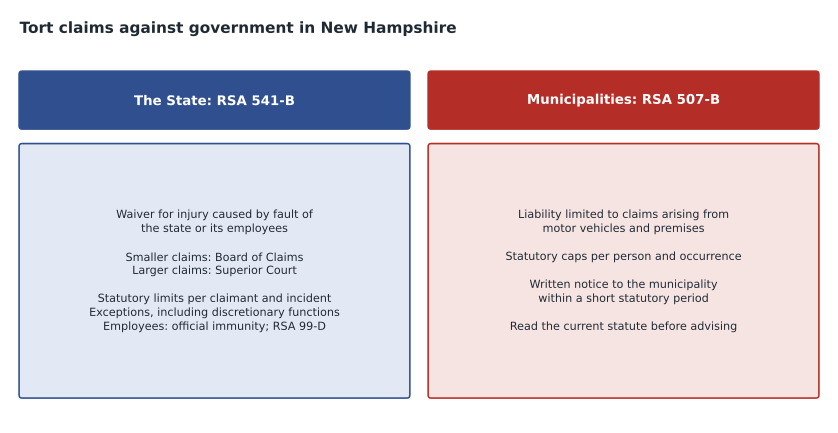
The state of New Hampshire is immune from suit except to the extent the legislature has waived its immunity. RSA 541-B is the main waiver for tort claims. It allows claims against the state for bodily injury, personal injury and property damage caused by the fault of the state or its employees acting within the scope of their duties, subject to exceptions, procedural requirements and limits on recovery per claimant and per incident set in the statute. Smaller claims go to an administrative Board of Claims, while larger claims go to the Superior Court, and the statute sets the dividing line and the filing deadlines. State employees acting within the scope of their duties are generally protected by official immunity and by the state's indemnification statute, RSA 99-D, which makes the state the proper defendant.
Because the details, including the dollar limits and the time limits, are set by statute and have been amended over the years, a new lawyer should read the current text of RSA 541-B before advising a client with a claim against the state. Claims against the state also exclude certain kinds of governmental activity, such as discretionary policy decisions, from the waiver.
Claims against municipalities
Towns, cities, counties and school districts are governed by a separate statute, RSA 507-B. It limits municipal liability for bodily injury, personal injury and property damage to claims arising out of the ownership, occupation, maintenance or operation of motor vehicles and premises, subject to exceptions, and it caps damages per person and per occurrence. A plaintiff must give the municipality written notice of the claim within a short period after the injury, and the statute's notice requirements are strictly applied.
In the loading dock case, the city's potential liability turns on whether the removal of the warning sign is premises-related conduct within RSA 507-B and whether notice was given in time. Caswell had Ezra send a notice letter to the city the same week the client signed the engagement letter. 'Never let a notice deadline be the reason a client loses a claim,' she told him.
Recreation, skiing and the North Country
New Hampshire's economy depends on outdoor recreation, and its tort law reflects that. Two statutes appear often in practice. The recreational use statute, RSA 212:34, encourages landowners to open their land to the public by limiting their duty to people who use the land for recreation without paying a fee, such as hikers, hunters and snowmobilers. A landowner who allows free recreational use is generally not liable for injuries unless the landowner willfully or maliciously failed to guard or warn against a dangerous condition.
The ski area statute, RSA 225-A, provides that skiers accept as a matter of law the dangers inherent in the sport, such as changes in terrain and snow conditions, and it sets out the duties of ski area operators and skiers. Claims against ski areas must fit within the operator's statutory duties, and the statute has notice and timing provisions of its own. A lawyer whose client was hurt on the slopes at a New Hampshire resort begins with RSA 225-A, not with general premises liability.
Putting the pieces together
New Hampshire tort practice combines a plaintiff-friendly constitutional tradition with defendant-friendly statutory rules. The constitution's right to a remedy and the courts' skepticism toward caps favor plaintiffs, as does the fifty percent comparative fault rule. Several liability, apportionment to nonparties, the bar on punitive damages and the immunity statutes favor defendants. A new lawyer on either side must know all of them, because each one changes the value of a case.
Ezra finished his week on the loading dock file by preparing a short memo listing the issues: comparative fault, apportionment including the possibility that the delivery company would blame the restaurant and the city, damages without punitive damages but with possible enhanced compensatory damages if the restaurant's disregard of the lighting complaints was wanton, and the RSA 507-B notice and cap for the city. Caswell read it, made two corrections in red and told him it was the kind of memo that would make him useful on day one.
Common mistakes
MistakeA plaintiff who is 50 percent at fault recovers nothing in New Hampshire.
InsteadUnder RSA 507:7-d, a plaintiff whose fault is not greater than the defendants' recovers reduced damages, so 50 percent recovers half.
MistakeAll defendants in New Hampshire are jointly and severally liable.
InsteadLiability is several, except for a defendant 50 percent or more at fault or defendants acting under a common plan.
MistakeThe jury can only assign fault to parties in the courtroom.
InsteadUnder DeBenedetto, fault can be apportioned to nonparties on proof.
MistakePunitive damages are available for malicious conduct.
InsteadRSA 507:16 bars them; enhanced compensatory damages may be available.
MistakeA claim against a town follows the same rules as a claim against a business.
InsteadRSA 507-B limits the claims, caps damages and requires prompt written notice.
Summary and key terms
- RSA 507:7-d allows recovery when the plaintiff's fault is not greater than the defendants' combined fault, with damages reduced proportionally.
- RSA 507:7-e makes liability several, with joint and several liability for a defendant 50 percent or more at fault or for a common plan.
- DeBenedetto allows apportionment of fault to nonparties when a defendant proves their fault.
- RSA 507:16 bars punitive damages unless a statute provides; Vratsenes allows enhanced compensatory damages for wanton, malicious or oppressive conduct.
- Carson and Brannigan explain the absence of general damages caps.
- Claims against the state run under RSA 541-B and against municipalities under RSA 507-B, each with limits and procedural requirements.
- 0
- modified comparative fault
- 1
- several liability
- 2
- joint and several liability
- 3
- apportionment
- 4
- enhanced compensatory damages
- 5
- Consumer Protection Act
- 6
- sovereign immunity
- 7
- recreational use statute
Practice problems
Work each problem on paper first, then reveal the answer to check.
A plaintiff is 50 percent at fault and the single defendant 50 percent. What does the plaintiff recover?
Show answer
Half of the damages, because the plaintiff's fault is not greater than the defendant's.
When is a New Hampshire defendant jointly and severally liable?
Show answer
When its fault is 50 percent or more, or when it knowingly pursued a common plan or design resulting in the harm.
Are punitive damages available in a New Hampshire assault case?
Show answer
No, unless a statute provides for them; enhanced compensatory damages may be awarded for wanton, malicious or oppressive conduct.
Which statute governs tort claims against a New Hampshire town?
Show answer
RSA 507-B, which limits the claims, caps damages and requires written notice.
Lesson quiz · 5 questions
Score 60% or more to complete this lesson.
Create a free account to save your progress, take quizzes and earn a certificate.