
BAR-230 · Lesson 3 of 12 · 20 min
Character and fitness and the MPRE
▶ Video coming soon A video version of this lesson is on the way.
Ezra's hardest evening with the Petition and Questionnaire came in early October, at his kitchen table, with a cup of coffee going cold. The form asked about every address he had lived at, every job he had held, every traffic ticket and every time he had been a party to a lawsuit. Most of it was easy. Two items were not. When he was nineteen, a police officer in Gilford had issued him a summons for possessing alcohol as a minor at a lakeside party, and the case had been resolved by a fine. And during his second year of law school, a credit card account had gone to collections for four months while he was between part-time jobs, before he paid it off.
He brought both items to his session with Marchetti. 'Ms. Caswell says to disclose everything,' he said, 'but part of me wonders if the alcohol summons even counts after all these years, and the credit card is paid. Do I really need to write a paragraph about each?' Marchetti's answer came without hesitation. 'Yes, and the paragraph is the point. The Committee is not looking for people who never made mistakes. It is looking for people who tell the truth about them, explain what happened and show what they learned. The quickest way to turn a minor incident into a serious problem is to leave it off the form and let the investigation find it.'
This lesson covers the character and fitness review in New Hampshire, from the petition and questionnaire through the Committee's investigation, the hearing process and Supreme Court review, and then turns to the Multistate Professional Responsibility Examination and New Hampshire's required scaled score of 79.
The standard and the burden
Rule 42 requires every applicant to establish good moral character and fitness to practice law, and it places the burden of proof squarely on the applicant. The court's separate rule on character and fitness standards, Rule 42B, describes what the Committee looks for and the kinds of conduct that raise concern. The basic question is whether the applicant can be trusted with clients' money, confidences and causes, and whether the applicant will deal honestly with courts and opposing parties.
Two consequences follow from placing the burden on the applicant. First, silence works against the applicant. Rule 42 provides that failing to answer questions or to supply requested documents may support a finding that the applicant has not met the burden. Second, the applicant controls much of the record. A candid, well-documented petition, with explanations that take responsibility, gives the Committee what it needs to recommend admission. A thin or evasive petition invites a deeper investigation and a hearing.
The Petition and Questionnaire for Admission
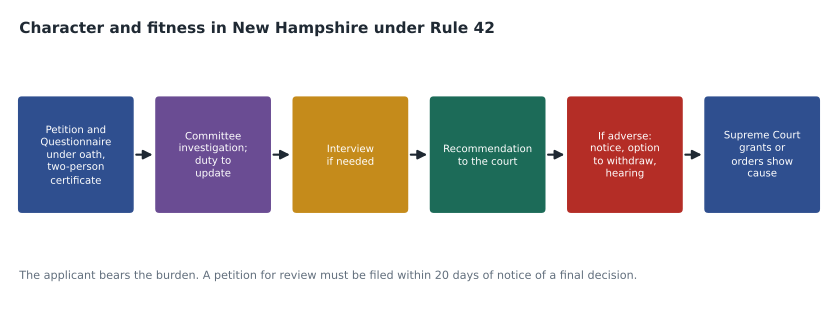
Every applicant, on every route, files the Petition and Questionnaire for Admission to the New Hampshire Bar. It is made under oath. It asks for a full history: residences, education, employment, military service, bar admissions elsewhere, discipline, criminal matters including those that were dismissed or annulled, civil litigation, financial problems, and certain health matters that bear on current fitness. It includes a certificate in which two people who know the applicant vouch for the applicant's character.
The petition is not a one-time filing. Rule 42 imposes a continuing duty to keep the information current in writing throughout the application process. A new traffic citation, a new job, a lawsuit, a change of address or a new financial problem after filing must be reported promptly. Candidates sometimes forget this during the months of study, and an update made only when the Committee asks looks worse than one made voluntarily.
| Area of the questionnaire | What candidates sometimes miss | Better practice |
|---|---|---|
| Criminal history | Old minor offenses, juvenile matters asked about, annulled or dismissed charges | Read each question's scope carefully and disclose everything it asks about |
| Employment | Short part-time jobs and jobs ended by termination | List every position asked for, with honest reasons for leaving |
| Financial matters | Accounts in collections, defaults later cured | Disclose and attach proof of payment or a payment plan |
| Academic matters | Law school honor code or conduct proceedings | Disclose and obtain the school's record |
| Driving record | Speeding tickets and license suspensions | Obtain the official record before answering |
| Updates | New events after filing | Report promptly in writing under the continuing duty |
The Committee's investigation
The Character and Fitness Committee reviews each petition and investigates. Staff contact references, employers and schools, check court and motor vehicle records, and obtain reports from other jurisdictions where the applicant has lived or been admitted. If something needs explanation, the Committee may ask for more documents or interview the applicant. Many questions are resolved at this stage with a letter or a short conversation.
When the Committee completes its review, it makes a recommendation to the Supreme Court. For most applicants the recommendation is favorable and the process is invisible. When the Committee is considering an adverse recommendation, Rule 42 gives the applicant notice and an opportunity to withdraw the application. An applicant who does not withdraw receives a hearing before the Committee, with the chance to present evidence and witnesses.
Supreme Court review
If the Committee recommends against admission after the hearing, the matter goes to the Supreme Court. The court may grant the application despite the recommendation, or it may order the applicant to show cause why the application should not be denied. Rule 42 also gives an applicant twenty days from notice of a final decision to petition the court for review. The court makes the final decision, consistent with admission being a judicial function.
Conduct that raises concern, and what helps
Rule 42B and the general practice of character and fitness committees identify recurring concerns: dishonesty or lack of candor, including on the bar application itself; criminal conduct, especially involving fraud, theft or violence; academic misconduct; neglect of financial responsibilities; violation of court orders, including child support orders; and conduct showing disregard for the rights of others. Current substance use problems that are untreated may bear on fitness, while a history of treatment that the applicant is managing well generally does not, and modern committees focus on conduct rather than diagnosis.
Several factors help an applicant whose record includes problems. The age of the conduct matters: a minor offense at nineteen weighs much less than a recent one. The seriousness and frequency matter. Candor matters enormously, as does evidence of rehabilitation, such as completed treatment, paid debts, positive work history and community service. Positive references from people who know the full story are persuasive. And the applicant's own explanation, written in the first person, accepting responsibility without excuses, often carries the day.
Worked problem
Disclosing Ezra's two items
Ezra must decide how to handle the alcohol summons at nineteen and the credit card account that went to collections during his second year.
Show solution
- Read the question: the petition asks about criminal and quasi-criminal matters regardless of outcome, so the summons is covered even though it ended in a fine.
- Obtain records: he requested the district division's record of the case so his description matches the official file.
- Explain briefly: one paragraph stating the date, the charge, the fine, and what he took from it.
- Financial item: he disclosed the account, attached the collection agency's letter showing payment in full, and explained the gap between jobs.
- Nothing more is needed unless the Committee asks; both items are old or cured and fully disclosed.
Answer: Full disclosure with records and short, candid explanations turns both items into routine matters.
The MPRE: what it is
The Multistate Professional Responsibility Examination is a two-hour multiple-choice test written and administered by NCBE. It has sixty questions, of which fifty are scored and ten are unscored pretest questions that are not identified. It tests the law governing lawyers: the ABA Model Rules of Professional Conduct, the ABA Model Code of Judicial Conduct, and generally accepted principles from court decisions and procedural and evidentiary rules on matters such as the attorney-client privilege, malpractice and disqualification. It does not test the New Hampshire Rules of Professional Conduct as such. Where New Hampshire's rules differ from the Model Rules, as Lesson 10 explains, the MPRE follows the Model Rules.
The MPRE is given several times a year at testing centers and is scored on a scale from 50 to 150. NCBE reports the score to the jurisdictions the candidate designates. The New Hampshire FAQs remind candidates to designate New Hampshire when they register so that the score is certified to New Hampshire. A candidate who forgot to designate New Hampshire can request a score transfer from NCBE afterward.
New Hampshire's required score: 79
New Hampshire requires an MPRE scaled score of 79. That is close to the middle of the range used across the country: some jurisdictions require 75, many require 80 or 85, and California requires 86. Because the scaled score is a national measure, a candidate's score does not change by jurisdiction; only the threshold does. A score of 82 passes in New Hampshire but would fall short of an 85 requirement elsewhere.
NCBE's chart lists no time limit for New Hampshire. Unlike states that require the MPRE to be passed within a set number of years before or after the bar exam, New Hampshire accepts a passing score regardless of when it was earned, subject to the general rule that every requirement must be completed within two years of the notice of passing. The court's FAQs add that the MPRE may be taken before or after the bar exam, but passing it is a requirement for admission. For a candidate seeking admission by transferred UBE score, the transferred-score rule requires the MPRE to be passed before the motion is filed.
Planning the MPRE
The usual advice is to take the MPRE during the second or third year of law school, after the professional responsibility course, when the material is fresh and before bar study begins. A candidate who passes early removes one requirement from the post-graduation rush. A candidate who did not take it in law school can take it in the months before or after the bar exam, but should be careful about the calendar: MPRE results take several weeks, and admission waits for them.
For the study group, the MPRE is old news for some and current for others. Dana Whitfield's score from spring 2026 is long since reported. Ngozi Adeyemi and Eddie Boudreaux sat in mid-November 2026 and are waiting for results. Ezra's 88 from August 2025 is on file with NCBE and designated for New Hampshire. Marchetti reminded him to log into his NCBE account and confirm that New Hampshire appears among the score recipients.
Character and fitness on the other routes
The character and fitness review is the same for every route. A lawyer seeking admission on motion, an applicant with a transferred UBE score and a Daniel Webster Scholar all file the same petition and questionnaire and go through the same Committee review. For applicants already admitted elsewhere, the Committee also obtains certificates of good standing and checks for discipline. Rule 42 requires motion applicants to be in good standing in every jurisdiction where they are admitted, with no discipline imposed and no matter pending. The transferred-score rule provides a partial refund of the character and fitness investigation fee if the motion is denied before the investigation begins, a detail that shows how much of the fee pays for the investigation itself.
Common mistakes
MistakeAn old minor offense that ended in a fine is not worth mentioning.
InsteadIf the question asks about it, disclose it. Nondisclosure is often treated more seriously than the conduct itself.
MistakeOnce I file the petition, I am done with it.
InsteadRule 42 imposes a continuing duty to update the information in writing throughout the process.
MistakeThe MPRE tests the New Hampshire Rules of Professional Conduct.
InsteadThe MPRE tests the ABA Model Rules and general principles; New Hampshire variations are not tested.
MistakeMy MPRE score expires after a few years.
InsteadNCBE lists no time limit for New Hampshire, though all requirements must be finished within two years of the notice of passing.
MistakeIf the Committee is unhappy, my application is automatically denied.
InsteadThe applicant receives notice, a chance to withdraw, a hearing, and Supreme Court review.
Responding to a Committee letter
Many applicants receive at least one letter from the Character and Fitness Committee's staff asking for more information. A letter is not an accusation. It usually means a document is missing, a date does not match a record, or an answer needs explanation. The right response is prompt, complete and calm: answer every question asked, attach the documents requested, correct any error in the original petition and say so plainly, and keep a copy of everything sent.
Ezra received one such letter in November. The Committee's staff had found a second traffic citation, for an expired inspection sticker in 2021, that he had forgotten. He wrote back within a week, explaining that he had overlooked it, attaching the record showing that the fine was paid, and amending his petition. Marchetti told him that the speed and candor of the response mattered more than the citation itself. A forgotten minor item, promptly corrected, is a routine event; the same item, explained defensively or ignored, can become a question about candor.
Applicants with more serious issues, such as a criminal conviction, academic discipline or significant financial problems, often benefit from talking with a lawyer who represents bar applicants before filing the petition. The lawyer can help gather records, prepare a candid explanation and present evidence of rehabilitation. The goal is the same as for a minor item: to give the Committee a full and truthful picture with the context it needs.
Summary and key terms
- The applicant bears the burden of proving good moral character and fitness, judged under Rule 42B.
- The Petition and Questionnaire is filed under oath with a certificate from two people and must be kept current.
- The Committee investigates, may interview, and recommends; an adverse recommendation brings notice, an option to withdraw and a hearing.
- The Supreme Court decides; a petition for review must be filed within twenty days of a final decision.
- New Hampshire requires an MPRE scaled score of 79, with no time limit listed by NCBE.
- Candor, rehabilitation and documentation are the strongest tools for an applicant with past problems.
- 0
- burden of proof
- 1
- Rule 42B
- 2
- certificate of character
- 3
- continuing duty to update
- 4
- adverse recommendation
- 5
- show cause order
- 6
- MPRE
- 7
- scaled score
Practice problems
Work each problem on paper first, then reveal the answer to check.
Who bears the burden in a New Hampshire character and fitness review?
Show answer
The applicant, who must establish good moral character and fitness.
What happens before an adverse Committee recommendation becomes final?
Show answer
The applicant receives notice and a chance to withdraw, then a hearing before the Committee; the Supreme Court decides.
What MPRE score does New Hampshire require?
Show answer
A scaled score of 79.
Must an applicant for admission by transferred UBE score pass the MPRE before filing?
Show answer
Yes. The transferred-score rule requires the MPRE to be passed before the motion is filed.
Lesson quiz · 5 questions
Score 60% or more to complete this lesson.
Create a free account to save your progress, take quizzes and earn a certificate.