
BAR-230 · Lesson 4 of 12 · 20 min
The New Hampshire bar exam: UBE format, scoring and the 270 passing score
▶ Video coming soon A video version of this lesson is on the way.
In the second week of November, Marchetti asked Ezra to describe the February exam to her as if she had never heard of it. He started confidently and then stalled. 'Tuesday is the written day: two performance tests in the morning and six essays in the afternoon. Wednesday is the MBE, two hundred questions. You need 270.' He paused. 'But I don't really understand how a 4 on an essay turns into points, or whether I can make up for a weak MBE with strong essays.' Marchetti nodded. 'That is exactly what you need to understand before you build a study schedule, because the weights should decide where your hours go.'
This lesson explains what the New Hampshire bar exam is, how the two days run, how the written answers are graded and scaled, how the total score is built from the parts and what a 270 means. It also covers results, the information a failing candidate receives and a few practical rules about laptops and arrival times.
New Hampshire gives the Uniform Bar Examination
New Hampshire has given the Uniform Bar Examination since February 2014, according to NCBE's records, and it will continue to give it through February 2028. The UBE has three parts, all written by NCBE: the Multistate Performance Test, the Multistate Essay Examination and the Multistate Bar Examination. Because every UBE jurisdiction gives the same questions on the same days and scores them on the same scale, a UBE score earned in New Hampshire can be transferred to other UBE jurisdictions that accept it, if it meets their passing score and time limits.
New Hampshire requires all three parts to be taken in New Hampshire during the same administration. The court's FAQs state that the Board will not accept MBE scores from earlier administrations for computing the overall grade. A candidate cannot bank a strong MBE score from one exam and combine it with written scores from another. Each attempt is a complete exam.
The two days
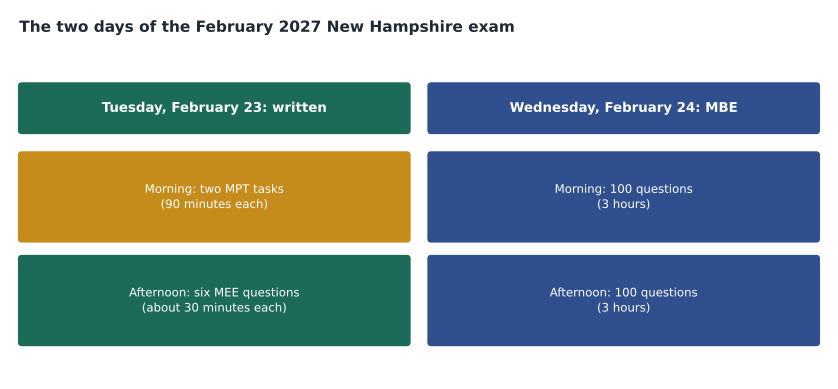
New Hampshire gives the exam twice a year, in February and July, over two days: the last Wednesday of the month and the Tuesday before it. For the February 2027 exam those are Tuesday, February 23, and Wednesday, February 24. The court's FAQs tell candidates that registration begins at 8:00 a.m. and that they should arrive by 8:15 a.m.
Tuesday morning is the Multistate Performance Test: two tasks, ninety minutes each. Each task gives the candidate a file of facts and a library of legal authorities, and asks for a practical document such as a memorandum, a brief, a letter to a client or a set of discovery requests. Tuesday afternoon is the Multistate Essay Examination: six questions, with about thirty minutes each. Wednesday is the Multistate Bar Examination: two hundred multiple-choice questions, one hundred in a three-hour morning session and one hundred in a three-hour afternoon session.
What the MEE now covers
The subject list for the Multistate Essay Examination changed in July 2026. NCBE removed four subjects from the MEE beginning with that exam: conflict of laws, family law, trusts and estates, and secured transactions. The MEE now draws on business associations, meaning agency and partnership, corporations and limited liability companies, together with the seven MBE subjects: civil procedure, constitutional law, contracts, criminal law and procedure, evidence, real property and torts. Family law and trusts and estates may still appear on the MPT through February 2028, but there the relevant law is supplied in the library rather than tested from memory.
Candidates who read the New Hampshire court's bar examination page in November 2026 will find an older list that still includes the removed subjects. That page predates the change. NCBE's current subject outlines control what is tested, and the Board grades answers according to NCBE's analyses. This is one more example of a theme from Lesson 1: published pages lag behind changes, so candidates should rely on the most current official source for each item.
| MEE subjects before July 2026 | MEE subjects from July 2026 |
|---|---|
| Business associations | Business associations (agency and partnership; corporations and LLCs) |
| Civil procedure, constitutional law, contracts and sales | Civil procedure, constitutional law, contracts |
| Criminal law and procedure, evidence | Criminal law and procedure, evidence |
| Real property, torts | Real property, torts |
| Conflict of laws | Removed |
| Family law | Removed (may appear on the MPT with law supplied) |
| Trusts and estates | Removed (may appear on the MPT with law supplied) |
| Secured transactions | Removed |
How the written answers are graded
Members of the New Hampshire Board of Bar Examiners grade the MPT and MEE answers. Grading is anonymous: papers are identified only by an applicant number until scoring is complete. Each of the two MPT answers and each of the six MEE answers receives a raw score on a scale of 1 to 6. The six MEE answers are weighted equally. NCBE supplies grading materials and analyses, and graders attend NCBE's calibration sessions so that answers in New Hampshire are measured against the same standards as answers elsewhere.
The court's page makes two points that candidates often find reassuring. There is no curve, in the sense that there is no fixed number of candidates who must fail. And a candidate does not need to pass each MPT or MEE question; what matters is adequate overall performance. A weak answer on one essay can be offset by strong answers elsewhere.
Scaling the written scores to the MBE
Raw written scores cannot simply be added to MBE scores, because the written questions differ in difficulty from one administration to the next and graders' raw scores are not on the same scale as the MBE. So the written scores are scaled to the MBE. The court's page describes the method: the combined MPT and MEE raw scores are converted to the MBE scale using the mean and standard deviation of the MBE scores of the same group of candidates. In simple terms, if a candidate's written performance is one standard deviation above the group's written average, the candidate's scaled written score is placed one standard deviation above the group's MBE average.
Scaling protects candidates from the luck of the draw. If a February exam has unusually hard essays, raw written scores drop for everyone, but scaling to the MBE, which is itself equated across administrations, brings them back to a consistent scale. The practical lesson is that a candidate's written score depends on how well the candidate writes compared with other candidates in the same administration.
Building the total: the UBE weights
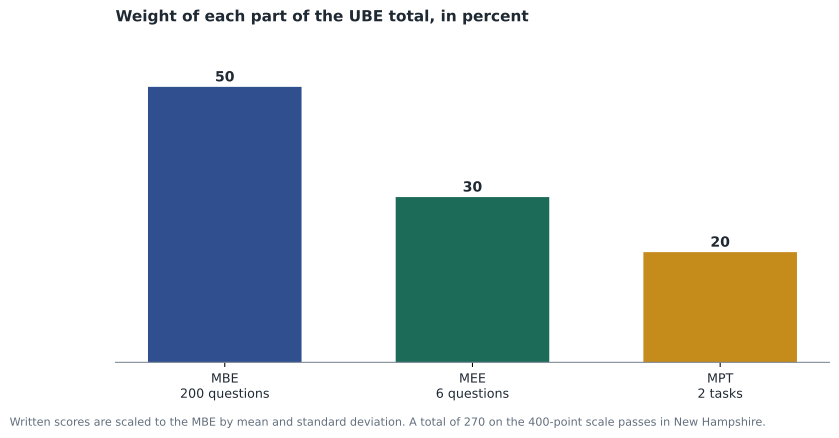
The UBE total is reported on a 400-point scale and built from fixed weights: the MBE counts for 50 percent, the MEE for 30 percent and the MPT for 20 percent. The two MPT tasks together therefore count for two-thirds as much as the six MEE questions, and each MPT task is worth considerably more than any single MEE question. The MBE alone is half the score.
Worked problem
Turning weights into study hours
Ezra has about 300 study hours between December 1 and February 22. He wants to divide them sensibly among the three parts.
Show solution
- Start from the weights: MBE 50 percent, MEE 30 percent, MPT 20 percent.
- Adjust for difficulty: the MBE covers seven subjects in depth and is the most knowledge-intensive part, so it deserves at least its weight.
- Do not neglect the MPT: each task is worth about 10 percent of the total, and performance improves quickly with timed practice.
- A reasonable split is about 150 hours on MBE subjects, about 90 hours on MEE practice and review, and about 60 hours on MPT practice.
Answer: Roughly 150, 90 and 60 hours, with the MBE hours doubling as substantive review for the MEE.
What a 270 means
A total of 270 or more on the 400-point scale passes in New Hampshire. The court's page states the rule simply: a total score of 270 or more on a scale of 400 is a passing score. A score of 269 fails, regardless of how the parts break down, and the Board does not regrade or reconsider papers on request. Rule 42 provides that scores are final and not reviewable; only disputes about the conduct of the exam can be taken to the Supreme Court, within twenty days of the final decision.
New Hampshire's 270 is in the middle of the UBE range. Several jurisdictions require 260 or 266, many require 270, and a few require 280. Because scores are on a common scale, a 272 earned in New Hampshire is the same 272 everywhere, but it passes only in jurisdictions whose minimum is 272 or lower. Candidates who expect to practice in more than one state should know the minimum in each.
Results and score information
The Board's chair notifies applicants of their results, and a list of successful applicants is posted on the court's website. The FAQs note a feature that surprises some candidates: applicants who pass are told that they passed but do not receive their scores from New Hampshire. Applicants who fail receive a score breakdown by mail about a month after results are announced, showing their MBE scaled score and their written scores so that they can plan a retake.
New Hampshire keeps MPT and MEE answers for one year. An unsuccessful applicant may review his or her own essays at the Office of Bar Admissions. Reviewing graded answers, especially alongside NCBE's published analyses, is one of the most useful things a failing candidate can do, because it shows whether the problem was knowledge, organization or time.
A passing candidate who later needs a score, for example to transfer it to another UBE jurisdiction, can obtain an official score transcript through NCBE's score services. The candidate requests the transfer and NCBE sends the score directly to the receiving jurisdiction.
Laptops and practical rules
Candidates may handwrite their MPT and MEE answers or type them on a laptop. Laptop registration happens after the application is filed, during the month before the exam, and NCBE's chart lists a laptop fee. Candidates who choose to type should install the required exam software early, run the practice exam it provides and know the procedure for a technical failure, which usually involves switching to handwriting for the remainder of the session.
The rest of the practical advice is common to all bar exams. Bring the admission materials the Office specifies, approved identification and only the items the instructions permit. Plan the drive to the test site with winter weather in mind; February in New Hampshire can bring snow, and the Office's instructions will explain what happens if a storm affects the exam. Ezra, who will drive from Concord, plans to scout the route the weekend before.
Common mistakes
MistakeI can use my MBE score from an earlier exam and just redo the essays.
InsteadNew Hampshire requires all three parts in the same administration and does not use prior MBE scores.
MistakeThe MEE still tests family law and trusts and estates.
InsteadThose subjects, along with conflict of laws and secured transactions, were removed in July 2026.
MistakeI must pass every essay to pass the exam.
InsteadWhat matters is the combined total; no single question must be passed.
MistakeIf I pass, I will receive my score from New Hampshire.
InsteadPassing applicants are told only that they passed; failing applicants receive a score breakdown.
MistakeA 268 can be appealed for regrading.
InsteadScores are final and not reviewable under Rule 42.
Using a score breakdown on a retake
A candidate who falls short in New Hampshire receives a breakdown about a month after results, and it is worth reading carefully. The breakdown separates the MBE scaled score from the written score, and it allows the candidate to see whether one part pulled the total down or whether performance was uniformly a little low. A candidate whose MBE score was strong but whose written score was weak should spend the next study period on timed essays and performance tests, and should visit the Office of Bar Admissions to read the graded answers. A candidate whose written score was strong but whose MBE score was weak needs volume: thousands of practice questions, with careful review of every miss.
Marchetti tells retakers to look at the distance from 270 as well as its direction. A total of 262 calls for adjustments; a total of 230 calls for a new approach, often including a different schedule, fewer working hours or a different study method. Because New Hampshire continues the legacy exam through February 2028, a February 2027 candidate who falls short has two more chances on the same exam, and a realistic plan should use the first of them.
Common misunderstandings about the total score
Three misunderstandings come up in almost every study group. The first is that the essays are graded on a fixed scale, so that a 4 is always worth the same number of points; in fact the scaling step means a 4 is worth more on a hard exam than on an easy one. The second is that the MPT is a minor part of the exam; at 20 percent of the total, the two tasks together are worth more than any two MBE subjects. The third is that a strong MBE can rescue any written performance; the MBE is half of the score, so a candidate who neglects the other half is betting the whole exam on one day.
Summary and key terms
- New Hampshire gives the UBE: two MPT tasks and six MEE questions on Tuesday, and the 200-question MBE on Wednesday.
- From July 2026 the MEE covers business associations and the seven MBE subjects.
- Board members grade written answers on a 1 to 6 scale; written scores are scaled to the MBE by mean and standard deviation.
- The total uses fixed weights, MBE 50, MEE 30 and MPT 20 percent, on a 400-point scale.
- A total of 270 passes; scores are final and not reviewable.
- Passing applicants are not told their scores; failing applicants receive a breakdown and may review their essays.
- 0
- Uniform Bar Examination
- 1
- Multistate Performance Test
- 2
- Multistate Essay Examination
- 3
- Multistate Bar Examination
- 4
- raw score
- 5
- scaling
- 6
- score portability
- 7
- passing score
Practice problems
Work each problem on paper first, then reveal the answer to check.
On which days is the February 2027 New Hampshire exam given?
Show answer
Tuesday, February 23, and Wednesday, February 24, 2027.
How are MEE and MPT raw scores combined with the MBE?
Show answer
They are scaled to the MBE using the mean and standard deviation of the group's MBE scores, then combined with weights of 30 and 20 percent.
Which four subjects left the MEE in July 2026?
Show answer
Conflict of laws, family law, trusts and estates, and secured transactions.
What does a failing New Hampshire candidate receive?
Show answer
A score breakdown by mail about a month after results, and the right to review his or her essays at the Office of Bar Admissions for one year.
Lesson quiz · 5 questions
Score 60% or more to complete this lesson.
Create a free account to save your progress, take quizzes and earn a certificate.