
BAR-230 · Lesson 7 of 12 · 20 min
New Hampshire courts, the state constitution and civil procedure
▶ Video coming soon A video version of this lesson is on the way.
Ezra's first week at Caswell and Thayer included a lesson in geography. On Monday he carried a probate filing to the circuit court in Concord. On Wednesday he sat in the back of the Merrimack County Superior Court while Margaret Caswell argued a motion in a slip-and-fall case. On Friday she asked him to pull a recent New Hampshire Supreme Court opinion on the state constitution's guarantee of a remedy. 'Three courts in one week,' he told Marchetti. 'I thought I understood the system from law school, but New Hampshire's version is its own thing.'
'It is,' Marchetti said, 'and none of it is on your February exam. But this is the frame for everything else in the New Hampshire part of this course. Torts, family law, wills and professional conduct all happen inside these courts and under this constitution. Learn the map now and the rest will make sense.' This lesson describes New Hampshire's courts, the selection and tenure of judges, the distinctive features of the New Hampshire Constitution, and the basics of civil procedure and limitations that a new lawyer uses every week.
The structure of the courts
New Hampshire has a unified court system with three levels: the Supreme Court, the Superior Court and the Circuit Court. The Supreme Court is the only appellate court; New Hampshire has no intermediate court of appeals, so appeals go directly from the trial courts to the Supreme Court. The Superior Court is the trial court of general jurisdiction. The Circuit Court, created in 2011, handles probate, family and district court matters through three divisions.
The Supreme Court has five justices, a chief justice and four associate justices. It hears appeals from the Superior Court and the Circuit Court and from many state administrative agencies, supervises the courts and the bar, adopts the rules of court and administers bar admission and lawyer discipline. Its procedure is governed by the Supreme Court Rules. Rule 7 distinguishes between mandatory appeals, which the court must accept, and discretionary appeals, which it may decline, and its forms and instructions require an appellant to identify which kind of appeal is being filed. A new lawyer filing a notice of appeal should read Rule 7 closely, because the category determines what the court will do with the case.
The Superior Court sits in each of New Hampshire's ten counties, with two locations in Hillsborough County, the most populous. It hears felony prosecutions, civil cases including all jury trials in civil matters, equity cases such as injunctions and quiet title actions, and a range of other matters assigned by statute. Its civil practice is governed by the Rules of the Superior Court.
The Circuit Court opened on July 1, 2011, when the legislature merged the former probate courts, district courts and family division into a single court. It has three divisions. The Probate Division handles estates, trusts, guardianships, adoptions and involuntary admissions. The Family Division handles divorce, parenting, child support, domestic violence petitions and juvenile matters. The District Division handles misdemeanors and violations, small claims, landlord and tenant cases and civil cases up to its statutory jurisdictional limit. Most New Hampshire residents who ever see a courtroom see a Circuit Court courtroom.
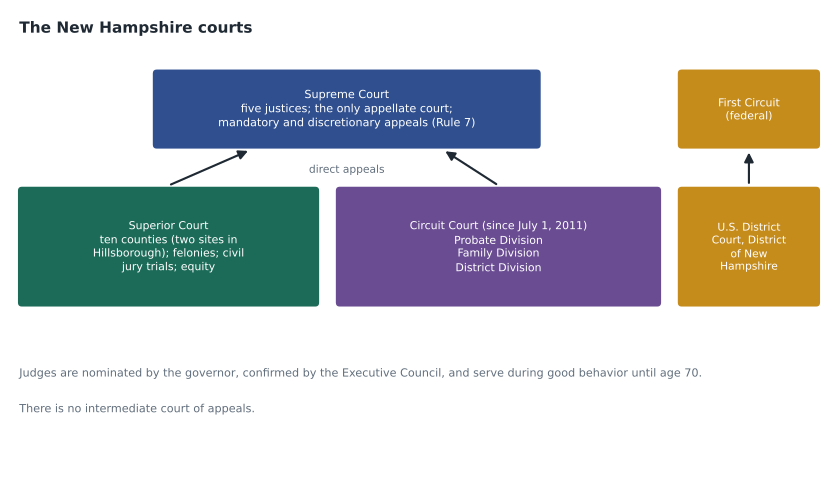
Federal cases arising in New Hampshire are heard in the United States District Court for the District of New Hampshire, in Concord, with appeals to the United States Court of Appeals for the First Circuit, which also covers Maine, Massachusetts, Rhode Island and Puerto Rico.
How New Hampshire chooses its judges
New Hampshire does not elect its judges. The governor nominates judges and the Executive Council, a five-member body elected by district, confirms or rejects the nomination. The Executive Council is a distinctive New Hampshire institution: it also approves state contracts and many appointments, and its confirmation votes on judicial nominees are public and sometimes contested.
Under the constitution, judges hold office during good behavior, subject to a mandatory retirement age of seventy. They can be removed by impeachment or by address of both houses of the legislature. There are no retention elections. The practical result is a stable bench, and a new lawyer who appears in the same county for years will come to know its judges well.
The New Hampshire Constitution
New Hampshire's constitution dates from 1784, which makes it one of the oldest written constitutions still in force in the United States. It has two parts. Part First is the Bill of Rights, a series of articles that predate the federal Bill of Rights and are often broader. Part Second, the Form of Government, establishes the legislature, called the General Court, with its unusually large House of Representatives of four hundred members; the executive, including the governor and the Executive Council; and the judiciary.
Several articles of Part First matter in practice. Article 14 guarantees every person a certain remedy, by recourse to the laws, for all injuries received in person, property or character, freely, completely and promptly. New Hampshire courts have relied on Article 14, together with the state's equal protection guarantees, to scrutinize laws that restrict tort remedies. Article 2-b, added in 2018, declares an individual's right to live free from governmental intrusion in private or personal information. Article 2-a protects the right to keep and bear arms. Article 10 preserves the people's right of revolution against a government that abandons its purposes, a striking reminder of the document's origins.
State constitution first: State v. Ball
New Hampshire is known nationally for its approach to state constitutional law. In State v. Ball, decided in 1983, the New Hampshire Supreme Court held that it would interpret the state constitution first, as an independent source of rights, and consider the federal constitution only when the state constitution did not resolve the issue. Federal decisions are treated as guidance, not as a ceiling. In criminal cases, this means a New Hampshire defense lawyer raises state constitutional claims first, and the court often decides cases on state grounds, which insulates the decision from review by the United States Supreme Court.
For a new lawyer, Ball has a practical consequence. A brief that argues only the Fourth Amendment, in a search and seizure case, has skipped New Hampshire's primary source of protection, Part First, Article 19. The same habit applies in civil cases involving equal protection, due process or the right to a remedy.
Equal protection and the right to a remedy: Carson v. Maurer
In Carson v. Maurer, decided in 1980, the New Hampshire Supreme Court struck down a medical malpractice statute that, among other things, limited damages and shortened the time to sue in malpractice cases. The court applied the state constitution's equal protection guarantees with an intermediate level of scrutiny, asking whether the classifications in the statute were reasonable and had a fair and substantial relation to the statute's purpose, and concluded that they did not. In 1991, in Brannigan v. Usitalo, the court applied similar reasoning to strike down a statutory cap on noneconomic damages.
The two cases explain why New Hampshire tort practice looks different from states with damages caps. Lesson 8 returns to these themes in discussing damages and claims against government.
Education funding and advisory opinions
Two other features of New Hampshire constitutional law are worth knowing. First, in the Claremont School District cases of the 1990s, the Supreme Court held that Part Second, Article 83 imposes on the state a duty to provide a constitutionally adequate education to every child and to guarantee adequate funding. Litigation about school funding has continued in the decades since, and the issue remains a recurring subject of state politics.
Second, the New Hampshire Constitution authorizes the justices of the Supreme Court to give advisory opinions on important questions of law when either house of the legislature or the governor and council request them. These are published as Opinions of the Justices. Advisory opinions are rare in American constitutional systems, and they give the legislature a way to test the constitutionality of a bill before it becomes law.
| Provision or case | What it does | Why it matters in practice |
|---|---|---|
| Part First, Article 14 | Guarantees a certain remedy for injuries to person, property or character | Basis for challenges to laws restricting tort remedies |
| Part First, Article 2-b (2018) | Right to privacy against governmental intrusion into private information | Raised in data and surveillance cases |
| Part First, Article 19 | Protection against unreasonable searches and seizures | Argued first in criminal cases under Ball |
| State v. Ball (1983) | State constitution interpreted first and independently | Defense briefs lead with state grounds |
| Carson v. Maurer (1980) | Struck down malpractice restrictions on state equal protection grounds | Explains the absence of general damages caps |
| Part Second, Article 83; Claremont cases | State duty to provide and fund an adequate education | Ongoing school funding litigation |
| Opinions of the Justices | Advisory opinions requested by the legislature or governor and council | Pre-enactment constitutional review |
Civil procedure in the Superior Court
A civil case in the Superior Court begins with a complaint filed with the court. The Rules of the Superior Court govern service, pleadings, motions, discovery, alternative dispute resolution, pretrial conferences and trial. The rules were substantially rewritten in the last decade to adopt a more modern, uniform structure, and much of the vocabulary will be familiar to anyone who studied the Federal Rules of Civil Procedure, but the details differ. A new lawyer should read the rules themselves for deadlines, rather than assuming the federal timelines apply.
New Hampshire also has its own Rules of Evidence, modeled on the Federal Rules of Evidence with New Hampshire variations, and its own rules for the Circuit Court divisions. Electronic filing is required in many case types. Much of the practical knowledge of how a case moves, such as how judges handle structuring conferences, what goes into a pretrial statement and how mediation is scheduled, is learned from mentors and from the Practical Skills Course.
Limitations periods
The most important limitations statute for a new litigator is RSA 508:4, which sets a three-year period for most personal actions, including tort and contract claims, with a discovery rule: when the injury and its causal relationship to the defendant's conduct were not discovered and could not reasonably have been discovered at the time of the act, the period runs from when the plaintiff discovered, or in the exercise of reasonable diligence should have discovered, the injury and its cause. The discovery rule has generated substantial case law, and a lawyer who relies on it must be prepared to prove when the client knew or should have known.
Some claims have different periods, set by specific statutes, and claims against the state and municipalities carry their own notice and filing requirements, covered in Lesson 8. For real property, New Hampshire's limitations statute for real actions sets a twenty-year period, which is the period for acquiring title by adverse possession. A new lawyer should calendar every limitations date the day a file is opened and should confirm the governing statute for each claim.
Worked problem
Calendaring a limitations date
A client comes to Caswell and Thayer on November 16, 2026. She slipped on an icy step at a Concord apartment building on January 9, 2024, and injured her wrist. She has not filed suit.
Show solution
- Identify the claim: negligence against the property owner, a personal action under RSA 508:4.
- Apply the period: three years from the act or omission, so the ordinary deadline is January 9, 2027.
- Consider the discovery rule: she knew of the injury and its cause on the day she fell, so the discovery rule does not extend the period.
- Check for special rules: if the property owner were a municipality, special notice provisions might apply; here it is a private owner.
- Calendar: set the filing deadline and an internal target well before it.
Answer: The complaint must be filed by January 9, 2027, and the firm should aim to file in December 2026.
Appeals
Because New Hampshire has no intermediate appellate court, every appeal goes to the Supreme Court. The appellant files a notice of appeal within the time set by the Supreme Court Rules, generally thirty days from the clerk's notice of the decision being appealed, identifying whether the appeal is mandatory or discretionary under Rule 7. The court may decide a case after full briefing and oral argument, on briefs alone, or by order. The New Hampshire Supreme Court publishes its opinions on the judicial branch website, and practitioners follow them closely because a single opinion can change practice statewide.
Common mistakes
MistakeNew Hampshire has an intermediate court of appeals.
InsteadAppeals go directly from the trial courts to the Supreme Court.
MistakeDivorces are heard in the Superior Court.
InsteadDivorce and parenting cases are heard in the Family Division of the Circuit Court.
MistakeNew Hampshire judges stand for retention elections.
InsteadJudges are nominated by the governor, confirmed by the Executive Council and serve until age seventy.
MistakeA search and seizure brief should start with the Fourth Amendment.
InsteadUnder State v. Ball, New Hampshire courts decide state constitutional claims first.
MistakeThe discovery rule always extends the three-year period.
InsteadIt applies only when the injury or its cause was not and could not reasonably have been discovered.
Summary and key terms
- New Hampshire has a Supreme Court, a Superior Court and a Circuit Court with Probate, Family and District divisions; there is no intermediate appellate court.
- Judges are nominated by the governor, confirmed by the Executive Council and serve during good behavior until seventy.
- The 1784 constitution has a Bill of Rights that New Hampshire courts interpret first and independently under State v. Ball.
- Part First, Article 14 guarantees a remedy; Carson v. Maurer and Brannigan v. Usitalo struck down malpractice restrictions and a noneconomic damages cap.
- The justices may give advisory opinions on request of the legislature or the governor and council.
- RSA 508:4 sets a three-year period with a discovery rule for most personal actions; real actions carry a twenty-year period.
- 0
- Circuit Court
- 1
- Superior Court
- 2
- Executive Council
- 3
- Part First
- 4
- State v. Ball
- 5
- Article 14
- 6
- Opinions of the Justices
- 7
- discovery rule
Practice problems
Work each problem on paper first, then reveal the answer to check.
Which court hears a New Hampshire divorce?
Show answer
The Family Division of the Circuit Court.
What did State v. Ball establish?
Show answer
That New Hampshire courts interpret the state constitution first, as an independent source of rights, using federal law only as guidance.
What is the general limitations period for a New Hampshire negligence claim?
Show answer
Three years under RSA 508:4, subject to the discovery rule.
Who confirms New Hampshire judicial nominees?
Show answer
The Executive Council.
Lesson quiz · 5 questions
Score 60% or more to complete this lesson.
Create a free account to save your progress, take quizzes and earn a certificate.