
BAR-231 · Lesson 11 of 12 · 20 min
Score transfer, admission by motion and practice after admission
▶ Video coming soon A video version of this lesson is on the way.
Two people in Marchetti's group had very different New Jersey questions in November. Leon, a member who lives in Philadelphia, had passed the UBE in Pennsylvania in July 2025 with a 271 and now wanted to join a firm in Cherry Hill. Teresa, who had not yet sat for any exam, wanted to know what happened on the day after she passed. 'Leon needs to know how to bring a score into New Jersey,' Marchetti said. 'Teresa needs to know what New Jersey expects of her in her first two years. Today we do both, and we add the third route, admission by motion, for lawyers who have been practicing for years.'
This lesson covers admission by transferred UBE score, admission by motion, limited forms of practice such as pro hac vice and in-house registration, and the obligations that begin with admission: the oath, annual registration, the Lawyers' Fund fee and continuing legal education, including New Jersey's special requirement for newly admitted lawyers.
Admission by transferred UBE score
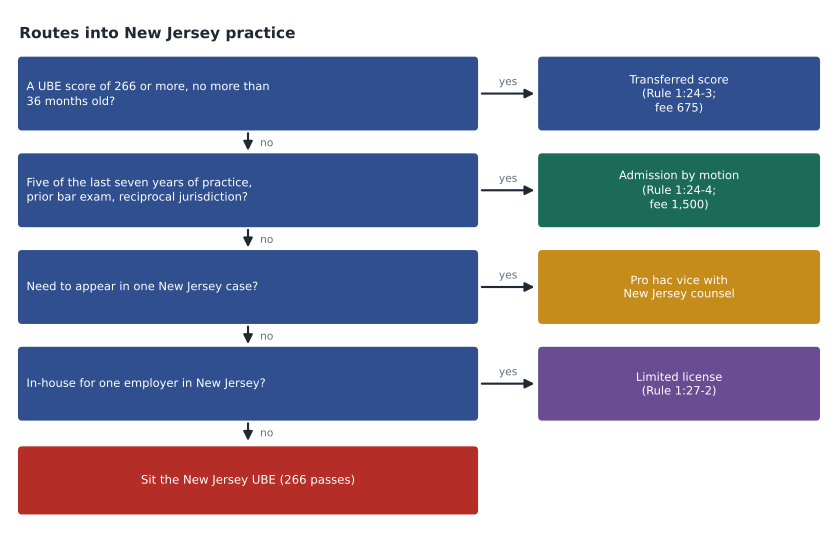
Rule 1:24-3 allows admission based on a UBE score earned in another jurisdiction. NCBE's jurisdiction chart sets out the main conditions. The candidate must have a scaled UBE score of at least 266, the score must be no more than 36 months old, and there is no limit on the number of attempts the candidate took to earn it. A candidate may not have concurrent applications pending for admission by transferred score and by examination. The application fee is 675 dollars. New Jersey does not accept transferred MBE scores standing alone, and no New Jersey component is required for transfer applicants.
A transfer applicant must meet the same character and professional responsibility requirements as an exam candidate. That means a Certified Statement of Candidate, character certification by the Committee on Character and either an MPRE score of 75 or the qualifying law school course. The applicant must hold an ABA-approved J.D. The score itself is sent to New Jersey through NCBE's score transfer service at the applicant's request.
Leon's case was straightforward. His 271 from July 2025 is above 266 and well within 36 months, so it qualifies until July 2028. He needed to file the transfer application, the Certified Statement and the fee, arrange the NCBE score transfer and wait for character certification. Marchetti reminded him that the 36-month window is measured from the exam date, not from the date of admission elsewhere, and that he should file well before the window closes because character review takes time.
Admission by motion
Experienced lawyers can seek admission without any New Jersey exam or score under Rule 1:24-4, adopted in 2016 and effective September 1, 2016. The rule allows admission by motion to the Supreme Court for an applicant who has lawfully practiced law for five of the last seven years within a United States jurisdiction, has previously sat for and passed a bar examination in another United States jurisdiction, is currently admitted in a United States jurisdiction that extends admission by motion to New Jersey lawyers, completes a New Jersey ethics and professionalism course and meets the other requirements of Rule 1:24-1.
NCBE's chart adds detail. Qualifying practice can include law teaching, work for a government agency, military service, in-house corporate work and service in a court of record, in addition to private practice. The applicant must be a graduate of an ABA-approved law school. Lawyers first admitted by diploma privilege are not eligible, because the rule requires a prior bar examination. The fee is 1,500 dollars. Because the rule is reciprocal, the answer depends on the applicant's home jurisdiction: a lawyer from a jurisdiction that does not admit New Jersey lawyers on motion cannot use this route.
| Route | Key requirements | Fee (NCBE chart) |
|---|---|---|
| Transferred UBE score (Rule 1:24-3) | 266 or higher; no more than 36 months old; ABA J.D.; character and professional responsibility requirements | 675 dollars |
| Admission by motion (Rule 1:24-4) | Five of last seven years of practice; prior bar exam passed; admitted in a reciprocal jurisdiction; New Jersey ethics and professionalism course; ABA J.D. | 1,500 dollars |
| Pro hac vice | Admission for a single case, by motion, associated with New Jersey counsel | Set by rule and the Lawyers' Fund |
| In-house limited license (Rule 1:27-2) | Licensed elsewhere in the United States; employed by a single organization in New Jersey | Set by rule |
Worked problem
Can this lawyer be admitted by motion?
Sandra passed the Pennsylvania bar exam in 2016 and has practiced there since, first at a firm for four years and then as an assistant district attorney for six. She has never been admitted elsewhere. Pennsylvania admits lawyers from reciprocal jurisdictions on motion. Can she be admitted in New Jersey by motion?
Show solution
- Practice: she has practiced for well over five of the last seven years; government work as a prosecutor qualifies.
- Prior exam: she passed the Pennsylvania bar exam, so she was not admitted by diploma privilege.
- Reciprocity: she is admitted in a jurisdiction that extends admission on motion; she should confirm that Pennsylvania's rule reaches New Jersey lawyers.
- Other requirements: ABA-approved J.D., character certification and the New Jersey ethics and professionalism course.
Answer: Sandra appears to qualify for admission by motion under Rule 1:24-4, subject to confirming reciprocity and completing character review and the ethics course.
Pro hac vice and in-house counsel
A lawyer licensed in another jurisdiction who needs to appear in a single New Jersey case may ask the court for admission pro hac vice. The lawyer must be associated with New Jersey counsel of record, who remains responsible for the conduct of the case, and must comply with the rule's requirements, including payments to the Lawyers' Fund. RPC 5.5 lists the limited circumstances in which out-of-state lawyers may practice in New Jersey, including pro hac vice admission and in-house practice, and requires them to submit to New Jersey's disciplinary authority and register annually with the Lawyers' Fund.
In-house lawyers who are licensed in another United States jurisdiction and work for a single employer in New Jersey can obtain a limited license under Rule 1:27-2. The limited license does not allow them to represent anyone other than their employer or to appear in New Jersey courts generally. Limited-license holders are not subject to the new-admittee coursework requirement described below.
The day after passing
For an exam candidate like Teresa, passing is followed by character certification, if not already complete, and then the oath of admission. New admittees take the oath, typically at an admission ceremony, and sign the roll of attorneys. Admission is not the end of the paperwork. Each New Jersey lawyer must complete the annual attorney registration and pay the annual assessment to the Lawyers' Fund for Client Protection and the disciplinary system. Failure to register and pay can lead to an order declaring the lawyer administratively ineligible to practice. A lawyer in private practice must open an attorney trust account and an attorney business account at approved New Jersey institutions before handling client funds, as Lesson 10 described.
Continuing legal education
The Board on Continuing Legal Education administers New Jersey's mandatory CLE program. Each lawyer must complete 24 credits every two years, including at least five credits in ethics and professionalism, of which at least two must be in diversity, inclusion and elimination of bias. Lawyers are assigned to one of two compliance groups by birth date: those born January 1 to June 30 report in even-numbered years, and those born July 1 to December 31 report in odd-numbered years. Up to 12 credits above the requirement can be carried into the next period.
The new-admittee requirement
New Jersey adds a special requirement for newly admitted lawyers with a plenary license. During the first full compliance period, a new lawyer must complete 16 credits in at least six of twelve New Jersey-specific subject areas, such as trial preparation, family law, estate administration and labor and employment law, and at least one of the 16 credits must be in New Jersey attorney trust and business accounting fundamentals. Older guidance referred to a separate Skills and Methods course for new lawyers; the Board's current instructions frame the requirement as the 16 credits in New Jersey subjects. Courses taken after law school but before admission count if completed no more than 12 months before admission.
The timing depends on the year of admission and the compliance group. The Board publishes a guide for each admission year. For lawyers admitted in 2026, for example, the requirement begins January 1, 2027. Those in the first group have a transitional period requiring 12 credits by December 31, 2027, including at least 2.5 credits in ethics and professionalism with at least one diversity credit, followed by a full 24-credit period in 2028 and 2029 that includes the new-admittee requirement. Those in the second group have a first full period ending December 31, 2028, which must include the new-admittee requirement. Teresa, who hopes to be admitted in 2027, will follow the Board's guide for 2027 admittees, which uses the same structure one year later.
| Requirement | What New Jersey requires |
|---|---|
| General CLE | 24 credits every two years |
| Ethics and professionalism | At least 5 credits per period, including 2 in diversity, inclusion and elimination of bias |
| New-admittee coursework (plenary license) | 16 credits in at least 6 of 12 New Jersey subject areas, including 1 in trust and business accounting |
| Carryover | Up to 12 credits into the next period |
| Pre-admission courses | Count if completed no more than 12 months before admission |
| Noncompliance | Late fees (50 dollars, then a further 50 dollars) and possible administrative ineligibility |
Consequences of falling behind
The Board enforces the requirements. A lawyer who does not complete courses by the deadline pays a nonrefundable 50-dollar late fee, and a further 50 dollars, for a total of 100 dollars, if the courses are not completed within the grace period or compliance is not reported. A noncompliant lawyer may be declared administratively ineligible to practice New Jersey law. Practicing while ineligible is itself a disciplinary problem, so a new lawyer should calendar CLE deadlines alongside client deadlines.
Planning a second license
Many New Jersey candidates plan a second license, usually in New York or Pennsylvania. The same tools work in reverse: a New Jersey UBE score can be transferred to other UBE jurisdictions within their own time limits and minimum scores, and some jurisdictions impose additional requirements. A lawyer who waits too long may need admission by motion instead, which requires years of practice. Teresa's plan is to apply in Pennsylvania within months of passing, while her score is fresh, and to decide about New York later after reviewing New York's own requirements.
Common mistakes
MistakeA UBE score transfers to New Jersey for five years.
InsteadThe score must be no more than 36 months old.
MistakeAn MBE score alone can be transferred into New Jersey.
InsteadNew Jersey does not accept transferred MBE scores.
MistakeAny lawyer with five years of practice can be admitted by motion.
InsteadThe applicant must also have passed a bar exam elsewhere, be admitted in a reciprocal jurisdiction and complete a New Jersey ethics and professionalism course.
MistakeNew lawyers can wait until their second period to start CLE.
InsteadThe requirement begins on a schedule set by the Board for each admission year, with the 16 new-admittee credits due in the first full period.
MistakeA lawyer who misses CLE deadlines faces only a small fee.
InsteadNoncompliance can lead to administrative ineligibility to practice.
A first-year compliance calendar
Marchetti recommends that every new New Jersey lawyer build a compliance calendar on the day of admission. It should include the annual attorney registration deadline and the Lawyers' Fund payment, the end of the lawyer's CLE compliance period and grace period, the date by which the new-admittee coursework must be complete and, for lawyers in private practice, a monthly reminder to complete the trust account reconciliation required by Rule 1:21-6. A lawyer who also seeks admission in another jurisdiction should add that jurisdiction's deadlines, including any score transfer window and its own CLE and registration duties.
New lawyers sometimes assume their employer will track these obligations. Many firms do, but the duties belong to the individual lawyer, and administrative ineligibility attaches to the lawyer, not the firm. Teresa planned to keep her calendar in the same red-ink desk diary Joan Vellucci uses for court deadlines, with a second copy in her phone.
When a second license is not worth it yet
Not every new lawyer needs a second license immediately. A lawyer whose practice is entirely in New Jersey state courts may decide to wait, accepting that a transferred score may expire and that admission by motion will require years of practice. The decision should be made deliberately, with the receiving jurisdiction's current rules in hand, rather than by letting a score window close unnoticed.
Summary and key terms
- Transferred UBE score (Rule 1:24-3): 266 or more, no more than 36 months old, no attempt limit, no concurrent exam application, 675-dollar fee; no MBE-only transfer.
- Admission by motion (Rule 1:24-4, effective September 1, 2016): five of the last seven years of practice, a prior bar exam, admission in a reciprocal jurisdiction, a New Jersey ethics course; 1,500-dollar fee; no diploma privilege admittees.
- Pro hac vice and the Rule 1:27-2 in-house limited license allow limited practice.
- After admission: oath, roll, annual registration and Lawyers' Fund assessment, trust and business accounts.
- CLE: 24 credits every two years with 5 ethics credits, including 2 in diversity; the new-admittee requirement adds 16 credits in New Jersey subjects, including trust accounting.
- Noncompliance brings late fees and possible administrative ineligibility.
- 0
- transferred UBE score
- 1
- admission by motion
- 2
- reciprocity
- 3
- pro hac vice
- 4
- limited license
- 5
- annual attorney registration
- 6
- Board on Continuing Legal Education
- 7
- compliance group
- 8
- new-admittee requirement
- 9
- administrative ineligibility
Practice problems
Work each problem on paper first, then reveal the answer to check.
How old can a UBE score be for transfer into New Jersey?
Show answer
No more than 36 months old.
Name the four core requirements of Rule 1:24-4.
Show answer
Five of the last seven years of practice, a prior bar exam passed elsewhere, admission in a reciprocal jurisdiction and a New Jersey ethics and professionalism course.
How many CLE credits must a New Jersey lawyer complete every two years?
Show answer
24, including at least 5 in ethics and professionalism, 2 of them in diversity, inclusion and elimination of bias.
What does the new-admittee requirement add?
Show answer
16 credits in at least six of twelve New Jersey subject areas, including at least one in trust and business accounting.
Lesson quiz · 5 questions
Score 60% or more to complete this lesson.
Create a free account to save your progress, take quizzes and earn a certificate.