
BAR-231 · Lesson 9 of 12 · 23 min
New Jersey family law, wills and estates
▶ Video coming soon A video version of this lesson is on the way.
Half of Vellucci & Kaczmarek's work is family and estates practice, handled by the firm's other partner, Stefan Kaczmarek. In November, he asked Teresa to sit in on two consultations in one afternoon. The first was a woman married for fourteen years whose husband had moved out in August. The second was a son whose father had died in Hamilton leaving a handwritten note on the kitchen table that said, in shaky capitals, 'House to Dorota. Everything else split between the kids.' Teresa came back to her desk with two pages of questions. 'None of this is on the MEE anymore,' she told Marchetti. 'And all of it is in this office every day.'
Family law and trusts and estates left the MEE in July 2026, and New Jersey has no local exam component, so a February 2027 candidate will not be examined on New Jersey's divorce or wills statutes. These subjects can still appear on an MPT with the law supplied, and they appear constantly in practice and in the new-admittee CLE. This lesson covers the main New Jersey rules: divorce grounds and procedure, equitable distribution, alimony after the 2014 reform, custody and support, will formalities including the writing-intended-as-a-will statute, probate and the elective share.
Where family cases are heard
Divorce, custody, support, domestic violence and juvenile matters are heard in the Family Part of the Chancery Division of the Superior Court. A divorce complaint is filed in the county where the plaintiff lived when the parties separated or, if the plaintiff does not live in New Jersey, where the defendant lives. At least one spouse must be a New Jersey resident. For a divorce on the ground of irreconcilable differences, the court's guidance states that either spouse must have lived in New Jersey for 12 consecutive months before filing.
Parties with children who seek custody or parenting time must each attend a parenting workshop and pay a workshop fee. Many cases are referred to an Early Settlement Panel of experienced family lawyers who recommend a resolution of financial issues, and to economic mediation. Domestic violence restraining orders change those steps; a court will not require mediation where a restraining order has been entered, although a victim may choose financial mediation.
Grounds for divorce
New Jersey allows divorce on several grounds under N.J.S.A. 2A:34-2. Most divorces today proceed on irreconcilable differences, a no-fault ground added in 2007. It requires that the parties have experienced irreconcilable differences for a period of six months that make it appear the marriage should be dissolved, with no reasonable prospect of reconciliation.
| Ground (N.J.S.A. 2A:34-2) | Time element |
|---|---|
| Adultery | None |
| Willful and continued desertion | 12 or more months |
| Extreme cruelty | No complaint until three months after the last act of cruelty relied on (not for counterclaims) |
| Separation in different residences | At least 18 consecutive months, with no reasonable prospect of reconciliation |
| Voluntarily induced addiction or habitual drunkenness | 12 or more consecutive months after marriage |
| Institutionalization for mental illness | 24 or more consecutive months after marriage |
| Imprisonment | 18 or more consecutive months after marriage |
| Deviant sexual conduct without consent | None |
| Irreconcilable differences | Six months of irreconcilable differences, no reasonable prospect of reconciliation |
Fault grounds still matter occasionally, for example where a party wants a faster resolution than the six-month period or where conduct is relevant to alimony. In most cases, however, the choice of ground has little effect on the outcome. Equitable distribution in New Jersey generally does not turn on marital fault.
Equitable distribution
New Jersey divides marital property by equitable distribution, not by community property rules. The Supreme Court established the framework in Painter v. Painter and Rothman v. Rothman, both decided in 1974, shortly after the Legislature authorized courts to distribute property acquired during the marriage. The court follows three steps: it identifies the property eligible for distribution, values it, and then decides how to divide it equitably. Equitable does not mean equal, although many divisions end up close to equal.
Property acquired by either spouse during the marriage is generally eligible for distribution, regardless of whose name it is in. Property acquired before the marriage is generally excluded, as is property acquired during the marriage by gift, devise or inheritance from someone other than the spouse, although the increase in value of excluded property caused by the efforts of the spouses during the marriage may be distributable. N.J.S.A. 2A:34-23.1 lists factors the court must consider in deciding how to divide the property, including the length of the marriage, the age and health of the parties, the income and property each brought to the marriage, the standard of living, any written agreement, the economic circumstances of each party, each party's contributions, including as a homemaker, and the tax consequences of the distribution.
Alimony after the 2014 reform
New Jersey reformed alimony by P.L. 2014, chapter 42, effective September 10, 2014. The reform replaced permanent alimony with open durational alimony and kept three other forms: rehabilitative alimony, which requires a plan showing the steps, timeline and period of employment; limited duration alimony; and reimbursement alimony, which compensates a spouse who supported the other's advanced education and cannot be modified. A court may award one form or a combination.
The reform added a durational limit. For marriages or civil unions of less than 20 years, the total duration of alimony generally may not exceed the length of the marriage, except in exceptional circumstances, such as the parties' ages, a dependent relative's needs, a party's health, career sacrifices or a disproportionate property distribution. The reform also created a rebuttable presumption that alimony ends when the paying spouse reaches full retirement age, while preserving arrears, and it set standards for early retirement. It defined cohabitation broadly as a mutually supportive, intimate relationship in which the couple has undertaken duties and privileges commonly associated with marriage, even without a shared household, and allowed alimony to be suspended or terminated on that basis. The reform did not change the term of alimony set in existing final judgments or agreements.
| Type of alimony | Key features after P.L. 2014, c. 42 |
|---|---|
| Open durational | Replaces permanent alimony; generally for marriages of 20 years or more |
| Limited duration | Fixed term; for marriages under 20 years the total generally cannot exceed the marriage length |
| Rehabilitative | Requires a plan with steps, a timeline and an employment period |
| Reimbursement | Compensates support of the other spouse's advanced education; not modifiable |
Custody and child support
Custody decisions are governed by the best interests of the child, under N.J.S.A. 9:2-4, which declares a public policy of assuring minor children frequent and continuing contact with both parents and lists factors the court considers, such as the parents' ability to agree and cooperate, the child's relationship with each parent, the child's needs, the stability of the home, the history of any domestic violence and the child's preference when the child is mature enough. New Jersey distinguishes legal custody, meaning decision-making authority, from physical custody and parenting time.
Child support is calculated under the New Jersey Child Support Guidelines, which are part of the Rules of Court. The guidelines use both parents' incomes and the parenting time arrangement to produce a presumptive amount, and the court may deviate when the guidelines would produce an unjust result. Child support continues, as a general rule, until the child reaches 19, with exceptions for children who are still in high school or full-time postsecondary education or who have a disability, under the child support emancipation statute.
Worked problem
First consultation: the fourteen-year marriage
The client married in 2012. Her husband moved out in August 2026. They own a house bought in 2014, his retirement account (funded since 2005), and a cabin she inherited from her aunt in 2019. They have a ten-year-old son. She wants a divorce and alimony. What should Teresa note?
Show solution
- Ground: irreconcilable differences once six months of irreconcilable differences can be shown; residency is satisfied.
- Equitable distribution: the house is marital. The retirement account is marital to the extent of contributions and growth during the marriage, from 2012; the pre-2012 portion is generally excluded.
- The inherited cabin is generally excluded, unless marital efforts increased its value.
- Alimony: the marriage is under 20 years, so any limited duration alimony generally cannot exceed about fourteen years, absent exceptional circumstances.
- Custody and support: best interests under N.J.S.A. 9:2-4; both parents attend the parenting workshop; support under the Child Support Guidelines.
Answer: The case is a typical irreconcilable differences divorce with distributable marital assets, an excluded inheritance and an alimony term capped by the length of the marriage.
Will formalities
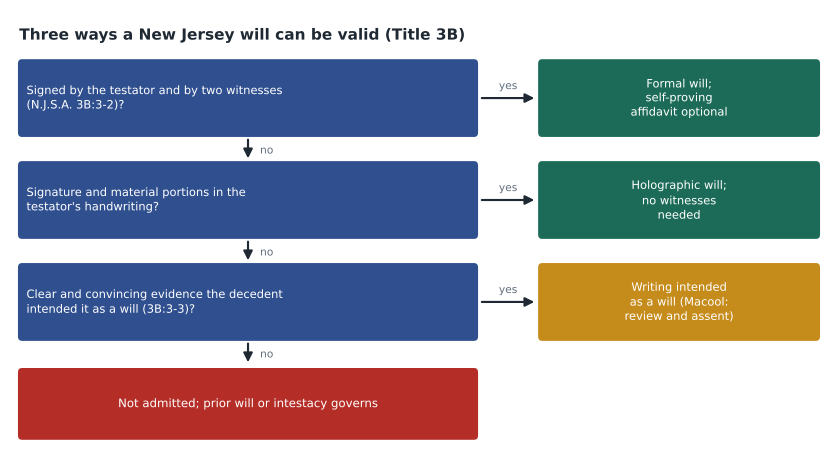
A New Jersey will can be valid in three ways under Title 3B. A formal will under N.J.S.A. 3B:3-2 must be in writing, signed by the testator (or by someone else in the testator's presence and at the testator's direction) and signed by at least two witnesses, each of whom signed within a reasonable time after witnessing the signing or the testator's acknowledgment of the signature or the will. A will may be made self-proving with an affidavit signed before an officer authorized to administer oaths, which simplifies probate.
New Jersey also recognizes holographic wills. A will is valid as a writing intended as a will, whether or not it is witnessed, if the signature and the material portions of the document are in the testator's handwriting. Unlike some states, New Jersey does not require the entire document to be handwritten; the signature and material portions are enough.
Writings intended as wills
The most important New Jersey wills statute for practitioners is N.J.S.A. 3B:3-3, which adopts a harmless error approach. A document or writing added to a will is treated as if it had been executed in compliance with the formalities if the proponent establishes by clear and convincing evidence that the decedent intended the document to be the decedent's will, a partial or complete revocation, an addition or alteration, or a partial or complete revival.
In In re Probate of Will and Codicil of Macool (App. Div. 2010), the decedent met with her lawyer, who prepared a draft will from her handwritten notes; she died about an hour later without ever reading it. The Appellate Division held that a signature is not required under section 3B:3-3, but the proponent must prove by clear and convincing evidence that the decedent actually reviewed the document and gave her final assent to it. Because the decedent never saw the draft, it could not be admitted. Later cases have admitted unsigned or informal documents when that proof was made.
Worked problem
Second consultation: the kitchen-table note
The father's 2010 formal will left everything equally to his three children. In 2026, two years after he married Dorota, he wrote in his own handwriting, in capitals, 'House to Dorota. Everything else split between the kids,' and signed his first name at the bottom. Is the note valid?
Show solution
- Formal will: no witnesses, so not valid under the two-witness rule.
- Holographic will: the signature and material portions appear to be in his handwriting. A first-name signature can be sufficient if it was intended as his signature. Handwriting must be proved.
- If the holographic route fails, the proponent can try N.J.S.A. 3B:3-3, proving by clear and convincing evidence that he intended the note as a will or codicil; unlike in Macool, he wrote and signed it himself.
- The note partly revokes the 2010 will as to the house; the rest of the estate passes as the 2010 will and the note together direct.
- Dorota is a surviving spouse, so if the note fails she may consider the elective share; if it is admitted, she may still compare it with what the elective share would give her.
Answer: The note is a strong candidate for probate as a holographic will or, failing that, as a writing intended as a will; the dispute, if any, will be contested in the Chancery Division, Probate Part.
Probate and the elective share
Uncontested wills are probated before the county Surrogate, who admits the will and issues letters testamentary to the executor. Contested matters go to the Chancery Division, Probate Part. Intestate estates pass under Title 3B's intestacy rules, which, in broad terms, favor the surviving spouse and descendants, with the shares depending on whether there are descendants from other relationships.
A surviving spouse or domestic partner who is unhappy with the will may claim an elective share under N.J.S.A. 3B:8-1 equal to one-third of the augmented estate, a measure that includes certain transfers outside the probate estate. The right is not available if, at the time of death, the spouses were living separate and apart in different habitations or had ceased to cohabit as spouses under circumstances that would have given rise to a cause of action for divorce or nullity. That condition often decides elective share cases in practice.
New Jersey's estate tax was repealed for deaths on or after January 1, 2018, but the state still imposes an inheritance tax on transfers to certain classes of beneficiaries, such as siblings and unrelated persons, while transfers to spouses, children and grandchildren are exempt. Estate administration in New Jersey therefore often involves filing an inheritance tax return or a waiver even when no tax is due.
Common mistakes
MistakeNew Jersey is a community property state.
InsteadNew Jersey uses equitable distribution, following Painter and Rothman and N.J.S.A. 2A:34-23.1.
MistakePermanent alimony still exists in New Jersey.
InsteadThe 2014 reform replaced it with open durational alimony and limited the duration of alimony for marriages under 20 years.
MistakeA holographic will must be entirely handwritten.
InsteadOnly the signature and material portions must be in the testator's handwriting.
MistakeAn unsigned draft prepared by a lawyer is a valid will if the client wanted it.
InsteadUnder Macool, the proponent must prove by clear and convincing evidence that the decedent reviewed the document and gave final assent.
MistakeA separated spouse always takes the elective share.
InsteadThe share is unavailable if the spouses lived separate and apart or had ceased cohabiting in circumstances that would support a divorce.
Summary and key terms
- Family matters are heard in the Family Part of the Chancery Division; irreconcilable differences requires six months and, per court guidance, 12 months of residency.
- N.J.S.A. 2A:34-2 lists nine grounds, including 18 months' separation and irreconcilable differences.
- Equitable distribution (Painter, Rothman, N.J.S.A. 2A:34-23.1) divides property acquired during the marriage; gifts and inheritances from third parties are generally excluded.
- P.L. 2014, c. 42 created open durational alimony, limited alimony for marriages under 20 years to the marriage length absent exceptional circumstances, and added retirement and cohabitation rules.
- Wills: formal wills need two witnesses; holographic wills need the signature and material portions in handwriting; N.J.S.A. 3B:3-3 admits writings intended as wills on clear and convincing evidence (Macool: review and final assent).
- The elective share is one-third of the augmented estate, unless the spouses were living separate and apart in qualifying circumstances.
- 0
- Family Part
- 1
- irreconcilable differences
- 2
- equitable distribution
- 3
- open durational alimony
- 4
- limited duration alimony
- 5
- holographic will
- 6
- writing intended as a will
- 7
- Surrogate
- 8
- elective share
- 9
- augmented estate
Practice problems
Work each problem on paper first, then reveal the answer to check.
How long must irreconcilable differences last before a New Jersey divorce on that ground?
Show answer
Six months, with no reasonable prospect of reconciliation.
For a marriage of 12 years, how long can limited duration alimony generally last?
Show answer
No longer than 12 years, absent exceptional circumstances.
What must be in the testator's handwriting for a New Jersey holographic will?
Show answer
The signature and the material portions of the document.
What did Macool require under N.J.S.A. 3B:3-3?
Show answer
Clear and convincing evidence that the decedent actually reviewed the document and gave final assent to it.
Lesson quiz · 5 questions
Score 60% or more to complete this lesson.
Create a free account to save your progress, take quizzes and earn a certificate.