
BAR-231 · Lesson 3 of 12 · 20 min
Character and the professional responsibility requirement
▶ Video coming soon A video version of this lesson is on the way.
Teresa had two worries about the Certified Statement of Candidate. The first was a 2019 speeding ticket on the Garden State Parkway that she had paid online and almost forgotten. The second was a credit card she had let fall sixty days behind during her first year of law school, when her financial aid arrived late. 'Do I really have to list a speeding ticket?' she asked Marchetti. 'And will the credit card keep me out?'
Marchetti answered the way she answers every character question. 'If the form asks for it, you list it, completely and accurately. The ticket is trivial unless you hide it; then it becomes a question about candor. The credit card is the kind of thing the Committee sees all the time. What they want to know is what happened, what you did about it and whether it is behind you. The worst outcome is not a late payment from 2023. The worst outcome is an answer that does not match the credit report.'
This lesson covers the two requirements that run alongside the exam in New Jersey: character certification by the Committee on Character, and the professional responsibility requirement, which New Jersey lets candidates satisfy either with an MPRE score or with a qualifying law school course. Both must be complete before admission.
The Committee on Character
Rule 1:25 establishes the Committee on Character. Its job is to determine whether each candidate has the good character required to practice law in New Jersey. The Committee is separate from the Board of Bar Examiners: the Board decides whether a candidate passed the exam, and the Committee decides whether the candidate is fit to be admitted. A candidate needs both.
The burden is on the candidate. The Committee does not have to prove that a candidate lacks character; the candidate must show that he or she has it. In practice, that means the candidate supplies complete and accurate information, explains anything that might raise a question and cooperates with the Committee's requests. Most candidates are certified on the papers without any interview or hearing.
What the Committee reviews
The Committee's review starts with the Certified Statement of Candidate. It asks for residences, employment, education, military service, financial obligations, motor vehicle history, criminal charges, civil litigation, school and workplace discipline, prior bar applications and admission elsewhere, among other things. The Committee verifies the statement against outside sources. It obtains credit history reports, fingerprint-based criminal history checks through the New Jersey State Police and the FBI, the driver's abstracts the candidate supplies, and records from schools, employers and courts as needed.
The comparison between what the candidate disclosed and what the records show is central. A candidate who discloses a problem, explains it and shows how it was resolved usually raises far less concern than a candidate whose records reveal something the statement omitted. That is why Marchetti tells every candidate that candor is the single most important character trait the process tests.
| Source | What the Committee looks for |
|---|---|
| Certified Statement of Candidate | Complete, accurate, consistent answers with explanations attached by section number |
| Credit history report | Unpaid debts, defaults, collections and whether the statement discloses them |
| Fingerprint checks (State Police and FBI) | Arrests and convictions, including matters the candidate believed were sealed or minor |
| Driver's abstracts (seven years) | Moving violations, suspensions, unpaid tickets |
| School and employer records | Academic discipline, terminations, honesty issues |
| Court records | Civil suits, judgments, family matters, bankruptcies |
The continuing duty to update
The Certified Statement speaks as of the date it is signed, but the duty to disclose continues until admission. If a candidate is charged with an offense, sued, fired, receives a judgment or has any other change that affects an answer, the candidate must amend the statement promptly. The Board's online system lets candidates amend through their user page. A candidate who passes the exam in April and is charged with an offense in May must report it even though the exam is over, because the Committee has not yet certified and the candidate is not yet admitted.
How a review can unfold
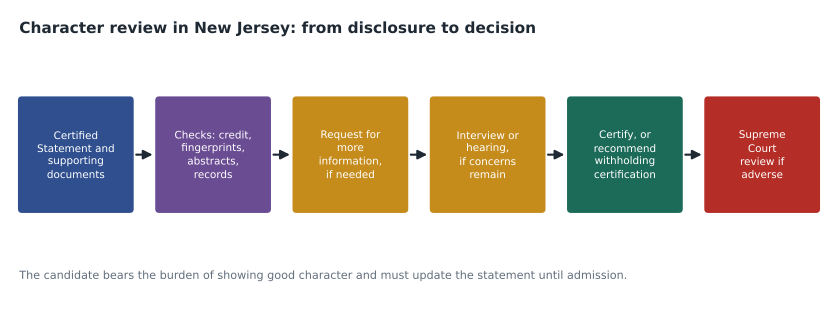
When the papers raise no question, the Committee certifies the candidate without further steps. When something needs explanation, the Committee's staff or a member may ask for more documents or a written statement. If concerns remain, the Committee may interview the candidate and, in more serious cases, hold a hearing before a panel. At the end of the process, the Committee either certifies the candidate or recommends that certification be withheld. A candidate who disagrees with an adverse recommendation may seek review by the Supreme Court, which makes the final decision on admission.
Common issues and how to handle them
Certain issues come up again and again. Financial problems, such as late payments, collections and student loan defaults, are common. The Committee looks at whether the candidate acted responsibly: contacting creditors, entering payment plans, keeping current since. Criminal matters, from underage drinking charges in college to more serious offenses, require full disclosure even if the matter was dismissed, diverted or expunged, unless the form's own instructions say otherwise. Academic discipline, especially for plagiarism or cheating, goes directly to honesty and requires a careful explanation. Prior applications to other bars, and any problems in those applications, must be disclosed.
Mental health and substance use questions have drawn national attention. Many jurisdictions, following the ABA's guidance, have narrowed or removed questions about diagnosis and treatment and focus instead on conduct. A candidate should answer exactly the question the current New Jersey statement asks, no more and no less, and should know that seeking treatment is generally viewed as responsible conduct rather than a mark against character.
Writing an explanation
A good explanation is short, factual and complete. It states what happened, when, what the candidate did about it, the current status and what the candidate has learned or changed. It attaches documents: a court disposition, a payment history, a letter from a creditor. It does not minimize, blame others or argue. Teresa's explanation of the late credit card took six sentences: the date her loan disbursement was delayed, the two missed payments, her call to the card issuer, the payment plan, the date the account was brought current and the fact that it has stayed current since. She attached the issuer's letter confirming the account was in good standing.
Worked problem
Disclosing a dismissed charge
Matteo, another candidate in Teresa's study group, was charged in 2021 with a disorderly persons offense after an argument outside a bar in Hoboken. The charge was dismissed in municipal court after he completed a short conditional dismissal program. He assumes he does not need to mention it. What should he do?
Show solution
- Read the exact question in the current Certified Statement. Character questionnaires typically ask about charges and arrests, not only convictions.
- If the question covers the charge, disclose it with the date, the court, the charge and the disposition.
- Attach the municipal court disposition record and a short explanation of what happened and what he has done since.
- Remember that the fingerprint check may reveal the arrest whether or not he discloses it.
Answer: Matteo should disclose the charge if the question reaches it. A dismissed disorderly persons charge, fully explained, is unlikely to prevent certification. An omitted one, discovered through the fingerprint check, becomes a candor problem.
The professional responsibility requirement
Every New Jersey candidate must satisfy a professional responsibility requirement, but New Jersey offers two ways to do it, which is unusual. The first is the familiar one: a scaled score of at least 75 on the Multistate Professional Responsibility Examination. NCBE's chart notes that New Jersey imposes no time limit on when the MPRE score must have been earned.
The second way is a law school course. A candidate may satisfy the requirement by completing an approved law school course in professional responsibility with a qualifying grade. Law school guidance describes the standard as a grade of C-minus or better in a course of at least one credit hour, with at least nine classroom hours, devoted entirely to legal ethics and professional responsibility. The law school verifies the course on Part II of the Law School Certificate. Candidates should confirm the exact standard in the Board's current instructions and make sure their course qualifies.
| Route | Requirement | How it is proved |
|---|---|---|
| MPRE | Scaled score of 75 or higher; no time limit in New Jersey | Score report transferred from NCBE to the Board |
| Law school course | Qualifying professional responsibility course with the minimum grade (law school guidance: C-minus, at least one credit, nine classroom hours, devoted entirely to ethics) | Part II of the Law School Certificate, completed by the school |
Why many candidates take the MPRE anyway
If a law school course satisfies New Jersey, why would a candidate take the MPRE? The answer is portability. Most other jurisdictions require an MPRE score and do not accept a law school course in its place, and their minimum scores vary. Pennsylvania, for example, requires a score of 75, and New York requires 85. A New Jersey lawyer who later seeks admission in another state, whether on a transferred UBE score or by motion, will almost certainly need an MPRE score. Taking it while the material is fresh, during or just after law school, is far easier than taking it years later.
Teresa is in the best position: her law school course grade satisfies New Jersey, and her August 2025 MPRE score of 97 satisfies Pennsylvania and New York. Marchetti suggested she file the proof the Board's acknowledgment packet requests and keep her NCBE score report on file for the Pennsylvania application.
The MPRE in brief
The MPRE is a two-hour, 60-question multiple-choice exam, of which 50 questions are scored, offered by NCBE several times a year. It tests the ABA Model Rules of Professional Conduct, the ABA Model Code of Judicial Conduct and generally accepted principles of law governing lawyers. It does not test New Jersey's own Rules of Professional Conduct, which differ from the Model Rules in several important ways covered in Lesson 10. A candidate who passes the MPRE has learned the national baseline; a New Jersey lawyer must still learn where New Jersey departs from it.
Common mistakes
MistakeOnly convictions need to be disclosed.
InsteadAnswer the exact question asked. Character questionnaires commonly reach charges, arrests and dismissed matters.
MistakeOnce the exam is passed, the Certified Statement no longer needs updating.
InsteadThe duty to update continues until admission; new charges, suits or judgments must be reported promptly.
MistakeNew Jersey requires an MPRE score of 85.
InsteadNew Jersey requires 75, or a qualifying law school professional responsibility course. New York is the jurisdiction that requires 85.
MistakeA New Jersey MPRE score expires after a few years.
InsteadNCBE's chart shows no time limit in New Jersey, though other jurisdictions may impose one.
MistakeThe Committee must prove a candidate lacks character.
InsteadThe candidate bears the burden of showing good character.
A character file checklist
Before filing, Marchetti asks each candidate to work through a short checklist. Does every address in the residence history connect to the next without gaps? Does every job, including summer and part-time work, appear with accurate dates and a supervisor's contact information? Has the candidate pulled a personal credit report and compared it with the financial answers? Has the candidate listed every traffic ticket, court matter, academic discipline and prior bar application the form asks about? Are explanations attached for every yes answer, labeled by section number, with supporting documents?
She also asks candidates to read the completed statement out loud, start to finish, a day after finishing it. Mistakes that slip past a tired reader at midnight are obvious in daylight. Teresa found two errors that way: a transposed year in her employment history and a former landlord's address that she had listed for the wrong apartment.
When something goes wrong after filing
Life does not pause during bar preparation. If a candidate receives a new traffic ticket, is named in a lawsuit, falls behind on a debt or faces any other new matter after filing, the right response is the same: amend the statement promptly and explain. A candidate who amends voluntarily shows exactly the candor the Committee is looking for. A candidate who waits and hopes the matter will not surface takes a much larger risk, because the Committee's checks often run again before certification.
Character after admission
The values the Committee tests do not stop at admission. A lawyer's duty of candor to courts, to clients and to the disciplinary system continues throughout a career, and New Jersey's disciplinary rules treat dishonesty severely, as Lesson 10 shows. Candidates who approach the Certified Statement as a first exercise in professional candor, rather than as a form to get through, are rehearsing a habit they will need every day in practice.
Teresa's speeding ticket took one line on the statement. Her credit card explanation took six sentences and one attached letter. By late November 2026, the Committee had asked her for nothing further. 'That is what a clean file looks like,' Marchetti said. 'Not a perfect history. A complete one.'
Summary and key terms
- The Committee on Character under Rule 1:25 certifies character; it is separate from the Board of Bar Examiners.
- The candidate bears the burden; candor and complete disclosure matter more than any single past problem.
- The Committee verifies the Certified Statement with credit reports, fingerprint checks, driver's abstracts and other records.
- The duty to update the statement continues until admission.
- The professional responsibility requirement is met by an MPRE score of 75 (no time limit) or a qualifying law school ethics course verified on the Law School Certificate.
- Taking the MPRE anyway preserves options in other jurisdictions such as Pennsylvania (75) and New York (85).
- 0
- Committee on Character
- 1
- Certified Statement of Candidate
- 2
- burden of proof
- 3
- duty to update
- 4
- MPRE
- 5
- professional responsibility requirement
- 6
- candor
Practice problems
Work each problem on paper first, then reveal the answer to check.
Who bears the burden in a New Jersey character review?
Show answer
The candidate, who must show good character.
Must a candidate report a new criminal charge after passing the exam but before admission?
Show answer
Yes. The duty to update the Certified Statement continues until admission.
Name the two ways to satisfy New Jersey's professional responsibility requirement.
Show answer
An MPRE scaled score of 75 or a qualifying law school professional responsibility course with the minimum grade.
Why take the MPRE if a law school course satisfies New Jersey?
Show answer
Other jurisdictions generally require an MPRE score, so it preserves portability for later admissions.
Lesson quiz · 5 questions
Score 60% or more to complete this lesson.
Create a free account to save your progress, take quizzes and earn a certificate.