
BAR-231 · Lesson 12 of 12 · 20 min
Capstone: New Jersey practice questions and an exam-day plan
▶ Video coming soon A video version of this lesson is on the way.
In mid-November 2026, about fourteen weeks before the exam, Marchetti sent Teresa two documents. The first was a twelve-week study calendar ending on Wednesday, February 24, 2027. The second was a practice file she had written herself, set entirely in New Jersey, with a note on top: 'This is not the bar exam. The bar exam will not ask you about New Jersey law. This is your first month at the firm. Do it once now, so that when you pass you are already a New Jersey lawyer, and then put it away and go back to the MBE.'
This capstone has two parts. The first part pulls together the New Jersey law from Lessons 7 through 11 in an original practice file with a full model answer, followed by short original practice questions. The second part is an exam-day plan for the February 2027 UBE: the last twelve weeks, the final week, and the two days of the exam. Both parts reflect the course's central message. Pass the UBE on general and federal law, and practice in New Jersey on New Jersey law.
Part one: the practice file
Read the facts as you would read an assignment from a supervising partner. Then work through the analysis in memo form, issue by issue, before reading the model answer.
The facts. On April 9, 2026, Eleni Petrakis, age 58, slipped on a wet ramp at the entrance to the Lawrence Township public library. A maintenance worker employed by the township had mopped the ramp ten minutes earlier and placed no warning sign. Eleni was looking at her phone. She fractured her hip and needed surgery and a partial hip replacement. Her medical expenses so far total 62,000 dollars, and her orthopedic surgeon has written that she has a permanent loss of range of motion and will walk with a cane, confirmed by imaging and objective testing. The library is operated by the township. The ramp had been redesigned in 2024 by a private engineering firm, Teague Design Group, which specified a smooth finish that, according to an expert Eleni's family consulted, does not meet accepted standards for slip resistance on outdoor ramps.
Eleni first consulted a lawyer in Princeton on May 1, 2026. That lawyer sent a notice of claim to the New Jersey Department of Treasury on June 20, 2026, but not to Lawrence Township. In September 2026, the lawyer withdrew, and Eleni came to Vellucci & Kaczmarek on November 2, 2026. She also owes the Princeton lawyer 2,400 dollars, and the lawyer has threatened to sue her for the fee. Eleni wants to know whether she still has a case against the township and the designer, what she might recover and what the firm would charge.
Model answer
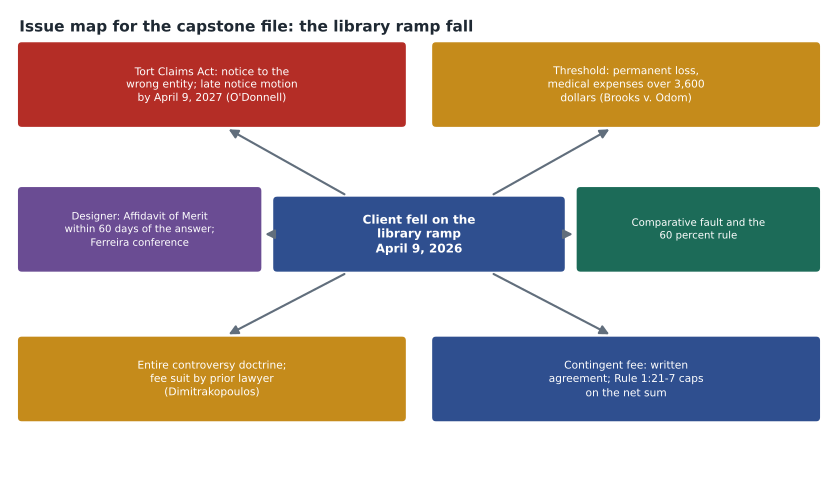
Issue 1: Is the claim against the township barred for lack of a timely notice of claim? The Tort Claims Act requires a notice of claim filed with the specific public entity within 90 days after accrual under N.J.S.A. 59:8-8. The claim accrued on April 9, 2026, so the 90-day deadline was July 8, 2026. The notice sent to the Department of Treasury on June 20 was timely in date but was not filed with Lawrence Township, the public entity responsible for the library. Filing with the wrong entity does not satisfy the statute.
Issue 2: Can Eleni obtain leave to file a late notice? Under N.J.S.A. 59:8-9, a court may permit a late notice on motion made within one year after accrual, that is, by April 9, 2027, if the claimant shows extraordinary circumstances and the public entity is not substantially prejudiced. In O'Donnell v. New Jersey Turnpike Authority (2019), the Supreme Court found extraordinary circumstances where counsel had timely served the wrong public entity, the claimant had pursued the claim diligently and in good faith and the correct entity suffered no prejudice. The Court emphasized that attorney error alone is not enough. Here, as in O'Donnell, a timely notice went to the wrong public body and Eleni acted promptly in seeking counsel. Unlike O'Donnell, there is no indication that another claimant gave the township notice of the same incident, so the township may argue prejudice and that this is simple attorney error. The firm should move immediately for leave to file a late notice, supported by a certification from Eleni about her diligence, the timing of her treatment and the prior lawyer's conduct, and by evidence that the township's records of the incident (any incident report, the maintenance log and video) remain available. Suit against the township must in any event be filed within two years of accrual, by April 9, 2028, and not until six months after the township receives the notice.
Issue 3: Does Eleni meet the pain and suffering threshold? Under N.J.S.A. 59:9-2(d), pain and suffering damages against the township require a permanent loss of a bodily function, permanent disfigurement or dismemberment, and medical treatment expenses over 3,600 dollars. Her expenses of 62,000 dollars easily exceed the monetary threshold. Under Brooks v. Odom (1997), the loss must be permanent and substantial, though not total, and proved by objective medical evidence. A partial hip replacement with an objectively documented permanent loss of range of motion requiring a cane is strong evidence of a substantial permanent loss. Even if the threshold were not met, she could recover economic damages.
Issue 4: What is the township's liability theory? The claim is for a dangerous condition of public property created by a public employee's mopping without warning. The Act's dangerous-condition provisions require, among other things, that the condition created a reasonably foreseeable risk of the kind of injury suffered and that the entity's action or inaction was palpably unreasonable; the firm should research and plead those elements carefully. The Act also bars punitive damages against the township.
Issue 5: What claim does Eleni have against Teague Design Group, and what must she do? A negligent design claim against a licensed engineering firm is a professional negligence claim subject to the Affidavit of Merit statute, N.J.S.A. 2A:53A-26 to -29. After Teague files its answer, the firm must serve an affidavit from an appropriately licensed engineer within 60 days, extendable once by up to 60 days for good cause. Failure is treated as failure to state a cause of action. The firm should line up the expert now and calendar a Ferreira conference within 90 days of the answer. The two-year limitations period for personal injury under N.J.S.A. 2A:14-2 runs to April 9, 2028, but there is no reason to wait.
Issue 6: How would fault be allocated, and what can she collect? Under the Comparative Negligence Act, Eleni recovers if her fault, for looking at her phone, is not greater than the combined fault of the defendants, that is, 50 percent or less, and her damages are reduced by her percentage. Under N.J.S.A. 2A:15-5.3, she can collect the full award, less her own share, from any defendant found 60 percent or more responsible, and only its share from a defendant below 60 percent. If the jury allocated 25 percent to Eleni, 55 percent to the township and 20 percent to Teague, neither defendant would reach 60 percent, and each would pay only its share. The township's share of pain and suffering also depends on meeting the threshold; Teague's does not.
Issue 7: Should one action include everything? The entire controversy doctrine and Rule 4:30A require Eleni to join in one action all claims arising from the same transaction or related facts. Her claims against the township and Teague arise from the same fall and should be brought together, and the complaint's Rule 4:5-1(b)(2) certification must disclose any related actions and potentially liable non-parties. Because the township claim cannot be filed until six months after a late notice is allowed and received, the firm may need to coordinate timing, but it should not file separate suits on the same fall. The potential dispute with the Princeton lawyer is separate. If that lawyer sues Eleni for the 2,400-dollar fee, Dimitrakopoulos v. Borrus (2019) teaches that a malpractice claim against the lawyer, based on the misdirected notice, may have to be raised as a counterclaim in the fee collection action, subject to the doctrine's accrual and fairness limits. The firm should advise Eleni about that risk promptly and consider referring the malpractice question to separate counsel.
Issue 8: What may the firm charge? A personal injury contingent fee is governed by RPC 1.5(c) and Rule 1:21-7. The agreement must be in writing, signed by the lawyer and client, with a duplicate to the client, and must state the percentages for settlement, trial and appeal and how costs are handled. The fee may not exceed 33 and one-third percent of the first 750,000 dollars of the net sum recovered, with lower percentages on higher bands, and the fee is computed after deducting disbursements but not medical liens. Because Eleni has not been a regular client, RPC 1.5(b) also requires the fee basis to be communicated in writing.
Short practice questions
Answer each in two or three sentences before reading the answer.
| Question | Answer |
|---|---|
| A plaintiff is 50 percent at fault. Does she recover under the Comparative Negligence Act? | Yes. Her negligence is not greater than the defendants' combined negligence, so she recovers half her damages. |
| A defendant is found 59 percent at fault and the co-defendant is insolvent. How much can the plaintiff collect from the solvent defendant? | Only its 59 percent share, because it is below the 60 percent threshold in N.J.S.A. 2A:15-5.3. |
| A will is typed, signed by the testator and witnessed by one person. Can it be probated? | Not as a formal will, but possibly under N.J.S.A. 3B:3-3 on clear and convincing evidence that the decedent intended it as a will. |
| A couple married 16 years divorces. What is the general limit on alimony duration? | For marriages under 20 years, total alimony generally may not exceed the length of the marriage, absent exceptional circumstances. |
| A lawyer uses 3,000 dollars of trust funds for rent and repays it a week later. What sanction is likely? | Disbarment under In re Wilson, because it is knowing misappropriation. |
| A lawyer learns a client will commit a fraud causing substantial financial loss to a buyer. Must the lawyer disclose? | Yes. RPC 1.6(b) requires disclosure to the proper authorities to prevent it. |
| A Pennsylvania lawyer has a 2024 UBE score of 268. Can she transfer it to New Jersey in 2026? | Yes, if it is no more than 36 months old when she applies and she meets the character and professional responsibility requirements. |
| A new lawyer admitted in 2026 has completed 10 general CLE credits. Has she met the new-admittee requirement? | Not necessarily. She needs 16 credits in at least six of twelve New Jersey subject areas, including one in trust accounting, within the period the Board sets. |
Part two: the exam-day plan
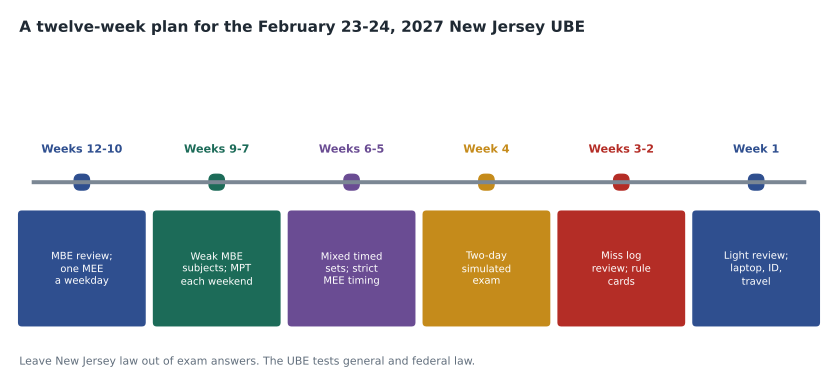
The rest of this lesson turns back to the exam itself. In the last twelve weeks, consistency matters more than intensity. Marchetti's plan for Teresa had six phases.
| Weeks before the exam | Focus |
|---|---|
| 12 to 10 | MBE subject review with daily timed sets; one MEE question each weekday; diagnostic MPT |
| 9 to 7 | Continue MBE sets in weak subjects; two MEE questions on most weekdays; one MPT each weekend |
| 6 to 5 | Mixed MBE sets of 50 or 100 questions; MEE answers under strict 30-minute timing; MPT time budget practice |
| 4 | Full simulated exam on two consecutive days; review and a miss log |
| 3 to 2 | Targeted review from the miss log; rule statement flashcards for MEE subjects |
| 1 | Light review, sleep, logistics, laptop and software check |
The miss log
The most useful study tool in the final weeks is a miss log: a running list of every MBE question missed and every MEE rule misstated, with the correct rule and the reason for the error. Patterns appear quickly. Teresa's log showed that most of her Real Property misses involved future interests and recording acts, and most of her Evidence misses involved hearsay exceptions for statements against interest and present sense impressions. She spent two weeks on those topics and her practice scores rose by six points.
Her log also revealed a New Jersey problem. Twice she had answered torts questions using New Jersey's 50 percent bar when the question stated no rule. She added a line to the top of her log in red: 'The exam is not in New Jersey.'
The final week
The final week is for rest and logistics, not new material. Confirm the exam location and the route, including parking and travel time in winter weather. Confirm the admission ticket, identification and permitted items under the Board's rules for the February 2027 administration. If using a laptop, confirm that the exam software is installed, registered and tested, and that the laptop is charged and updated, by the Board's deadline. Plan meals and sleep. Do a short set of MBE questions each day to stay sharp, and stop studying by the early evening before day one.
Day one: the MPT and the MEE
In the morning MPT session, budget each 90-minute task: about 15 minutes for the task memo and file, about 25 minutes for the library and outline, and about 50 minutes to write. Follow the supervising attorney's instructions exactly, use only the library's law, and write in the format requested. If one task runs long, move on at 90 minutes; an unfinished second task costs more than a slightly thinner first one.
In the afternoon MEE session, spend about 30 minutes on each question: five minutes to read the call and facts and outline, twenty-five to write. Lead with conclusions, state each rule accurately, apply it to the facts and answer the question asked. Leave New Jersey law at home. Use the break between sessions to eat and reset, not to discuss the morning's tasks.
Day two: the MBE
Each MBE session has 100 questions in three hours, or about 1.8 minutes per question. Check progress at the halfway point of each session: 50 questions at about 90 minutes. Answer every question, because there is no penalty for wrong answers. Read the call first, then the facts, and watch for jurisdictional instructions in the question. When unsure, eliminate wrong answers and choose; do not let one hard question cost three easy ones.
After the exam
After the exam, keep the Certified Statement current and respond to any Committee on Character inquiries. When results arrive, a passing candidate moves toward the oath and registration; a candidate who falls short should obtain the score report, identify the weakest components and plan a retake while the legacy UBE remains available in July 2027 or February 2028. Either way, the New Jersey law in this course will be waiting.
Marchetti ended her last session with the group with a reminder. 'You know how the exam is built and you know how New Jersey practice works,' she said. 'Keep them separate for two days in February. After that, bring them together for the rest of your career.'
Common mistakes
MistakeA notice of claim sent on time to the wrong public body satisfies the Tort Claims Act.
InsteadIt must be filed with the specific public entity; the remedy is a late notice motion within one year on extraordinary circumstances.
MistakeClaims against a public entity and a private designer from the same accident should be filed separately.
InsteadThe entire controversy doctrine favors joining them in one action, with the Rule 4:5-1(b)(2) certification.
MistakeStudying New Jersey law in the final weeks will raise a UBE score.
InsteadThe UBE tests general and federal law; New Jersey rules can cause wrong answers.
MistakeUnanswered MBE questions are safer than guesses.
InsteadThere is no penalty for wrong answers, so every question should be answered.
MistakeThe final week is the time to learn new subjects.
InsteadThe final week is for light review, rest and logistics.
Summary and key terms
- The practice file combines the Tort Claims Act notice and late notice rules (O'Donnell), the 59:9-2(d) threshold (Brooks v. Odom), the Affidavit of Merit, comparative fault and the 60 percent rule, the entire controversy doctrine (Dimitrakopoulos) and the contingent fee rules.
- Late notice motions must be made within one year of accrual; suit against a public entity must be filed within two years.
- A twelve-week plan builds from subject review to mixed timed sets and a full simulation, guided by a miss log.
- On day one, budget 90 minutes per MPT task and about 30 minutes per MEE question; on day two, about 1.8 minutes per MBE question.
- Keep New Jersey law out of UBE answers; use it in practice after admission.
- 0
- notice of claim
- 1
- late notice
- 2
- Affidavit of Merit
- 3
- entire controversy doctrine
- 4
- miss log
- 5
- time budget
- 6
- simulated exam
Practice problems
Work each problem on paper first, then reveal the answer to check.
By when must Eleni move for leave to file a late Tort Claims Act notice?
Show answer
Within one year after accrual, by April 9, 2027.
Does the Affidavit of Merit apply to her claim against the engineering firm?
Show answer
Yes. A negligent design claim against a licensed engineer requires an affidavit within 60 days after the answer, with one extension of up to 60 days.
How much time per MBE question should a candidate budget?
Show answer
About 1.8 minutes, or 50 questions in about 90 minutes.
What should a candidate do in the final week before the exam?
Show answer
Light review, rest and logistics: location, admission ticket, ID, permitted items and laptop software.
Lesson quiz · 5 questions
Score 60% or more to complete this lesson.
Create a free account to save your progress, take quizzes and earn a certificate.