
BAR-231 · Lesson 6 of 12 · 20 min
What the exam tests and how New Jersey law appears
▶ Video coming soon A video version of this lesson is on the way.
Halfway through an MBE set on torts, Teresa stopped and messaged Marchetti. 'Question 14 says the plaintiff was 55 percent at fault and asks what she recovers. Under New Jersey law she gets nothing, because she is more than 50 percent at fault. The answer key says she recovers 45 percent of her damages. Which is right?' Marchetti replied within a minute. 'Read the call of the question again. It says the jurisdiction has adopted pure comparative negligence. On the MBE, you answer under the rule the question gives you or, if it gives none, under the general rule NCBE tests. You will use the New Jersey rule at Joan's firm on Monday morning. You do not use it on the exam.'
New Jersey has no jurisdiction-specific component. There are no New Jersey essays, no New Jersey multiple-choice section and no required New Jersey law course before admission. That is a major difference from states such as Mississippi, Texas or Virginia, where candidates must study local law in depth for the exam. It does not mean New Jersey law is irrelevant. It means candidates must keep two bodies of law in their heads and know when to use each: the general law tested on the UBE and the New Jersey law they will use in practice. This lesson explains how to manage that split.
What the UBE tests
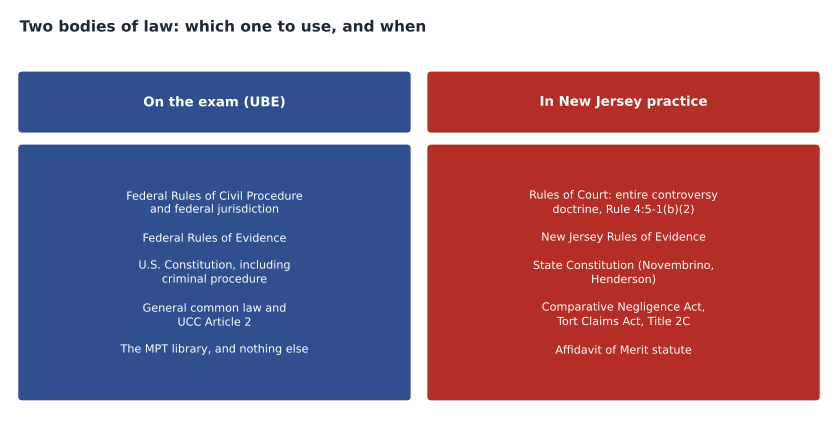
The MBE and MEE test generally accepted principles of law, as described in NCBE's subject matter outlines. For civil procedure and evidence, the tested law is federal: the Federal Rules of Civil Procedure, the federal jurisdiction statutes and the Federal Rules of Evidence. For constitutional law, it is the United States Constitution as interpreted by the Supreme Court of the United States. For contracts, torts, criminal law and real property, it is the majority or generally accepted common law and, for sales, Article 2 of the Uniform Commercial Code. Where the law varies across states and NCBE wants to test a particular approach, the question will usually say so, as Teresa's question did.
The MPT tests no memorized law at all. The law is in the library, and it may be from the fictional jurisdiction NCBE uses for many tasks. A candidate who brings New Jersey law into an MPT answer, or general law that contradicts the library, loses points. The MPT rewards using exactly what the library provides.
Where New Jersey law differs from what the exam tests
Most of the time, New Jersey law and the general law tested on the UBE are close. In some important areas they differ, and those are the traps. Knowing them helps in two ways. It prevents a candidate from importing New Jersey rules into exam answers, and it gives the candidate a head start on what matters in New Jersey practice.
| Area | What the exam generally tests | New Jersey practice |
|---|---|---|
| Comparative negligence | Whatever rule the question states; otherwise general principles | Modified comparative negligence: a plaintiff more than 50 percent at fault recovers nothing (N.J.S.A. 2A:15-5.1) |
| Joint and several liability | General principles or the rule stated | Full recovery only from a defendant 60 percent or more at fault (N.J.S.A. 2A:15-5.3) |
| Claim preclusion and joinder | Federal transactional claim preclusion and the Federal Rules | The entire controversy doctrine (Rule 4:30A) and the Rule 4:5-1(b)(2) certification |
| Professional negligence suits | General negligence principles | The Affidavit of Merit statute, N.J.S.A. 2A:53A-26 to -29 |
| Claims against public entities | Federal and general sovereign immunity concepts | The New Jersey Tort Claims Act, Title 59, with its notice and threshold rules |
| Criminal offense grading | Common law and Model Penal Code concepts, felonies and misdemeanors | Crimes of the first to fourth degree and disorderly persons offenses (N.J.S.A. 2C:1-4) |
| Search and seizure | Fourth Amendment as interpreted by the Supreme Court of the United States | Article I, paragraph 7 of the New Jersey Constitution, sometimes more protective |
| Evidence | Federal Rules of Evidence | New Jersey Rules of Evidence, similar in structure but with differences |
Torts: a common trap
Torts is where New Jersey law most often tempts candidates. New Jersey's Comparative Negligence Act bars a plaintiff whose negligence is greater than the combined negligence of the defendants, which the model jury charge expresses as recovery only if the plaintiff's share is 50 percent or less. New Jersey also limits joint and several liability: a plaintiff may recover the full amount of damages only from a defendant found 60 percent or more responsible, and recovers from any other defendant only that defendant's share. Neither rule is the default on the MBE. MBE questions that turn on comparative fault normally state the rule, and if they do not, the candidate should apply the general approach the question appears to test rather than New Jersey's thresholds.
Lesson 8 covers the New Jersey rules in depth because they matter in practice. For exam purposes, the takeaway is to read every torts question for an instruction about the jurisdiction's rule and follow it.
Civil procedure: federal on the exam, New Jersey in practice
Civil procedure on the MBE and MEE means federal procedure. Candidates answer personal jurisdiction, subject matter jurisdiction, venue, pleading, joinder, discovery, summary judgment and preclusion questions under federal law. In New Jersey state court practice, the Rules of Court govern, and they include features with no federal equivalent, especially the entire controversy doctrine, which requires a party to bring all claims arising from a single controversy in one action, and the certification in the first pleading under Rule 4:5-1(b)(2) disclosing other related actions and parties. A candidate who writes an MEE answer about claim preclusion using the entire controversy doctrine instead of federal transactional preclusion will misstate the tested rule, even though the two often reach similar results.
Criminal law and procedure
The MBE tests criminal law using common law concepts and, where questions say so, the Model Penal Code. New Jersey's Code of Criminal Justice, Title 2C, is based substantially on the Model Penal Code, so the two are often consistent, but its vocabulary differs. New Jersey grades crimes as first, second, third or fourth degree. Disorderly persons offenses and petty disorderly persons offenses are not crimes under the New Jersey Constitution; they carry no right to indictment or jury trial, and a conviction does not carry the disabilities of a criminal conviction. Terms like felony and misdemeanor, which appear in many MBE questions, are not the working vocabulary of New Jersey criminal practice.
Criminal procedure on the exam is constitutional criminal procedure under the federal Constitution. The Supreme Court of New Jersey has interpreted the State Constitution to give broader protection in some areas. It declined to adopt the federal good-faith exception to the exclusionary rule in State v. Novembrino (1987). In State v. Henderson (2011), after a special master reviewed the scientific research, it revised the test for admitting eyewitness identifications and required enhanced jury instructions about factors that affect reliability. Those are important New Jersey cases, but they are not the rules the MBE tests. On the exam, apply federal constitutional law.
Evidence
The MBE and MEE test the Federal Rules of Evidence. New Jersey has its own Rules of Evidence, organized much like the federal rules, with differences in areas such as some hearsay exceptions and rules on character evidence and privileges. For the exam, learn the federal rules. In practice, check the New Jersey rule before relying on federal law in a state court.
Real property, family law and estates
Real property on the exam is general common law plus recording acts and the topics in NCBE's outline. New Jersey has local practices that matter in practice but not on the exam, such as the attorney review period for residential real estate contracts. Under the real estate regulations, a contract for the sale of residential property with one to four dwelling units prepared by a real estate licensee must contain an attorney review clause: either party's attorney may disapprove the contract within three business days after delivery of the signed contract, and the contract becomes binding only if no attorney disapproves within that period. That practice grew out of the 1983 settlement between the State Bar Association and the realtors' association approved by the Supreme Court in New Jersey State Bar Association v. New Jersey Association of Realtor Boards.
Family law and trusts and estates are no longer MEE subjects. A New Jersey candidate does not need to memorize New Jersey's divorce grounds or will execution statute for the exam. Those subjects may still appear on an MPT, with the law provided. They matter a great deal in practice, which is why Lesson 9 covers them.
How New Jersey law reaches new lawyers
If New Jersey law is not on the exam, how does New Jersey make sure new lawyers know it? The main answer is the new-admittee CLE requirement. During the first full compliance period after admission, a newly admitted lawyer with a plenary license must complete 16 credits in at least six of twelve New Jersey-specific subject areas, such as trial preparation, family law, estate administration and labor and employment law, including at least one credit in New Jersey attorney trust and business accounting. Those courses, offered by approved providers, teach the New Jersey practice rules the UBE does not cover. Lesson 11 covers the requirement in detail.
The other answer is supervision and practice. Most new lawyers learn New Jersey procedure from the lawyers they work with and the courts they appear in. Joan Vellucci has her own method: every new clerk drafts a complaint, a Tort Claims Act notice, a set of interrogatories and a contingent fee agreement in the first month, and she marks them up in red ink.
Worked problem
Choosing the right rule on an MEE question
An MEE question describes a negligence suit in federal court. After judgment, the plaintiff sues the same defendant in a new action on a related contract claim arising from the same events. The call asks whether the second action is barred. Teresa knows that New Jersey's entire controversy doctrine would likely bar the second action in state court. How should she answer?
Show solution
- Identify the tested subject: civil procedure, claim preclusion.
- Apply the generally accepted rule: in federal court, claim preclusion applies when there is a final judgment on the merits, the same parties or their privies, and the same claim, defined transactionally under the modern approach.
- Apply it: the contract claim arises from the same transaction or series of connected transactions and could have been joined, so it is likely precluded.
- Do not cite the entire controversy doctrine or Rule 4:30A; they are New Jersey state rules, not the tested federal rule.
Answer: Teresa should answer under federal transactional claim preclusion. She may reach the same result New Jersey would, but she must reach it through the tested rule.
A habit for the exam: read for instructions
The simplest discipline is to read every question for jurisdictional instructions. MBE questions often specify the rule: the jurisdiction has a race-notice recording act, the jurisdiction follows pure comparative negligence, the jurisdiction has adopted the Model Penal Code. When the question gives the rule, apply it even if it differs from New Jersey or from the majority. When it gives no rule, apply the general principle NCBE tests. Never assume the exam is set in New Jersey.
Marchetti suggested Teresa keep a short list of New Jersey traps taped to her monitor: comparative negligence thresholds, the 60 percent rule, the entire controversy doctrine, Title 2C grading and the State Constitution's broader search protections. 'Each time you feel the pull of one of these on a practice question,' she said, 'tap the list and remind yourself which exam you are taking.'
Common mistakes
MistakeNew Jersey law is tested somewhere on the New Jersey exam.
InsteadNew Jersey has no jurisdiction-specific component. The UBE tests general and federal law.
MistakeOn a torts question, apply New Jersey's 50 percent bar.
InsteadApply the rule the question states, or the general principle tested, not New Jersey's statute.
MistakeThe entire controversy doctrine is the claim preclusion rule tested on the MEE.
InsteadThe MEE tests federal transactional claim preclusion; the doctrine is a New Jersey state rule.
MistakeNew Jersey crimes are felonies and misdemeanors.
InsteadNew Jersey grades crimes by degree (first to fourth) and has disorderly persons offenses that are not crimes.
MistakeBecause family law left the MEE, it cannot appear on the exam.
InsteadIt can appear on the MPT with the law supplied in the library.
A drill for spotting New Jersey traps
Marchetti gives her New Jersey candidates a short drill. She mixes ten MBE-style questions with three New Jersey practice questions and asks the candidate to label each one before answering: exam rule or New Jersey rule. The exercise sounds trivial, but it builds the habit of checking which body of law applies before analyzing. Candidates who work in New Jersey law offices during preparation, as Teresa does, find the drill especially useful, because they spend their days applying New Jersey rules and their evenings answering questions that require general ones.
Teresa's first attempt produced two mistakes. She applied New Jersey's 60 percent joint and several liability rule to an MBE question that called for general principles, and she cited the New Jersey Rules of Evidence in an MEE answer on hearsay. After a week of the drill, she stopped making either mistake. 'It is like switching languages,' she told Marchetti. 'Once you notice which one you are speaking, you stop mixing them.'
Summary and key terms
- New Jersey has no jurisdiction-specific exam component; the UBE tests general and federal law.
- Civil procedure and evidence on the exam are federal; constitutional criminal procedure is federal.
- New Jersey practice differs in comparative negligence (50 percent bar), joint and several liability (60 percent), the entire controversy doctrine, the Affidavit of Merit, the Tort Claims Act and Title 2C grading.
- The State Constitution can be more protective, as in Novembrino (no good-faith exception) and Henderson (eyewitness identification).
- Family law and estates may appear on the MPT with the law supplied.
- New Jersey law reaches new lawyers through the 16-credit new-admittee CLE requirement and supervised practice.
- 0
- jurisdiction-specific component
- 1
- generally accepted principles
- 2
- entire controversy doctrine
- 3
- disorderly persons offense
- 4
- attorney review clause
- 5
- new-admittee CLE requirement
Practice problems
Work each problem on paper first, then reveal the answer to check.
Does New Jersey test New Jersey law on its bar exam?
Show answer
No. It gives the UBE with no jurisdiction-specific component.
On an MBE question with no stated comparative negligence rule, should you apply New Jersey's 50 percent bar?
Show answer
No. Apply the general principle the question tests.
How does New Jersey grade crimes?
Show answer
As crimes of the first, second, third or fourth degree; disorderly persons offenses are not crimes.
How does New Jersey ensure new lawyers learn local practice?
Show answer
Through the new-admittee CLE requirement of 16 credits in New Jersey-specific subjects, including trust accounting.
Lesson quiz · 5 questions
Score 60% or more to complete this lesson.
Create a free account to save your progress, take quizzes and earn a certificate.