
BAR-231 · Lesson 4 of 12 · 20 min
The New Jersey bar exam: UBE format, scoring and the 266 passing score
▶ Video coming soon A video version of this lesson is on the way.
Teresa's first practice MPT went badly. She spent forty minutes reading the library, another thirty outlining, and finished the memo with three paragraphs missing. 'I know the law,' she told Marchetti. 'I just ran out of time.' Marchetti was not worried. 'That is the most common first MPT in the world,' she said. 'The exam rewards people who understand its structure and budget their time. Today we take the structure apart: what happens each day, how each piece is graded, how the pieces are combined and what 266 really means.'
New Jersey has given the Uniform Bar Examination since February 2017, after the Supreme Court adopted it in 2016. The UBE is prepared by NCBE and is the same exam in every UBE jurisdiction. Each jurisdiction grades its own written answers under NCBE's grading process and sets its own passing score. New Jersey's is 266 on the 400-point UBE scale. This lesson walks through the format, the subjects, the scoring and how candidates should use that knowledge to plan their preparation.
The two days
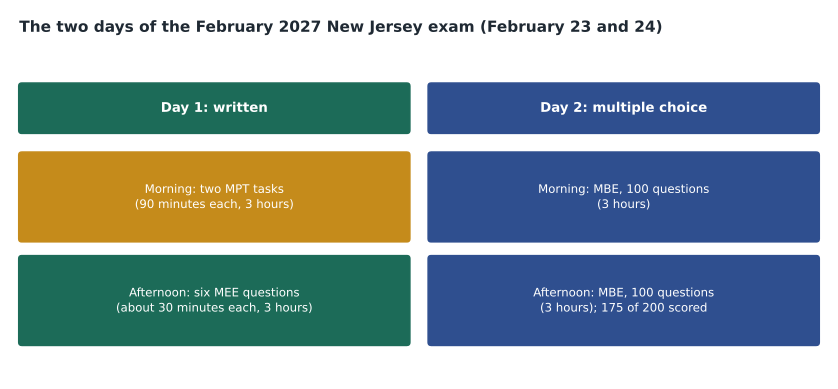
The February 2027 exam falls on Tuesday and Wednesday, February 23 and 24, 2027, the national UBE dates. Day one is the written day. The morning session is the Multistate Performance Test: two 90-minute tasks, for three hours in total. The afternoon session is the Multistate Essay Examination: six questions, with about 30 minutes suggested for each, for three hours in total. Day two is the Multistate Bar Examination: 200 multiple-choice questions, 100 in a three-hour morning session and 100 in a three-hour afternoon session.
| Session | Component | Content | Time |
|---|---|---|---|
| Day 1 morning | MPT | Two performance tasks with a file and a library | Three hours (90 minutes each suggested) |
| Day 1 afternoon | MEE | Six essay questions | Three hours (about 30 minutes each) |
| Day 2 morning | MBE | 100 multiple-choice questions | Three hours |
| Day 2 afternoon | MBE | 100 multiple-choice questions | Three hours |
The Multistate Bar Examination
The MBE has 200 questions, but only 175 count. The other 25 are unscored pretest questions that NCBE is trying out for future exams, mixed in so candidates cannot tell them apart. The scored questions cover seven subjects: Civil Procedure, Constitutional Law, Contracts (including sales under Article 2 of the Uniform Commercial Code), Criminal Law and Procedure, Evidence, Real Property and Torts. NCBE publishes a subject matter outline for each subject, and those outlines define what can be tested.
The MBE tests generally accepted principles of law, not New Jersey law. Civil Procedure questions are based on the Federal Rules of Civil Procedure and federal jurisdiction statutes, and Evidence questions on the Federal Rules of Evidence. A candidate who answers an MBE question using New Jersey's entire controversy doctrine or New Jersey's comparative negligence statute instead of the general rule the question tests will get it wrong. That is one of the main messages of Lesson 6.
Raw MBE scores are converted to a scaled score through a statistical process called equating, which adjusts for small differences in difficulty between exams. Equating means a scaled MBE score represents the same level of performance on any administration. A candidate does not need a particular number of correct answers; what matters is the scaled score.
The Multistate Essay Examination
The MEE has six questions, each built around a fact pattern that may raise issues from more than one subject. Beginning with the July 2026 exam, NCBE narrowed the MEE subject list by removing Conflict of Laws, Family Law, Trusts and Estates and Secured Transactions. For February 2027, MEE questions may therefore come from Business Associations (agency and partnership, corporations and limited liability companies), Civil Procedure, Constitutional Law, Contracts and Sales, Criminal Law and Procedure, Evidence, Real Property and Torts.
The removed subjects can still appear in an MPT file, where the law is supplied in the library. A candidate does not need to memorize New Jersey's divorce statute for the MEE, but should not be surprised to see a family law or estates problem on the MPT with the relevant rules provided.
MEE answers are graded on a relative scale within each jurisdiction. Graders, trained with NCBE's materials, compare answers to each other and to model analyses and assign grades that reflect how the answer ranks among all answers to that question. A strong answer identifies the issues, states the rules accurately, applies them to the facts and reaches a conclusion. Organization and clarity matter because graders read many answers quickly.
The Multistate Performance Test
Each MPT task gives the candidate a file (the facts: memos, letters, transcripts, documents) and a library (the law: cases, statutes, rules). The candidate must complete a lawyering task, such as an objective memo, a persuasive brief, a client letter, a contract provision or a discovery plan, using only the materials provided. The law in the library may be from a fictional jurisdiction. The MPT does not test memorized law; it tests whether a candidate can read, organize and apply legal materials under time pressure and follow the supervising attorney's instructions.
Time management is everything on the MPT. Marchetti teaches a simple budget: about 15 minutes reading the task memo and file, about 25 minutes reading the library and building an outline, and about 50 minutes writing. Teresa's first practice failed because she spent too long reading. On her third practice, using the budget, she finished with four minutes to spare.
How the pieces are combined
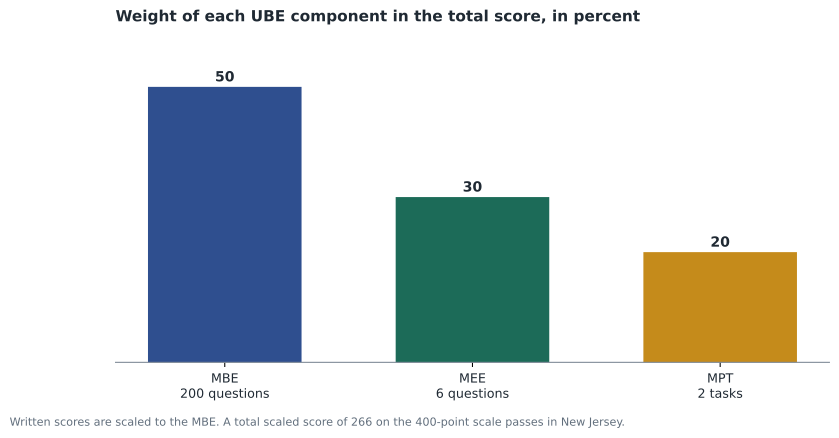
The UBE total score combines the three components with fixed weights: the MBE counts for 50 percent, the MEE for 30 percent and the MPT for 20 percent. Because the written components are graded on a relative scale, their raw scores are converted, or scaled, to the MBE score scale. That makes the written scores comparable from one administration to the next. The scaled MBE score and the scaled written score are then combined to produce a total on a scale that runs up to 400.
What 266 means
New Jersey's passing score is 266 on the 400-point scale. That is the same as an average of 133 on the 200-point scale some jurisdictions use. UBE jurisdictions set their own passing scores, and they differ: some require 260, others 270 or more. A score of 266 in New Jersey is a pass; the same 266 transferred to a jurisdiction with a higher minimum would not qualify there.
Because the components are combined, a candidate can pass with a weaker MBE score if the written score is strong, or with a weaker written score if the MBE is strong. There is no separate minimum for any component. A candidate who scores 140 on the MBE and the equivalent of 126 on the written portion, scaled to the MBE, would have a total of about 266 under a simple equal-weighting illustration. The exact computation follows the 50/30/20 weights, but the lesson is the same: every point counts, and no component can be written off.
Worked problem
Working out where a candidate needs to improve
On a full-length practice exam, Teresa's estimated scaled MBE score was 128 and her estimated written score, scaled to the MBE, was 140. Using the simplified approach that doubles the weighted average of the two components to reach the 400-point scale, is she on track for 266, and where should she focus?
Show solution
- The MBE counts for 50 percent and the written components together for 50 percent (30 for the MEE and 20 for the MPT).
- Weighted average on the 200-point scale: 0.5 times 128 plus 0.5 times 140 equals 134.
- On the 400-point scale: 134 times 2 equals 268, just above 266.
- The margin is thin. Her MBE is the weaker component, and the MBE is the half of the exam most responsive to drilling, so she should add timed MBE sets in her weakest subjects.
Answer: Teresa is narrowly on track at about 268. Raising her MBE by four or five scaled points would give her a much safer margin.
Scaling and why practice scores are estimates
Commercial courses and NCBE's practice materials give estimated scores, but those are only estimates. The real scaled score depends on equating and on how a candidate's written answers rank against everyone else's answers on the same day. A candidate who consistently scores in the low 270s on full practice exams is in a reasonable position; one who hovers around 262 needs to improve. Marchetti tells candidates to aim for a practice margin of at least ten points above the passing score.
Exam-day rules
The Board publishes rules for each administration covering admission tickets, identification, permitted items, laptop use and conduct. Candidates who use laptops must register their computers and install the required exam software by the Board's deadline, and a laptop fee may apply. Candidates who handwrite answers must follow the Board's instructions for answer booklets. The rules are strict: bringing a prohibited item, such as a phone, into the testing room can lead to disqualification. Read the rules for the specific administration, not last year's version.
Results and the score report
After results are released, candidates receive their scores. Passing candidates then await character certification and admission. Failing candidates receive a score report showing their component scores, which is the starting point for a retake plan. A candidate who plans to transfer a UBE score should request the transfer through NCBE's score services, following the receiving jurisdiction's rules.
Using the format to plan study
Knowing the format shapes how to study. The MBE is half the score and rewards repeated timed practice with real-style questions and careful review of errors. The MEE rewards rule statements that are precise and an answer structure that graders can follow quickly. The MPT rewards a disciplined time budget and practice with several task types. A sensible plan spends roughly half of study time on MBE subjects and practice, a third on MEE practice and the rest on MPT tasks, adjusted for the candidate's strengths.
Teresa built her plan that way: MBE drills every weekday morning before work, one MEE question each weekday evening, and two MPTs each weekend. 'It looks boring on paper,' she said. 'It is supposed to,' Marchetti answered. 'Boring and consistent passes this exam.'
Common mistakes
MistakeThe MEE tests New Jersey law.
InsteadThe MEE tests generally accepted principles. New Jersey writes no questions of its own.
MistakeFamily law and trusts and estates are still MEE subjects.
InsteadNCBE removed them, along with conflict of laws and secured transactions, from the MEE beginning in July 2026. They may appear on the MPT with the law supplied.
MistakeAll 200 MBE questions are scored.
Instead175 are scored; 25 are unscored pretest questions.
MistakeEach component has its own minimum score.
InsteadThere is no component minimum; only the total score of 266 matters.
MistakeA 266 passes in every UBE jurisdiction.
InsteadEach UBE jurisdiction sets its own passing score, from 260 upward, so a 266 may fall short elsewhere.
Writing MEE answers that score
Because MEE answers are graded on a relative scale, small improvements in structure can move a candidate up several places in the ranking. Marchetti teaches a simple pattern for each issue: a short heading that names the issue, a one-sentence conclusion, the rule stated precisely, the application to the specific facts and a closing sentence that answers the question asked. Graders reading quickly can find every element. A candidate who writes a long narrative without headings forces the grader to search for the analysis, and some of it may not be found.
Rule statements deserve special practice. A rule stated with the right elements, in the right order, earns credit even when the application is brief. Teresa kept a deck of rule statement cards for the MEE subjects, including business associations, which many candidates neglect because it is not on the MBE. She reviewed twenty cards every morning on the train to Trenton.
The MPT as a writing test
The MPT rewards a different kind of writing. Graders look for a document that follows the task memo: the right format, the right audience, the right tone and the right use of authorities from the library. An objective memo should weigh both sides and predict an outcome. A persuasive brief should argue for the client, with headings that state conclusions. A client letter should explain the law in plain language. Teresa's early practice tasks lost points because she wrote every task as an objective memo. Once she began reading the task memo twice and copying its instructions into her outline, her scores improved.
Retakers and score reports
A candidate who does not pass receives a score report showing the scaled MBE score and the written scores. That report is the most valuable document in planning a retake. A candidate whose MBE score was strong but whose written score was weak should change the balance of preparation toward writing practice, and the reverse. A candidate who missed by a few points should not start over from the beginning; the report usually shows exactly where the points were lost. Because the legacy UBE ends in New Jersey after February 2028, a candidate who sits in February 2027 and does not pass should plan a retake in July 2027, as Lesson 5 explains.
Keeping score in practice
Throughout preparation, Teresa logged every practice score in one table: MBE sets by subject, MEE questions by subject with a self-assessed grade against the model analysis, and MPT tasks by type. Every two weeks she and Marchetti looked at the trend rather than any single result. A falling score in one subject prompted a week of review; a flat score after many sets prompted a change of method, such as writing out rule statements instead of rereading them.
Summary and key terms
- New Jersey has given the UBE since February 2017; February 2027 is on February 23 and 24.
- Day one: two 90-minute MPT tasks and six MEE questions. Day two: the 200-question MBE, with 175 scored.
- From July 2026 the MEE no longer covers conflict of laws, family law, trusts and estates or secured transactions.
- Weights: MBE 50 percent, MEE 30 percent, MPT 20 percent; written scores are scaled to the MBE.
- New Jersey's passing score is 266 on the 400-point scale, with no component minimums.
- Practice scores are estimates; aim for a margin of about ten points above 266.
- 0
- Uniform Bar Examination
- 1
- MBE
- 2
- MEE
- 3
- MPT
- 4
- equating
- 5
- scaling
- 6
- pretest questions
- 7
- passing score
Practice problems
Work each problem on paper first, then reveal the answer to check.
What are the weights of the three UBE components?
Show answer
MBE 50 percent, MEE 30 percent and MPT 20 percent.
How many MBE questions are scored?
Show answer
175 of the 200; the other 25 are unscored pretest questions.
What is New Jersey's UBE passing score?
Show answer
266 on the 400-point scale.
Which subjects left the MEE in July 2026?
Show answer
Conflict of laws, family law, trusts and estates and secured transactions.
Lesson quiz · 5 questions
Score 60% or more to complete this lesson.
Create a free account to save your progress, take quizzes and earn a certificate.