
BAR-232 · Lesson 1 of 12 · 22 min
Becoming a lawyer in New Mexico
▶ Video coming soon A video version of this lesson is on the way.
Paloma Archuleta grew up in Española, in Rio Arriba County, where her grandmother still irrigates a strip of chile and corn from an acequia that the neighbors clean together every spring. She finished law school in May 2026. That June she started work as a law clerk at Benally & Trujillo, a three-lawyer firm in Gallup, in McKinley County, a little more than two hours west of Albuquerque on Interstate 40. The firm's clients come from Gallup itself, from the ranches and small towns along the highway, and from the Navajo Nation and the Pueblo of Zuni, both of which border the county. In a single week Paloma might draft a divorce petition that turns on community property, calculate the notice deadline for a claim against the county and help the senior partner, Delores Benally, prepare to register a Navajo Nation court judgment in state district court.
In October 2026 Paloma filed her application for the February 2027 New Mexico bar examination and joined Hollis Marchetti's online study group. At their first one-on-one session she explained what was worrying her. 'Everyone tells me New Mexico is a UBE state, so the exam is the same as everywhere else,' she said. 'But Ms. Benally says I also have to take a course on Indian law and community property before I can be licensed, my classmates keep talking about NextGen, and I read in August that the Supreme Court approved some kind of pathway that skips the exam. I need to know exactly what I am sitting for in February and what else stands between me and a license.'
Marchetti had the answer ready. 'New Mexico gives the Uniform Bar Examination, and February 2027 is its last legacy UBE. You need a scaled score of 260. You also need an MPRE score of 80, a character and fitness clearance from the Board of Bar Examiners, and proof that you attended a course on Indian law, New Mexico community property law and professionalism. Starting in July 2027 New Mexico switches to the NextGen exam with a passing score of 610, and the skills-based pathway is approved but not yet open. This course keeps all of those tracks in view, then spends real time on the New Mexico law you will meet in Gallup, in the course and in your first year of practice.'
This lesson maps the whole process: who controls admission in New Mexico, the bodies that do the work, the routes into practice and the usual order of events for a first-time candidate. Later lessons take each step in detail.
The Supreme Court of New Mexico controls admission
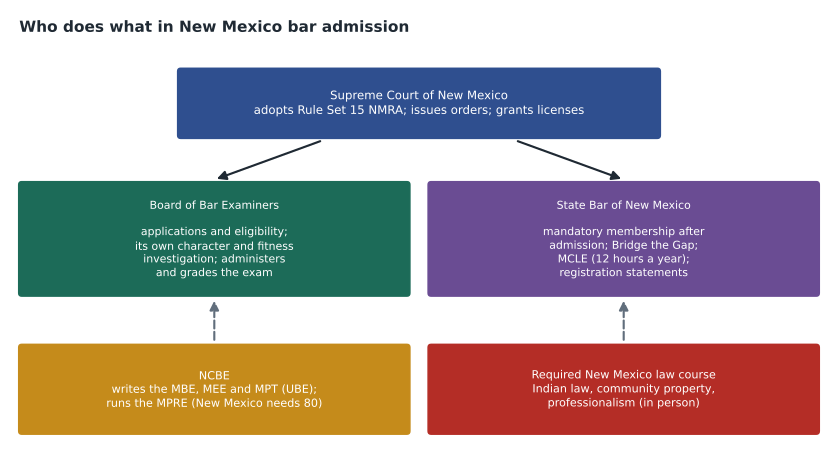
Admission to practice law in New Mexico is a judicial function. The Supreme Court of New Mexico adopts the Rules Governing Admission to the Bar, which appear as Rule Set 15 of the New Mexico Rules Annotated, usually cited as NMRA. The Court alone grants licenses. Every step a candidate takes, from the first application to the oath, happens under those rules and under the Court's orders. When the Court changes the exam, it acts by order: on June 15, 2026, in an administrative order signed by Chief Justice Julie J. Vargas and the other four justices, it directed that the NextGen exam be given beginning with the July 2027 examination and set its passing score at 610.
That structure matters in practice. A candidate who needs a ruling on eligibility, an extension or a review of a character and fitness decision deals first with the Board of Bar Examiners and, if the matter goes further, with the Supreme Court. Bar review summaries, classmates' advice and the memories of lawyers who were admitted twenty years ago are useful background, but only the current rules, the Court's orders and the Board's instructions are authority. Paloma keeps a folder with the current Rule Set 15, the Board's instructions for the February 2027 exam and every email the Board sends her.
The Board of Bar Examiners
The New Mexico Board of Bar Examiners administers admission for the Court. Its office is on Louisiana Boulevard NE in Albuquerque, and its website, nmexam.org, posts forms, deadlines, exam information and results. The Board does three main jobs. It processes applications and decides whether each applicant meets the qualifications in the rules. It runs the character and fitness investigation and decides, subject to review by the Supreme Court, whether the applicant has shown good moral character and fitness. And it administers and grades the bar examination, which in New Mexico is built entirely from National Conference of Bar Examiners materials.
One detail sets New Mexico apart from many UBE states. NCBE hosts the online application form, but New Mexico does not use NCBE's character and fitness investigation service. The Board conducts its own investigation, and its own instructions control what an applicant files and when. Candidates who have read about another state's process should not assume that New Mexico works the same way.
The State Bar of New Mexico after admission
The State Bar of New Mexico is the integrated, mandatory bar. A candidate has little to do with it before admission, but every lawyer licensed in New Mexico becomes a member and pays annual dues. The State Bar administers the Bridge the Gap mentorship program that most new lawyers must complete in their first full year, and it runs the minimum continuing legal education program under the Supreme Court's rules: twelve hours a year, including two hours of ethics and professionalism and one hour of equity in justice. Lawyer discipline is handled for the Court by the Disciplinary Board. Lesson 11 returns to these duties.
NCBE's part
The National Conference of Bar Examiners writes every component of the current New Mexico exam: the Multistate Bar Examination, the Multistate Essay Examination and the Multistate Performance Test, which together make up the Uniform Bar Examination. NCBE also writes the Multistate Professional Responsibility Examination, on which New Mexico requires a scaled score of 80. New Mexico does not use a jurisdiction-drafted exam. That means no New Mexico essays appear on the bar exam itself. New Mexico law enters the process through the separate required course, through the character and fitness standards and, after admission, through practice.
NCBE does not decide who is admitted. New Mexico decides the passing score, whether to accept scores from other states and what extra requirements to impose. NCBE's jurisdiction page for New Mexico is a convenient summary and, as of its October 2026 update, matches the Court's June 2026 order, but when NCBE and the Board differ, the Board controls.
Routes into practice
There are four ways a lawyer can begin practicing in New Mexico. The first is admission by examination, the route for every new graduate. The second is admission by transferred UBE score, for someone who earned a passing UBE score elsewhere within the last sixty months. The third is admission on motion, for lawyers who have actively practiced for five of the last seven years and are admitted in a jurisdiction that grants New Mexico lawyers the same courtesy. The fourth is limited appearance in a single case, called pro hac vice admission, which requires association with a New Mexico lawyer. A fifth route, the skills-based pathway approved in August 2026, will let graduates qualify through supervised practice and a portfolio, but the Court has said it will set the start date by a further order and expects applications to open around the middle of 2027. Lesson 5 covers that pathway, and lesson 11 covers transfer and motion admission.
| Step | What it involves | Who handles it |
|---|---|---|
| Education | J.D. from an ABA-approved law school (narrow exception for experienced lawyers from other law schools) | Board checks the transcript |
| Exam application | November 1 for February, May 1 for July; a later final deadline at a higher fee | Board of Bar Examiners |
| Character and fitness | Board investigation: credit report, fingerprints, three attorney statements, records | Board of Bar Examiners |
| Bar exam | UBE through February 2027: MEE, MPT and MBE; 260 passes | Board administers; NCBE writes |
| MPRE | Scaled score of 80 | NCBE administers; Board checks |
| New Mexico law course | Attend in person a course on Indian law, community property and professionalism | Board or Supreme Court approves the course |
| License | Certificate of understanding, oath, State Bar membership, Bridge the Gap | Supreme Court; State Bar |
The usual order of events
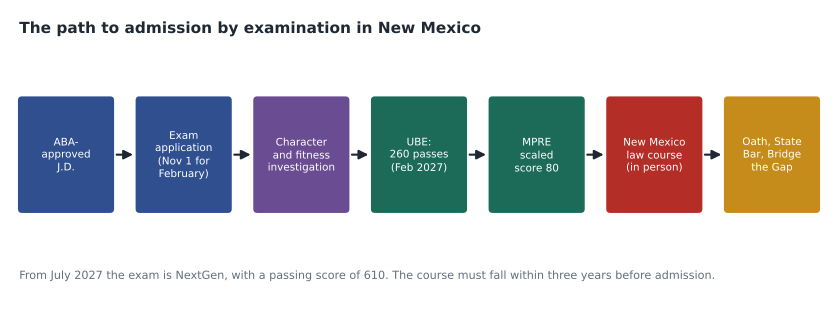
Most New Mexico candidates follow a predictable rhythm. They take the MPRE during the second or third year of law school. In the final year they file the exam application by the first deadline for their chosen exam, which keeps the fee at its lowest and gives the Board time to finish the character and fitness investigation. They sit the exam, receive their results and attend the required New Mexico law course, which may be taken before or after the exam as long as it falls within the time window in the rules. When the Board confirms that every requirement is met, they sign the certificate of understanding, take the oath and receive a license.
Paloma's path looked like that. She took the MPRE in August 2025 and scored 86. She filed her application on October 20, 2026, eleven days before the November 1 first deadline, with her credit report printed the week before. Her law school sent her transcript, and she asked three Gallup lawyers who know her work to send character statements directly to the Board. She plans to attend the New Mexico law course in the spring of 2027, after the exam.
Why New Mexico's requirements look the way they do
New Mexico adopted the UBE effective November 1, 2015, and gave its first UBE in February 2016. The appeal was portability: a candidate who passes in New Mexico can carry the score to other UBE states, and lawyers from other states can transfer in. The price of portability is that the exam tests only general principles. A state that wants new lawyers to know its own law must find another way to teach it.
New Mexico chose a required course and focused it on three subjects that make practice here different. Indian law matters because twenty-three tribes, nineteen Pueblos, three Apache tribes and the Navajo Nation, are located wholly or partly within the state, and questions about tribal, state and federal jurisdiction come up constantly in ordinary cases. Community property matters because New Mexico is one of a handful of community property states, so every divorce, probate and real estate deal involving a married person turns on property classification. Professionalism matters because the Supreme Court wants new lawyers to begin practice already familiar with the Rules of Professional Conduct, the State Bar's Creed of Professionalism and the duties that apply from the first day.
For a candidate, the practical lesson is that passing the exam is not the same as being ready to practice in New Mexico. Paloma's first month at Benally & Trujillo made that obvious. She spent a morning learning why a deed signed by only one spouse could be void, an afternoon learning that a claim against McKinley County had to be noticed within ninety days, and a Friday listening to Ms. Benally explain why a lawsuit against a Navajo business over a sale at its store on the reservation belonged in tribal court rather than state court.
Worked problem
Sorting out who to ask
In early November 2026 Paloma has three questions: whether her August 2025 MPRE score will still count if she passes in February 2027, where to send a new mailing address, and whether she has to join the State Bar before the exam.
Show solution
- New Mexico requires a scaled MPRE score of 80. NCBE's chart for New Mexico lists no limit on how old the score may be, and an 86 from August 2025 is well within any reasonable window. She confirms with the Board in writing.
- Address changes and every other update go to the Board of Bar Examiners. The rules impose a continuing duty to keep the application current while it is pending.
- State Bar membership follows admission. There is nothing to join before the oath.
Answer: Her MPRE counts, the address update goes to the Board, and State Bar membership comes after she is licensed.
Building a study year around the process
Marchetti asked Paloma to plan the next four months on one page. At the top she wrote the exam dates, February 23 and 24, 2027. Below that she listed the administrative items still open: confirm that all three attorney statements and her fingerprint results reached the Board, answer any Board questions within a week, and watch for the Board's instructions about laptop registration and admission tickets. The rest of the page went to study: the seven MBE subjects, the MEE subjects including business associations, and the MPT.
'The paperwork should take an hour a month if you stay on top of it,' Marchetti told her. 'Where candidates get into trouble is letting a request from the Board sit for three weeks while they study evidence. Answer every letter the week it arrives.'
Paloma also asked how much of her clerk work would help. Marchetti was practical. Drafting a petition for dissolution, reading a Court of Appeals opinion on transmutation or calculating a Tort Claims Act notice deadline teaches New Mexico law in context, and some of it will help on the MPT, which often uses family law and estates problems. But the UBE rewards organized written analysis of general principles under time pressure, and that skill comes only from timed practice. She decided to clerk thirty hours a week through December and cut back to fifteen in January.
What this course covers
Lessons 2 and 3 cover eligibility, deadlines, fees, character and fitness and the MPRE. Lesson 4 explains the UBE's format, weighting and scoring and New Mexico's 260 passing score. Lesson 5 covers the move to NextGen in July 2027 and the skills-based pathway. Lesson 6 covers the required New Mexico law course and how New Mexico law shows up in the licensing process. Lessons 7 through 10 teach the New Mexico law a new lawyer meets early: courts, procedure and limitations periods; torts, the Tort Claims Act and the Civil Rights Act; community property, divorce and estates; and Indian law and tribal jurisdiction. Lesson 11 covers score transfer, admission on motion and practice after admission, and lesson 12 is a capstone with original practice questions and an exam-day plan.
Common mistakes
MistakeThe State Bar of New Mexico runs the bar exam.
InsteadThe Board of Bar Examiners, acting under rules adopted by the Supreme Court, runs applications, character and fitness and the exam. The State Bar is the mandatory association lawyers join after admission.
MistakeBecause New Mexico gives the UBE, there is nothing New Mexico-specific to complete.
InsteadEvery applicant must also attend in person an approved course on Indian law, New Mexico community property law and professionalism before receiving a license.
MistakeNew Mexico essays appear on the bar exam.
InsteadNew Mexico does not use a jurisdiction-drafted exam. The essays are the six MEE questions, which test general principles.
MistakeThe skills-based pathway is open now.
InsteadThe Supreme Court approved it in August 2026 but will set the start date by a further order; applications are expected around mid-2027.
Summary and key terms
- The Supreme Court of New Mexico adopts the Rules Governing Admission to the Bar (Rule Set 15 NMRA) and grants licenses.
- The Board of Bar Examiners processes applications, conducts its own character and fitness investigation and administers the exam.
- Through February 2027 New Mexico gives the UBE, with a passing score of 260; NextGen begins in July 2027 with a passing score of 610.
- An MPRE scaled score of 80 is required.
- Every applicant must attend an approved course on Indian law, New Mexico community property law and professionalism.
- Routes into practice are examination, transferred UBE score, admission on motion and pro hac vice appearance, with a skills-based pathway approved for the future.
- 0
- Rule Set 15 NMRA
- 1
- Board of Bar Examiners
- 2
- State Bar of New Mexico
- 3
- Uniform Bar Examination
- 4
- New Mexico law course
- 5
- admission on motion
- 6
- transferred UBE score
- 7
- pro hac vice
Practice problems
Work each problem on paper first, then reveal the answer to check.
Which body adopts the rules governing admission to the New Mexico bar?
Show answer
The Supreme Court of New Mexico, which also grants licenses.
Does New Mexico use NCBE's character and fitness investigation service?
Show answer
No. NCBE hosts the application, but the Board of Bar Examiners conducts its own investigation.
What three subjects does the required New Mexico law course cover?
Show answer
Indian law, New Mexico community property law and professionalism.
What passing scores apply to the February 2027 and July 2027 exams?
Show answer
260 on the legacy UBE in February 2027; 610 on the NextGen exam from July 2027.
Lesson quiz · 5 questions
Score 60% or more to complete this lesson.
Create a free account to save your progress, take quizzes and earn a certificate.