
BAR-232 · Lesson 2 of 12 · 21 min
Eligibility, education, deadlines and fees
▶ Video coming soon A video version of this lesson is on the way.
Two weeks before she filed, Paloma spread her application materials across the conference table at Benally & Trujillo after the office closed. She had the Board's instructions for the February 2027 exam, the current Rule Set 15, a checklist she had built from both, and a highlighter. Ray Trujillo, the firm's younger partner, stopped on his way out. 'When I applied,' he said, 'I nearly missed that the credit report had to be printed within thirty days of filing. I had pulled mine in the summer. Read every line of Rule 15-203.'
This lesson covers who may apply to take the New Mexico bar exam, what education the rules require, what goes into an application, the filing deadlines and the fees. The details are unforgiving. New Mexico's rules say that late applications are not accepted after the final deadline and that an application cannot be deferred to a later exam. A candidate who misreads a date can lose a full exam cycle.
The basic qualifications
Rule 15-103 NMRA lists the qualifications for a license. An applicant must be at least eighteen years old. The applicant must hold a J.D. or LL.B. from a law school accredited by the American Bar Association, measured as of the exam or, for a transferred score, as of the transfer application. The applicant must show good moral character and the physical and mental fitness to practice. If admitted anywhere else, the applicant must be in good standing in every such jurisdiction. The applicant must be otherwise professionally qualified. And the applicant must be current on any court-ordered child or spousal support; someone on the state's certified list of obligors needs a certified statement from the Human Services Department.
The same rule contains a sentence that reflects New Mexico's population and values: citizenship or immigration status alone cannot be the basis for denying a license. An applicant without lawful immigration status who meets every other requirement may be admitted.
The education requirement in detail
For nearly every first-time applicant, the education requirement means a J.D. from an ABA-approved law school, conferred by the time of the exam. New Mexico does not allow candidates to sit before graduation on the strength of coursework alone. A student finishing in May sits in July, and a student finishing in December sits in February.
The rules give a narrow alternative for graduates of law schools that are not ABA-accredited. Such a graduate may qualify by having practiced law in another state for at least four of the six years before applying. NCBE's summary describes the same route as open to graduates of non-ABA, correspondence or online law schools, and to graduates of foreign law schools, provided they have been admitted and practicing in another United States jurisdiction for four of the six years before filing. An LL.M. or other graduate degree from an ABA-approved school does not by itself make a foreign-educated lawyer eligible, which is a sharp difference from New York or California.
There is one unusual exception in the rules on examination: certain full-time University of New Mexico law faculty may be licensed without the exam. It affects very few people, but it explains why a reader may occasionally meet a law professor admitted on a different footing.
| Applicant | Eligible to sit or transfer? | Notes |
|---|---|---|
| ABA J.D. graduate, first time | Yes | Degree must be conferred by the exam |
| Third-year student | No | No early sitting on coursework alone |
| Graduate of a non-ABA U.S. law school | Only after 4 of the last 6 years of practice elsewhere | Must be admitted and in good standing in that state |
| Foreign-educated lawyer with a U.S. LL.M. | Not on the LL.M. alone | Needs admission and 4 of 6 years of practice in a U.S. jurisdiction |
| Lawyer with a passing UBE elsewhere | Yes, by transfer, within 60 months | Score of 260 or more; transfer fee applies |
What the application contains
Rule 15-203 NMRA describes the application. It must be sworn or affirmed and filed on the Board's forms or through the method the Board prescribes, which today means NCBE's online application system followed by the Board's own instructions. The form asks for identifying information, every name and alias used, residences for at least five years, citizenship, occupations, legal and general background, and detailed information bearing on character.
The application must be accompanied by a full credit report from one of the three major credit bureaus, printed within thirty days before filing. This is the requirement Ray Trujillo nearly missed, and it trips up candidates every cycle because many people pull a free report months before they file.
Several documents must come to the Board directly from third parties, not from the applicant. These are an authenticated law school transcript showing the J.D. or LL.B., a form authorizing the Board to contact the law school, fingerprints for background checks by the FBI and the State of New Mexico, and character and fitness statements from three attorneys in good standing who know the applicant and are not related to the applicant. An applicant who is or was admitted elsewhere must also arrange for each jurisdiction to send a certificate of good standing and a disciplinary history.
Paloma's three attorney statements came from Delores Benally, from a public defender she had worked with in a law school clinic, and from a Gallup lawyer she had assisted on a probate matter. She asked all three in early September and gave each a short note with the Board's instructions so they knew where and how to send the statement.
Deadlines
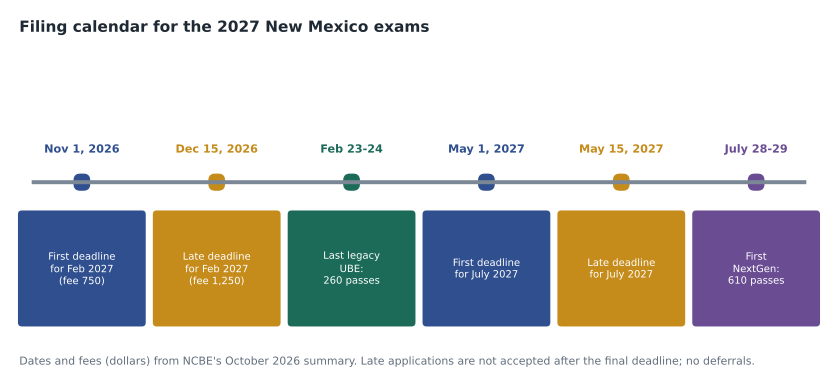
New Mexico uses a two-step filing calendar. According to NCBE's summary of New Mexico requirements, updated in October 2026, the first filing deadline for the February 2027 exam is November 1, 2026, and the final, late filing deadline is December 15, 2026. For July 2027 the first deadline is May 1, 2027, and the late deadline is May 15, 2027. A filing is timely only if it is submitted as the Board specifies by 5:00 p.m. Mountain Time on the deadline day. After the final deadline, the rules say plainly that late applications are not accepted.
Deadlines have shifted from year to year. An older NCBE help page listed a January 1 late deadline for February 2026 and a June 1 late deadline for July 2025, while the October 2026 summary lists December 15 and May 15 for the 2027 exams. That is exactly why the Board's own posted instructions, not a summary or a memory, must drive the calendar. Paloma printed the Board's page and taped it inside her folder.
No deferrals, and what happens to a withdrawn application
New Mexico does not allow an application to be deferred to a later exam. An applicant who cannot sit must withdraw and file again for the next administration, paying the fees again. The rules allow withdrawal before a decision, but fees on a withdrawn application are generally forfeited, subject to the refund provisions in Rule 15-204. The Board may also treat an application as withdrawn if the applicant ignores update requests for six months or fails to supply required documents within twelve months, although an applicant may ask in writing for a six-month extension before the twelve months run out.
Two other rules round this out. An applicant may reapply without limit, paying the fees each time; New Mexico does not cap the number of attempts. And documents submitted to the Board are not returned. Keep copies of everything.
Fees
NCBE's October 2026 summary lists New Mexico's exam fees as 750 dollars for a first-time applicant who files by the first deadline and 1,250 dollars for one who files by the late deadline. The same amounts apply to applicants who are already lawyers elsewhere. Repeat takers pay a lower base fee, with the same late increase. An applicant who is permitted to use a laptop pays an additional 100 dollars. For comparison, admission by transferred UBE score costs 1,700 dollars and admission on motion 2,500 dollars.
| Item | Amount (dollars) | When |
|---|---|---|
| Exam, first-time or attorney applicant | 750 | Filed by the first deadline |
| Exam, first-time or attorney applicant | 1,250 | Filed by the late deadline |
| Laptop fee | 100 | If permitted to type |
| Admission by transferred UBE score | 1,700 | Separate application |
| Admission on motion | 2,500 | Separate application |
The late fee is a strong incentive to file early, but the bigger reason is time. The Board's investigation, including fingerprints, the credit report and three attorney statements, takes weeks. An applicant who files in October has far more room to resolve a question than one who files in mid-December.
Worked problem
Checking a filing plan
Paloma's classmate Joaquin finished law school in May 2026, failed to file for July, and on November 20, 2026, decides to take the February 2027 New Mexico exam. He has a credit report printed in August and plans to ask his attorney references next week.
Show solution
- Joaquin has missed the November 1 first deadline, so the late deadline of December 15, 2026, and the higher fee apply, assuming the Board's posted dates match NCBE's summary.
- His August credit report is too old. Rule 15-203 requires a report printed within thirty days of filing, so he must pull a new one shortly before he files.
- His three attorney statements must go directly from the attorneys to the Board, so he should ask now and give them the instructions.
- If anything is missing at the late deadline, he cannot defer. He would have to withdraw and refile for July 2027, which will be a NextGen exam.
Answer: Joaquin can still sit in February 2027 if he files a complete application with a fresh credit report by December 15 and pays the late fee.
Keeping the application current
Filing is not the end of the applicant's duties. The rules impose a continuing obligation to keep the Board informed of every change in the information on the application, through the entire review and any appeal to the Supreme Court. A new address, a new job, a traffic citation, a lawsuit, a change in a support obligation or a new arrest must be reported promptly. Candidates sometimes treat this as a technicality, but an unreported change can turn into a candor problem, and in character and fitness review, candor problems are often more serious than the underlying event.
Marchetti ends this part of her course the same way every year. 'Your application is a living document,' she tells the group. 'If something happens between November and your oath, the Board should hear it from you first.'
Common mistakes
MistakeI can sit in February because I will finish my last class in December and graduate in May.
InsteadThe J.D. must be conferred by the exam. New Mexico does not allow early sitting on coursework alone.
MistakeA foreign lawyer with an LL.M. from an ABA-approved school can sit in New Mexico.
InsteadAn LL.M. alone does not qualify. Foreign-educated applicants generally need admission and four of the last six years of practice in another U.S. jurisdiction.
MistakeIf I am not ready, I can defer my application to July.
InsteadNew Mexico does not permit deferral. The applicant must withdraw and refile, and fees are generally forfeited.
MistakeAny recent credit report will do.
InsteadThe report must be a full report from a major bureau printed within thirty days before filing.
Choosing February or July
Most May graduates sit in July, when they can study full time through June and July. Graduates with jobs, families or other obligations sometimes do better in February, when they can study in the evenings through the fall and take a short leave in January. For New Mexico candidates in the 2026 to 2027 cycle, the choice carries an extra consequence: February 2027 is the last legacy UBE, and July 2027 is the first NextGen exam. A candidate who prepared with legacy materials and wants to use them should sit in February. A candidate who would rather wait and prepare for the new format can sit in July. Neither choice is wrong. What matters is matching the exam to the months when real study is possible and filing for that exam on time.
Paloma chose February for two reasons. She had been studying the legacy subjects since the summer, and the firm agreed to reduce her hours in January. 'If I fail in February,' she told Marchetti, 'I will have to retake on NextGen in July. So I want to give February everything I have.'
A filing checklist that works
Marchetti gives every New Mexico candidate the same three-column checklist: requested, sent and confirmed received. Each item gets its own row. The rows for a first-time applicant are the online application, the fee, the credit report, the law school transcript, the law school authorization form, the fingerprint card or electronic fingerprinting appointment, each of the three attorney statements, and any good standing certificates from other jurisdictions. Each row also notes who must send the document, because several items must come from the third party directly, and a copy forwarded by the applicant will not do.
She also recommends a short email to the Board about two weeks after filing, asking whether any required item is still missing. 'It takes thirty seconds to ask,' she says, 'and it saves you from learning in January that a fingerprint card was rejected in November.'
Questions to put to the Board in writing
The Board's staff answers questions about the rules and procedures, and candidates should ask, in writing, whenever the instructions do not cover their situation. Good questions are specific: whether a particular document is acceptable, how to report a change discovered after filing, whether a laptop request has been approved, or how the late deadline applies to a candidate whose final transcript is delayed. A written answer from the Board is far more reliable than a classmate's recollection, and it creates a record if the issue comes up later.
Summary and key terms
- Rule 15-103 requires age eighteen, an ABA-accredited J.D. or LL.B., good character and fitness, good standing elsewhere, and current support payments.
- Citizenship or immigration status alone cannot be the basis for denying a license.
- Non-ABA and foreign-educated graduates generally need four of the last six years of practice in another U.S. jurisdiction; an LL.M. alone is not enough.
- The application needs a credit report printed within thirty days, a transcript, fingerprints and three unrelated attorney statements sent directly to the Board.
- For February 2027 the first deadline was November 1 and the late deadline December 15; late applications are not accepted after that, and deferral is not allowed.
- Fees are 750 dollars on time and 1,250 dollars late, plus 100 dollars for a laptop.
- 0
- Rule 15-103
- 1
- Rule 15-203
- 2
- first filing deadline
- 3
- late filing deadline
- 4
- deferral
- 5
- certified list of obligors
- 6
- character and fitness statement
Practice problems
Work each problem on paper first, then reveal the answer to check.
How recent must the credit report be?
Show answer
Printed within thirty days before the application is filed.
How many attorney character statements does New Mexico require, and how are they sent?
Show answer
Three, from unrelated attorneys in good standing, sent directly to the Board.
May an applicant defer to the next exam?
Show answer
No. The applicant must withdraw and refile.
What is the exam fee for a first-time applicant filing by the first deadline?
Show answer
750 dollars, according to NCBE's October 2026 summary.
Lesson quiz · 5 questions
Score 60% or more to complete this lesson.
Create a free account to save your progress, take quizzes and earn a certificate.