
BAR-232 · Lesson 9 of 12 · 20 min
New Mexico community property, divorce and estates
▶ Video coming soon A video version of this lesson is on the way.
Frances Yepa came to Benally & Trujillo in October 2026 to end a fourteen-year marriage. Her husband, Gilbert, had bought their house in Gallup in 2010, two years before they married, with a down payment from his savings. Since the wedding, the mortgage had been paid from their paychecks. Gilbert had a retirement account at the railroad, started in 2008. Frances had inherited a small parcel of land near Jemez Springs from her grandmother in 2019. And in the spring of 2026, Gilbert had signed a deed, alone, selling a vacant lot the couple bought in 2017 to a friend for far less than it was worth. 'What is mine, what is his and what is ours?' Frances asked. Delores Benally turned to Paloma. 'That is the whole case,' she said. 'Start with the statute.'
New Mexico is a community property state, one of nine in the United States. The rules that classify property, decide who may manage it, divide it at divorce and pass it at death are different from the equitable distribution and elective share rules in most states, and lawyers trained elsewhere get them wrong. This lesson covers the Community Property Act, the main divorce rules and the parts of the Probate Code that interact with community property.
Separate and community property
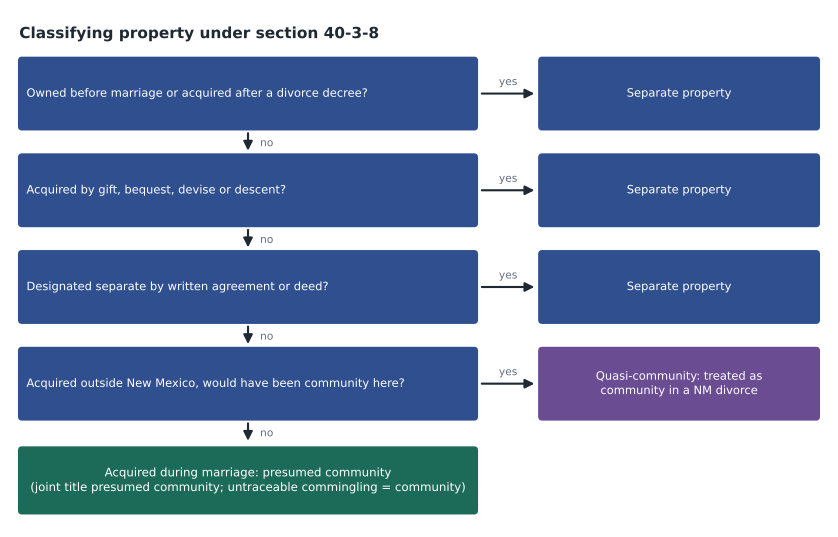
The definitions are in section 40-3-8 of the New Mexico Statutes Annotated. Separate property includes property a spouse owned before marriage or acquired after a final decree of dissolution, property acquired after a decree of legal separation unless the decree provides otherwise, property a court has designated as separate, property acquired by gift, bequest, devise or descent, and property the spouses have designated as separate in a written agreement, including a deed that describes jointly held property as separate. Community property is everything else acquired by either or both spouses during the marriage.
Two presumptions do most of the work. Property acquired during marriage is presumed to be community, and a spouse claiming it as separate must rebut the presumption by a preponderance of the evidence. And property titled in both spouses' names as joint tenants or tenants in common is presumed to be community, unless it meets the definition of separate property. Separate property that is commingled with community property so thoroughly that it can no longer be traced is treated as community.
The character of property is fixed when it is acquired. Gilbert's house was his separate property because he bought it before the marriage, and paying the mortgage with community earnings during the marriage does not change its character. It does, however, give the community a claim for reimbursement or a share of the equity attributable to community contributions, and courts have developed formulas for apportioning such claims. Similarly, a retirement account started before marriage is partly separate and partly community: contributions and growth attributable to the years of marriage are community, and the rest is separate.
Transmutation is the change of property from separate to community or the reverse. New Mexico courts require clear and convincing evidence of intent to transmute. Putting separate funds into a joint account can create a presumption, but the courts look for evidence of what the spouses actually intended. Written agreements, including deeds expressly designating property as separate, are the cleanest way to transmute.
Quasi-community property
Couples move to New Mexico from common law states. Section 40-3-8 defines quasi-community property as property acquired while a spouse was living outside New Mexico, or in exchange for such property, that would have been community property if the spouse had been domiciled in New Mexico when it was acquired. In a divorce or legal separation in which both spouses are New Mexico domiciliaries at the time of the proceeding, quasi-community property is treated as community property. A couple who married in Colorado and moved to Gallup will therefore have their Colorado earnings divided as if they had been community property all along.
Managing community property
The Act gives each spouse broad power to manage community personal property. Under section 40-3-14, either spouse acting alone may manage, control, dispose of and encumber all of the community personal property, with two exceptions. If only one spouse's name appears on a document showing title, such as a stock certificate or a car title, only that spouse may deal with it. If both names appear joined by 'and', both must join; if joined by 'or' or 'and/or', either may act. That power is limited by a fiduciary duty: a spouse may not dispose of community property in breach of the duty owed to the other spouse, and a substantial gift of community property to a third party without the other spouse's consent can be set aside, absent intervening equities.
Real property is treated more strictly. Under section 40-3-13, both spouses must join in any transfer, conveyance or mortgage of community real property, in any contract to do those things, and in any lease of community real property whose initial term plus options exceeds five years or is indefinite. The same rule applies to separate real property the spouses hold as joint tenants or tenants in common. There are exceptions for purchase-money mortgages, for transfers between the spouses, for dealings by one spouse with that spouse's own separate real property, and for a spouse acting under a recorded power of attorney. A non-joining spouse can ratify the transaction in writing. Otherwise, a transfer by one spouse alone in violation of the statute is void.
That rule settles part of Frances's case. The lot bought in 2017 was acquired during the marriage and is presumed community real property. Gilbert's deed, signed by him alone, is void under section 40-3-13 unless Frances ratifies it. The friend who received the deed has no valid title, and a title insurer reviewing the deed would refuse to insure it.
| Asset | Classification | Reason |
|---|---|---|
| House bought by Gilbert in 2010 | Separate, with a community claim | Acquired before marriage; mortgage paid with community earnings |
| Railroad retirement account started 2008 | Part separate, part community | Contributions and growth during the marriage are community |
| Jemez Springs parcel inherited 2019 | Frances's separate property | Acquired by inheritance |
| Vacant lot bought 2017 | Community real property | Acquired during marriage; Gilbert's solo deed is void |
| Paychecks and joint savings since 2012 | Community | Acquired during marriage |
Divorce
New Mexico calls divorce dissolution of marriage. Section 40-4-1 lists four grounds: incompatibility, cruel and inhuman treatment, adultery and abandonment. Nearly every case is filed on incompatibility, which New Mexico courts treat as a no-fault ground: fault and misconduct are irrelevant, either spouse may seek dissolution on it, and once the court finds incompatibility, it must enter a decree. To file, one party must have resided in New Mexico for at least six months immediately before filing and be domiciled in the state, under section 40-4-5.
In the decree, the court divides the community property and debts. New Mexico divides community property equally. Each spouse keeps his or her separate property, subject to any community claims against it, such as the community's interest in Gilbert's house. Community debts are allocated between the spouses under the statutory scheme for debts in the Community Property Act. Retirement accounts are divided by valuing the community portion and either offsetting it with other property or dividing it through a qualified domestic relations order.
The court may award spousal support, which New Mexico statutes call alimony, under section 40-4-7, considering factors such as the spouses' age and health, earning capacity, needs, the duration of the marriage and the property each receives. For children, section 40-4-9.1 creates a presumption that joint custody is in the child's best interests, which the other parent can rebut, and child support follows the statutory guidelines in section 40-4-11.1.
Worked problem
Dividing the Yepa estate
Frances and Gilbert agree that the house is worth 260,000 dollars with a remaining mortgage of 40,000 dollars. A financial expert estimates that 90,000 dollars of the equity is attributable to community mortgage payments since 2012. The community share of the retirement account is valued at 120,000 dollars. The vacant lot is worth 50,000 dollars.
Show solution
- The house is Gilbert's separate property, but the community has a claim to the 90,000 dollars of equity attributable to community payments; Frances is entitled to half, or 45,000 dollars.
- The community portion of the retirement account, 120,000 dollars, is divided equally: 60,000 dollars to each spouse, by offset or a domestic relations order.
- The lot is community real property. Gilbert's deed is void, so the lot remains in the community and is divided equally, 25,000 dollars to each.
- The Jemez Springs parcel remains Frances's separate property and is not divided.
Answer: Frances is entitled to 45,000 dollars from the house claim, 60,000 dollars from the retirement account and half of the lot, and she keeps her inherited parcel.
Estates: intestacy
New Mexico has adopted the Uniform Probate Code in chapter 45, with its own community property provisions. Under section 45-2-102, a surviving spouse's intestate share depends on the kind of property. As to the decedent's separate property, the surviving spouse takes all of it if the decedent left no descendants, and one-fourth of it if the decedent left descendants, with the rest passing to the descendants. As to community property, the surviving spouse takes the one-half of the community property over which the decedent had testamentary power. Since the surviving spouse already owns the other half, the surviving spouse ends up with all of the community property.
This is one of the most frequently misunderstood rules in New Mexico estate practice. A married person with children who dies without a will leaves all the community property to the surviving spouse, but most of the separate property to the children. Families with separate property inherited from parents, like Frances's Jemez Springs parcel, often do not expect that result.
Estates: wills and nonprobate transfers
Each spouse may dispose by will of that spouse's separate property and of one-half of the community property; a will cannot give away the surviving spouse's half. Under section 45-2-502, a will must be in writing, signed by the testator or by someone else in the testator's name, in the testator's presence and at the testator's direction, and signed by at least two witnesses. New Mexico's version is stricter than the Uniform Probate Code in one respect: each witness must sign in the presence of the testator and of each other, after witnessing the signing. New Mexico's statute does not contain the Uniform Probate Code's provision validating unwitnessed holographic wills, so a handwritten, unwitnessed will signed in New Mexico is not valid, although a will executed elsewhere in compliance with the law of that place can be recognized.
New Mexico was an early adopter of transfer on death deeds, which allow an owner to designate a beneficiary who takes real property at death without probate; the deed must be signed and recorded before the owner's death and can be revoked. A transfer on death deed of community real property raises the same question as a will: one spouse alone can affect only that spouse's half.
Common mistakes
MistakePaying the mortgage with marital earnings turns a spouse's premarital house into community property.
InsteadCharacter is fixed at acquisition. The house stays separate, but the community gains a claim for its contributions.
MistakeEither spouse can sell community land if the deed is in that spouse's name.
InsteadSection 40-3-13 requires both spouses to join in transferring or mortgaging community real property; a solo transfer is void.
MistakeIn New Mexico, a surviving spouse with children receives half of everything by intestacy.
InsteadThe spouse receives all community property and one-fourth of the separate property when there are descendants.
MistakeA handwritten, unwitnessed will is valid in New Mexico.
InsteadSection 45-2-502 requires two witnesses who sign in each other's presence; New Mexico has no holographic will provision.
Community property in everyday transactions
The joinder rule in section 40-3-13 shapes real estate practice throughout New Mexico. Title companies routinely require both spouses to sign deeds, mortgages and long leases of property owned by a married person, and they ask sellers to confirm marital status at closing. A buyer who signs a purchase contract with only one spouse of a married couple risks holding a void contract: the courts have held that a contract made in violation of the statute generally cannot be enforced by specific performance or damages, though the buyer may sometimes have a claim for negligent misrepresentation against the spouse who signed. A new lawyer handling a sale for a married client should therefore confirm, at the very first meeting, who owns the property, how it was acquired and whether both spouses will sign.
Lenders and creditors face the same issues. A creditor of one spouse may be able to reach that spouse's separate property and, depending on the kind of debt, some or all of the community property, under the debt provisions of the Community Property Act. Lawyers advising a married client who is starting a business often recommend a written agreement about which property will be separate, because classification affects what a business creditor can reach.
Estate planning for married clients
For a married client, a sound estate plan starts with an inventory that classifies each asset as separate or community, notes how it is titled and identifies any beneficiary designations. A client who wants separate property inherited from a parent to pass to children rather than to a surviving spouse needs a will or a nonprobate transfer that says so, because intestacy would give one-fourth of it to the spouse and the rest to descendants, while giving all of the community property to the spouse. Conversely, a client who wants everything to go to the surviving spouse can achieve much of that result without a will as to community property, but a will removes doubt and covers the separate property too.
Summary and key terms
- Section 40-3-8 defines separate property (before marriage, after divorce, gift, inheritance, written designation) and community property (everything else acquired during marriage).
- Property acquired during marriage or held jointly is presumed community; transmutation requires clear and convincing evidence.
- Quasi-community property acquired while domiciled elsewhere is treated as community in a New Mexico divorce.
- Either spouse may manage community personal property, subject to title rules and a fiduciary duty; both must join to transfer or mortgage community real property under section 40-3-13.
- Divorce is usually on incompatibility after six months' residence; community property is divided equally, with alimony, joint custody and guideline child support under chapter 40.
- By intestacy a surviving spouse takes all community property and all or one-fourth of separate property; wills need two witnesses who sign in each other's presence.
- 0
- separate property
- 1
- community property
- 2
- quasi-community property
- 3
- transmutation
- 4
- commingling
- 5
- joinder
- 6
- incompatibility
- 7
- intestate share
Practice problems
Work each problem on paper first, then reveal the answer to check.
Which section requires both spouses to join in a mortgage of community real property?
Show answer
Section 40-3-13.
What is the standard of proof for transmutation?
Show answer
Clear and convincing evidence of intent.
What are the four grounds for divorce in section 40-4-1?
Show answer
Incompatibility, cruel and inhuman treatment, adultery and abandonment.
What share of separate property does a surviving spouse take by intestacy when the decedent left descendants?
Show answer
One-fourth.
Lesson quiz · 5 questions
Score 60% or more to complete this lesson.
Create a free account to save your progress, take quizzes and earn a certificate.