
BAR-232 · Lesson 11 of 12 · 19 min
Score transfer, admission on motion and practice after admission
▶ Video coming soon A video version of this lesson is on the way.
In mid-November 2026 Ray Trujillo asked Paloma for help with a hiring question. The firm wanted to add a lawyer, and two candidates had applied. One, a recent graduate named Shawna, had passed the UBE in Colorado in February 2025 with a score of 268 and wanted to move to Gallup. The other, Leland, had practiced in Arizona for eleven years, mostly in Flagstaff, and had been licensed there by examination. 'How fast can each of them be licensed here, and what do they still have to do?' Ray asked. 'And while you are at it, tell me what you will have to do in your first year after you pass.'
This lesson covers the routes into New Mexico practice for lawyers who have already passed a bar exam or practiced elsewhere, the temporary routes for out-of-state lawyers, and the duties that begin the day a new lawyer is licensed: State Bar membership, the Bridge the Gap mentorship program and continuing legal education.
Admission by transferred UBE score
New Mexico accepts UBE scores earned in other jurisdictions. According to NCBE's October 2026 summary of New Mexico's rules, a transferred score must be no more than sixty months old, measured under the Board's rules, and it must meet New Mexico's passing score: 260 for a legacy UBE score. Under the Supreme Court's June 15, 2026, order, New Mexico has also accepted NextGen scores transferred from other jurisdictions since July 2026, at the NextGen passing score of 610. New Mexico does not accept stand-alone MBE scores. It allows concurrent applications, so a candidate can apply to transfer a score while waiting on another application, and it places no limit on the number of attempts to earn a passing UBE score.
Transfer is not automatic. A transfer applicant must file a complete application, pay the 1,700 dollar transfer fee, pass the same character and fitness investigation as any other applicant, meet the MPRE requirement of a scaled score of 80, attend the required New Mexico law course on Indian law, community property and professionalism, and sign the certificate of understanding. The education requirement applies too: an ABA-accredited J.D., or the alternative based on practice elsewhere.
Shawna's case is straightforward. Her February 2025 Colorado UBE score of 268 is above 260 and well within sixty months. If she files promptly, her application turns on character and fitness, her MPRE score and the course. She could be licensed within a few months of filing.
Admission on motion
Admission on motion lets an experienced lawyer from another jurisdiction be licensed without taking any bar exam. NCBE's summary describes New Mexico's requirements as follows. The applicant must have actively practiced law for five of the seven years immediately before applying. Qualifying practice includes private practice, law teaching, work for a government agency, military legal service, in-house corporate practice and judicial service in a court of record. The route is based on reciprocity: the applicant must be admitted in a jurisdiction that would admit a New Mexico lawyer on comparable terms. Graduation from an ABA-approved law school is not required for this route. Applicants who were originally admitted by diploma privilege are not eligible. The fee is 2,500 dollars, and the applicant must meet the MPRE requirement, complete the character and fitness investigation and attend the New Mexico law course.
Leland's case depends on reciprocity. He has eleven years of practice in Arizona, so the five-of-seven requirement is easily met. The question is whether Arizona is a jurisdiction that grants admission on motion to New Mexico lawyers on comparable terms. Arizona does have an admission on motion rule, but the reciprocity list changes over time, and the Board's current list controls. Paloma's memo recommended that Leland confirm with the Board in writing before filing, and noted that if reciprocity failed, Leland could still be admitted by taking the New Mexico exam, which in July 2027 would be NextGen.
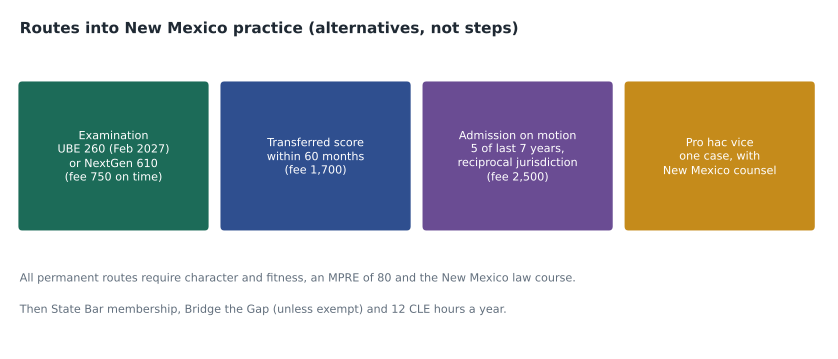
| Route | Key requirements | Fee (dollars) |
|---|---|---|
| Examination | ABA J.D., pass the UBE (260) or NextGen (610), MPRE 80, character and fitness, New Mexico law course | 750 on time; 1,250 late |
| Transferred UBE or NextGen score | Score within 60 months at or above 260 or 610; same other requirements | 1,700 |
| Admission on motion | 5 of the last 7 years of active practice; reciprocal jurisdiction; not originally admitted by diploma privilege | 2,500 |
| Pro hac vice | Single case; association with New Mexico counsel; court approval | Set by rule |
Temporary practice
Lawyers licensed elsewhere who need to appear in a single New Mexico case may seek permission to appear pro hac vice. New Mexico requires association with a lawyer licensed in New Mexico, who remains responsible for the case, and the court's approval. The New Mexico Rules of Professional Conduct also contain a version of Model Rule 5.5 on multijurisdictional practice, which allows some temporary work by out-of-state lawyers, such as work that is reasonably related to their home-state practice. Neither route is a substitute for a license for a lawyer who wants to establish a practice in New Mexico.
Score portability from New Mexico
The UBE's portability runs both ways. A candidate who passes in New Mexico with a legacy score can transfer it to other UBE jurisdictions that accept legacy scores, provided the score meets that jurisdiction's passing score and maximum score age. A 260 from New Mexico transfers to states with a 260 minimum but not to states that require 266, 270 or 280. Candidates who think they may move should aim well above 260. Paloma, who expects to stay in New Mexico but has family in Colorado, set herself a target of 270 so that her score would transfer to Colorado as well.
State Bar membership and registration
Once licensed, every New Mexico lawyer becomes a member of the State Bar of New Mexico, pays annual dues and files an annual registration statement. The registration statement includes the certification required by Rule 16-104(C) of whether the lawyer carries professional liability insurance meeting the rule's minimums and, if insured, the insurer's name. Lawyers must keep their contact information current with the State Bar.
Bridge the Gap mentorship
Rule 24-110 NMRA requires most new lawyers to complete the Bridge the Gap program, a mentorship program run by the State Bar. A new lawyer must enroll within thirty days of admission and complete the program by December 31 of the first full calendar year after admission. The Commission on Professionalism certifies mentors, and the Supreme Court appoints them; the assigned mentor signs the certificate of completion. The fee is 300 dollars, half due by March 1 of the year after admission and the rest by December 31 of that year. Completing the program satisfies the new lawyer's continuing legal education requirement for the first full year.
Three groups are exempt: lawyers who practiced in another state for at least two of the five years before New Mexico admission; active-status lawyers with no New Mexico office, clients, matters or cases; and certain limited-license lawyers whose practice under the license does not exceed a year. Judicial law clerks may defer for the length of the clerkship, and lawyers who are unemployed or not practicing may seek a temporary deferral. A lawyer who fails to complete the program faces a citation from the Supreme Court and must show cause within fifteen days why the lawyer should not be suspended. Mentors outside the new lawyer's firm are presumed not to represent the new lawyer's clients, but client confidences must be protected and mentors must run conflict checks.
Shawna, admitted in Colorado in 2025 and practicing there for about a year and a half, would not meet the two-of-five-years exemption and would have to complete Bridge the Gap. Leland, with eleven years in Arizona, would be exempt. Paloma, if she passes in February 2027, would enroll within thirty days of her admission and complete the program by December 31, 2028, if admitted in 2027.
Continuing legal education
After the first year, New Mexico lawyers must complete twelve hours of minimum continuing legal education every year, under Rule Set 18 NMRA. At least two hours must be ethics and professionalism credits, and at least one hour must be an equity in justice credit, covering fair treatment under the law and the elimination of bias. Since the 2024 compliance year, all twelve hours may be earned through live programs, pre-approved self-study or a combination. The compliance year is the calendar year, and the State Bar's rules set the reporting deadline and the limits on carrying excess credits forward; a lawyer should check the current State Bar guidance each year rather than rely on a summary.
Worked problem
Advising the firm
Ray Trujillo wants to know what Shawna (Colorado UBE 268, February 2025, admitted in Colorado) and Leland (Arizona, eleven years of practice) must do to join the firm in 2027.
Show solution
- Shawna: admission by transferred UBE score. Her 268 exceeds 260 and is within sixty months. She needs a complete application, the 1,700 dollar fee, character and fitness clearance, an MPRE of 80 and the New Mexico law course. After admission she must complete Bridge the Gap.
- Leland: admission on motion if Arizona is on the Board's reciprocity list. He meets five of seven years. He needs the 2,500 dollar fee, character and fitness clearance, the MPRE and the course. He is exempt from Bridge the Gap.
- If Arizona is not a reciprocal jurisdiction, Leland must take the exam, which from July 2027 is NextGen with a 610 passing score.
- Both will need the Rule 16-104(C) insurance certification on their registration statements; the firm's policy should cover them.
Answer: Shawna has the clearest path; Leland's depends on reciprocity, which the firm should confirm with the Board before he files.
Common mistakes
MistakeA UBE score from anywhere transfers to New Mexico indefinitely.
InsteadThe score must be no more than sixty months old and at least 260 (or 610 for NextGen).
MistakeAdmission on motion is open to any lawyer with five years of practice.
InsteadThe applicant's jurisdiction must be reciprocal, the practice must fall within five of the last seven years, and diploma privilege admittees are excluded.
MistakeTransfer and motion applicants skip the New Mexico law course.
InsteadThe course is required of every applicant before a license issues.
MistakeBridge the Gap is optional for new lawyers.
InsteadRule 24-110 requires it unless an exemption applies; noncompliance can lead to suspension.
Planning the first year of practice
Marchetti ends the admission part of her course by asking each candidate to sketch the first year after the oath, because several duties start immediately and overlap. For Paloma, the sketch had five lines. Enroll in Bridge the Gap within thirty days and schedule the first meeting with her mentor. Confirm that Benally & Trujillo's professional liability policy covers her, so that no Rule 16-104(C) notice is needed, and answer the insurance question on her first registration statement accurately. Learn the firm's trust account procedures before she handles any client money. Set up a simple system for tracking continuing legal education, even though Bridge the Gap covers her first full year. And decide whether to apply for admission to the Navajo Nation bar, which would let her appear in the tribal courts where many of the firm's clients' cases are heard.
Marchetti added a sixth line for every candidate: write down the name of a lawyer outside the firm to call with an ethics question. The State Bar offers ethics guidance to members, and a mentor is a good first call, but every new lawyer benefits from a second person who can give a quick, candid answer about a conflict, a fee arrangement or a difficult opposing counsel.
Keeping licenses in good standing
A New Mexico license, once earned, has to be maintained. Lawyers who move to inactive status, practice mainly in another state or take a job that does not require a license should learn the State Bar's rules for changing status, because the dues, CLE and registration duties differ by status and returning to active status has its own requirements. Lawyers licensed in more than one state, as Shawna would be in Colorado and New Mexico, must meet each state's CLE and registration requirements separately, although some programs qualify for credit in more than one state.
A license can also be lost by neglect. Failure to pay dues, file the registration statement, complete CLE or finish Bridge the Gap can lead to suspension. These are administrative suspensions, not discipline for misconduct, but they still prevent the lawyer from practicing until cured, and practicing while suspended is itself serious misconduct. A calendar reminder each December costs nothing and avoids the problem entirely.
Summary and key terms
- New Mexico accepts transferred legacy UBE scores of 260 or more and, since July 2026, NextGen scores of 610 or more, within sixty months; it does not accept stand-alone MBE scores.
- Admission on motion requires five of the last seven years of active practice in a reciprocal jurisdiction; diploma privilege admittees are ineligible; the fee is 2,500 dollars.
- Every route requires character and fitness clearance, an MPRE of 80 and the New Mexico law course.
- Pro hac vice admission requires association with New Mexico counsel and court approval.
- Bridge the Gap under Rule 24-110 requires enrollment within thirty days and completion by December 31 of the first full calendar year, unless an exemption applies.
- Continuing legal education is twelve hours a year, with two ethics and professionalism hours and one equity in justice hour.
- 0
- transferred UBE score
- 1
- maximum score age
- 2
- admission on motion
- 3
- reciprocity
- 4
- pro hac vice
- 5
- Bridge the Gap
- 6
- Rule 24-110
- 7
- equity in justice credit
Practice problems
Work each problem on paper first, then reveal the answer to check.
How old may a transferred UBE score be in New Mexico?
Show answer
No more than sixty months.
What practice history does admission on motion require?
Show answer
Active practice for five of the seven years before applying, in a reciprocal jurisdiction.
When must a new lawyer enroll in Bridge the Gap?
Show answer
Within thirty days of admission.
How many annual CLE hours must be equity in justice credits?
Show answer
At least one.
Lesson quiz · 5 questions
Score 60% or more to complete this lesson.
Create a free account to save your progress, take quizzes and earn a certificate.