
BAR-232 · Lesson 6 of 12 · 20 min
The New Mexico law course and how New Mexico law appears
▶ Video coming soon A video version of this lesson is on the way.
When Paloma told Delores Benally that the bar exam had no New Mexico questions, Ms. Benally laughed. 'The exam does not,' she said. 'Your clients will. The first week I practiced, a woman came in with a deed her husband had signed alone, a judgment from Window Rock she wanted enforced in Gallup, and a question about whether she could sue the county over a road grader. Not one of those questions is on the UBE. That is why the Court makes you take the course.'
New Mexico is a UBE jurisdiction, so its bar exam tests general principles only. The Supreme Court still wants every new lawyer to arrive with a working knowledge of the parts of New Mexico law that make practice here different. It does that through a required course, through the certificate of understanding every applicant signs, and through the first-year Bridge the Gap mentorship. This lesson explains the course requirement, previews its three subjects, and introduces the New Mexico rules of professional conduct that a new lawyer needs on the first day.
The requirement
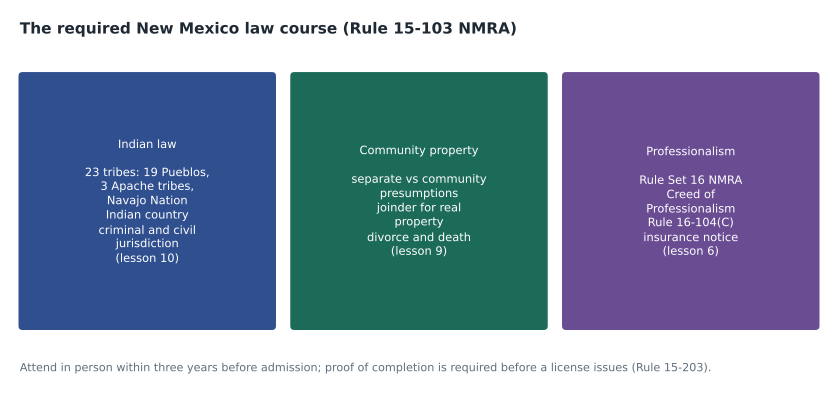
Rule 15-103 NMRA requires every applicant to attend in person and complete a course approved by the Supreme Court covering Indian law, New Mexico community property law and professionalism, within three years before admission. Rule 15-203 NMRA adds the procedural step: before a license issues, the applicant must submit proof of attending and completing a course approved by the Board or the Supreme Court. Bar review summaries describe it as a one-day class organized by the Board of Bar Examiners.
The requirement applies across the routes to a license. NCBE's summary of New Mexico requirements lists the course as a jurisdiction-specific component for both legacy UBE and NextGen candidates, and it applies equally to lawyers admitted by transferred score. Lawyers admitted on motion meet a parallel requirement; the State Bar's continuing education materials refer to a Board course for reciprocity applicants. A transferring lawyer who assumes that a high UBE score is all New Mexico needs will be surprised.
Timing has practical consequences. Because the course must be taken within three years before admission, a candidate can complete it before the exam, between the exam and results, or after results. Candidates who pass and then wait months for the next course date delay their own licenses. Paloma checked the Board's course schedule as soon as she filed, and she plans to attend the first session offered after the February exam.
Part one: Indian law
Indian law is in the course because it is unavoidable in New Mexico practice. Twenty-three tribes are located wholly or partly within the state: nineteen Pueblos, three Apache tribes (the Fort Sill Apache Tribe, the Jicarilla Apache Nation and the Mescalero Apache Tribe) and the Navajo Nation. Each is a sovereign government with its own laws, and most have their own courts. Federal law, not state law, defines most of the boundaries among tribal, federal and state authority.
A new lawyer needs a framework for three recurring questions. Is the place where the events happened Indian country under federal law? Are the people involved Indians, and members of the tribe in question? And is the matter civil or criminal? The answers sort cases into tribal court, federal court or state court, and they determine whether state law applies at all. New Mexico's own constitution, in Article XXI, section 2, disclaims title to lands held by Indian tribes and recognizes the jurisdiction of Congress over them, and New Mexico never assumed jurisdiction under Public Law 280. Lesson 10 develops the framework in detail.
Part two: New Mexico community property law
New Mexico is one of the community property states. Under the Community Property Act, chapter 40, article 3 of the New Mexico Statutes Annotated, property acquired by either spouse during marriage is presumed to be community property, owned equally by both spouses, while property owned before marriage or received by gift or inheritance is separate. The classification affects divorce, death, debt collection, real estate closings and estate planning. A lawyer who drafts a deed, a will or a loan document for a married client without thinking about community property can harm the client badly.
Some of the rules surprise lawyers trained elsewhere. Both spouses must join in transferring or mortgaging community real property, and a transfer by one spouse alone in violation of the statute is void. Property acquired while living in a common law state can be treated as community property in a New Mexico divorce. And at death, a surviving spouse takes the decedent's half of the community property by intestacy. Lesson 9 covers these rules and the divorce and probate law built on them.
Part three: professionalism
The professionalism part of the course introduces the rules and expectations that govern New Mexico lawyers. The core text is the New Mexico Rules of Professional Conduct, Rule Set 16 NMRA. The rules follow the structure of the ABA Model Rules, with New Mexico numbering: Rule 16-101 corresponds to Model Rule 1.1 on competence, Rule 16-104 to Model Rule 1.4 on communication, and so on through the 16-800 series on maintaining the integrity of the profession. A lawyer who knows the Model Rules can find the New Mexico counterpart by dropping the decimal point and adding the 16 prefix.
Alongside the rules sits the State Bar's Creed of Professionalism, a statement of aspirations about courtesy, candor, punctuality and respect for the justice system. The Creed is not a disciplinary rule, but the Supreme Court treats it seriously: every applicant certifies having read it, and a lawyer who ignores it in litigation can expect opposing counsel and the bench to notice.
A New Mexico rule every new lawyer must know: insurance disclosure
One of the most practical New Mexico differences is in Rule 16-104(C), which has no counterpart in the Model Rules. A lawyer who does not carry professional liability insurance with limits of at least 100,000 dollars per claim and 300,000 dollars in the aggregate must tell the client in writing at the time of formal engagement, using the form the rule prescribes, and the client signs an acknowledgment. The same notice is required if a policy in force at engagement lapses or is terminated during the representation. Deductibles and self-insured retentions count toward the limits only if they can actually be paid. The lawyer must keep the disclosures for six years after the representation ends, and every active lawyer certifies on the annual registration statement whether the rule applies and whether the lawyer complies.
The rule does not apply to full-time judges, in-house lawyers for a single corporate employer or lawyers who practice only as government employees. It does apply to provisionally admitted lawyers. In In re Torres, 2016-NMSC-019, the Supreme Court held that the disclosure requirement is mandatory and that a lawyer's failure to tell clients that his policy had lapsed violated the rule. For a new lawyer starting a solo practice in Gallup or Taos, this is not an abstract point: buying insurance or making the disclosure is a first-week task.
| Item | Rule 16-104(C) requirement |
|---|---|
| Minimum coverage | 100,000 dollars per claim, 300,000 dollars aggregate |
| If not insured at engagement | Written notice on the prescribed form; client signs acknowledgment |
| If coverage lapses later | Same notice during the representation |
| Records | Keep disclosures six years after the representation ends |
| Exempt | Full-time judges, single-employer in-house lawyers, government-only lawyers |
| Leading case | In re Torres, 2016-NMSC-019: the requirement is mandatory |
How New Mexico law appears in the licensing process
Putting the pieces together, New Mexico law reaches a new lawyer at four points. The exam does not test it, but the MPT may use family law or estates problems with a library that looks much like New Mexico law, and good MPT technique transfers directly. The course introduces Indian law, community property and professionalism. The certificate of understanding requires the applicant to confirm reading the Rules of Professional Conduct, the disciplinary rules, the Creed and the laws governing attorneys. And Bridge the Gap pairs the new lawyer with a mentor for the first full year of practice, which lesson 11 describes.
For bar preparation, that means a February 2027 candidate should not spend exam study time on New Mexico law. The time for New Mexico law is the course, the clerkship and the first year. This course nonetheless covers New Mexico law in lessons 7 through 10 because a candidate who will practice here needs it, because it is the content of the required course, and because several of the rules, such as community property classification and Tort Claims Act notice, cause real harm when a new lawyer gets them wrong.
Worked problem
Planning the course
Paloma passes the February 2027 exam. Her results arrive in the spring, and the next New Mexico law course is scheduled six weeks later. Her MPRE and character and fitness clearance are complete. Can she be licensed before the course?
Show solution
- Rule 15-203 requires proof of attending and completing the approved course before a license issues.
- Rule 15-103 requires in-person attendance within three years before admission, so a recorded version or a course taken years ago will not do.
- If she had attended a course offered before the exam, it would count, because it would fall within three years before her admission.
Answer: No. She must attend the course first. Candidates who want to be licensed as soon as results arrive should attend a course before or soon after the exam.
Common mistakes
MistakeThe New Mexico law course is optional for UBE transfer applicants.
InsteadThe course is a jurisdiction-specific component for all applicants, including those admitted by transferred score.
MistakeI can complete the course online at my own pace.
InsteadRule 15-103 requires in-person attendance at an approved course within three years before admission.
MistakeThe New Mexico Rules of Professional Conduct are identical to the Model Rules.
InsteadThey follow the Model Rules' structure with 16-series numbering but contain New Mexico provisions, such as the insurance disclosure in Rule 16-104(C).
MistakeThe Creed of Professionalism is just a suggestion with no role in admission.
InsteadEvery applicant certifies having read the Creed as part of the certificate of understanding.
Practicing in tribal courts is a separate admission
A New Mexico license does not by itself allow a lawyer to appear in a tribal court. Each tribe decides who may practice before its courts. The Navajo Nation, the largest tribe in the state, has its own bar association, the Navajo Nation Bar Association, founded in 1978, and its own bar examination for lawyers and tribal court advocates who want to practice in Navajo courts. Other tribes have their own admission rules, which may require an application, a fee, an oath and sometimes familiarity with the tribe's code and customary law. A lawyer who wants to represent a client in the courts of the Pueblo of Zuni, the Jicarilla Apache Nation or the Navajo Nation must check that court's rules first.
Delores Benally is admitted both in New Mexico and before the Navajo Nation courts, and she tells every new clerk the same thing. 'The Navajo Nation's courts apply Navajo statutory law and Diné customary law, and they take both seriously. Do not walk into a Navajo courtroom treating it like a state court with different furniture.'
Getting the most out of the course
The course is short, and candidates who arrive prepared take far more from it. Marchetti suggests three steps. First, read the relevant lessons of this course beforehand, so that the community property and Indian law material is a review rather than a first encounter. Second, bring questions from real work: a clerk at a firm like Benally & Trujillo will have seen deeds, divorce files and tribal court judgments and can ask how the rules apply to them. Third, keep the course materials. They are a useful starting point for research during the first year, before a new lawyer has built a library of New Mexico sources.
The habits the professionalism part is trying to build
The professionalism material in the course is less about memorizing rules than about habits. The habits that matter most in a new New Mexico practice are simple to state and easy to neglect: confirm engagement terms in writing, including the Rule 16-104(C) insurance disclosure where it applies; calendar every deadline, especially short statutory notice periods; return calls and emails promptly; keep client funds separate in a trust account; treat opposing counsel with courtesy even in hard cases; and ask an experienced lawyer before acting when unsure. The Bridge the Gap mentorship, which follows admission, is built to reinforce these habits through the first full year.
Paloma's first assignment at the firm tested one of them. A new client called about a car accident with a county truck that had happened seven weeks earlier. Before anything else, Ray Trujillo asked her to calculate the Tort Claims Act notice deadline and put it on the firm calendar. 'Ninety days from the accident,' he said. 'We have about six weeks. The case can wait a day. The calendar cannot.'
Summary and key terms
- Rule 15-103 requires in-person attendance at a Supreme Court-approved course on Indian law, New Mexico community property law and professionalism within three years before admission.
- Rule 15-203 requires proof of completion before a license issues.
- Twenty-three tribes, nineteen Pueblos, three Apache tribes and the Navajo Nation, are located in New Mexico.
- New Mexico is a community property state; property acquired during marriage is presumed community.
- The Rules of Professional Conduct are Rule Set 16 NMRA, numbered to track the Model Rules.
- Rule 16-104(C) requires written disclosure to clients if a lawyer lacks liability insurance of 100,000 dollars per claim and 300,000 dollars aggregate; In re Torres, 2016-NMSC-019, enforces it.
- 0
- New Mexico law course
- 1
- Indian country
- 2
- community property
- 3
- Rule Set 16 NMRA
- 4
- Creed of Professionalism
- 5
- Rule 16-104(C)
- 6
- In re Torres
- 7
- certificate of understanding
Practice problems
Work each problem on paper first, then reveal the answer to check.
Within what period before admission must the New Mexico law course be taken?
Show answer
Within three years before admission, in person.
What three subjects does the course cover?
Show answer
Indian law, New Mexico community property law and professionalism.
What insurance limits trigger the Rule 16-104(C) disclosure?
Show answer
Coverage below 100,000 dollars per claim and 300,000 dollars aggregate.
Which case held the insurance disclosure requirement mandatory?
Show answer
In re Torres, 2016-NMSC-019.
Lesson quiz · 5 questions
Score 60% or more to complete this lesson.
Create a free account to save your progress, take quizzes and earn a certificate.