
BAR-232 · Lesson 7 of 12 · 20 min
New Mexico courts, civil procedure and limitations periods
▶ Video coming soon A video version of this lesson is on the way.
Paloma's first research assignment at Benally & Trujillo looked simple. A rancher south of Gallup had bought a stock trailer from a dealer in Farmington under a written contract in 2021, and the axle failed in 2026. Ray Trujillo wanted to know which court to sue in, which rules would govern, and whether the claim was still timely. 'Answer those three questions in that order,' he said, 'and do not write a word about the merits until you have.'
Those three questions, where, under what rules and by when, come up in every New Mexico case. The UBE tests federal civil procedure and general principles, but a new New Mexico lawyer needs to know the state's court structure, its rule sets and its limitations periods from the first day. This lesson covers all three.
The court system
New Mexico has a unified state court system under the administrative supervision of the Supreme Court. At the top is the Supreme Court of New Mexico, with five justices, which hears appeals in the most serious criminal cases, reviews decisions of the Court of Appeals by writ of certiorari, regulates the practice of law and adopts the rules of procedure for every state court. Below it, the Court of Appeals is the intermediate appellate court and hears most civil and criminal appeals from the district courts as of right.
The district courts are the courts of general jurisdiction. The state is divided into thirteen judicial districts, each covering one or more counties; McKinley County, where Gallup sits, is in the Eleventh Judicial District together with San Juan County. District courts hear civil cases of any amount, felony prosecutions, domestic relations cases, probate matters that go beyond informal administration, and appeals from courts of limited jurisdiction.
Below the district courts are courts of limited jurisdiction. Magistrate courts sit in every county except Bernalillo and hear smaller civil claims, misdemeanors, traffic matters and the first appearances in felonies. In Bernalillo County, which includes Albuquerque, the Bernalillo County Metropolitan Court serves the same function. Municipal courts hear violations of city ordinances. Probate courts in each county handle informal probate of uncontested estates; their judges need not be lawyers, and a contested matter moves to the district court.
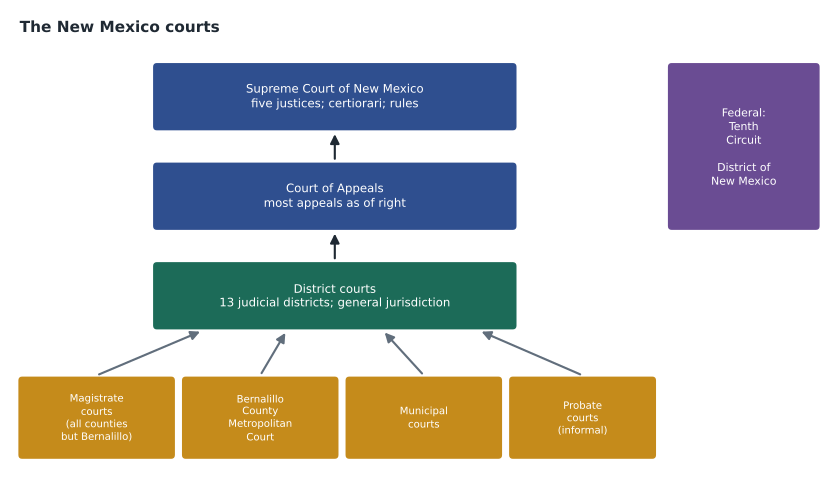
Federal cases in New Mexico go to the United States District Court for the District of New Mexico, with appeals to the Tenth Circuit in Denver. Because so much of New Mexico is Indian country and federal land, federal court is more common for a small-town practice here than in many states, especially in criminal cases involving Indians on reservations and Pueblos, where federal jurisdiction is often exclusive of the state.
The rule sets
The Supreme Court adopts the rules of procedure for every state court, and they appear in the New Mexico Rules Annotated in numbered rule sets. The numbers are worth learning because New Mexico lawyers use them constantly. Rule Set 1 contains the Rules of Civil Procedure for the District Courts, so the rule on the summons is Rule 1-004 NMRA and the rule on motions to dismiss is Rule 1-012 NMRA. The courts of limited jurisdiction have their own civil rule sets. Rule Set 5 contains the Rules of Criminal Procedure for the District Courts. Rule Set 11 contains the Rules of Evidence, so the hearsay definition is in Rule 11-801 NMRA. Rule Set 12 contains the Rules of Appellate Procedure. Rule Set 15 governs bar admission, Rule Set 16 is the Rules of Professional Conduct, and Rule Set 23 contains the Supreme Court's general rules, including Rule 23-112 NMRA on citation form.
Because the district court civil rules are modeled on the Federal Rules of Civil Procedure, a new lawyer who knows the federal rules will recognize most of them. Rule 1-012 tracks federal Rule 12, Rule 1-056 tracks federal Rule 56, and so on. The numbering follows the federal numbering after the prefix. But the texts are not identical, and New Mexico courts interpret their rules for themselves. A lawyer should read the New Mexico rule rather than assume it says what the federal rule says.
| Rule set | Subject | Example |
|---|---|---|
| 1 | Civil procedure, district courts | Rule 1-012 NMRA, defenses and objections |
| 5 | Criminal procedure, district courts | Rule 5-401 NMRA, pretrial release |
| 11 | Rules of Evidence | Rule 11-801 NMRA, definitions for hearsay |
| 12 | Rules of Appellate Procedure | Appeal deadlines and briefing |
| 15 | Admission to the bar | Rule 15-103 NMRA, qualifications |
| 16 | Rules of Professional Conduct | Rule 16-104 NMRA, communication |
| 23 | Supreme Court general rules | Rule 23-112 NMRA, citation form |
Citing New Mexico cases
New Mexico uses a vendor-neutral citation system for its appellate opinions. Each opinion of the Supreme Court or Court of Appeals receives a citation made of the year, the court and a sequence number, such as 2016-NMSC-019 for an opinion of the Supreme Court or 2015-NMCA-097 for one of the Court of Appeals, and pinpoint citations refer to numbered paragraphs rather than pages. Rule 23-112 NMRA sets the citation format. For opinions before 2012 the format adds parallel citations to the New Mexico Reports and the Pacific Reporter, and for later opinions to the Pacific Reporter. A typical citation looks like Scott v. Rizzo, 1981-NMSC-021, 96 N.M. 682, 634 P.2d 1234.
New Mexico's official online source for opinions, statutes and rules is NMOneSource, maintained under the Supreme Court. Paloma bookmarked it on her first day.
Limitations periods
New Mexico's general limitations statutes are in chapter 37, article 1 of the New Mexico Statutes Annotated. The periods a new lawyer meets most often are these. Personal injury actions must be brought within three years under section 37-1-8, and wrongful death actions within three years under section 41-2-2. Actions on written contracts have six years under section 37-1-3, while unwritten contracts, injury to property and fraud have four years under section 37-1-4; fraud claims accrue on discovery under section 37-1-7. Claims for sale of goods under the Uniform Commercial Code have four years under section 55-2-725. Medical malpractice claims governed by the Medical Malpractice Act must be brought within three years from the date of the act of malpractice under section 41-5-13, which runs from the act rather than from discovery. Claims against governmental entities under the Tort Claims Act have two years under section 41-4-15, with a separate ninety-day notice requirement covered in lesson 8. A New Mexico judgment can be enforced for fourteen years under section 37-1-2.
| Claim | Period | Statute (NMSA 1978) |
|---|---|---|
| Personal injury | 3 years | 37-1-8 |
| Wrongful death | 3 years | 41-2-2 |
| Written contract | 6 years | 37-1-3 |
| Unwritten contract, property damage, fraud | 4 years | 37-1-4 (fraud accrues on discovery, 37-1-7) |
| UCC sale of goods | 4 years | 55-2-725 |
| Medical malpractice | 3 years from the act | 41-5-13 |
| Tort Claims Act | 2 years, plus 90-day notice | 41-4-15, 41-4-16 |
| Enforcement of a New Mexico judgment | 14 years | 37-1-2 |
Limitations questions are rarely as simple as reading a table. A lawyer must decide which claim the facts support, when it accrued, whether any tolling rule applies and whether a more specific statute controls. The trailer case shows how.
Worked problem
The trailer case
In 2021 a rancher bought a stock trailer from a dealer in Farmington under a written sales contract with a warranty. The axle failed in March 2026, causing damage to the trailer but no injuries. The rancher wants to sue the dealer in November 2026.
Show solution
- Court: the rancher lives in McKinley County and the dealer is in San Juan County, both in the Eleventh Judicial District, so a district court in either county is a natural choice for a claim of this size, with venue determined by the venue statute. If the claim is small, magistrate court may also be available.
- Rules: in district court, Rule Set 1 governs procedure and Rule Set 11 governs evidence.
- Limitations: a stock trailer is a good, so the claim for breach of the sales contract is governed by the UCC four-year period in section 55-2-725, not the six-year period for written contracts. Under the UCC, a warranty claim generally accrues when tender of delivery is made, unless the warranty explicitly extends to future performance.
- If the trailer was delivered in 2021, four years ran in 2025 unless the warranty extended to future performance. The claim may be time-barred; the lawyer must read the warranty language closely.
Answer: The answer turns on the UCC statute, not the general written-contract statute, and on whether the warranty extended to future performance. Paloma flagged the issue for Ray Trujillo before writing anything about the merits.
Pleading and practice notes
A few practical points recur in early New Mexico practice. Complaints in district court follow Rule 1-008 NMRA's requirement of a short and plain statement of the claim. Service of process follows Rule 1-004 NMRA, which sets out an order of preferred methods for serving individuals. Discovery tracks the federal model but has its own rules and local practices, and each judicial district has local rules that can matter. Many districts require or encourage alternative dispute resolution before trial.
Language access is part of ordinary practice. New Mexico courts provide certified interpreters, and Spanish and Navajo interpretation are common in the courts of the Eleventh Judicial District. A lawyer who represents a client with limited English should request an interpreter early and should plan client meetings with an interpreter as well, since misunderstandings in the office become problems in the courtroom.
Appeals
Appeals in civil cases generally go from the district court to the Court of Appeals, with further review in the Supreme Court by certiorari. The time to appeal is short, and Rule Set 12 controls it, so a lawyer who loses a motion that ends the case should calendar the appeal deadline the same day. Appeals from magistrate and metropolitan courts generally go to the district court. The Supreme Court hears some appeals directly, most notably criminal cases in which a sentence of life imprisonment has been imposed.
Common mistakes
MistakeThe six-year written-contract period always applies when there is a written contract.
InsteadA contract for the sale of goods falls under the UCC four-year period in section 55-2-725, which controls over the general statute.
MistakeA medical malpractice claim accrues when the patient discovers the injury.
InsteadUnder section 41-5-13 the three-year period runs from the date of the act of malpractice.
MistakeNew Mexico civil rules are identical to the federal rules.
InsteadRule Set 1 is modeled on the federal rules and follows their numbering, but the texts and interpretations differ.
MistakePinpoint citations to New Mexico opinions use page numbers.
InsteadVendor-neutral citations use numbered paragraphs.
Researching New Mexico law efficiently
New Mexico's legal sources are compact and well organized, and a new lawyer who learns them early saves hours. Statutes are cited to the New Mexico Statutes Annotated 1978, abbreviated NMSA 1978, by chapter, article and section, such as NMSA 1978, section 41-4-16. The first number is the chapter, so chapter 37 is limitations, chapter 40 is domestic affairs, chapter 41 is torts and chapter 45 is the Uniform Probate Code. Learning the chapter numbers for a practice area makes the code easy to navigate.
Court rules, including the procedural rule sets in this lesson, are collected in the New Mexico Rules Annotated. The same compilation contains the Uniform Jury Instructions, which New Mexico lawyers use as a research tool long before trial. Because the civil instructions state the elements of common claims and defenses in plain language with committee commentary, they are often the fastest way to find the elements of a tort or contract claim under New Mexico law and the leading cases on each element.
For case law, the vendor-neutral citation makes opinions easy to find on NMOneSource. Court of Appeals opinions include a large body of memorandum opinions, which are not precedential; a lawyer should check whether an opinion is published before relying on it. The New Mexico Supreme Court's decisions on certiorari can overrule or limit Court of Appeals opinions, so a lawyer should always check whether a Court of Appeals case was reviewed.
Working with the federal court and the Tenth Circuit
Many New Mexico lawyers practice in both state and federal court. Federal practice in the District of New Mexico follows the Federal Rules of Civil Procedure and the district's local rules, and federal judges in New Mexico apply New Mexico substantive law in diversity cases by predicting how the New Mexico Supreme Court would rule. Where the state's law is unsettled, the federal court can certify a question to the New Mexico Supreme Court, which may accept it and answer. A lawyer researching a New Mexico tort question should therefore check Tenth Circuit and District of New Mexico decisions as well as state cases, while remembering that only the New Mexico Supreme Court has the final word on New Mexico law.
A first-week checklist for a new case
Ray Trujillo gives every new clerk a five-line checklist for any new matter. Identify the claim and the defendant, including whether the defendant is a governmental entity or a tribe or tribal entity. Calculate the limitations period and any notice deadline, and put both on the firm calendar. Identify the court, including whether tribal or federal jurisdiction might be exclusive. Identify the governing rule sets and any local rules. Only then begin work on the merits.
Summary and key terms
- The Supreme Court (five justices) supervises a unified system with the Court of Appeals, district courts in thirteen judicial districts and courts of limited jurisdiction.
- Magistrate courts serve every county except Bernalillo, which has the Bernalillo County Metropolitan Court; probate courts handle informal probate.
- Rule Set 1 (civil), 5 (criminal), 11 (evidence), 12 (appellate), 15 (admission), 16 (professional conduct) and 23 (general rules, including citation) are the core rule sets.
- New Mexico appellate opinions use vendor-neutral citations such as 2016-NMSC-019, with paragraph pinpoints.
- Personal injury and wrongful death have three years, written contracts six, unwritten contracts, property damage and fraud four, UCC sales four, and Tort Claims Act claims two.
- Medical malpractice runs three years from the act; New Mexico judgments are enforceable for fourteen years.
- 0
- judicial district
- 1
- magistrate court
- 2
- Bernalillo County Metropolitan Court
- 3
- probate court
- 4
- NMRA
- 5
- vendor-neutral citation
- 6
- NMOneSource
- 7
- statute of limitations
Practice problems
Work each problem on paper first, then reveal the answer to check.
Which court serves the function of magistrate court in Bernalillo County?
Show answer
The Bernalillo County Metropolitan Court.
What rule set contains the New Mexico Rules of Evidence?
Show answer
Rule Set 11 NMRA.
What is the limitations period for a written contract for services?
Show answer
Six years under section 37-1-3.
When does the limitations period for medical malpractice begin to run?
Show answer
From the date of the act of malpractice, under section 41-5-13.
Lesson quiz · 5 questions
Score 60% or more to complete this lesson.
Create a free account to save your progress, take quizzes and earn a certificate.