
BAR-233 · Lesson 10 of 12 · 20 min
The New York Rules of Professional Conduct, escrow accounts and attorney registration
▶ Video coming soon A video version of this lesson is on the way.
Ngozi prepared for the MPRE on the ABA Model Rules. In New York she will practice under the New York Rules of Professional Conduct, and the NYLE's professional responsibility questions test the New York version. 'Most of it is the same,' Hollis told her. 'The differences are exactly the things that get new lawyers into trouble: engagement letters, escrow accounts, conflict checks, advertising, and the registration you forget to renew.' Gianna added that Rosemarie Cutrone gave her one rule above all others on her first day: 'Never touch the escrow account without asking me.'
This lesson covers the New York Rules of Professional Conduct and the most important New York differences from the Model Rules, the rules on fees and engagement letters, the escrow account rules in Rule 1.15, the 2026 changes to the advertising rules, attorney discipline, and attorney registration.
The New York Rules
The New York Rules of Professional Conduct took effect on April 1, 2009, replacing the older Code of Professional Responsibility. They are adopted by the four Appellate Division departments jointly and published as 22 NYCRR Part 1200, so Rule 1.15 is cited as 22 NYCRR 1200.1.15. The Rules follow the numbering and format of the ABA Model Rules, but New York kept many of its own policies, and a lawyer who knows only the Model Rules will get some New York questions wrong. The New York State Bar Association publishes comments to the Rules, which are helpful but not adopted by the courts.
Fees and engagement letters
Rule 1.5 prohibits excessive or illegal fees and requires the lawyer to communicate the scope of the representation and the basis of the fee and expenses to the client. New York adds a separate written requirement in Part 1215 of the court rules. A lawyer must provide a written letter of engagement, or enter a signed written retainer agreement, explaining the scope of the services, the fees, expenses and billing practices, and, where applicable, the client's right to arbitrate fee disputes under Part 137, the court system's fee dispute resolution program. Part 1215 has exceptions, including matters in which the fee is expected to be less than 3,000 dollars, services of the same general kind previously provided to the same client, domestic relations matters, which have their own rules, and certain lawyers admitted elsewhere who do not have an office in New York.
Contingent fees must be in writing and must explain how the fee is calculated, including whether expenses are deducted before or after the percentage is applied. In personal injury and wrongful death cases, Appellate Division rules limit contingent fees, and Judiciary Law section 474-a sets a sliding scale for medical, dental and podiatric malpractice cases, with the percentage falling as the recovery rises. Rule 1.5 prohibits contingent fees in domestic relations matters and in criminal cases.
Domestic relations matters are governed additionally by Part 1400 of the court rules. A lawyer in a divorce or similar matter must give the client a Statement of Client's Rights and Responsibilities and enter a written retainer agreement, must bill at least every 60 days, and may not take a nonrefundable retainer. Rule 1.5(d) also bars nonrefundable retainer fees generally, though a lawyer may enter a minimum fee arrangement that is clear about when the fee is earned.
Conflicts and confidentiality
The New York conflict rules, Rules 1.7 to 1.10, track the Model Rules in structure, but New York adds a requirement that law firms keep records of prior engagements and maintain a system for checking proposed engagements against them. Rule 1.10(e) requires a firm to have a conflict-checking system adequate to its size and practice, and failure to have one is itself a violation, whether or not a conflict actually arises.
Rule 1.6 protects confidential information, which New York defines broadly to include information gained during or relating to the representation that is protected by the attorney-client privilege, likely to be embarrassing or detrimental to the client if disclosed, or information the client has asked to be kept confidential. The exceptions, such as disclosure to prevent reasonably certain death or substantial bodily harm, to prevent the client from committing a crime, or to defend the lawyer, are similar to but not identical with the Model Rule's. A lawyer should read the New York text before relying on an exception.
Rule 8.4(g) prohibits a lawyer from engaging in unlawful discrimination in the practice of law, a New York rule that predated the ABA's own anti-discrimination rule. New York also continues to enforce Judiciary Law section 487, a statute that makes a lawyer guilty of a misdemeanor and liable for treble damages for deceit or collusion with intent to deceive a court or a party. In Amalfitano v. Rosenberg (2009), the Court of Appeals held that the statute applies to an attempted deceit even if the court is not actually deceived.
Escrow accounts: Rule 1.15
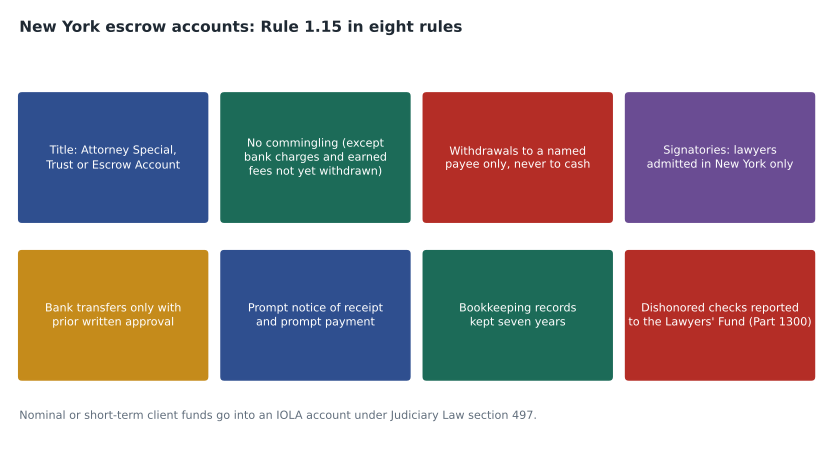
Rule 1.15 is the rule most often at issue in New York discipline cases involving new lawyers and small firms. A lawyer who holds funds belonging to a client or a third person in connection with a representation must keep them in a special account, separate from the lawyer's own funds, in a banking institution in New York, or elsewhere with consent. The account must be titled Attorney Special Account, Attorney Trust Account or Attorney Escrow Account, and the checks and deposit slips must carry that title.
The rule's prohibitions are concrete. A lawyer may not commingle the lawyer's own funds with client funds, except for amounts reasonably needed to cover bank charges and fees that are earned but not yet withdrawn. Withdrawals must be made only to a named payee, never to cash. Only a lawyer admitted in New York may be an authorized signatory on the account. Withdrawals are made by check or, with the prior written approval of the person entitled to the funds, by bank transfer. The lawyer must promptly notify the client or third person when funds in which they have an interest are received, and must promptly pay or deliver funds the person is entitled to.
Rule 1.15(d) requires detailed bookkeeping records: deposit and withdrawal records for each account, ledger records for each client, copies of retainer and closing statements, bank statements and canceled checks, and records of bills. These records must be kept for seven years after the events they record. Under the court system's dishonored check reporting rules in Part 1300, banks must report to the Lawyers' Fund for Client Protection when a check drawn on an attorney special account is dishonored, which commonly triggers a grievance inquiry.
Small amounts of client money that are nominal in amount or held for a short time cannot earn meaningful interest for the client, so New York lawyers deposit them in IOLA accounts, under Judiciary Law section 497. The interest is paid to the state's Interest on Lawyer Account Fund, which supports civil legal services.
Advertising and solicitation: the 2026 amendments
New York's attorney advertising rules were among the most detailed in the country, with labels, disclaimers, filing and retention requirements. Effective June 1, 2026, the Presiding Justices of the four Appellate Division departments adopted amendments that reshaped them along the lines of the ABA Model Rules as amended in 2018. Rule 7.1 now covers all communications about a lawyer or the lawyer's services and prohibits those that are false or misleading; several former content requirements, such as the Attorney Advertising label and the prior-results disclaimer, were removed. Communications must still identify at least one responsible lawyer or firm with contact information. Former Rule 7.4 on specialization was eliminated and its subject moved into Rule 7.1, so that a lawyer may describe a practice as concentrated or specialized if the description is not misleading, and a claim of certification must name the certifying organization.
Rule 7.3 on solicitation was also revised. The amendments removed the former 30-day waiting period on solicitation after a personal injury, wrongful death or mass tort incident, removed filing and recordkeeping requirements for solicitations, and added an exception permitting solicitation of people who routinely use the type of legal service offered for business purposes. Live person-to-person solicitation of ordinary consumers remains restricted. Because these changes are recent, older study materials describing the 30-day rule or the labeling requirements are out of date.
Discipline
Each Appellate Division department supervises lawyers through attorney grievance committees, under the statewide Rules for Attorney Disciplinary Matters in Part 1240, adopted in 2016 to make procedures uniform across the four departments. A grievance committee investigates complaints and may dismiss, issue a private letter of advisement or admonition, or bring formal charges in the Appellate Division, which may censure, suspend or disbar. Serious crimes and misconduct involving escrow funds are treated with particular severity.
Attorney registration and the office requirement
Every lawyer admitted in New York must register with the Office of Court Administration every two years under Judiciary Law section 468-a, during the period around the lawyer's birthday, pay the biennial registration fee, which is currently 375 dollars for most lawyers, and certify compliance with the CLE requirements. A lawyer who fails to register is in violation of the Judiciary Law and may be suspended, and the Appellate Division periodically brings proceedings against lawyers who are years behind. Registration includes lawyers who live and practice outside New York; a lawyer who is retired from practice may register as retired.
Judiciary Law section 470 requires a lawyer who practices in New York courts but does not live in New York to maintain an office in the state. In Schoenefeld v. State of New York (2015), the Court of Appeals, answering a question certified by the federal Second Circuit, held that the statute requires a nonresident lawyer to maintain a physical office in New York, and the Second Circuit then upheld the statute against constitutional challenge. The requirement has been criticized, and proposals to repeal or change it have been made; a nonresident new lawyer should check its current status before appearing in a New York court.
Worked problem
The settlement check
Rosemarie Cutrone's firm receives a 60,000 dollar settlement check for a hypothetical client, Wilhelmina Okereke. The firm's fee under the written contingent fee agreement is one-third after expenses of 3,000 dollars. Cutrone is out of the office and asks Gianna, now a law clerk awaiting admission, to deposit the check and write the checks.
Show solution
- The check belongs in the firm's attorney escrow account, not its operating account, and the firm must promptly notify the client of its receipt.
- Under Rule 1.15, only a lawyer admitted in New York may sign escrow checks; Gianna, not yet admitted, may not.
- Expenses are deducted first under the agreement: 60,000 minus 3,000 is 57,000; one-third is 19,000 dollars in fees; the client receives 38,000 dollars.
- Each withdrawal must be to a named payee, never to cash, and the firm should give the client a closing statement and keep the records for seven years.
Answer: Gianna may help prepare the deposit and closing statement, but Cutrone must sign the escrow checks: 38,000 dollars to the client, 19,000 to the firm and 3,000 to reimburse expenses.
Common mistakes
MistakeThe ABA Model Rules govern New York lawyers.
InsteadNew York lawyers are governed by the New York Rules of Professional Conduct, 22 NYCRR Part 1200.
MistakeEngagement letters are optional in New York.
InsteadPart 1215 requires a letter of engagement or signed retainer unless an exception applies.
MistakeA paralegal or law clerk may sign escrow checks.
InsteadOnly a lawyer admitted in New York may be a signatory.
MistakeNew York still requires a 30-day wait before soliciting accident victims.
InsteadThe June 1, 2026 amendments removed that waiting period.
MistakeRegistration is a one-time step after admission.
InsteadRegistration under Judiciary Law 468-a is every two years, with CLE certification.
Practice problems
Work each problem on paper first, then reveal the answer to check.
Where are the New York Rules of Professional Conduct published?
Show answer
22 NYCRR Part 1200.
What must a Part 1215 engagement letter cover?
Show answer
Scope of services, fees, expenses and billing practices, and, where applicable, the right to fee arbitration under Part 137.
What does Rule 1.10(e) require?
Show answer
A conflict-checking system adequate to the firm's size and practice.
How long must escrow records be kept?
Show answer
Seven years after the events they record.
What did the June 1, 2026 amendments change?
Show answer
They rewrote Rule 7.1 on communications, moved specialization into it, removed the 30-day solicitation waiting period and many filing and labeling requirements.
Fee disputes and client protection
Two court programs often come up in a small firm. Part 137 of the Rules of the Chief Administrator creates the Fee Dispute Resolution Program, under which a client in many civil matters may require the lawyer to arbitrate a fee dispute within the program's range of amounts; the engagement letter must tell the client about this right where it applies, and the lawyer must give notice of it before suing a client for a fee. The Lawyers' Fund for Client Protection, funded through part of the attorney registration fee, reimburses clients who lose money because a New York lawyer stole it in the course of practice. Gianna asked why both mattered to a new lawyer. 'Because the first is how most fee fights end,' Hollis said, 'and the second exists because some lawyers ignored Rule 1.15.'
Summary and key terms
- The New York Rules (22 NYCRR Part 1200), effective April 2009, follow the Model Rules' format but differ in important places.
- Part 1215 requires a letter of engagement or signed retainer, with exceptions such as fees under 3,000 dollars; Part 1400 governs matrimonial retainers.
- Rule 1.10(e) requires a conflict-check system; Rule 8.4(g) prohibits unlawful discrimination; Judiciary Law 487 punishes deceit.
- Rule 1.15: titled escrow account, no commingling, named payees only, New York-admitted signatories, records kept seven years.
- Effective June 1, 2026, the advertising rules were rewritten and the 30-day solicitation pause removed.
- Lawyers register every two years under Judiciary Law 468-a; nonresidents must maintain a New York office under section 470 (Schoenefeld).
- Part 1200
- The New York Rules of Professional Conduct.
- letter of engagement
- The written statement of scope, fees and billing required by Part 1215.
- attorney escrow account
- The titled special account in which a New York lawyer holds client and third-party funds.
- IOLA
- Interest on Lawyer Account, the program for nominal or short-term client funds.
- Judiciary Law 468-a
- The statute requiring biennial attorney registration.
Lesson quiz · 5 questions
Score 60% or more to complete this lesson.
Create a free account to save your progress, take quizzes and earn a certificate.