
BAR-233 · Lesson 6 of 12 · 20 min
The New York Law Course and the New York Law Exam
▶ Video coming soon A video version of this lesson is on the way.
Gianna finished the New York Law Course on Monday, November 9, 2026, after watching its recorded lectures over four evenings. 'You cannot skip ahead,' she reported. 'You cannot speed it up. Every so often it stops and asks you a question, and you have to answer it correctly before it keeps going.' She registered the same night for the December 17, 2026 New York Law Exam, well before the November 17 deadline. Ngozi asked the question everyone asks: 'Is the NYLE hard?' Gianna shrugged. 'It is open book. That is not the same as easy.'
The UBE tests general law. New York's own law is tested separately, through two linked requirements: the New York Law Course, the NYLC, and the New York Law Exam, the NYLE. Every applicant for admission on examination or by transferred UBE score must complete both. This lesson explains how they work, the timing rules that connect them to the UBE, the subjects they cover and how to prepare.
The New York Law Course
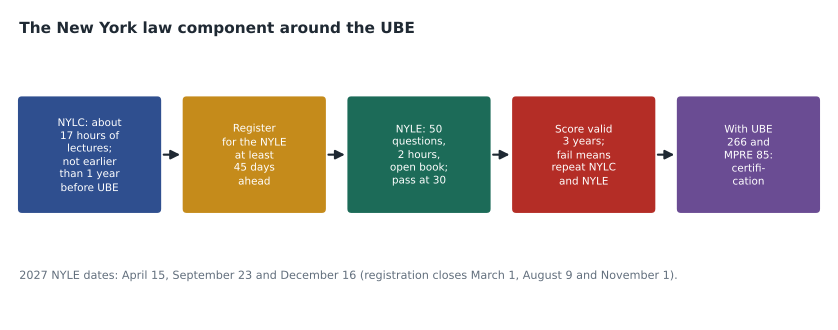
The NYLC is an online course of recorded video lectures on New York law, produced for the Board. Under the Board's rules it is on demand, so applicants watch it when they choose, and it contains embedded questions that the applicant must answer correctly to continue. Each lecture must be watched in full, at normal speed; the software does not allow skipping or fast-forwarding during the required viewing. Law schools that advise students describe the course as about 17 hours of lectures. There is no fee.
The course covers twelve subject areas: administrative law, business relationships, civil practice and procedure, conflict of laws, contracts, criminal law and procedure, evidence, matrimonial and family law, professional responsibility, real property, torts and tort damages, and trusts, wills and estates. Its focus is on the ways New York law differs from the general principles tested on the UBE, and on rules that a new New York lawyer is likely to need in practice.
Once an applicant has completed the course, the lectures remain available to watch again, without the embedded questions, which makes them a useful study resource for the NYLE.
Timing the course
The Board's rules allow the NYLC to be completed no earlier than one year before the applicant first sits the UBE, or at any time after. An applicant who completes the course more than a year before the first UBE sitting must repeat it. The course must be completed before the applicant may register for the NYLE. For applicants transferring a UBE score from another jurisdiction, the same timing rules apply in relation to the UBE they took.
The New York Law Exam
The NYLE is a 50-question multiple-choice exam, two hours long, taken online. It is open book: applicants may consult their own materials, including notes and outlines. It is administered through the Board's exam software, which the applicant must buy, download and register before the deadline. The software does not allow going back to earlier questions once answered, so each question must be finished before moving on. The questions cover the same twelve subjects as the NYLC.
The passing score is 30 correct answers out of 50, which is 60 percent. A passing NYLE score is valid for three years from the date it is received. An applicant who fails the NYLE may take it again without limit, but must complete the NYLC again before each retake. Results are usually released within a few weeks; for the September 24, 2026 NYLE, results were posted to applicants' accounts on October 6, 2026.
| Feature | New York Law Course (NYLC) | New York Law Exam (NYLE) |
|---|---|---|
| Format | Recorded online lectures with embedded questions | 50 multiple-choice questions, open book, online |
| Length | About 17 hours of lectures | Two hours |
| Subjects | Twelve areas of New York law | The same twelve areas |
| Fee | None | A small fee for the exam software |
| Passing | Completion of every lecture | 30 of 50 correct |
| Timing | No earlier than one year before the first UBE | After completing the NYLC; valid three years |
Dates and registration
The NYLE is offered three times a year. In 2026 it was given on September 24 and December 17. In 2027 it will be given on Thursday, April 15, Thursday, September 23 and Thursday, December 16, each beginning at noon Eastern time. Registration closes well before each exam. Under a Board rule effective September 1, 2026, applicants must register electronically at least 45 days before the NYLE, and applicants re-applying for previously approved non-standard test accommodations must apply at least 60 days before. For 2027 the registration deadlines are March 1 for April 15, August 9 for September 23 and November 1 for December 16. The December 2026 NYLE kept its earlier deadline of November 17, 2026.
Why timing matters
A passing UBE result does not lead to certification until the NYLE and the MPRE are also passed. A July examinee who has not taken the NYLE when results come out in late October may have to wait until the December NYLE, and then for its results, before the Board certifies the applicant to the Appellate Division. Law schools therefore encourage students sitting the July exam to take the NYLE before UBE results are released, typically in September. An applicant who plans well can be certified as soon as UBE results arrive.
The three-year validity periods can also catch applicants out. A UBE score is usable for admission only if the application for admission is filed within three years of the exam. A NYLE score is valid for three years from the date it is received. An applicant who took the NYLE a year before the UBE could find that the NYLE score expires before the UBE window closes, and would have to retake the NYLC and NYLE. The safest course is to take the NYLE close to the UBE and file the admission application promptly after passing.
Gianna's timing was slower than ideal: she meant to take the September NYLE but missed its registration deadline while working full-time. 'My UBE pass came in October and I could not use it until the NYLE,' she said. 'If I pass on December 17, I am certified in January instead of November.' Ngozi has already completed the NYLC within the one-year window before her February exam and plans to sit the April 15, 2027 NYLE, after the bar exam but before results.
What the NYLE tests
The NYLE tests New York law at the level a new lawyer needs. The questions tend to focus on New York rules that differ from the majority rules tested on the UBE, and on practical New York rules a new lawyer uses. Lessons 7 to 10 of this course cover many of them: the court structure and the CPLR; pure comparative fault under CPLR 1411 and the limits on joint and several liability in Article 16; the Labor Law's protections for construction workers and the no-fault serious injury threshold; equitable distribution, maintenance guidelines and child support; the execution of wills, intestate shares and the elective share; and the New York Rules of Professional Conduct, including the rules on escrow accounts and letters of engagement.
Because the exam is open book, the challenge is not memory but speed and accuracy. Fifty questions in two hours is less than two and a half minutes each, and there is no going back. An applicant who looks up every answer will run out of time. The best preparation is to know the material well enough to answer most questions directly and to have an organized, indexed outline for the rules that are easy to confuse, such as limitations periods and dollar thresholds.
Preparing efficiently
Hollis recommended a short plan. During the NYLC, take notes by subject, recording each New York rule and how it differs from the general rule. After the course, condense the notes into a single outline of no more than about forty pages, organized by the twelve subjects, with a one-page index of numbers: limitations periods, notice periods, dollar amounts and percentages. Practice with any sample questions the Board publishes and with a commercial question set if one is available. Take one timed practice of 50 questions in two hours using the outline, to learn how often looking things up helps and how often it only costs time.
Ngozi asked whether the NYLE could hurt her UBE preparation. Hollis's answer was that it depends on timing. Studying New York distinctions while preparing for the MBE can confuse an applicant who is still learning the general rule. The safer approach for a February examinee is to complete the NYLC early, as Ngozi did, but leave serious NYLE review until after the bar exam.
Worked problem
Will she be certified on time?
A hypothetical July 2027 examinee, Kavitha Ramaswamy, completes the NYLC in June 2026, sits the UBE on July 27-28, 2027, and plans to take the NYLE on September 23, 2027.
Show solution
- The NYLC may be completed no earlier than one year before the first UBE sitting. June 2026 is more than a year before July 27, 2027.
- Her NYLC completion therefore does not count, and she must complete it again within the window before registering for the NYLE.
- For the September 23, 2027 NYLE, registration closes on August 9, 2027, at least 45 days before the exam.
- If she completes the NYLC again and registers by August 9, she can sit the NYLE in September, before UBE results are released, and be certified promptly if she passes both.
Answer: She must redo the NYLC between July 27, 2026 and August 9, 2027 and register for the NYLE by August 9, 2027.
Common mistakes
MistakeThe NYLC can be completed at any time during law school.
InsteadIt must be completed no earlier than one year before the first UBE sitting.
MistakeThe NYLE is closed book.
InsteadIt is open book, but only two hours long for 50 questions with no going back.
MistakeA failed NYLE can be retaken immediately.
InsteadThe applicant must complete the NYLC again before each retake.
MistakeNYLE registration closes 30 days before the exam.
InsteadFrom September 1, 2026, registration closes 45 days before the exam.
MistakeA passing NYLE score lasts as long as the UBE score.
InsteadIt is valid for three years from the date received, which may expire earlier.
Practice problems
Work each problem on paper first, then reveal the answer to check.
What is the NYLE passing score?
Show answer
30 correct answers out of 50.
How long is a passing NYLE score valid?
Show answer
Three years from the date it is received.
When may the NYLC be completed?
Show answer
No earlier than one year before the applicant's first UBE sitting, or any time after.
What are the 2027 NYLE dates?
Show answer
April 15, September 23 and December 16, 2027.
What must an applicant do before retaking a failed NYLE?
Show answer
Complete the NYLC again.
Five original NYLE-style warm-ups
Hollis wrote five short questions in the style of the NYLE, original to the group and not drawn from any released exam, and asked Ngozi and Gianna to answer each in under two and a half minutes using only a one-page index.
The first: a pedestrian injured by a negligent driver is found 40 percent at fault, with damages of 200,000 dollars. What does she recover in New York? The answer is 120,000 dollars, because CPLR 1411 applies pure comparative fault and reduces her damages by her share rather than barring recovery. Ngozi answered in twenty seconds; it is the kind of question the NYLE uses to check that an examinee has not carried a majority or modified rule over from the MBE.
The second: a client wants to sue a town for a fall on a town-owned sidewalk that happened four months ago. What is the first problem? The 90-day notice of claim under General Municipal Law section 50-e has passed, so the client needs leave to serve a late notice. Gianna knew this one from her firm.
The third: a will is signed at the end by the testator, who tells two witnesses it is her will; one witness signs that day and the other signs 45 days later. Is the will validly executed? Under EPTL 3-2.1 the witnesses must attest within one 30-day period, so the late attestation is a problem, and a court would ask whether the requirements were met within a single 30-day window. Ngozi wanted to look this up and did, which cost her a minute: the index entry 'wills, 30 days' would have saved it.
The fourth: a construction worker falls from an unsecured ladder and is found partly careless. Can the owner reduce damages for his negligence under Labor Law section 240(1)? No; comparative negligence is not a defense to a section 240(1) claim, though a worker whose own conduct was the sole proximate cause cannot recover under the statute.
The fifth: a lawyer receives a 15,000 dollar settlement check for a client. Where must it go? Into the lawyer's attorney special, trust or escrow account, kept separate from the lawyer's own funds under Rule 1.15 of the New York Rules of Professional Conduct, with prompt notice to the client.
Both of them got all five right. Both also noticed that the questions they answered fastest were the ones where they knew both the general rule and the New York rule and could see the difference immediately. 'That is the whole exam,' Hollis said. 'Know the difference.'
Summary and key terms
- The NYLC is about 17 hours of recorded lectures on twelve subjects of New York law, with embedded questions and no fee.
- The NYLC may be completed from one year before the first UBE sitting onward and must precede the NYLE.
- The NYLE is 50 open-book multiple-choice questions in two hours online; 30 correct passes; the score lasts three years.
- From September 1, 2026, NYLE registration closes 45 days before the exam; 2027 dates are April 15, September 23 and December 16.
- Certification requires the UBE, NYLE and MPRE, so July examinees should take the NYLE before UBE results.
- NYLC
- The New York Law Course, an online lecture course on New York law required before the NYLE.
- NYLE
- The New York Law Exam, a 50-question open-book online exam on New York law.
- embedded question
- A question inside an NYLC lecture that must be answered correctly to continue.
- open book
- An exam at which the examinee may consult notes and materials.
- certification
- The Board's notice sending an applicant who has passed all exams to the Appellate Division.
Lesson quiz · 5 questions
Score 60% or more to complete this lesson.
Create a free account to save your progress, take quizzes and earn a certificate.