
BAR-233 · Lesson 4 of 12 · 21 min
The New York bar exam: the UBE, scoring and the 266 passing score
▶ Video coming soon A video version of this lesson is on the way.
Hollis asked Gianna to describe her July exam to Ngozi, who sits in February. 'Two days,' Gianna said. 'Tuesday is writing: two performance tests in the morning, three hours, and six essays in the afternoon, three hours. Wednesday is the MBE: a hundred questions in the morning, a hundred in the afternoon. You type the writing on your laptop. The MBE is on paper with a pencil. You leave on Wednesday afternoon feeling like you failed, and then you wait three months.' She paused. 'I scored 284. I needed 266. I still thought I failed.'
New York gives the Uniform Bar Examination, written by NCBE and graded in New York, and it will keep giving it through February 2028. This lesson explains the structure of the UBE, how the three parts are scored and combined, what New York's passing score of 266 means, the regrading rule for scores just below the line, and how and when results are released.
The structure of the UBE
The UBE has three parts, all written by NCBE. The Multistate Performance Test, the MPT, consists of two 90-minute tasks. Each gives the examinee a File of facts and a Library of legal authorities and asks for a piece of legal writing, such as an objective memo, a persuasive brief, a client letter or a demand letter. The MPT tests lawyering skills: following instructions, separating relevant facts from irrelevant ones, extracting rules from the Library and writing a usable product. All the law needed is in the Library.
The Multistate Essay Examination, the MEE, consists of six 30-minute essay questions. Since July 2026 NCBE has drawn MEE questions from a narrower list of subjects: business associations (agency and partnership, corporations and limited liability companies), civil procedure, constitutional law, contracts including Article 2 of the Uniform Commercial Code, criminal law and procedure, evidence, real property and torts. Conflict of laws, family law, trusts and estates and secured transactions were removed from the MEE for the remaining legacy administrations. The MEE tests general principles, not New York law.
The Multistate Bar Examination, the MBE, consists of 200 multiple-choice questions over two three-hour sessions, 100 in each. Of the 200, 175 are scored and 25 are unscored pretest questions that look exactly like the others. The MBE covers civil procedure, constitutional law, contracts, criminal law and procedure, evidence, real property and torts.
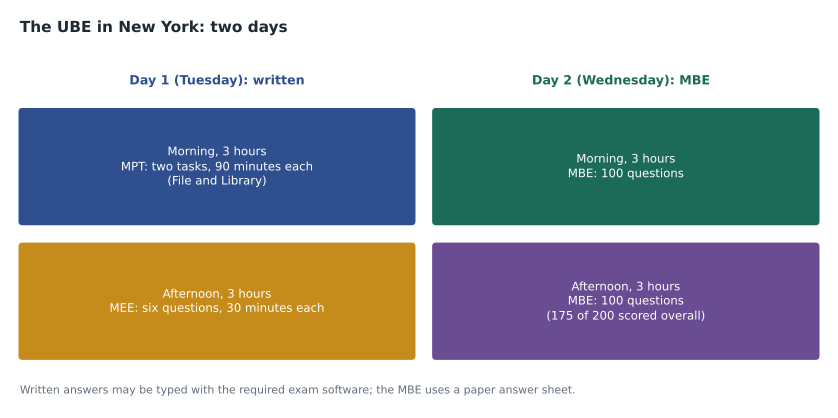
In New York, the written components are given on the first day, a Tuesday, and the MBE on the second day, a Wednesday. The February 2027 exam is on February 23 and 24, and the July 2027 exam on July 27 and 28. The Board assigns each applicant to a test site and publishes site information before the exam. Applicants may type the MPT and MEE on their own laptops using the required exam software, or handwrite them; laptop users pay the laptop fee and must register the software by the deadline. The MBE is answered on a paper answer sheet.
How the parts are weighted
Each component is scaled, and the three are combined into a single UBE score on a 400-point scale. The weights are fixed for every UBE jurisdiction: the MBE counts for 50 percent of the total, the MEE for 30 percent and the MPT for 20 percent. In other words, half the score comes from multiple choice and half from writing, and within the writing half the six essays count for more than the two performance tests.
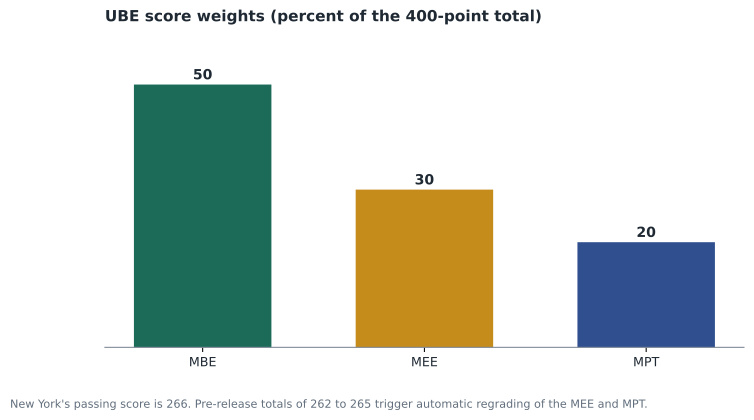
Scaling is what makes UBE scores portable. The MBE is equated by NCBE across administrations, so that a given scaled MBE score represents the same level of performance from one exam to the next regardless of small differences in difficulty. The written scores are then scaled to the MBE: the raw MPT and MEE grades in a jurisdiction at a given administration are mapped onto the MBE scale for that group of examinees. This means that graders in New York grade the written answers relative to one another, using NCBE's grading materials, and the scaling places those grades on a common footing with every other UBE jurisdiction.
Two consequences follow for candidates. First, the score is compensatory: there is no minimum on any one part, and a strong MBE can offset weaker essays or the reverse. Second, because written scores are scaled to the MBE performance of the group, an examinee's written score depends on how the answer compares with other answers in New York at that administration. A clear, organized, complete answer that addresses the call of the question earns points even when the examinee is unsure of a rule; a blank or unfinished answer earns very little.
The 266 passing score
Under the Board's rules, the score required to pass the UBE in New York is 266. The score is on the 400-point UBE scale. New York's 266 sits in the middle of the range among UBE jurisdictions, which runs from 260 to 270. The figure matters beyond New York: a candidate who scores 266 in New York passes New York but may not have a score high enough to transfer to a jurisdiction that requires 270, while a score of 266 earned in another UBE jurisdiction is high enough to transfer into New York.
| Score | Result in New York | Example of what it means elsewhere |
|---|---|---|
| 260 | Does not pass | Passes in jurisdictions that set 260 |
| 262 to 265 | Does not pass; written answers are regraded first | Depends on the other jurisdiction |
| 266 | Passes | Transfers to jurisdictions at 266 or below |
| 270 or more | Passes | Transfers to every UBE jurisdiction's passing score |
The regrading rule
New York has an unusual rule for scores just below the line. Under section 6000.11 of the Board's rules, an examinee whose total weighted scale score falls between 262 and 265 before release has the MEE and MPT answers regraded by different graders, and the final UBE score is recomputed using the regrade. This happens automatically, before results are released; the examinee does not ask for it. After the final score is computed, there is no appeal. An examinee who still falls short after regrading has failed and may sit again.
Hollis pointed out what the rule does not do. It does not regrade the MBE, which is machine-scored. It does not apply to an examinee at 261 or below. And it does not guarantee a higher score: the regrade can go down as well as up. 'The rule exists to make sure a borderline result is right,' she said. 'Your job is to stay out of the borderline.'
Results
The Board releases results to examinees' online accounts. For the July 2026 exam, results were posted on October 23, 2026, and the public list of passing candidates was posted on October 26, 2026. February results typically come out in the spring. An examinee who failed sees the component scores in the account, which shows where the points were lost; the Board's website explains its current procedure for failing candidates who want to review their written answers. A failing examinee who wants to sit the next exam must re-apply by the later of the regular deadline or the seventh day after results.
A passing result is not admission. As lesson 1 explained, a candidate who has passed the UBE must also have passed the New York Law Exam and the MPRE before the Board certifies the candidate to the Appellate Division. Gianna's result letter said exactly that: she passed the UBE and would be certified once her NYLE score arrived.
Strategy by component
The MBE rewards breadth and volume of practice. Because it is half the score, most candidates should spend the largest share of their study time on timed MBE questions, reviewing every explanation, keeping an error log and returning to weak subjects. A realistic goal for many New York candidates is a scaled MBE score in the high 130s or above, which gives room for ordinary essays; but the score is compensatory, so there is no single target.
The MEE rewards a disciplined method: read the call first, identify the issues, state the rule, apply it to the specific facts and conclude. Graders look for issue spotting and analysis more than for perfect rule statements. With the narrower MEE subject list from July 2026, candidates can concentrate on fewer subjects, but those subjects overlap heavily with the MBE, which makes study time count twice.
The MPT rewards following instructions and managing time. Each 90-minute task should be planned: read the task memo, skim the Library for rules, read the File for facts, outline and write. A complete, well-organized product in the format requested beats an elegant but unfinished one.
Ngozi, who will type her written answers, has practiced six MEE questions in three hours twice a week since October and two MPTs in three hours each Friday. Her diagnostic MBE score in early November was 131 scaled. 'My target is to be above 140 by February,' she said, 'so my essays can be ordinary.'
Worked problem
Reading a score report
A hypothetical examinee, Fintan Ainsworth, receives a July score report showing a scaled MBE score of 135.0, a written scaled score of 128.0 (MEE and MPT combined) and a total UBE score of 263. He asks whether he can appeal and whether his MBE score can be banked for the next exam.
Show solution
- The total is below 266, so he did not pass.
- Because his score was between 262 and 265 before release, his MEE and MPT answers were already regraded by different graders under section 6000.11; 263 is the recomputed final score.
- There is no appeal from a final score after regrading.
- New York does not allow an MBE score from one administration to be combined with written scores from another; all parts must be taken at the same exam.
Answer: He did not pass, cannot appeal and cannot bank his MBE. He can re-apply by the later of the regular deadline or seven days after results and sit the full exam again.
Common mistakes
MistakeNew York requires 270 on the UBE.
InsteadNew York's passing score is 266.
MistakeThe MEE and MPT each count for a third of the score.
InsteadThe MBE counts 50 percent, the MEE 30 percent and the MPT 20 percent.
MistakeAn examinee at 264 can request a regrade.
InsteadScores from 262 to 265 are regraded automatically before release; there is no request and no appeal.
MistakeThe MEE tests New York law.
InsteadThe MEE tests general principles; New York law is tested by the New York Law Exam.
MistakeFamily law and trusts are still MEE subjects.
InsteadFrom July 2026 they were removed from the MEE, along with conflict of laws and secured transactions.
Practice problems
Work each problem on paper first, then reveal the answer to check.
What are the three parts of the UBE and their weights?
Show answer
MBE 50 percent, MEE 30 percent, MPT 20 percent.
How many MBE questions are scored?
Show answer
175 of the 200; 25 are unscored pretest questions.
What is New York's passing score?
Show answer
266 on the 400-point UBE scale.
What happens to a pre-release score between 262 and 265?
Show answer
The MEE and MPT answers are regraded by different graders and the score is recomputed.
When were July 2026 results released?
Show answer
October 23, 2026, with the public pass list on October 26, 2026.
Exam day in New York
Hollis walked through exam day as Gianna lived it. The admission ticket, printed from the BOLE account, lists the test site and seat assignment, and the name on it must match the government-issued photo identification the examinee brings. Sites open before the start of each session for check-in, and the Board's attendance rules are strict: an examinee who arrives more than 30 minutes after a session starts is not admitted, and an examinee who misses a first-day session may not sit the MBE the next day. Gianna arrived an hour early on both days. 'The line for check-in was long,' she said. 'Nobody in it was relaxed.'
The Board publishes a list of items that may and may not be brought into the room, and examinees should read the current list rather than relying on what a friend was allowed. In general, phones and other electronic devices other than the registered laptop are not allowed at the desk, study materials are prohibited and food and drink are restricted. Laptop users should charge the laptop fully, bring the power cord if the rules allow it, and run the exam software's practice test in the days before the exam so that the first time it opens is not the first morning of the bar exam.
Pacing is the skill that matters most on the day. On the morning of day one, the two MPTs share three hours, and the clock does not divide itself: a candidate who spends 110 minutes on the first task has 70 for the second. On the afternoon of day one, six essays share three hours, which means 30 minutes each. On day two, each MBE session gives 100 questions in three hours, or about one minute and 48 seconds per question. Hollis suggested checkpoints: question 34 by the end of the first hour, question 67 by the end of the second. 'Write the checkpoints on the scratch paper before you start,' she said. 'Then look at the clock only at the checkpoints.'
Between the days, the best preparation is rest. Gianna admitted she reviewed MBE flashcards late into Tuesday night and regretted it. Ngozi's plan for February is a short walk, a simple dinner and twenty minutes on a single page of evidence rules she always forgets, then sleep.
Why a 266 is not a target
Candidates sometimes treat the passing score as the goal. Hollis warned against this, for two reasons. The first is variance: a candidate whose practice performance sits at about 266 has roughly even odds on the day, because a hard essay set, a slow MPT or a bad night's sleep moves the score a few points either way. A practice level comfortably above the line is the real goal. The second is portability. A candidate who might want to practice in another UBE jurisdiction within three years should know that jurisdiction's passing score; a score of 270 or more transfers everywhere, while a score of 266 transfers only to jurisdictions whose passing score is 266 or lower.
Summary and key terms
- The UBE has the MPT (two 90-minute tasks), the MEE (six 30-minute essays) and the MBE (200 questions, 175 scored).
- In New York the written parts are on Tuesday and the MBE on Wednesday; February 2027 is February 23-24.
- Weights are MBE 50, MEE 30 and MPT 20 percent; written scores are scaled to the MBE; the score is compensatory.
- New York's passing score is 266; scores of 262 to 265 are regraded automatically before release, with no appeal.
- Since July 2026 the MEE omits conflict of laws, family law, trusts and estates and secured transactions.
- A passing UBE result leads to certification only after the NYLE and MPRE are also passed.
- UBE
- The Uniform Bar Examination, NCBE's portable bar exam made up of the MBE, MEE and MPT.
- MBE
- The Multistate Bar Examination, 200 multiple-choice questions over two sessions.
- MEE
- The Multistate Essay Examination, six 30-minute essay questions.
- MPT
- The Multistate Performance Test, two 90-minute tasks using a File and a Library.
- scaling
- Placing written scores on the MBE scale so that UBE scores are comparable.
Lesson quiz · 5 questions
Score 60% or more to complete this lesson.
Create a free account to save your progress, take quizzes and earn a certificate.