
BAR-233 · Lesson 12 of 12 · 21 min
Capstone: New York practice questions and an exam-day plan
▶ Video coming soon A video version of this lesson is on the way.
For the last New York session Hollis sent Ngozi and Gianna a packet of three original problems, written for the group and not drawn from any released bar exam or NYLE, with instructions to answer each in IRAC form in about 30 minutes, the time allowed for an MEE question. 'The UBE will not test New York law,' she wrote, 'but the NYLE will, and your first supervising partner will. These problems mix both.' The packet ended with a fourth task: a written exam-day plan. This lesson sets out the problems, model analyses and the plan.
Problem 1: the warehouse roof
Facts. Pelham Dock Logistics LLC owns a warehouse in Queens. It hires Stanwick Builders Inc. as general contractor to replace the roof. Stanwick subcontracts the work to Tidewell Roofing Co., which employs Dmitri Salazar-Penn as a roofer. Stanwick's site foreman, aware that the roof edge had no guardrails and that the harnesses supplied were too few for the crew, told Tidewell to proceed anyway to keep to schedule. On March 12, 2026, Salazar-Penn, without a harness because none was left, slipped on loose gravel and fell 20 feet from the roof edge. He suffered a fractured pelvis and a brain injury causing permanent total disability. A jury later finds Salazar-Penn 20 percent at fault, Stanwick 30 percent, Pelham Dock 0 percent (it did not supervise the work) and Tidewell, which is not a party, 50 percent. His damages are 1,000,000 dollars for pain and suffering and 600,000 dollars in lost earnings and medical costs. Discuss the claims under the Labor Law and the effect of comparative fault and Article 16.
Issue. Whether Pelham Dock and Stanwick are liable under Labor Law section 240(1), whether Salazar-Penn's fault reduces recovery, and whether Article 16 limits Stanwick's share of non-economic damages.
Rule. Section 240(1) imposes a non-delegable duty on owners and contractors engaged in covered work, including repairing or altering a building, to provide safety devices giving proper protection against gravity-related risks; liability is absolute once a violation proximately causes injury, and the worker's comparative negligence is not a defense, though sole proximate cause defeats the claim (Blake). Liability under Article 10 of the Labor Law is an exception to Article 16 under CPLR 1602, so defendants liable under section 240(1) remain jointly and severally liable. Workers' Compensation Law section 11 bars third-party claims against the employer unless the employee suffered a grave injury.
Application. Roof replacement is repair or alteration of a building, and a 20-foot fall from an unguarded roof edge without a harness is the classic elevation risk. The absence of guardrails and sufficient harnesses is a failure to provide proper protection, and it was a proximate cause of the fall. Pelham Dock is liable as owner although it did not supervise, because the duty is non-delegable; Stanwick is liable as general contractor. Salazar-Penn's 20 percent fault does not reduce his section 240(1) recovery, and his conduct cannot be the sole proximate cause where the necessary devices were not available. Because liability under section 240(1) falls within the CPLR 1602 exception for Labor Law Article 10, Article 16 does not limit either defendant's share of non-economic loss. As for Tidewell, the employer: Salazar-Penn cannot sue it, but Pelham Dock and Stanwick may seek contribution or indemnity from it because a brain injury causing permanent total disability is a grave injury under section 11.
Conclusion. On the section 240(1) claim, Pelham Dock and Stanwick are jointly and severally liable for the full 1,600,000 dollars, without reduction for Salazar-Penn's fault, and may pursue Tidewell for contribution or indemnity because the injury is grave. The jury's fault percentages matter for any section 241(6) or section 200 claims, where comparative negligence applies, and for contribution among the defendants, but not for the plaintiff's recovery under section 240(1).
Problem 2: the estate and the divorce that never finished
Facts. Lorenzo Battaglia-Reyes, domiciled in Westchester County, died on June 2, 2026. His 2019 will, signed at the end and witnessed by two neighbors on the same afternoon after he told them it was his will, leaves everything to his brother Sergio. Sergio died in 2025, survived by a son, Mateus. Lorenzo had commenced a divorce action against his wife Yolanda in 2025, but no judgment was entered before he died. Lorenzo also held a joint bank account with survivorship rights with his niece Fernanda, containing 300,000 dollars, funded entirely by him. His probate estate, after debts and expenses, is 600,000 dollars. Yolanda asks what she is entitled to.
Issue. Who takes under the will, whether the pending divorce affects Yolanda's rights, and what Yolanda can obtain through the elective share.
Rule. EPTL 3-2.1 sets the execution requirements; EPTL 3-3.3 saves a gift to the testator's brother or sister who predeceases leaving issue; EPTL 5-1.4 revokes provisions for a former spouse on divorce or annulment, which requires a judgment; and EPTL 5-1.1-A gives a surviving spouse the greater of 50,000 dollars or one-third of the net estate, which includes testamentary substitutes such as joint accounts with survivorship, subject to disqualification in limited circumstances such as abandonment.
Application. The will was validly executed: it was signed at the end, published to two witnesses and attested by both the same day. The gift to Sergio would lapse, but Sergio was Lorenzo's brother and left a son, so under the anti-lapse statute the gift passes to Mateus. Yolanda is not mentioned in the will. Because no divorce judgment was entered, she remains Lorenzo's surviving spouse; EPTL 5-1.4 does not apply. Her elective share is computed on the net estate including testamentary substitutes: the 600,000 dollar probate estate plus the 300,000 dollar joint account, 900,000 dollars in all. One-third is 300,000 dollars, which is greater than 50,000. Unless Mateus can show a ground for disqualification, which a pending divorce alone is not, Yolanda may elect within six months of the issuance of letters and no later than two years after death.
Conclusion. Mateus takes under the will by anti-lapse, Fernanda takes the joint account by survivorship, but Yolanda may elect 300,000 dollars, contributed from the estate and from the testamentary substitute. She should file a timely election in the Surrogate's Court, Westchester County.
Problem 3: the new associate and the escrow account
Facts. Aurelio Benavides-Stone passed the July 2026 New York UBE and the September 2026 NYLE and was admitted in January 2027. In February 2027 his firm's managing partner asks him to take over a personal injury matter. The client, Wendeline Haverkamp-Rao, receives a 90,000 dollar settlement. The partner tells Aurelio to deposit the check in the firm's operating account 'just for a day' because the escrow account has a hold, and to withdraw the firm's fee by a check payable to cash. Aurelio also realizes the firm never gave the client a written fee agreement, though the file shows a verbal contingent fee of one-third. Advise Aurelio.
Issue. Whether the proposed handling of the settlement complies with Rule 1.15, whether the fee arrangement complies with the rules on contingent fees, and what Aurelio's own obligations are.
Rule. Rule 1.15 requires client funds to be held in a titled attorney special, trust or escrow account, forbids commingling with firm funds, requires withdrawals to named payees only and never to cash, and requires prompt notice to the client and prompt delivery of funds. Rule 1.5 and the Appellate Division rules require a contingent fee arrangement to be in a writing explaining the method of calculation. Rule 5.2 makes a subordinate lawyer responsible for his own violations, except where he acts on a supervisor's reasonable resolution of an arguable question of professional duty.
Application. Depositing the settlement in the operating account would commingle client funds with firm funds, whatever the reason or duration; this is not an arguable question but a clear violation. Withdrawing the fee by a check to cash is also expressly prohibited. Aurelio must deposit the check in the escrow account, notify the client promptly and disburse by checks to named payees once the funds clear. The missing written contingent fee agreement is a separate problem: the firm should not take a contingent fee that was never put in writing as required without resolving the issue with the client, and the partner should be told so. Because the instructions involve clear violations, Rule 5.2 offers Aurelio no protection if he follows them.
Conclusion. Aurelio should decline the instructions, explain the Rule 1.15 requirements to the partner, deposit the funds in escrow, notify the client, and raise the fee agreement problem. If the firm insists on misconduct, he should seek ethics advice, which the New York State Bar Association and local bar associations make available.
A self-check after the problems
Gianna scored her own answers with Hollis's checklist: did each answer name the New York rule and the general rule where they differ, apply each rule to the specific facts, and reach a clear conclusion? Ngozi noticed that every problem turned on a New York distinction she had studied in this course: the scaffold law's rejection of comparative negligence, Article 16's exceptions, the grave injury rule, anti-lapse limited to issue and siblings, testamentary substitutes and New York's escrow rules. Both of them missed one point: neither noticed in Problem 1 that the jury's fault findings still mattered for contribution among the defendants and for any section 241(6) claim.
The exam-day plan
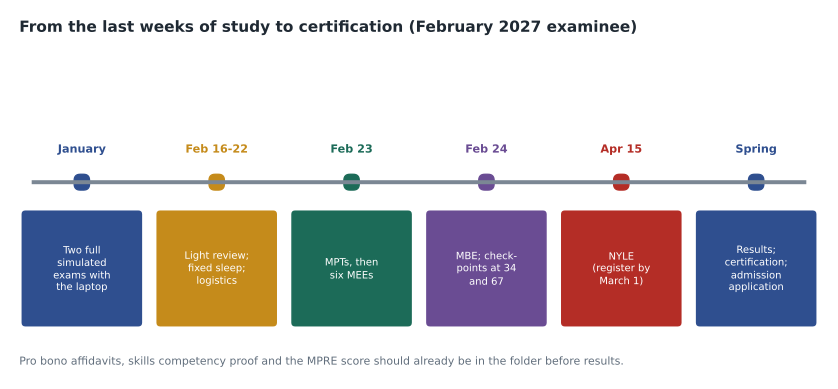
The fourth task was a written plan. Ngozi's plan for the February 23-24, 2027 exam, refined with Hollis, is shown below, together with the steps that follow.
| When | Step |
|---|---|
| January 2027 | Two full simulated exams on Saturdays and Sundays: two MPTs and six MEEs, then 200 MBE questions the next day, with the laptop and exam software |
| By the Board's deadline | Register and test the exam software on the laptop; print the admission ticket; confirm the site and travel |
| February 16 to 22, 2027 | Light review only: MBE error log, one-page rule summaries, sleep on a fixed schedule |
| Monday, February 22, 2027 | Pack identification, ticket, laptop and charger, permitted items; short walk; early night |
| Tuesday, February 23, 2027 | Morning: two MPTs, 90 minutes each; afternoon: six MEEs, 30 minutes each; no discussion of answers afterward |
| Wednesday, February 24, 2027 | MBE: 100 questions in each three-hour session; checkpoints at questions 34 and 67 in each session |
| By March 1, 2027 | Register for the April 15, 2027 NYLE (NYLC already completed within the window) |
| April 15, 2027 | NYLE: 50 questions, two hours, open book, with an indexed outline |
| Spring 2027 | UBE results; MPRE score already sent; Notice of Certification; Third Department or other department application with pro bono and skills competency affidavits |
Gianna's plan is shorter, because her exam is behind her: finish NYLE review by December 14, sit the NYLE on December 17, 2026, file the Second Department application the day she is certified, prepare for her character and fitness interview by rereading her own application, and register with the Office of Court Administration promptly after admission. 'And keep the folder,' she said.
Closing advice
Hollis ended the course with three sentences for the group's notes. Prepare for the UBE as a general-law exam and the NYLE as a New York-law exam, and do not mix them in the last month. Finish every New York requirement you can before results come out, so that a pass leads straight to certification. And read the rule itself, on the Court's or the Board's website, before every deadline, because New York's rules have changed in 2024, 2026 and will change again in 2028.
Worked problem
Choosing the right NYLE date
A hypothetical examinee, Jun-seo Ainsley, will sit the July 27-28, 2027 UBE in New York and completed the NYLC on July 1, 2027. He asks which NYLE to take.
Show solution
- His NYLC completion is within one year before his first UBE, so it counts.
- The 2027 NYLE dates are April 15, September 23 and December 16; registration closes 45 days before each.
- July UBE results typically come out in late October, so the September 23 NYLE, with registration by August 9, 2027, lets him be certified as soon as UBE results arrive.
- Registration takes only minutes, so he can register in the first days of August, after the UBE, without losing study time before it.
Answer: He should register by August 9, 2027 and sit the September 23, 2027 NYLE.
Common mistakes
MistakeA worker's fault reduces a Labor Law 240(1) award.
InsteadIt does not, unless the worker's conduct was the sole proximate cause.
MistakeA pending divorce cuts off a spouse's elective share.
InsteadOnly a judgment of divorce or annulment, or a statutory disqualification, does.
MistakeJoint accounts are outside the elective share.
InsteadJoint accounts with survivorship are testamentary substitutes included in the net estate.
MistakeA new associate who follows a partner's instruction is always protected.
InsteadRule 5.2 protects only reliance on a reasonable resolution of an arguable question.
MistakeThe exam plan ends on day two.
InsteadThe NYLE, certification and the admission application follow, and need their own dates.
Practice problems
Work each problem on paper first, then reveal the answer to check.
Why are Pelham Dock and Stanwick jointly and severally liable in Problem 1?
Show answer
Labor Law Article 10 liability is a CPLR 1602 exception to Article 16.
Why may the defendants in Problem 1 seek contribution from the employer?
Show answer
A brain injury causing permanent total disability is a grave injury under Workers' Compensation Law section 11.
Who takes Sergio's gift in Problem 2, and why?
Show answer
Mateus, under the anti-lapse statute, because Sergio was the testator's brother and left issue.
What is Yolanda's elective share in Problem 2?
Show answer
One-third of 900,000 dollars, or 300,000 dollars, including the joint account.
What two Rule 1.15 violations did the partner propose in Problem 3?
Show answer
Commingling client funds in the operating account and withdrawing funds by a check to cash.
Summary and key terms
- Problem 1: Labor Law 240(1) liability of owner and contractor is absolute, comparative fault is no defense and Article 16 does not apply; a grave injury opens contribution from the employer.
- Problem 2: anti-lapse saves a sibling's gift for his issue; a pending divorce leaves the spouse's elective share intact; joint accounts count as testamentary substitutes.
- Problem 3: client funds go only in a titled escrow account, never to cash; contingent fees need a writing; Rule 5.2 does not excuse clear violations.
- An exam-day plan should cover simulated exams, logistics, pacing checkpoints, the NYLE date and the admission application.
- Finish New York requirements before results so a pass leads straight to certification.
- IRAC
- Issue, Rule, Application, Conclusion: the standard structure for a legal answer.
- sole proximate cause
- The defense that defeats a Labor Law 240(1) claim when the worker's own conduct alone caused the accident.
- testamentary substitute
- A lifetime transfer counted in the net estate for the elective share.
- commingling
- Mixing client funds with a lawyer's or firm's own funds, prohibited by Rule 1.15.
- Rule 5.2
- The rule on the responsibilities of a subordinate lawyer acting under a supervisor's direction.
Lesson quiz · 5 questions
Score 60% or more to complete this lesson.
Create a free account to save your progress, take quizzes and earn a certificate.