
BAR-233 · Lesson 2 of 12 · 21 min
Eligibility, education, filing periods and fees
▶ Video coming soon A video version of this lesson is on the way.
Ngozi's eligibility took longer to settle than any other part of her file. Before she could apply to sit the February 2027 exam, the Board had to decide whether her Nigerian law degree and her US LLM together qualified her. 'I sent transcripts from Lagos, a certificate from the Council of Legal Education, proof that my degree is what Nigeria requires to practice, and my LLM transcript,' she told the group. 'It took months. I am glad I started early.' Gianna's eligibility took no time at all: she has a JD from an ABA-approved law school. 'Same exam,' Hollis said, 'very different front doors.'
This lesson covers who may sit the New York bar exam, the education rules for JD and foreign-educated applicants, the filing periods, the fees and the rules on repeat attempts, withdrawal and accommodations. The governing rules are sections 520.3 to 520.6 of the Court of Appeals rules and the Board's rules in Part 6000.
The standard route: a JD from an ABA-approved school
Section 520.3 is the usual route. An applicant qualifies to sit the exam by graduating with a first degree in law from a law school approved by the American Bar Association, after completing the required program of study. The rule tracks the ABA's standards on the length and content of the JD. In April 2024 the Court amended Part 520 to align New York's requirements more closely with current ABA standards, effective May 8, 2024, so that a JD that meets the ABA's rules on credit hours and distance education generally meets New York's as well.
Third-year students commonly apply in March for the July exam that follows graduation. The applicant files during the filing period and later supplies proof that the degree was conferred. Under the Board's rules, proof of eligibility must be received by June 15 for a July exam and by January 15 for a February exam. An applicant who expects to graduate but whose degree is delayed should contact the Board promptly, because an applicant without timely proof of eligibility cannot sit.
Other routes for US-educated applicants
Section 520.4 allows a combination of law school study and study in a law office under the supervision of a New York lawyer. The route is rare and has detailed requirements about the length of law school study, the length of the clerkship and the certifications required. Candidates considering it should read the rule itself and contact the Board before starting.
Section 520.5 covers graduates of law schools in the United States that are not ABA-approved. Such an applicant may qualify to sit in New York only after being admitted in another US jurisdiction and practicing there for a specified period. NCBE's comparison charts summarize the route as requiring prior bar admission and years of practice. A graduate of a non-ABA school who has not practiced elsewhere cannot sit the New York exam directly.
Foreign-educated applicants: section 520.6
Section 520.6 is the route Ngozi used. New York allows a lawyer educated outside the United States to sit the bar exam if the foreign legal education meets two tests. It must be substantially equivalent in duration to a JD program at an ABA-approved school, which in practice means a full-time program of at least three years, with calendar rules modeled on section 520.3. And it must be substantially equivalent in substance, which the rule ties to legal education based on the principles of English common law. The applicant must also show that the education qualifies the person to practice law in the country where it was obtained.
An applicant whose foreign education fails one of the two tests may cure the deficiency by completing a qualifying LLM at an ABA-approved law school. An LLM can cure a durational deficiency or a substantive deficiency, but not both. A three-year civil-law degree from a country that does not follow the common law, for example, is equivalent in duration but not in substance, so an LLM can cure it. A two-year common-law degree is short in duration but common-law in substance, so an LLM can cure that too. A two-year civil-law degree fails both tests and cannot be cured by an LLM alone.
The qualifying LLM has detailed content rules. It must include at least 24 semester hours of credit in classroom courses taken at the law school's US campus, completed within 24 months. Online and distance credits do not count, and at most 4 credits may come from summer courses. Within the 24 credits the applicant must take at least 2 credits in professional responsibility, 2 in legal research, writing and analysis, 2 in American legal studies, such as the US legal system or constitutional law, and 6 in subjects tested on the New York bar exam. Law schools publish lists of courses that satisfy each category.
| Foreign degree | Duration | Substance | Can an LLM cure it? |
|---|---|---|---|
| Common-law degree, three or more years | Equivalent | Equivalent | No cure needed |
| Common-law degree, two years | Deficient | Equivalent | Yes, durational cure |
| Civil-law degree, three or more years | Equivalent | Deficient | Yes, substantive cure |
| Civil-law degree, two years | Deficient | Deficient | No; both tests fail |
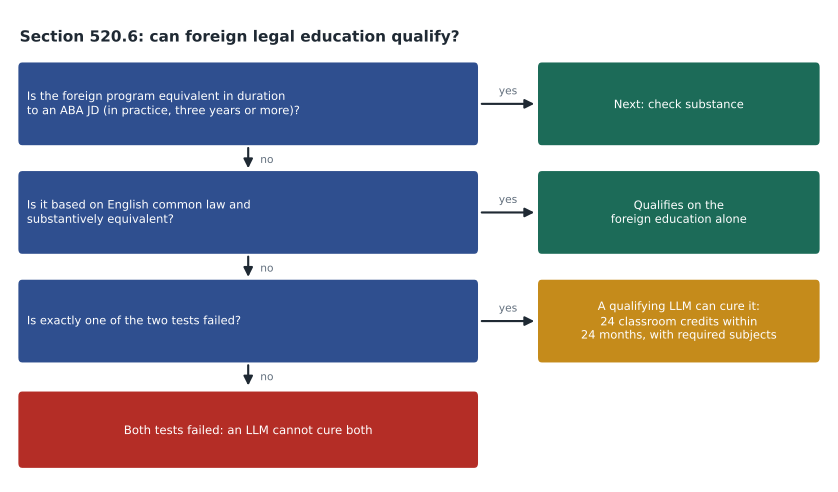
Ngozi's Nigerian law degree is a five-year common-law degree followed by the Nigerian Law School's vocational program, so it is common-law in substance and long enough in duration. On paper she might have qualified without the LLM. She took the LLM anyway, because it prepared her for US practice and because it made her evaluation more straightforward. 'And it means the American legal studies course already explained Erie to me,' she said, 'which no Nigerian lecturer ever did.'
The foreign education evaluation is a separate step that comes before the application to sit. The applicant submits an online request and has the foreign law school, the licensing authority and, where relevant, the US law school send documents directly to the Board. Documents not in English need official translations. The Board's advice is to request the evaluation well before the intended exam, ideally about a year ahead, and law schools that advise LLM students publish the Board's earlier evaluation deadlines for each exam. An applicant who waits until the filing period is likely to be too late.
The filing periods
New York does not have late filing. The Board's rules set one filing period for each exam: October 1 to 31 for the February exam and March 1 to 31 for the July exam. Applications are filed online through the applicant's BOLE account. For the February 23-24, 2027 exam, the filing period ran from October 1 to October 31, 2026, and the Board's website warned that the deadline would not be extended. For the July 27-28, 2027 exam, the filing period is March 1 to 31, 2027.
An applicant who failed the previous exam gets a short extension. The re-application deadline is the later of the regular deadline or the seventh day after the Board releases results. For the July 2026 exam, results were released on October 23, 2026, so unsuccessful examinees had until October 31, 2026, the regular deadline, to re-apply for February 2027.
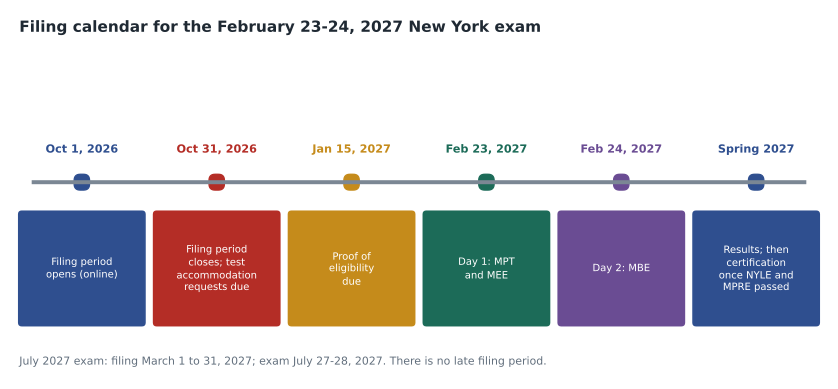
Ngozi filed on October 6, 2026, the first week of the period. 'I filed early in the week, while the website was quiet,' she said. Hollis approved: an application filed on the last evening of the period is an application that cannot be fixed if something goes wrong.
Fees
Bar exam fees in New York are set by statute, in section 465 of the Judiciary Law, rather than by the Board. The fee is 250 dollars for each taking or retaking of the exam. Applicants who qualify under the rules on study of law in a foreign country pay 750 dollars. Applicants who use a laptop for the written portion pay a separate laptop fee, which NCBE's chart for New York lists at 100 dollars. Fees are paid online by credit card. Section 465 allows a refund within three years in limited cases, such as an applicant who did not sit because of illness or for another reason the Board accepts.
The New York Law Course is free. The New York Law Exam has a small fee paid to the testing software vendor, and the MPRE fee is paid to NCBE. Applicants transferring a UBE score into New York pay the fee for that application, and applicants for admission without examination pay 400 dollars under section 465.
| Item | Who sets it | Amount |
|---|---|---|
| Bar exam, JD and other US-educated applicants | Judiciary Law section 465 | 250 dollars for each taking |
| Bar exam, foreign-educated applicants | Judiciary Law section 465 | 750 dollars for each taking |
| Laptop for the written portion | Listed in NCBE's New York chart | 100 dollars |
| New York Law Course | Board | No fee |
| Admission without examination | Judiciary Law section 465 | 400 dollars |
Repeat attempts
New York does not limit the number of times an applicant may sit the bar exam. Since December 1, 2024, however, an applicant who has failed four or more times may apply only for the February administration. The Board's rules also allow it to require a petition before re-application from applicants with repeated withdrawals or no-shows, or who the Board finds did not make a bona fide effort on an exam. The point of these rules is to keep seats for serious candidates; an applicant who is not ready should withdraw properly rather than simply not appear.
Withdrawal and attendance
An applicant who cannot sit must give notice of withdrawal before the exam begins. The Board's rules treat failing to appear for any part of the MBE as a withdrawal. Attendance rules are strict: an applicant may not enter the room more than 30 minutes after a session starts and must stay at least the first 30 minutes. An applicant who misses a session may not sit later sessions, and an applicant who misses either session on the first day may not sit the MBE on the second day. Every part of the UBE must be taken at the same administration in the same jurisdiction.
Test accommodations
Requests for test accommodations, such as extra time or a separate room, have firm deadlines that match the filing periods: October 31 for February and March 31 for July. Late requests are not accepted. Applicants previously approved for accommodations still need to re-apply for each exam. Separate deadlines apply to the New York Law Exam. Hollis told the group to treat the accommodation deadline as part of the filing deadline, not something that can wait for a doctor's appointment later in the season.
Worked problem
Can she sit in July?
A hypothetical applicant, Zinnia Ferraz, earned a three-year law degree in a civil-law country and practiced there for four years. In September 2026 she enrolled in a one-year LLM at an ABA-approved school, taking 26 classroom credits including 2 in professional responsibility, 3 in legal writing, 2 in an introduction to US law and 8 in bar-tested subjects. She wants to sit in July 2027.
Show solution
- Her degree is equivalent in duration (three years) but not in substance (civil law), so she has a single deficiency that an LLM can cure.
- Her LLM has at least 24 classroom credits with the required 2, 2, 2 and 6 credits, and will be completed within 24 months.
- She should request the Board's foreign education evaluation early, ideally in late 2026, and file during the March 1 to 31, 2027 period, paying the 750 dollar fee.
- She must also meet the pro bono requirement and a skills competency pathway before admission; her years of practice abroad may help with the second.
Answer: She can qualify for the July 2027 exam if the Board approves her evaluation and she files on time, pays the foreign-educated fee and supplies proof of the LLM by June 15, 2027.
Common mistakes
MistakeNew York has a late filing period with a higher fee.
InsteadThere is a single filing period for each exam: October for February, March for July.
MistakeAny foreign law degree plus an LLM qualifies.
InsteadAn LLM can cure a durational or a substantive deficiency, but not both.
MistakeOnline LLM credits count toward the 24 credits.
InsteadThe credits must be classroom courses on the US campus, with at most 4 summer credits.
MistakeEveryone pays the same exam fee.
InsteadApplicants who qualify through foreign study pay 750 dollars; others pay 250.
MistakeAfter four failures an applicant is barred from New York.
InsteadThere is no limit, but after four failures the applicant may sit only in February.
Practice problems
Work each problem on paper first, then reveal the answer to check.
When are the filing periods for the February and July exams?
Show answer
October 1 to 31 for February; March 1 to 31 for July.
What are the two tests in section 520.6?
Show answer
Equivalence in duration to an ABA JD and substantive equivalence based on English common law.
What must a qualifying LLM include?
Show answer
At least 24 classroom credits within 24 months, including 2 in professional responsibility, 2 in legal research and writing, 2 in American legal studies and 6 in bar-tested subjects.
What does the bar exam cost a foreign-educated applicant?
Show answer
750 dollars for each taking, under Judiciary Law section 465.
What rule applies after four unsuccessful attempts?
Show answer
The applicant may apply only for the February administration.
A checklist before the filing period opens
Hollis gave the group a checklist to finish before October 1 or March 1. First, confirm the route: section 520.3 for an ABA JD, section 520.6 for foreign education, or one of the rarer routes, and for foreign-educated applicants confirm that the Board's evaluation is complete or well under way. Second, open or update the BOLE online account, using the applicant's full legal name exactly as it appears on identification, because the name on the admission ticket must match the identification shown on exam day. Third, decide whether to request test accommodations and gather the supporting documents, since the request deadline is the last day of the filing period. Fourth, arrange the fee and the laptop. Fifth, check the Board's website for the current exam dates, sites and any notices, which change from one administration to the next.
Gianna added a sixth item from her own experience: keep a single folder, paper or digital, with every confirmation email, receipt, affidavit and letter from the Board. 'When the Second Department asked me for my MPRE score report and my pro bono affidavits,' she said, 'I had them in two minutes.' Ngozi added a seventh: write down every address and job since age eighteen while the filing period is still weeks away, because the admission application later asks for them all and the bar application asks for some. The two forms do not ask for exactly the same information, so the folder saves time twice.
Summary and key terms
- Section 520.3: a JD from an ABA-approved school is the standard route; the 2024 amendments align it with ABA standards.
- Section 520.6: foreign education must be equivalent in duration and common-law substance; an LLM cures one deficiency, not both.
- A qualifying LLM needs 24 classroom credits within 24 months with set subject minimums.
- Filing periods: October 1 to 31 for February and March 1 to 31 for July; there is no late filing.
- Fees under Judiciary Law section 465: 250 dollars, or 750 for foreign-educated applicants.
- After four failures an applicant may sit only in February; accommodation requests share the filing deadlines.
- section 520.3
- The Part 520 route for graduates of ABA-approved law schools.
- section 520.6
- The Part 520 route for applicants educated in law outside the United States.
- durational deficiency
- Foreign legal education shorter than the equivalent of an ABA JD.
- substantive deficiency
- Foreign legal education not based on English common law or not substantively equivalent.
- filing period
- The single window in which applications for a given exam are accepted.
Lesson quiz · 5 questions
Score 60% or more to complete this lesson.
Create a free account to save your progress, take quizzes and earn a certificate.