
BAR-233 · Lesson 9 of 12 · 21 min
New York family law, wills and estates
▶ Video coming soon A video version of this lesson is on the way.
Matrimonial and family law and trusts, wills and estates are two of the twelve subjects on the New York Law Course and Exam, and since July 2026 neither is tested on the MEE. 'So the only place New York tests them before admission is the NYLE,' Ngozi said, 'and the only place I will learn them is here and in the NYLC.' Gianna's firm sees both in small doses: an uncontested divorce, a client asking what happens to her house if she dies without a will, a father whose estranged son is named in an old will. This lesson covers the New York rules a new lawyer needs most in both areas.
Divorce: courts, residency and grounds
In New York, a divorce is a matrimonial action heard only in the Supreme Court. Family Court handles custody, support and family offense petitions between parties who are not seeking a divorce, but it cannot grant one. The Domestic Relations Law, the DRL, governs divorce, equitable distribution, maintenance and, together with the Family Court Act, child support.
Section 230 of the DRL sets durational residency requirements. In general, either spouse must have lived in New York continuously for two years before the action begins, or for one year if the couple married in New York, lived in New York as spouses or the grounds arose in New York; and there is no durational requirement if both spouses are residents when the action begins and the grounds arose in New York.
Section 170 lists the grounds. Most divorces today use the no-fault ground added in 2010, section 170(7): that the relationship has broken down irretrievably for a period of at least six months, as stated under oath by one spouse. A judgment on that ground may not be entered until the economic issues, such as equitable distribution, maintenance, child support, counsel fees and custody, have been resolved by agreement or by the court. The older fault grounds, such as cruel and inhuman treatment, abandonment and adultery, and the grounds based on living apart under a separation agreement or judgment, remain available but are used far less.
Equitable distribution
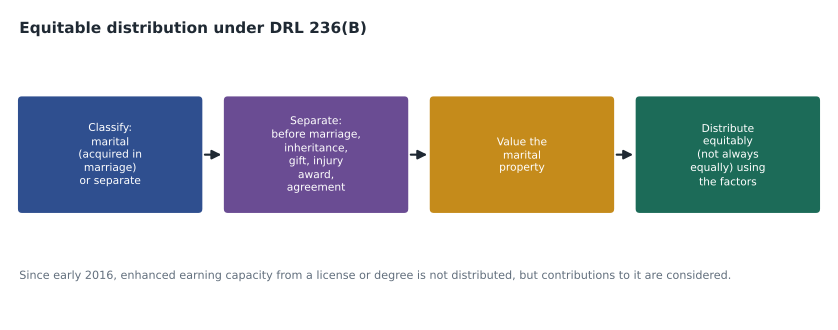
New York is an equitable distribution state, not a community property state. Under DRL section 236(B), the court classifies property as marital or separate, values it and distributes marital property equitably, which does not necessarily mean equally, considering a list of statutory factors. Marital property is all property acquired by either or both spouses during the marriage and before the execution of a separation agreement or the commencement of the matrimonial action, regardless of how title is held.
Separate property includes property acquired before the marriage; property acquired by inheritance or by gift from someone other than the spouse; compensation for personal injuries; property described as separate in a valid agreement between the spouses; and the increase in value of separate property, except to the extent the increase results from the contributions or efforts of the other spouse. Separate property can lose its character if it is commingled with marital property or retitled jointly.
New York once went further than most states in treating a professional license as marital property. In O'Brien v. O'Brien (1985), the Court of Appeals held that a medical license earned during the marriage was marital property whose value could be distributed. The Legislature changed that in 2015: for actions begun after the law took effect in early 2016, the enhanced earning capacity from a license, degree, celebrity goodwill or career enhancement is not distributed as marital property, though the court must consider a spouse's direct or indirect contributions to the other's enhanced earning capacity when distributing other marital property.
Maintenance and child support
New York uses statutory formulas for maintenance, the term for spousal support after divorce, and for temporary maintenance during the case. The 2015 legislation created formulas based on the incomes of the payor and the payee, applied to the payor's income up to a cap, with discretion above the cap. The cap is adjusted every two years; from March 1, 2026, it is 241,000 dollars of the payor's income. The statute also provides an advisory schedule for the duration of post-divorce maintenance based on the length of the marriage, ranging from 15 to 30 percent of the length of a marriage of up to 15 years to 35 to 50 percent of the length of a marriage of more than 20 years. The court may deviate from the formula or schedule if the result would be unjust or inappropriate, considering listed factors.
Child support is calculated under the Child Support Standards Act, found in DRL section 240(1-b) and Family Court Act section 413. The court determines the parents' combined parental income, applies a percentage based on the number of children, and divides the result between the parents in proportion to their incomes. The percentages are 17 percent for one child, 25 percent for two, 29 percent for three, 31 percent for four and at least 35 percent for five or more. The percentages apply to combined parental income up to a cap that is adjusted every two years; from March 1, 2026, it is 193,000 dollars. Above the cap the court may apply the percentages or other factors. In New York, parents are generally obliged to support a child until age 21, later than in many states.
| Number of children | Percentage of combined parental income |
|---|---|
| 1 | 17 percent |
| 2 | 25 percent |
| 3 | 29 percent |
| 4 | 31 percent |
| 5 or more | At least 35 percent |
Custody and agreements
Custody is decided by the best interests of the child, considering all the circumstances; no single factor controls. The Court of Appeals described the approach in Eschbach v. Eschbach (1982), and in Tropea v. Tropea (1996) it held that a parent's request to relocate with a child is decided by the child's best interests, weighing factors such as the reasons for the move, the effect on the child's relationship with the other parent and the possible benefits, rather than by a strict threshold test.
Agreements made before or during the marriage are valid under DRL section 236(B)(3) if they are in writing, subscribed by the parties and acknowledged or proven in the manner required for a deed to be recorded. An unacknowledged prenuptial agreement is not enforceable. Courts may also set aside agreements that are unconscionable or the product of fraud, duress or overreaching, and child support provisions must comply with the Child Support Standards Act.
Executing a will
A New York will must be executed under EPTL section 3-2.1. It must be in writing and signed at the end by the testator, or by another person in the testator's presence and at the testator's direction, who also signs his or her own name and address. The testator must sign in the presence of each witness or acknowledge the signature to each witness, and must declare to each witness that the document is the testator's will, which is called publication. At least two witnesses must attest within one 30-day period, signing at the end of the will at the testator's request, and the witnesses are to give their residence addresses. A rebuttable presumption applies that the 30-day requirement was met.
New York does not recognize holographic or oral wills for most people. Under EPTL section 3-2.2 they are valid only when made by members of the armed forces during armed conflict, people accompanying them, and mariners at sea, and they expire after a set period. New York has also enacted a law authorizing electronic wills, which is scheduled to take effect on December 12, 2027; until then, the written execution rules apply.
A witness who is also a beneficiary creates a problem under EPTL section 3-3.2. Unless the will is attested by at least two other disinterested witnesses, the interested witness's gift is void to the extent it exceeds what the witness would take in intestacy. The will itself remains valid.
Revocation, lapse and family protection
A will may be revoked by a later will or writing executed with the same formalities, or by burning, tearing, cutting, canceling, obliterating or destroying it with intent to revoke, done by the testator or by another in the testator's presence and at the testator's direction. Under EPTL section 5-1.4, a divorce or annulment revokes provisions in favor of the former spouse, including nominations as executor and trustee, unless the will or a court order says otherwise.
Under the anti-lapse statute, EPTL section 3-3.3, a gift to the testator's issue or to the testator's brother or sister who dies before the testator does not lapse if the beneficiary leaves issue; the gift passes to the beneficiary's issue by representation. A gift to anyone else who predeceases the testator lapses unless the will provides otherwise.
Intestacy
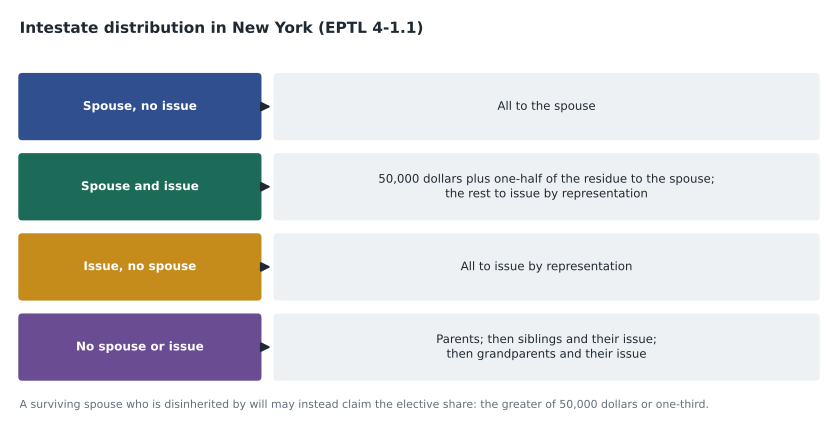
When a person dies without a will, EPTL section 4-1.1 distributes the estate. A surviving spouse with no issue takes everything. A surviving spouse and issue: the spouse takes 50,000 dollars and one-half of the residue, and the issue take the rest by representation. Issue and no spouse: the issue take everything by representation. With no spouse or issue, the estate passes to the parents, then to the issue of the parents, meaning brothers and sisters and their descendants, and then to grandparents and their issue under further rules.
The elective share
A surviving spouse cannot be disinherited in New York. Under EPTL section 5-1.1-A, the spouse may elect to take the greater of 50,000 dollars, or the whole net estate if it is smaller, or one-third of the net estate. The net estate for this purpose includes testamentary substitutes, lifetime transfers that the statute treats as part of the estate, such as joint accounts and jointly held property with survivorship, accounts in trust for another person, gifts within one year of death, revocable trusts and certain retirement benefits. The election must be made within six months after letters are issued, and no later than two years after death. A spouse may waive the right in a written agreement, and a spouse who abandoned the decedent may be disqualified.
Probate and small estates
Wills are probated, and estates administered, in the Surrogate's Court of the county where the decedent lived, under the Surrogate's Court Procedure Act. For estates with personal property of 50,000 dollars or less, excluding certain exempt property, a simplified voluntary administration is available under Article 13 of that Act, which avoids full probate or administration. New York also has its own estate tax, with an exclusion amount adjusted for inflation and a cliff: an estate that exceeds the exclusion amount by more than a small margin loses the exclusion entirely.
Worked problem
A will, a divorce and a missing sister
A hypothetical decedent, Bartholomew Stroud, died in 2026 leaving a 2015 will that gave everything one-half to his then-wife Rosalia and one-half to his sister Lidia. He and Rosalia divorced in 2020. Lidia died in 2024, leaving one daughter. He is survived by his second wife, Annika, whom he married in 2022, and no children. The will was signed by Bartholomew and two witnesses on the same day. His net estate is 900,000 dollars.
Show solution
- The will was validly executed under EPTL 3-2.1.
- The 2020 divorce revoked the gift to Rosalia under EPTL 5-1.4; that half passes as if Rosalia predeceased.
- The gift to Lidia, his sister, does not lapse under EPTL 3-3.3, because she left issue: it passes to her daughter.
- Rosalia's failed half is part of the residue; under EPTL 3-3.4, when a residuary gift to one of several residuary beneficiaries fails, it passes to the others, so it goes with Lidia's share to Lidia's daughter.
- Annika is not named in the will, and in New York a later marriage does not revoke a will; her protection is the elective share.
- Her elective share is the greater of 50,000 dollars or one-third of the net estate: one-third of 900,000 dollars is 300,000 dollars, plus any testamentary substitutes in the calculation.
Answer: Unless Annika elects, Lidia's daughter takes the whole estate. If Annika files a timely election, she takes 300,000 dollars (more if there are testamentary substitutes), and Lidia's daughter takes the rest.
Common mistakes
MistakeFamily Court can grant a divorce.
InsteadOnly Supreme Court can grant a divorce; Family Court handles custody, support and family offense matters.
MistakeNew York is a community property state.
InsteadNew York uses equitable distribution of marital property under DRL 236(B).
MistakeA medical degree earned during marriage is distributed as marital property.
InsteadFor actions begun after early 2016, enhanced earning capacity is not distributed, though contributions to it are considered.
MistakeA holographic will is valid in New York.
InsteadOnly for members of the armed forces in armed conflict, those accompanying them and mariners at sea.
MistakeA spouse can be disinherited by will.
InsteadThe elective share gives the greater of 50,000 dollars or one-third of the net estate, including testamentary substitutes.
Practice problems
Work each problem on paper first, then reveal the answer to check.
What is New York's no-fault divorce ground?
Show answer
Irretrievable breakdown for at least six months, under DRL 170(7).
What are the CSSA percentages for one and two children?
Show answer
17 percent and 25 percent of combined parental income.
What execution formalities does EPTL 3-2.1 require?
Show answer
Signature at the end, signing or acknowledgment before each witness, publication, and two witnesses attesting within one 30-day period.
What does a surviving spouse take in intestacy with issue?
Show answer
50,000 dollars plus one-half of the residue.
What is the elective share?
Show answer
The greater of 50,000 dollars (or the whole estate if smaller) or one-third of the net estate.
Summary and key terms
- Divorce is heard only in Supreme Court; most use the six-month irretrievable breakdown ground of DRL 170(7).
- DRL 236(B) equitable distribution: classify marital and separate property, value, distribute equitably; enhanced earning capacity is not distributed since 2016.
- Maintenance formulas apply to payor income up to 241,000 dollars and child support percentages to combined income up to 193,000 dollars, from March 1, 2026; support runs to age 21.
- Wills: signature at the end, publication and two witnesses within 30 days (EPTL 3-2.1); electronic wills from December 12, 2027.
- Divorce revokes gifts to a former spouse; anti-lapse saves gifts to issue and siblings who leave issue; a failed residuary share passes to the other residuary beneficiaries.
- Intestate spouse with issue takes 50,000 dollars plus half; the elective share is the greater of 50,000 dollars or one-third.
- equitable distribution
- Division of marital property in a fair, not necessarily equal, way under DRL 236(B).
- separate property
- Property excluded from distribution, such as pre-marital property, inheritances and personal injury compensation.
- Child Support Standards Act
- New York's child support formula statute, with percentages applied to combined parental income.
- publication
- The testator's declaration to the witnesses that the document is the testator's will.
- testamentary substitute
- A lifetime transfer counted in the net estate for the elective share.
Lesson quiz · 5 questions
Score 60% or more to complete this lesson.
Create a free account to save your progress, take quizzes and earn a certificate.