
BAR-234 · Lesson 1 of 12 · 21 min
Becoming a lawyer in North Carolina
▶ Video coming soon A video version of this lesson is on the way.
Grady Faircloth joined Hollis Marchetti's study group in the fall of 2026 with a legal pad full of questions and a habit of underlining the word North Carolina every time he wrote it. He grew up in Rocky Mount, finished law school at a North Carolina law school in May 2026, and since September 2026 had been working as a law clerk at Ruthanne Hatcher's three-lawyer firm in Greenville. The firm handles car wrecks, divorces, estates and the occasional dispute about a farm boundary. Grady had filed his application for the February 2027 North Carolina bar exam before the first deadline in October. 'Everyone tells me the exam is the Uniform Bar Exam and North Carolina law does not show up,' he said at his first one-on-one session with Hollis. 'Then my boss hands me a file where everything turns on North Carolina law. Which is it?'
Hollis said both were true, and that this course would explain how. The exam a North Carolina candidate sits in February 2027 is the legacy Uniform Bar Examination, written by the National Conference of Bar Examiners and graded in North Carolina. It tests general law. But a North Carolina lawyer practices North Carolina law from the first day after admission, and the state is changing its admission rules so that new lawyers must also show they know one area of North Carolina law in particular: decedents' estates and trusts. This first lesson maps the institutions involved, the routes to a license, and the plan for the rest of the course.
The institutions
Four bodies matter to a North Carolina applicant. The first is the Supreme Court of North Carolina, the state's highest court. It approves the rules that govern admission to the practice of law and the rules of the North Carolina State Bar, including the Rules of Professional Conduct. When the admission rules change, as they did in amendments approved in December 2025, it is the Court's approval that gives them force.
The second is the Board of Law Examiners of the State of North Carolina, based in Raleigh. The Board is the agency an applicant actually deals with. It receives applications, investigates character and fitness, administers and grades the bar examination, decides applications for admission by transferred Uniform Bar Examination score and by comity, and, under the amended rules, will administer the new State-Specific Component. The Board's rules are published in Title 27 of the North Carolina Administrative Code, in the chapter on admission to the practice of law, and they are cited by section numbers such as .0501 for the requirements for general applicants and .0504 for applicants by transferred score.
The third is the National Conference of Bar Examiners, usually called NCBE. NCBE writes the components of the Uniform Bar Examination: the Multistate Bar Examination, the Multistate Essay Examination and the Multistate Performance Test. It also writes the Multistate Professional Responsibility Examination, the separate ethics test North Carolina requires, and it will write the NextGen bar exam that North Carolina adopts in July 2028. NCBE scales scores so that results are comparable across administrations and jurisdictions, and it transfers Uniform Bar Examination scores between jurisdictions at an applicant's request.
The fourth is the North Carolina State Bar, an agency of the state created by statute. Every lawyer licensed in North Carolina must be an active or inactive member. The State Bar regulates lawyers after admission: it investigates grievances, prosecutes discipline before the Disciplinary Hearing Commission, runs the continuing legal education program through its Board of Continuing Legal Education, administers the trust account rules and issues formal ethics opinions. The State Bar should not be confused with the North Carolina Bar Association, a voluntary professional organization that many lawyers also join but that has no regulatory power.
Grady wrote the four names down in a column. 'So the Board lets me in, and the State Bar keeps watch once I am in.' Hollis said that was the right division, with the Supreme Court standing behind both.
Three routes to a license
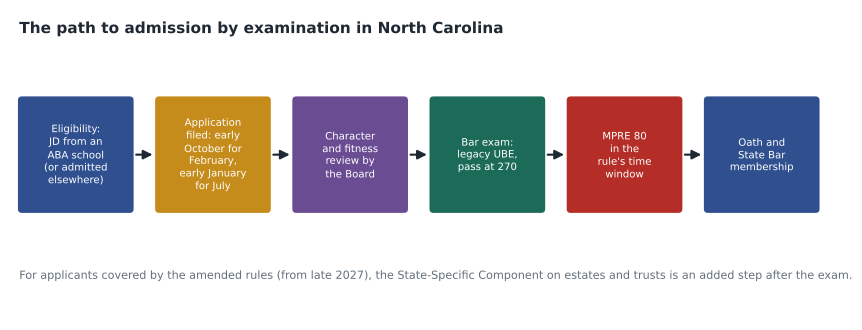
North Carolina admits lawyers by three routes. The first, and the one this course is built around, is admission by examination. A general applicant who meets the education requirements files an application with the Board, passes character and fitness review, passes the bar examination with the required score, and earns a passing score on the MPRE within the time window set by the rules. For the February 2027 exam the bar examination is the legacy Uniform Bar Examination and the passing score is a total scaled score of 270.
The second route is admission by transferred Uniform Bar Examination score. A candidate who sat the UBE in another jurisdiction and earned a score that meets North Carolina's minimum may apply to transfer the score instead of sitting again, so long as the score is recent enough under the Board's rules. NCBE reports that North Carolina accepts legacy UBE scores no more than three years old, and that it accepts transferred NextGen scores from July 2026 with a minimum of 620. North Carolina does not accept a transferred Multistate Bar Examination score on its own.
The third route is admission by comity, sometimes called admission on motion. A lawyer licensed in a state that grants reciprocal treatment to North Carolina lawyers, who has been actively practicing for the required period, may be admitted without examination. NCBE's guide describes the practice requirement as four of the past six years. Comity applicants still go through character and fitness review and must show a passing MPRE score.
What makes North Carolina different
Most of the distinctive features of North Carolina admission fall into four groups, and this course takes each in turn.
First, the calendar. North Carolina's filing deadlines come early. For the February exam the first filing deadline falls in early October of the year before, and the late deadline in early November. For the July exam the first deadline falls in early January and the late deadline in early March. A candidate who plans to sit right after graduation in May must therefore file during the last semester of law school. Lesson 2 covers eligibility, deadlines and fees in detail.
Second, the timing of the exam change. Many states moved to the NextGen bar exam in July 2026. North Carolina is moving later: NCBE reports that North Carolina's last legacy UBE will be in February 2028 and its first NextGen UBE in July 2028. For a candidate sitting in February 2027, nothing about the exam itself changes. For a candidate who might need to retake, the dates matter, because a candidate who does not pass by February 2028 will meet the new exam. Lesson 5 explains the transition.
Third, the new State-Specific Component. The amended rules require exam applicants, and later transfer applicants, to complete a multiple-choice component on decedents' estates and trusts within twelve months. This is North Carolina's way of making sure new lawyers know the state's law in an area where general principles and North Carolina's statutes diverge sharply. Lesson 6 explains who is covered, when the component is given and what it tests.
Fourth, the substantive law. North Carolina is one of a handful of jurisdictions that still apply contributory negligence as a complete bar to recovery in negligence cases. It is one of very few states that still allow suits for alienation of affection and criminal conversation. It divides marital property through a statutory system called equitable distribution, with a presumption of equal division. Its Rules of Professional Conduct include rules that differ from the ABA Model Rules, such as an express prohibition on sexual conduct with clients in Rule 1.19 and detailed trust account reconciliation requirements. Lessons 7 through 10 cover these areas, because they are what a new North Carolina lawyer meets first and what the multistate exam answer will not tell you.
Why the exam answer and the North Carolina answer differ
Hollis gave Grady a short example to show why this matters. On the Multistate Bar Examination, a negligence question involving a careless plaintiff is answered under the majority rule, usually some form of comparative negligence. The plaintiff recovers, but less. In North Carolina, the same plaintiff may recover nothing at all, unless a doctrine such as last clear chance applies. 'On the exam, answer the question the examiners asked,' Hollis said. 'In the office, answer the question the client is paying for. This course teaches you to keep them apart.'
Grady said that was exactly what had happened at the firm. Ruthanne had asked him to evaluate a rear-end collision in which the client had been stopped at a green light with her hazard lights off, looking at her phone. His first draft discussed comparative fault. Ruthanne had drawn a box around that paragraph and written two words in the margin: not here.
The plan for this course
The course has twelve lessons. Lessons 1 through 6 cover the path to admission: the institutions and routes in this lesson; eligibility, deadlines and fees in Lesson 2; character and fitness and the MPRE in Lesson 3; the exam format, scoring and passing score in Lesson 4; the move to NextGen in Lesson 5; and the State-Specific Component, including the core of North Carolina estates and trusts law, in Lesson 6.
Lessons 7 through 10 cover distinctive North Carolina law: the courts and civil procedure in Lesson 7; torts, including contributory negligence, damages limits and claims against the state, in Lesson 8; family law, including absolute divorce, equitable distribution, alimony and the heart-balm torts, in Lesson 9; and the Rules of Professional Conduct, trust accounts and discipline in Lesson 10.
Lesson 11 covers score transfer, comity and the duties that begin after admission, including the Professionalism for New Attorneys program and continuing legal education. Lesson 12 is a capstone: original practice questions on North Carolina law, answered in the form a bar grader or a supervising lawyer expects, and a plan for the exam days.
How to use the course alongside bar review
This course does not replace a commercial bar review course for the multistate subjects. Its job is narrower. It explains the North Carolina admission process so that nothing administrative goes wrong, and it teaches the North Carolina law a candidate needs for the component and for early practice. Hollis suggested Grady treat it as a parallel track: a session each week on North Carolina topics, kept separate from his daily MBE and essay work so that North Carolina rules would not leak into his multistate answers.
She also gave him the first entry for his checklist. Every fact in his application must match the documents he will later be asked to produce: addresses, employers, dates, court records. North Carolina's character and fitness review is thorough, and the most common delays come from small inconsistencies, not from serious problems. Lesson 3 returns to this.
| Body | Main role for an applicant | Main role after admission |
|---|---|---|
| Supreme Court of North Carolina | Approves the admission rules | Approves the State Bar's rules, including the Rules of Professional Conduct |
| Board of Law Examiners | Applications, character and fitness, exam, transfer, comity, component | None; its role ends at admission |
| NCBE | Writes and scales the UBE and MPRE; transfers scores | None |
| North Carolina State Bar | None before admission | Membership, discipline, CLE, trust account rules, ethics opinions |
Worked problem
Choosing a route
Clyde Pender, a hypothetical lawyer, has practiced full time in Virginia for seven years after graduating from an ABA-approved law school. He wants a North Carolina license so he can serve clients on both sides of the state line. He has never taken the UBE. Which route should he consider first?
Show solution
- Admission by transferred UBE score is not available, because he has no UBE score.
- Admission by comity requires a license in a state that grants reciprocity to North Carolina lawyers and active practice for four of the past six years.
- Clyde must confirm with the Board whether Virginia is treated as a reciprocal state under the comity rule; the Board decides reciprocity.
- If comity is not available, he can sit the bar exam as an attorney applicant, which carries a higher fee.
Answer: Clyde should first check comity eligibility with the Board, because his years of practice may qualify him. If reciprocity is not available, the bar exam remains open to him as an attorney applicant.
Common mistakes
MistakeThe North Carolina State Bar admits lawyers.
InsteadThe Board of Law Examiners decides admission; the State Bar regulates lawyers after admission.
MistakeNorth Carolina switched to NextGen in July 2026 like many states.
InsteadNorth Carolina's first NextGen exam is July 2028; its last legacy UBE is February 2028.
MistakeThe UBE tests North Carolina law.
InsteadThe legacy UBE tests general law; North Carolina law is tested through the new State-Specific Component on estates and trusts.
MistakeThe North Carolina Bar Association disciplines lawyers.
InsteadThe Bar Association is voluntary; discipline belongs to the State Bar and the Disciplinary Hearing Commission.
Practice problems
Work each problem on paper first, then reveal the answer to check.
Which body approves North Carolina's admission rules?
Show answer
The Supreme Court of North Carolina.
What passing score applies on the legacy UBE in North Carolina?
Show answer
A total scaled score of 270.
When is North Carolina's first NextGen bar exam?
Show answer
July 2028.
What area of North Carolina law does the new State-Specific Component test?
Show answer
Decedents' estates and trusts.
Name the three routes to a North Carolina license.
Show answer
Examination, transferred UBE score and comity.
Summary and key terms
- The Supreme Court of North Carolina approves the admission rules; the Board of Law Examiners runs admission; NCBE writes the exams; the State Bar regulates lawyers after admission.
- North Carolina admits by examination, by transferred UBE score and by comity.
- The February 2027 exam is the legacy UBE with a passing score of 270; NextGen arrives in July 2028.
- Amended rules add a State-Specific Component on decedents' estates and trusts.
- North Carolina's substantive law differs from the multistate rules in torts, family law and professional conduct; keep the two answers separate.
- Board of Law Examiners
- The North Carolina agency that decides applications for admission and administers the bar exam.
- North Carolina State Bar
- The state agency that regulates licensed lawyers, including discipline and CLE.
- comity
- Admission without examination based on practice in a reciprocal jurisdiction.
- legacy UBE
- The Uniform Bar Examination in its pre-NextGen form, given in North Carolina through February 2028.
- State-Specific Component
- North Carolina's multiple-choice test on decedents' estates and trusts required under the amended admission rules.
Lesson quiz · 5 questions
Score 60% or more to complete this lesson.
Create a free account to save your progress, take quizzes and earn a certificate.