
BAR-234 · Lesson 10 of 12 · 21 min
The North Carolina Rules of Professional Conduct, trust accounts and lawyer discipline
▶ Video coming soon A video version of this lesson is on the way.
On the Friday before the tenth session, Ruthanne Hatcher spent an hour with Grady going through the firm's trust account binder. She showed him the monthly bank reconciliation, the quarterly three-way reconciliation with its client ledger printouts, and the page she signs each quarter. 'Most lawyers who get in serious trouble with the State Bar do not set out to steal anything,' she told him. 'They stop reconciling, a mistake turns into a hole, and they cover the hole with the next client's money.' Grady repeated the line to Hollis, who said it was the best summary of North Carolina trust account discipline she had heard.
The MPRE tests the ABA Model Rules. A North Carolina lawyer is governed by the North Carolina Rules of Professional Conduct, adopted by the North Carolina State Bar and approved by the Supreme Court of North Carolina. They follow the Model Rules closely, but there are differences a new lawyer must know. This lesson covers the most important of them, the trust account rules, the formal ethics opinion system, and how grievances and discipline work.
The North Carolina Rules and the Model Rules
The North Carolina Rules use the Model Rules' numbering and much of their text, and North Carolina courts and the State Bar consult the ABA's comments and opinions. The North Carolina Rules have their own comments, and where North Carolina has departed from the Model Rules, the departure is deliberate. A North Carolina lawyer should read the North Carolina version of any rule before relying on it, especially in the areas below.
Rule 1.19: sexual conduct with clients
North Carolina has a separate rule, Rule 1.19, titled Sexual Conduct with Clients Prohibited, providing that a lawyer shall not engage in sexual activity with a client. The rule defines sexual activity and contains an exception for a spouse of the lawyer or a consensual sexual relationship that existed before the client-lawyer relationship began, together with related provisions on the conduct of lawyers in a firm. The Model Rules address the same subject in Rule 1.8(j). The separate numbering in North Carolina reflects the emphasis the State Bar places on the subject, especially in family law practice, where clients are often vulnerable.
Fees
Rule 1.5 prohibits clearly excessive fees, as North Carolina's version puts it, using factors similar to the Model Rules. A contingent fee agreement must be in writing, signed by the client, and must state the method by which the fee is determined, including the percentages in the event of settlement, trial or appeal, and whether expenses are deducted before or after the fee is calculated. At the end of the matter the lawyer must give the client a written statement showing the outcome and the method of determining the remittance. As under the Model Rules, a lawyer may not charge a contingent fee in a domestic relations matter when payment depends on securing a divorce or on the amount of alimony, support or property settlement, with narrow exceptions for collecting past-due amounts. For Grady's divorce client, the firm would therefore bill hourly or on another permitted basis.
Confidentiality and candor
Rule 1.6 requires a lawyer to protect information acquired during the professional relationship and lists permitted disclosures. North Carolina's list of exceptions differs from the Model Rule in some respects, and the North Carolina version should be checked before any disclosure. Rule 3.3 requires candor toward the tribunal, including correcting false statements of material fact and taking remedial measures when a client offers false evidence.
Advertising and solicitation
North Carolina's Rules 7.1 through 7.3 regulate communications about a lawyer's services. Rule 7.1 prohibits false or misleading communications, and North Carolina's comments give detailed guidance on misleading statements about results and comparisons. Rule 7.3 restricts live person-to-person solicitation. North Carolina has historically required targeted written communications to prospective clients known to need legal services in a particular matter to carry specific advertising labels, and a lawyer planning direct mail to accident victims or people facing foreclosure should read the current text of Rule 7.3 and the State Bar's opinions before sending anything.
Trust accounts: Rule 1.15
North Carolina's trust account rules are among the most detailed in the country. Rule 1.15 has four parts: Rule 1.15-1 defines terms; Rule 1.15-2 sets general rules for handling entrusted property; Rule 1.15-3 governs records and accountings; and Rule 1.15-4 governs the North Carolina interest on lawyers' trust accounts program, known as IOLTA.
Under Rule 1.15-2, all entrusted funds must be deposited in a trust account, separate from the lawyer's own funds. A general trust account holds nominal or short-term funds of many clients and must be maintained as an IOLTA account, with the interest paid to the North Carolina IOLTA program, which funds legal services. Funds that are large enough or held long enough to earn net interest for the client go in a dedicated trust account for that client. A lawyer may not use trust funds for personal purposes, may not borrow from them, and may not use one client's funds for another client's benefit. Funds belonging to the lawyer, such as earned fees, must be withdrawn promptly; leaving them in the account is commingling.
Rule 1.15-3 requires detailed records, including a client ledger for each person whose funds are in the account, and three kinds of review. Each month the lawyer must reconcile the trust account balance with the bank statement. Each quarter the lawyer must perform a three-way reconciliation, comparing the reconciled bank balance, the general trust account ledger balance and the total of the individual client ledger balances, all of which must match. The lawyer must review, sign and keep the reconciliation reports. The rules also require review of bank statements and canceled checks each month, and set record retention periods.
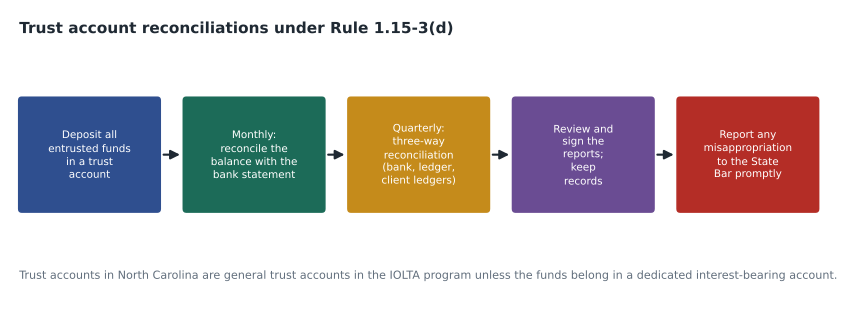
Banks that hold North Carolina trust accounts must agree to notify the State Bar when a trust account check is presented against insufficient funds. The State Bar conducts random audits of lawyers' trust accounts, and an audit that finds missing reconciliations or unexplained shortfalls can lead to a grievance even without any client complaint. A lawyer who discovers that entrusted funds have been misappropriated or misapplied must report it promptly to the State Bar under the rules.
Ruthanne's practice, which she required of everyone in the firm, was simple: no disbursement from the trust account until the deposit had cleared and been credited, every disbursement tied to a client ledger, and the quarterly reconciliation finished by the fifteenth of the following month. 'If the three numbers do not match, you do not go home until you know why,' she said.
Formal ethics opinions
The North Carolina State Bar issues formal ethics opinions through its Ethics Committee, adopted by the State Bar Council after notice and comment. They are numbered by year, such as 2024 Formal Ethics Opinion 1, which addressed lawyers' use of artificial intelligence tools in law practice. The opinions are not binding law in the way the rules are, but the State Bar treats compliance with an opinion as a safe harbor, and lawyers rely on them heavily. A lawyer with a question can also call the State Bar's ethics counsel for informal guidance before acting.
How discipline works
Lawyer discipline in North Carolina is administered by the State Bar under the Discipline and Disability Rules. Anyone may file a grievance against a lawyer. State Bar staff investigate, and the lawyer must respond. The Grievance Committee, made up of State Bar councilors and public members, decides whether there is probable cause to believe the lawyer violated the rules.
If the Committee finds probable cause, it can dismiss with a letter of caution or warning, issue an admonition, a reprimand or a censure, or refer the matter for a hearing before the Disciplinary Hearing Commission. The Disciplinary Hearing Commission is an independent body of lawyers and nonlawyers that hears contested cases in three-member panels and can impose admonition, reprimand, censure, suspension or disbarment. Appeals from the Commission go to the Court of Appeals. The State Bar's prosecuting attorneys are in the Office of Counsel.
Common grounds for discipline in North Carolina mirror those elsewhere: neglect and failure to communicate with clients, trust account violations, conflicts of interest, dishonesty, and criminal conduct reflecting on fitness. Trust account misappropriation is treated with special severity; disbarment is a common result.
| Body | Role |
|---|---|
| Grievance Committee | Decides probable cause; may issue admonitions, reprimands and censures or refer for hearing |
| Disciplinary Hearing Commission | Hears contested cases in panels; may suspend or disbar |
| Office of Counsel | Investigates and prosecutes for the State Bar |
| Court of Appeals | Hears appeals from the Disciplinary Hearing Commission |
| Client Security Fund | Reimburses clients for losses caused by dishonest lawyers |
Programs that help
The State Bar runs programs that help lawyers avoid trouble. The Lawyer Assistance Program offers confidential help with substance use, mental health and stress. A fee dispute resolution program offers clients a way to resolve fee disagreements without a grievance. The Client Security Fund reimburses clients for money lost through a lawyer's dishonest conduct, funded by lawyers' annual assessments. And the State Bar's Board of Legal Specialization certifies lawyers as specialists in defined fields, such as estate planning and probate law or family law, after experience, examination and peer review requirements.
Pro bono
Rule 6.1 of the North Carolina Rules states that every lawyer has a professional responsibility to provide legal services to those unable to pay and that a lawyer should aspire to render at least fifty hours of pro bono public legal services per year. The rule is aspirational, not enforced by discipline. Many North Carolina lawyers meet it through legal aid organizations, bar association clinics and court-appointed work.
Conflicts in a small-town practice
Ruthanne's firm faced conflict questions every week, because Greenville is a place where everyone knows everyone. North Carolina's conflict rules, Rules 1.7 through 1.10, follow the Model Rules' structure: a lawyer may not represent a client if the representation is directly adverse to another client or there is a significant risk that it will be materially limited by duties to others or the lawyer's own interests, unless the lawyer reasonably believes the representation will be competent and diligent, it is not prohibited by law, it does not involve asserting a claim by one client against another in the same litigation, and each affected client gives informed consent, confirmed in writing. Conflicts of one lawyer are generally imputed to the firm.
In family law the rules bite hard. A lawyer may not represent both spouses in a contested divorce, and a lawyer who consulted with one spouse in an initial meeting may be disqualified from representing the other, because the prospective client rule, Rule 1.18, protects information learned in a consultation. Ruthanne's firm ran every new intake through a conflict check that included the other spouse's name, any third parties and the names of businesses involved, before anyone heard the facts in detail.
Grady asked what happened when the check revealed a former client on the other side. Hollis said the answer depended on Rule 1.9: a lawyer may not represent a new client in the same or a substantially related matter adverse to a former client without the former client's informed consent, confirmed in writing, and may not use the former client's confidential information to the former client's disadvantage.
Worked problem
A shortfall in the trust account
Clyde Pender, a hypothetical sole practitioner in Rocky Mount, finishes his quarterly three-way reconciliation and finds that the total of his client ledgers exceeds the reconciled bank balance by 4,000 dollars. He discovers that three months earlier he paid a client's settlement before the insurer's check cleared, and the check was later returned. What must he do?
Show solution
- The shortfall means other clients' funds were used to pay this client, a misapplication of entrusted funds.
- He must replace the shortfall immediately with his own funds and correct the records.
- He must promptly report the misapplication to the State Bar as the rules require.
- He should change his practice to disburse only against collected funds, and complete his monthly reconciliations, which would have caught the problem sooner.
Answer: Clyde must restore the 4,000 dollars at once, report the misapplication to the State Bar, document the correction, and fix the practice that caused it.
Common mistakes
MistakeThe MPRE rules are the rules that govern North Carolina lawyers.
InsteadNorth Carolina lawyers are governed by the North Carolina Rules of Professional Conduct, which differ in places.
MistakeSexual relationships with clients are governed only by a conflict-of-interest rule.
InsteadNorth Carolina has a separate Rule 1.19 prohibiting sexual activity with clients, with limited exceptions.
MistakeA yearly reconciliation of the trust account is enough.
InsteadRule 1.15-3 requires monthly reconciliations and quarterly three-way reconciliations.
MistakeOnly clients can start a disciplinary case.
InsteadAnyone can file a grievance, and random audits and bank notices can also start investigations.
MistakeFormal ethics opinions are binding statutes.
InsteadThey are guidance adopted by the State Bar Council; compliance generally protects a lawyer.
Practice problems
Work each problem on paper first, then reveal the answer to check.
Which North Carolina rule prohibits sexual activity with clients?
Show answer
Rule 1.19.
How often must a lawyer perform a three-way reconciliation?
Show answer
Quarterly.
What program receives interest on general trust accounts?
Show answer
The North Carolina IOLTA program.
Which body can suspend or disbar a North Carolina lawyer?
Show answer
The Disciplinary Hearing Commission.
How many pro bono hours does Rule 6.1 suggest per year?
Show answer
At least fifty, as an aspiration.
Summary and key terms
- The North Carolina Rules follow the Model Rules' numbering but differ in places; always read the North Carolina text.
- Rule 1.19 separately prohibits sexual activity with clients, with limited exceptions.
- Rule 1.15 requires trust accounts, client ledgers, monthly reconciliations and quarterly three-way reconciliations, with general trust accounts in the IOLTA program.
- The Grievance Committee finds probable cause and can issue lesser discipline; the Disciplinary Hearing Commission can suspend or disbar.
- Formal ethics opinions, ethics counsel, the Lawyer Assistance Program and specialization support practice.
- three-way reconciliation
- Comparing the bank balance, the trust ledger and the total of client ledgers.
- IOLTA
- Interest on lawyers' trust accounts, paid to a program funding legal services.
- commingling
- Mixing a lawyer's own funds with entrusted funds.
- Disciplinary Hearing Commission
- The body that hears contested North Carolina discipline cases.
- formal ethics opinion
- Guidance on professional conduct adopted by the State Bar Council.
Lesson quiz · 5 questions
Score 60% or more to complete this lesson.
Create a free account to save your progress, take quizzes and earn a certificate.