
BAR-234 · Lesson 9 of 12 · 21 min
North Carolina family law: divorce, equitable distribution, alimony and the heart-balm torts
▶ Video coming soon A video version of this lesson is on the way.
The divorce intake that landed on Grady's desk in November read like a law school hypothetical. The client and her husband had separated in June 2026 after nineteen years of marriage. They owned a house in Winterville, two retirement accounts and a small landscaping business he had started during the marriage with money from his father. He had moved in with a coworker. The client wanted a divorce, half of everything, alimony, and, she said, to sue the coworker. 'Can she do that?' Grady asked. Hollis said that in North Carolina she very likely could, and that this was one of the reasons family law in the state is unlike anywhere else.
This lesson covers the North Carolina rules a family lawyer uses every week: absolute divorce and divorce from bed and board, equitable distribution, postseparation support and alimony, custody and child support in outline, separation and premarital agreements, domestic violence protective orders, and the torts of alienation of affection and criminal conversation.
Absolute divorce
North Carolina grants absolute divorce on a single no-fault ground: the spouses have lived separate and apart for one year, and at least one of them has resided in North Carolina for six months before filing. Living separate and apart means physical separation, with at least one spouse intending that the separation be permanent. Spouses who continue to live under the same roof are not separated, even if they sleep in different rooms. Isolated incidents of sexual intercourse between separated spouses do not restart the one-year period, under the statute.
Fault does not matter to the divorce itself. It matters a great deal to alimony and, through the heart-balm torts, to claims against third parties. North Carolina also has a separate fault-based proceeding, divorce from bed and board, which is a judicial separation, not a dissolution, available on grounds such as abandonment, maliciously turning the other spouse out of doors, cruel or barbarous treatment, indignities rendering the spouse's condition intolerable, excessive use of alcohol or drugs, and adultery.
The one-year waiting period shapes everything. The client in Grady's file separated in June 2026, so she could not file for absolute divorce until June 2027. In the meantime the other claims, equitable distribution, postseparation support, alimony, custody and support, could all be filed and litigated.
Equitable distribution
North Carolina divides property at divorce under section 50-20 of the General Statutes, the equitable distribution statute. The court proceeds in three steps.
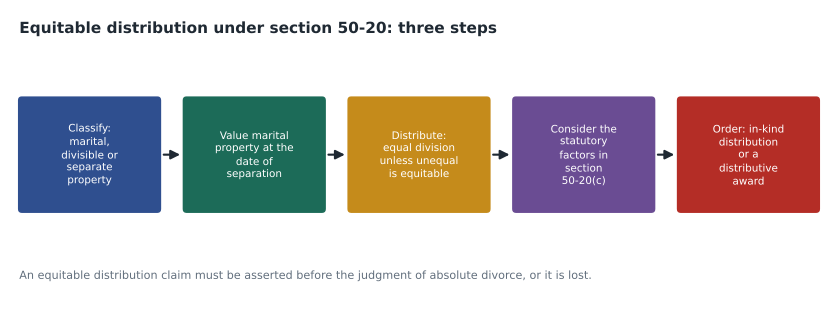
First, the court classifies property. Marital property is all real and personal property acquired by either or both spouses during the marriage and before the date of separation and presently owned, except separate property. It is presumed marital, and a spouse claiming that property is separate must prove it. Separate property is property acquired before the marriage, or acquired during the marriage by bequest, devise, descent or gift to that spouse alone. Property acquired in exchange for separate property remains separate. Increases in value of separate property, and income from it, remain separate, except that an increase caused by marital contributions of money or effort may be marital. Divisible property is a category that captures changes after separation: for example, passive increases and decreases in the value of marital property between the date of separation and the date of distribution, and certain property received after separation as a result of marital efforts.
Second, the court values marital property as of the date of separation, and divisible property as of the date of distribution.
Third, the court distributes. The statute provides that there shall be an equal division of the net value of marital and divisible property unless the court determines that an equal division is not equitable, in which case it divides the property equitably after considering the factors listed in section 50-20(c). The factors include the income, property and liabilities of each spouse; obligations of support from a prior marriage; the duration of the marriage and the age and health of the spouses; the need of a parent with custody to occupy the marital residence; expectations of pension and retirement rights; contributions to the career or education of the other spouse; the liquid or nonliquid character of the property; tax consequences; acts by either spouse to maintain, preserve, develop, expand, waste, neglect, devalue or convert marital property during the marriage or after separation; and any other factor the court finds just and proper. Marital misconduct unrelated to the economic condition of the marriage is generally not a distributional factor.
The court prefers in-kind distribution and may order a distributive award, a payment from one spouse to the other, where in-kind distribution is impractical, for example when one spouse keeps a business. Retirement accounts are commonly divided by domestic relations orders.
Timing is a trap. An equitable distribution claim must be asserted before the judgment of absolute divorce is entered. A judgment of absolute divorce destroys the right to equitable distribution if the claim has not been filed. A lawyer who obtains a divorce for a client before filing an equitable distribution claim, or before the other side files one, can extinguish the client's property rights. North Carolina practice is to file equitable distribution claims early, often with the complaint for postseparation support or custody.
In Grady's file, the landscaping business was started during the marriage, so it was presumptively marital, but the husband would argue that the start-up money from his father was a gift to him alone and therefore separate. If he could trace that money into the business, part of the business's value might be separate, with any increase caused by marital effort remaining marital. The house, bought during the marriage, was marital. The retirement accounts were marital to the extent of contributions during the marriage and before separation.
Postseparation support and alimony
North Carolina distinguishes postseparation support, a temporary award paid until alimony is decided, from alimony itself. Both require a dependent spouse, one who is actually substantially dependent on the other for maintenance and support or is substantially in need of maintenance and support, and a supporting spouse.
For alimony, the court must find that one spouse is dependent, the other is supporting, and an award is equitable after considering all relevant factors. The statute lists factors including marital misconduct, the earnings and earning capacities of the spouses, their ages and health, the amount and sources of income, the duration of the marriage, contributions to the other's education or earning power, the standard of living established during the marriage, the spouses' relative education and the time needed to obtain training, assets and liabilities, property brought to the marriage, contributions as a homemaker, the relative needs of the spouses, tax consequences and any other just factor.
Marital misconduct has special force when it is illicit sexual behavior during the marriage and before separation. If the court finds that the dependent spouse engaged in illicit sexual behavior during the marriage and before separation, the court shall not award alimony. If the court finds that the supporting spouse did so, the court shall order alimony to the dependent spouse. If both did, the court considers the misconduct in its discretion. Other marital misconduct, such as abandonment or cruel treatment, is a factor in the amount and duration of alimony. Misconduct after separation may be used to corroborate misconduct before separation.
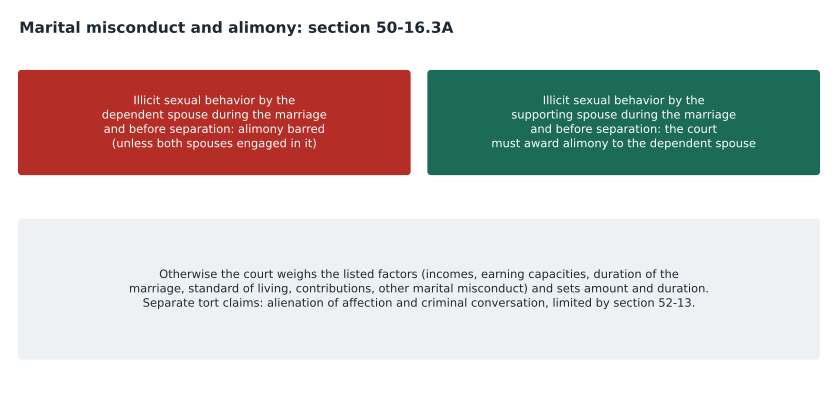
Like equitable distribution, a claim for alimony or postseparation support must be pending before the judgment of absolute divorce, or it is barred, unless the parties have a written agreement providing otherwise.
In Grady's file, if the client was the dependent spouse and the husband's relationship with the coworker began before the June 2026 separation, the statute would require an alimony award. If the relationship began only after separation, it would not count as pre-separation misconduct by itself, although it might corroborate evidence of earlier conduct.
Custody and child support in outline
Custody is decided under the best interest of the child standard. The court may award joint or sole custody, and it must consider factors relevant to the child's safety, including acts of domestic violence. Custody orders are modifiable on a showing of a substantial change in circumstances affecting the child's welfare. Interstate custody jurisdiction is governed by North Carolina's version of the Uniform Child-Custody Jurisdiction and Enforcement Act.
Child support is set under the North Carolina Child Support Guidelines, adopted by the Conference of Chief District Court Judges and revised periodically. The guidelines produce a presumptive amount based on the parents' combined income and the custody arrangement, and the court may deviate only on findings that applying the guidelines would be unjust or inappropriate.
Agreements
Spouses can resolve their claims by contract. Separation agreements and property settlements are common, and an agreement waiving equitable distribution or alimony is enforceable if properly executed. North Carolina has adopted the Uniform Premarital Agreement Act, which allows prospective spouses to agree on property rights, support and other matters, subject to defenses such as involuntariness and unconscionability coupled with lack of disclosure. A lawyer drafting either kind of agreement should take care with the statutory formalities, including acknowledgment where required.
Domestic violence protective orders
Chapter 50B of the General Statutes provides for domestic violence protective orders between people in a personal relationship, including current and former spouses, people who live or lived together, parents of a child in common and people in a dating relationship. A court may enter an ex parte order in an emergency and a protective order of up to one year after a hearing, renewable for good cause. Orders can grant possession of the residence, temporary custody, prohibit contact, and require surrender of firearms. Violation is a crime.
Alienation of affection and criminal conversation
North Carolina is one of a handful of states that still allow the heart-balm torts, and juries in the state have returned large verdicts.
Alienation of affection requires proof that the plaintiff and the spouse were happily married with genuine love and affection between them, that the love and affection was alienated and destroyed, and that the wrongful and malicious acts of the defendant produced and brought about the loss. The defendant's conduct need not be the sole cause, only a controlling or effective one. Criminal conversation requires proof of a valid marriage and sexual intercourse between the defendant and the plaintiff's spouse during the marriage. Consent of the spouse is not a defense, and the tort requires no proof of a happy marriage.
In 2009 the General Assembly limited both torts. Under section 52-13 of the General Statutes, no act of the defendant that occurs after the plaintiff and the spouse physically separate with the intent of either or both that the separation remain permanent may give rise to a claim, although post-separation conduct can be used to corroborate pre-separation conduct. The action must be brought within three years of the last act of the defendant giving rise to it. And it may be brought only against a natural person, not against an employer or other entity.
Constitutional challenges have so far failed. In Malecek v. Williams, 255 N.C. App. 300 (2017), the Court of Appeals rejected a claim that alienation of affection and criminal conversation violate the First and Fourteenth Amendments, reasoning that the torts regulate conduct, not protected expression or intimate association, in the way the challengers claimed.
For Grady's client, the timing of the coworker's relationship with the husband was decisive here too. Conduct before the June 2026 separation could support both torts. Conduct only after separation could not, by statute. Ruthanne had already asked Grady to build a timeline from the client's texts, credit card records and calendar, the kind of documentary record that both the alimony claim and a tort claim would need.
Worked problem
Protecting the property claim
Ivey Tolson, a hypothetical spouse, separates from her husband in January 2026. In March 2027 her husband files for absolute divorce. Ivey has not filed any claim for equitable distribution or alimony. What must her lawyer do?
Show solution
- The spouses have been separated more than a year, so the husband is entitled to an absolute divorce.
- A judgment of absolute divorce will bar equitable distribution and alimony claims that are not pending when it is entered.
- Ivey's lawyer must file counterclaims for equitable distribution and, if she is dependent, postseparation support and alimony, before the divorce judgment is entered.
- Filing preserves the claims; the divorce can then proceed while the property and support claims are litigated.
Answer: Ivey's lawyer must file her equitable distribution and alimony claims immediately, before the court enters the absolute divorce judgment. Delay could extinguish them.
Common mistakes
MistakeNorth Carolina grants absolute divorce for adultery or cruelty.
InsteadAbsolute divorce requires one year of separation; fault grounds support only divorce from bed and board.
MistakeMarital property is divided by percentage of contribution.
InsteadEqual division is presumed unless the court finds it is not equitable under the section 50-20(c) factors.
MistakeEquitable distribution can be filed any time after divorce.
InsteadThe claim must be pending before the judgment of absolute divorce.
MistakeInfidelity by the supporting spouse is just one factor in alimony.
InsteadPre-separation illicit sexual behavior by the supporting spouse requires an alimony award.
MistakeAn alienation of affection claim can rest on conduct after separation.
InsteadSection 52-13 bars claims based on acts after physical separation.
Practice problems
Work each problem on paper first, then reveal the answer to check.
What are the requirements for absolute divorce?
Show answer
One year of living separate and apart and six months of North Carolina residence by one spouse.
When is marital property valued?
Show answer
At the date of separation.
What is the presumption in distribution?
Show answer
An equal division of the net value of marital and divisible property.
What effect does pre-separation illicit sexual behavior by the dependent spouse have?
Show answer
The court shall not award alimony, unless both spouses engaged in it.
What is the limitations period for alienation of affection?
Show answer
Three years from the last act of the defendant giving rise to the claim.
Summary and key terms
- Absolute divorce requires a year of separation and six months of residence; fault grounds support only divorce from bed and board.
- Equitable distribution classifies, values at separation and divides marital and divisible property, presumptively equally.
- Equitable distribution and alimony claims must be pending before the absolute divorce judgment.
- Pre-separation illicit sexual behavior bars alimony to a dependent spouse and requires it from a supporting spouse.
- Alienation of affection and criminal conversation survive, limited since 2009 to pre-separation acts, natural persons and a three-year period.
- absolute divorce
- Dissolution of marriage after one year of separation.
- marital property
- Property acquired during the marriage and before separation, other than separate property.
- divisible property
- Post-separation changes in marital property and related property, distributed with marital property.
- dependent spouse
- A spouse substantially dependent on, or in need of support from, the other.
- alienation of affection
- A tort against a third party whose wrongful acts destroyed the love and affection in a marriage.
Lesson quiz · 5 questions
Score 60% or more to complete this lesson.
Create a free account to save your progress, take quizzes and earn a certificate.