
BAR-234 · Lesson 6 of 12 · 22 min
The North Carolina State-Specific Component on decedents' estates and trusts
▶ Video coming soon A video version of this lesson is on the way.
Ruthanne Hatcher's firm had three estates open the week Grady came to the sixth session, and he had spent most of Monday at the clerk of superior court's office in Pitt County filing an inventory. 'I did not know the clerk was the probate judge,' he said. 'I thought the clerk took filings and the judge decided things.' Hollis said that North Carolina's estates system surprises most people from other states, and that it was exactly the kind of North Carolina-specific knowledge the state had decided new lawyers should be tested on.
This lesson has two parts. The first explains the State-Specific Component that the amended admission rules add: who must take it, when it is given and how it fits with the bar exam. The second introduces the core of North Carolina law on decedents' estates and trusts: the clerk as probate judge, the formalities for wills, revocation, intestate succession, the elective share and the year's allowance, caveats and the basic framework of trust law. It is an introduction, not a substitute for the Board's published study materials; candidates covered by the component should use whatever outline the Board provides.
Why a component, and why estates
For decades North Carolina tested its own law on its own essay day. When it joined the UBE in 2019, North Carolina law dropped out of the exam. NCBE's removal of Trusts and Estates from the MEE from July 2026, and the NextGen exam's limited coverage of estates, mean that a new lawyer can now be admitted anywhere in the UBE system without having been tested on wills and trusts at all. Estates practice is a large part of general practice in North Carolina, and North Carolina's statutes in this area differ in important ways from the general rules taught in law school. A component on decedents' estates and trusts addresses that gap with a test of North Carolina law.
The rule
The amended admission rules approved by the Supreme Court of North Carolina in December 2025 create the State-Specific Component in two places.
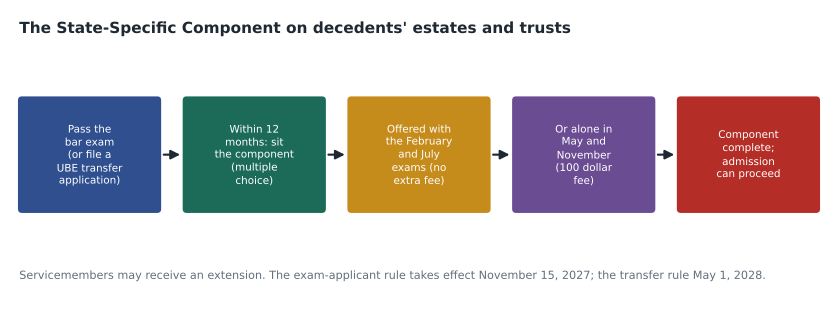
For general applicants, amended section .0501 requires an applicant to complete a multiple-choice component on decedents' estates and trusts within twelve months after the first day of the bar examination the applicant passed. The rule takes effect November 15, 2027. Servicemembers may have the twelve-month period extended under the rule.
For transfer applicants, amended section .0504 requires completion of the same component within twelve months after the applicant files the UBE transfer application. That rule takes effect May 1, 2028.
NCBE's description of North Carolina's NextGen arrangements states the same requirement: applicants admitted by examination or by transferred score must pass a state component exam on decedents' estates and trusts.
When and how it is given
Under the amended rules the component is offered four times a year: in February and July, alongside the bar examination, and in May and November as a standalone administration. There is no extra fee for the February and July administrations. The May and November administrations each cost 100 dollars, and the application deadlines for them are the third Tuesday in April for May and the third Tuesday in October for November. The rule describes the component as multiple choice.
Who does this reach first? The general-applicant rule takes effect November 15, 2027, and the transfer rule May 1, 2028, so the component arrives just before North Carolina's first NextGen administration in July 2028. Grady, sitting in February 2027, would ordinarily expect to be admitted well before the rule takes effect if he passes. A candidate whose admission is delayed, or who passes later, should check the Board's notices on how the effective dates apply to his or her file, because the Board's transition guidance controls.
Hollis said that whether or not Grady ever took the component, he should learn its subject. 'You will draft wills and open estates in your first year at Ruthanne's firm. The component is the state telling you what it thinks every new lawyer should know.'
The clerk of superior court as judge of probate
In North Carolina the clerk of superior court in each county is the judge of probate. The clerk has original jurisdiction over the probate of wills and the administration of decedents' estates. The clerk admits wills to probate, issues letters testamentary to executors named in wills and letters of administration to administrators of intestate estates, receives inventories and accountings, approves fees, and hears many contested estate matters. Appeals from the clerk's decisions in estate proceedings go to the superior court.
This structure means that a North Carolina estates lawyer spends a great deal of time before the clerk and the clerk's estates staff. The forms are prescribed by the Administrative Office of the Courts, and deadlines for inventories and annual and final accounts are enforced. A personal representative who fails to file can be ordered to do so and, in the end, removed.
Making a will
North Carolina recognizes three kinds of wills.
An attested written will must be in writing, signed by the testator or by another person in the testator's presence and at the testator's direction, and signed by at least two competent witnesses who sign in the testator's presence. The witnesses must see the testator sign or hear the testator acknowledge the signature. A will can be made self-proving by attaching an affidavit of the testator and witnesses before a notary, which allows it to be probated without the witnesses' testimony.
A holographic will must be written entirely in the testator's own handwriting, subscribed by the testator, and found after the testator's death among the testator's valuable papers or effects, in a safe-deposit box or other safe place where it was deposited by the testator or under the testator's authority, or in the possession or custody of a person with whom the testator deposited it for safekeeping. The location requirement is distinctive. A handwritten will found crumpled in a kitchen drawer may fail not for lack of handwriting or signature but because of where it was found. Typed or printed words generally cannot be part of a holographic will, although a court may disregard printed matter that is not necessary to the meaning.
A nuncupative, or oral, will is valid only in narrow circumstances: the testator must be in imminent peril of death and must die of that peril, the will must be declared before two competent witnesses who are asked to bear witness, and it can pass only personal property.
| Type | Main requirements | Common trap |
|---|---|---|
| Attested written will | Writing, testator's signature, two witnesses signing in the testator's presence | Witnesses who sign outside the testator's presence |
| Holographic will | Entirely in the testator's handwriting, subscribed, found in a qualifying place | A valid handwritten will found in the wrong place |
| Nuncupative will | Imminent peril of death, two witnesses asked to bear witness, death from that peril | Attempts to pass real property |
Revoking and changing a will
A will may be revoked by a later will or written instrument executed with the formalities of a will, or by a physical act, such as burning, tearing, canceling or obliterating, done by the testator or by another in the testator's presence and at the testator's direction, with the intent to revoke. The intent must accompany the act.
Changes in family circumstances have specific effects under North Carolina's statutes. A divorce, or an annulment, revokes the provisions of a will in favor of the former spouse, unless the will provides otherwise, and the will is read as if the former spouse had died first. Marriage after the will is made does not revoke it, but the surviving spouse is protected by the elective share and other spousal rights. A child born or adopted after the will was executed, and not provided for or mentioned in it, generally takes the share the child would have received in intestacy, unless the will shows an intent not to provide for the child or the child is otherwise provided for.
When a devisee dies before the testator, North Carolina's anti-lapse statute can save the gift for the devisee's descendants instead of letting it fail. The statute applies unless the will shows a contrary intent, and its exact scope should be read in the statute itself, because anti-lapse statutes differ significantly from state to state.
Intestate succession
When a person dies without a valid will, Chapter 29 of the General Statutes, the Intestate Succession Act, decides who takes. The surviving spouse's share depends on who else survives. If the decedent is survived by one child or the descendants of one child, the spouse takes a one-half undivided interest in the real property and a fixed dollar amount of the personal property plus one-half of the rest. If the decedent is survived by two or more children, or one child and the descendants of another, the spouse takes a one-third undivided interest in the real property and a fixed dollar amount of the personal property plus one-third of the rest. If there are no descendants but a parent survives, the spouse takes a one-half interest in the real property and a larger fixed amount of the personal property plus one-half of the rest. If no descendants or parents survive, the spouse takes everything. The fixed dollar amounts are set in the statute and have been raised over the years, so a practitioner should check the current figures.
Whatever does not pass to the spouse passes to descendants, then parents, then siblings and their descendants, and so on, under the statute's order. North Carolina's approach to real property in intestacy, giving the spouse a fractional undivided interest rather than a life estate, is a feature to remember.
The elective share
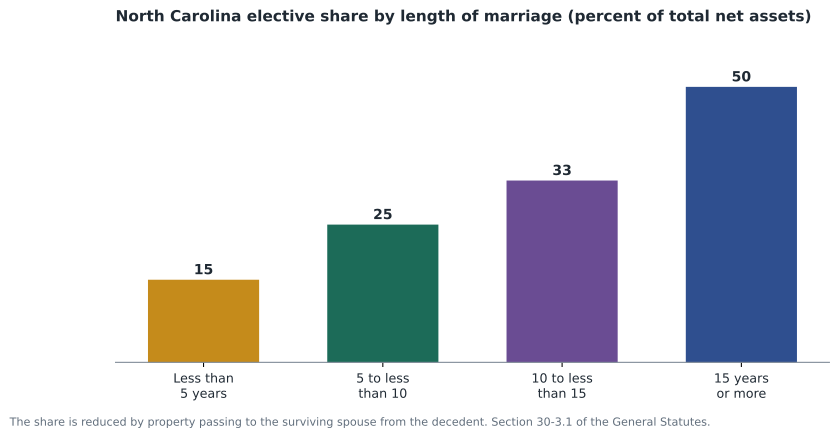
A surviving spouse who is left less by the decedent's will and other transfers than the law considers fair may claim an elective share. Since 2013 the elective share has been based on the decedent's total net assets, a figure that includes not only probate property but also certain nonprobate transfers, such as some property in revocable trusts, jointly held property and certain beneficiary designations. The share depends on the length of the marriage: 15 percent if the spouses were married less than five years, 25 percent for five to less than ten years, 33 percent for ten to less than fifteen years, and 50 percent for fifteen years or more. The amount is reduced by the value of property that passes to the surviving spouse from the decedent by will, intestacy or otherwise.
The claim has a short deadline. The spouse must petition the clerk within the time the statute allows after letters are issued, and a lawyer representing a surviving spouse should calendar it the day the representation begins. North Carolina also recognizes a year's allowance for the surviving spouse and for minor children out of the decedent's personal property, a fixed statutory amount intended to support the family during the first year, which has priority over most creditors.
Caveats
A will admitted to probate in common form before the clerk can be challenged by a caveat, a proceeding to contest its validity. A caveat is filed with the clerk but tried in superior court, usually before a jury, as an issue of devisavit vel non: is this paper the decedent's will or not? Grounds include improper execution, lack of testamentary capacity, undue influence, fraud and duress. A caveat generally must be filed within three years after probate, with longer periods for persons under a disability. While a caveat is pending, the estate's administration is limited to preserving the assets.
The slayer statute
Chapter 31A of the General Statutes bars a slayer, a person who willfully and unlawfully kills the decedent, from taking from the decedent's estate, by will, intestacy, elective share, insurance or survivorship. The property passes as if the slayer had died first. A conviction is not always required; the statute provides for a civil determination.
Trusts
North Carolina's trust law is codified in the North Carolina Uniform Trust Code, Chapter 36C of the General Statutes, based on the national Uniform Trust Code with North Carolina modifications. It governs the creation of trusts, the duties of trustees, the rights of beneficiaries, modification and termination, and the enforcement of spendthrift provisions. Revocable trusts are widely used in North Carolina estate planning to avoid probate administration, and Chapter 36C contains rules on when a trust is revocable, how revocation works, and how a revocable trust's assets are treated after the settlor's death, including their exposure to the elective share as part of total net assets.
Trustees owe duties of loyalty, prudence and impartiality, and North Carolina's version of the Uniform Prudent Investor Act governs investment decisions. A trustee must keep beneficiaries reasonably informed and may be removed for serious breaches. Many trust disputes are heard by the clerk of superior court in estate proceedings or in the superior court, depending on the nature of the claim.
Worked problem
A handwritten will
Clyde Pender, a hypothetical Greenville resident, writes out in his own hand a one-page document leaving his farm to his niece Odell, signs it, and puts it in the envelope with his deed and insurance papers in his desk drawer. He dies a year later. His only heirs are two adult children. Is the document a valid will?
Show solution
- It is entirely in Clyde's handwriting and subscribed by him.
- It was found among his valuable papers, with his deed and insurance papers, which satisfies the location requirement for a holographic will.
- No witnesses are needed for a holographic will.
- If his children challenge it, they would need a caveat, filed with the clerk and tried in superior court, on grounds such as lack of capacity or undue influence.
Answer: The document is likely a valid holographic will, and the farm passes to Odell unless a caveat succeeds. If the same page had been found loose in a kitchen drawer, its validity would be in doubt.
Common mistakes
MistakeA probate judge in a separate court handles North Carolina estates.
InsteadThe clerk of superior court is the judge of probate.
MistakeAny handwritten, signed will is a valid holographic will.
InsteadIt must also be found in a qualifying place, such as among valuable papers.
MistakeMarriage after a will is made revokes it.
InsteadIt does not; divorce revokes gifts to the former spouse.
MistakeThe elective share is always one-third.
InsteadIt ranges from 15 to 50 percent of total net assets depending on the length of the marriage.
MistakeA caveat is tried by the clerk.
InsteadIt is filed with the clerk but tried in superior court, usually before a jury.
Practice problems
Work each problem on paper first, then reveal the answer to check.
Within what period must a general applicant complete the component?
Show answer
Within twelve months after the first day of the bar exam passed.
In which months is the component offered?
Show answer
February, May, July and November.
Who is the judge of probate in North Carolina?
Show answer
The clerk of superior court.
What is the elective share after 12 years of marriage?
Show answer
33 percent of total net assets, less property passing to the spouse.
What makes a holographic will distinctive in North Carolina?
Show answer
It must be found after death in a qualifying place, such as among valuable papers.
Summary and key terms
- The amended rules add a multiple-choice component on decedents' estates and trusts, required within twelve months of the passed exam (from November 15, 2027) or of a transfer filing (from May 1, 2028).
- It is offered in February and July with the exam and in May and November for 100 dollars.
- The clerk of superior court is the judge of probate.
- Wills: attested (two witnesses), holographic (handwriting, signature, qualifying place) and narrow nuncupative wills.
- The spouse's intestate share depends on surviving descendants and parents; the elective share runs from 15 to 50 percent of total net assets by length of marriage.
- judge of probate
- In North Carolina, the clerk of superior court, who probates wills and supervises estates.
- holographic will
- A will entirely in the testator's handwriting, signed, and found in a qualifying place.
- elective share
- A surviving spouse's statutory right to a share of the decedent's total net assets.
- caveat
- A proceeding to contest the validity of a probated will.
- year's allowance
- A statutory allowance from personal property for the surviving spouse and children.
Lesson quiz · 5 questions
Score 60% or more to complete this lesson.
Create a free account to save your progress, take quizzes and earn a certificate.