
BAR-234 · Lesson 11 of 12 · 20 min
Score transfer, comity admission and practice after admission in North Carolina
▶ Video coming soon A video version of this lesson is on the way.
Ruthanne's firm was talking with a possible new associate for the spring: a lawyer who had passed the UBE in another state two years earlier and practiced there since. Ruthanne asked Grady to find out how the candidate could become licensed in North Carolina without sitting the exam, and what the new associate would need to do once admitted. Grady brought the question to the eleventh session. Hollis said it was a good way to learn the routes that do not run through the exam room, and the duties that begin for every new North Carolina lawyer on the day of admission.
This lesson covers admission by transferred UBE score, admission by comity, and the obligations of practice after admission: the oath, State Bar membership, continuing legal education, the Professionalism for New Attorneys program, and the steps every new lawyer should take in the first year.
Admission by transferred UBE score
A candidate who earned a qualifying UBE score in another jurisdiction may apply to North Carolina for admission based on that score. The key requirements, from the Board's rules and NCBE's guide, are these.
The score. For legacy UBE scores, North Carolina's minimum is 270. Since July 2026 North Carolina has also accepted transferred NextGen scores, with a minimum of 620. The amended transfer rule, effective May 1, 2028, ties the minimum to the passing score set as of the UBE administration immediately before the application is filed.
The age of the score. The applicant must have taken the UBE within the three years before filing the transfer application, measured from the date the applicant sat for the exam. A score earned in July 2024, for example, must be used by July 2027.
No concurrent applications. NCBE's guide notes that North Carolina does not allow a candidate to apply for admission by transferred score while also applying to sit the exam.
No MBE-only transfers. North Carolina does not accept a transferred MBE score by itself; the rule that once addressed MBE transfers was repealed effective January 1, 2026.
Character and fitness and the MPRE. A transfer applicant must pass character and fitness review and must have a passing MPRE score of 80.
The component. Under the amended rules, a transfer applicant whose application is governed by the version of section .0504 effective May 1, 2028 must complete the State-Specific Component on decedents' estates and trusts within twelve months after filing the transfer application.
The fee. NCBE's guide lists the fee for admission by transferred UBE score at 1,275 dollars or 1,500 dollars, depending on the applicant's category.
The candidate had sat the UBE two years earlier in a state with a lower passing score. Hollis told Grady to check the score report first: if the total was below 270, the transfer route was closed whatever her years of practice, and the firm would have to consider comity or the exam.
Admission by comity
Comity, which other states call admission on motion, allows an experienced lawyer licensed elsewhere to be admitted without examination. North Carolina's comity rule is based on reciprocity: the applicant must be licensed in a state that would admit North Carolina lawyers on comparable terms. NCBE's guide summarizes the main requirements.
Practice. The applicant must have been actively and substantially engaged in the practice of law for four of the past six years. Qualifying practice includes not only private practice but also law teaching, work for a government agency, military service as a lawyer, in-house corporate work, and service as a judge of a court of record.
Reciprocity. The applicant's licensing state must grant comparable treatment to North Carolina lawyers. The Board decides whether a state is reciprocal, and the answer can change when another state changes its own rules.
Education. NCBE's guide records that graduation from an ABA-approved law school is not required for comity applicants, and that attorneys initially admitted by diploma privilege are eligible.
MPRE. A passing MPRE score is required, but NCBE's guide records no time limit on it for comity applicants.
Fee. NCBE's guide lists the comity fee at 2,000 dollars.
Character and fitness. Comity applicants go through the same review as other applicants, with particular attention to their practice history and any discipline in other jurisdictions.
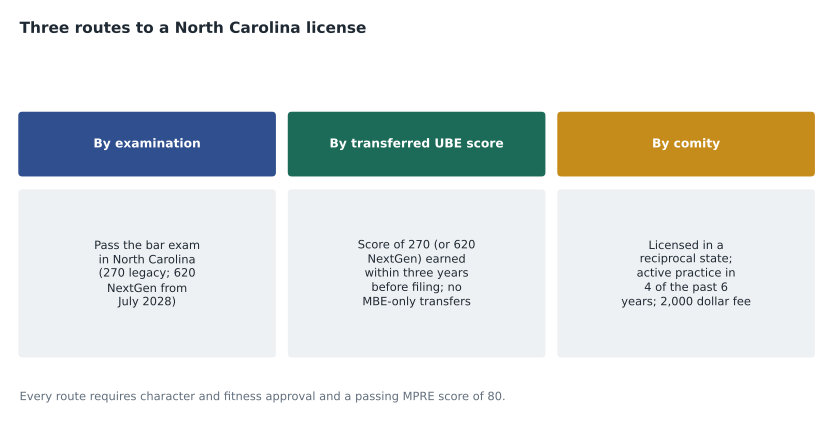
The candidate had practiced for two years, so comity was not yet available. The options were transfer, if the score was 270 or more and was less than three years old, or the exam. Grady drafted a short memo for Ruthanne laying out both, with the dates by which each would need to happen.
| Route | Score or practice required | MPRE | Fee (current) |
|---|---|---|---|
| Examination (general applicant) | Pass the North Carolina exam (270 legacy) | 80, within the rule's window | 850 or 1,650 dollars |
| Transferred UBE score | 270 legacy or 620 NextGen, taken within three years before filing | 80 | 1,275 or 1,500 dollars |
| Comity | Active practice four of the past six years; reciprocal state | 80, no time limit | 2,000 dollars |
Practicing before admission
A lawyer licensed elsewhere who moves to North Carolina cannot simply begin practicing North Carolina law while an application is pending. Rule 5.5 of the North Carolina Rules of Professional Conduct permits only limited temporary practice by lawyers admitted in other jurisdictions, and practice outside those limits is the unauthorized practice of law, which in North Carolina is also a crime under the General Statutes. A law clerk awaiting admission, like Grady, may work under a licensed lawyer's supervision but may not hold himself out as a lawyer, sign pleadings or give legal advice independently.
The oath and State Bar membership
After the Board approves an applicant, the applicant takes the oath of office prescribed for attorneys, which may be administered in a ceremony before a court. The new lawyer then becomes a member of the North Carolina State Bar and must pay the annual membership fee, the Client Security Fund assessment, the CLE attendance fee and other charges set by the State Bar each year. Failure to pay dues or meet CLE requirements can lead to administrative suspension.
Continuing legal education
North Carolina's CLE program, administered by the State Bar's Board of Continuing Legal Education, now uses two-year reporting periods. According to the State Bar, active members must complete 24 approved CLE hours every two years. Of those, four hours must be in professional responsibility, professionalism or a combination; one hour must be in technology training; and one hour must be in professional well-being, which replaced the former substance abuse and mental health awareness requirement. Up to twelve hours may be carried over to the next period, but only as general hours; the ethics, technology and well-being hours cannot be carried over. The State Bar's transition rules gave lawyers admitted in odd-numbered years a one-time twelve-hour, one-year period to align their reporting.
New members must complete the Professionalism for New Attorneys program in their first reporting period. The program covers professional responsibility, trust accounting and law office management, and the credit counts toward the regular requirement. Members who have been licensed in another state for five years or more when admitted in North Carolina are exempt from the program but must report the exemption.
Exemptions are available for some members, such as those on inactive status, certain government officials and members with hardship or disability, under the State Bar's rules, and they must be claimed each year.
The first year
Hollis gave Grady the list she gives every newly admitted North Carolina lawyer.
Register with the State Bar's member portal and confirm the contact information the State Bar and courts will use.
Complete the Professionalism for New Attorneys program early, before the press of a full caseload, and plan the rest of the CLE hours.
If you will handle client funds, learn the trust account rules before you touch the account. Ask to do the next monthly and quarterly reconciliations alongside the lawyer responsible.
Learn the local rules and practices of the courts where you will appear: the district court's family court procedures, the superior court's calendaring, the clerk's estates forms.
Find a mentor. The North Carolina Bar Association and local bar associations run mentoring programs, and many experienced lawyers are generous with time.
Know where to get help. The State Bar's ethics counsel answers questions about the Rules, and the Lawyer Assistance Program offers confidential support.
Consider malpractice insurance. North Carolina does not require it, but most firms carry it, and a new solo practitioner should obtain it before taking a first client.
Moving elsewhere later
A North Carolina UBE score is also portable outward. A lawyer who passes in February 2027 with 270 or more can transfer the score to another UBE jurisdiction within that jurisdiction's time limit and subject to its minimum. After several years of practice, comity or admission on motion in other states may become available. Some North Carolina lawyers near state lines, in Charlotte or the mountains, eventually seek licenses in South Carolina, Virginia or Tennessee, each with its own rules.
Inactive status and reinstatement
Not every lawyer stays on active status. A North Carolina lawyer who stops practicing, moves away or takes a job that does not require a license may elect inactive status, which reduces dues and suspends the CLE requirement. An inactive member may not practice law in North Carolina. Returning to active status requires a petition and, depending on how long the lawyer has been inactive, completion of CLE hours or other requirements set by the State Bar's rules. A lawyer administratively suspended for failure to pay dues or complete CLE must likewise petition for reinstatement and cure the deficiency. Grady noted that these rules mattered for the firm's new associate as well: a lawyer licensed elsewhere who has been on inactive status may have trouble showing the active practice comity requires.
Specialization
After several years of practice, some North Carolina lawyers seek certification by the State Bar's Board of Legal Specialization. Certification is available in fields such as estate planning and probate law, family law, criminal law, workers' compensation, real property and others. It requires a minimum period of practice with substantial involvement in the specialty, an examination, peer references and specialty CLE. Certified specialists may advertise their certification, which is otherwise restricted by the advertising rules. For a lawyer starting out, specialization is a long-term goal, but knowing it exists helps in planning what kind of work to seek.
The North Carolina Bar Association and local bars
Membership in the State Bar is mandatory; membership in the North Carolina Bar Association is voluntary. The Bar Association offers practice sections, CLE programs, publications, a young lawyers division and mentoring. Local bar associations, organized by judicial district or county, run their own events and often maintain the local practice knowledge that makes a new lawyer effective. Hollis told Grady to join both in his first year, and to go to the local bar's lunches even when he felt too busy, because the lawyers he met there would be the ones across the table, or on the phone asking for an extension, for the rest of his career.
Worked problem
Transfer or comity?
Odell Beasley, a hypothetical lawyer, sat the UBE in Colorado in July 2024 and scored 274. He has practiced in Denver since. In November 2026 he moves to Charlotte. Can he be admitted in North Carolina without an exam, and by when?
Show solution
- His score of 274 meets North Carolina's legacy minimum of 270.
- He must file his transfer application within three years after sitting the exam, so before the end of July 2027.
- He has only about two years of practice, so comity, which requires four of the past six years, is not available.
- He must pass character and fitness review and show an MPRE score of 80, and pay the transfer fee.
Answer: Odell should file for admission by transferred UBE score promptly, before July 2027. Comity is not yet available to him.
Common mistakes
MistakeAny UBE score of 266 transfers to North Carolina.
InsteadNorth Carolina requires 270 for legacy scores and 620 for NextGen scores.
MistakeA UBE score can be transferred at any time.
InsteadIt must have been earned within three years before the transfer application is filed.
MistakeComity requires five years of private practice.
InsteadNCBE's guide describes four of the past six years, including government, teaching, military, in-house and judicial work.
MistakeNorth Carolina requires 12 CLE hours every year.
InsteadThe State Bar now requires 24 hours every two years, with four ethics, one technology and one well-being hour.
MistakeEvery new lawyer must take the Professionalism for New Attorneys program.
InsteadMembers licensed elsewhere for five years or more at admission are exempt.
Practice problems
Work each problem on paper first, then reveal the answer to check.
What legacy UBE score transfers to North Carolina?
Show answer
270 or more, earned within three years before filing.
What NextGen score does North Carolina accept on transfer?
Show answer
620, since July 2026.
What practice requirement applies to comity?
Show answer
Active practice for four of the past six years.
How many CLE hours are required per two-year period?
Show answer
24, including four ethics or professionalism, one technology and one well-being hour.
How many CLE hours can be carried over?
Show answer
Up to twelve general hours.
Summary and key terms
- Transferred UBE scores need 270 (legacy) or 620 (NextGen), taken within three years before filing; no MBE-only transfers or concurrent applications.
- Comity requires a reciprocal licensing state and active practice for four of the past six years; the fee is 2,000 dollars.
- All routes require character and fitness approval and an MPRE score of 80.
- After admission: the oath, State Bar membership, 24 CLE hours every two years and the Professionalism for New Attorneys program.
- Practice before admission is limited by Rule 5.5; unauthorized practice is also a crime.
- transferred UBE score
- A UBE score earned in another jurisdiction used for admission in North Carolina.
- reciprocity
- Comparable treatment by another state of North Carolina lawyers seeking admission there.
- Professionalism for New Attorneys
- The State Bar's required program for new members in their first reporting period.
- carryover
- CLE hours beyond the requirement credited to the next period, up to twelve general hours.
- unauthorized practice of law
- Practicing law without a North Carolina license or authorization, prohibited by rule and statute.
Lesson quiz · 5 questions
Score 60% or more to complete this lesson.
Create a free account to save your progress, take quizzes and earn a certificate.