
BAR-234 · Lesson 4 of 12 · 20 min
The North Carolina bar exam: the UBE, scoring and the 270 passing score
▶ Video coming soon A video version of this lesson is on the way.
By the fourth session Grady had finished his first full-length timed MBE practice set and was not happy with the number. 'One hundred and twelve out of two hundred,' he said. 'I need to know what that means for 270.' Hollis said the honest answer was that a raw practice score translates only loosely into a scaled score, but that understanding how the UBE is built and scored would tell him where his points would come from and where to spend his next three months.
This lesson describes the exam North Carolina gives through February 2028: the legacy Uniform Bar Examination. It covers the three components, the two-day schedule, how the parts are weighted and scaled, what 270 means, and how to read a score report.
North Carolina and the UBE
North Carolina first gave the Uniform Bar Examination in February 2019. Before then it wrote and graded its own essay questions on North Carolina law. Since 2019 the exam has been the UBE: the same exam, built from NCBE's three components, that dozens of other jurisdictions give on the same days. North Carolina does not add an essay day of its own, and NCBE's guide notes that there is no jurisdiction-specific requirement attached to the legacy UBE in North Carolina. The new State-Specific Component, discussed in Lesson 6, is a separate requirement that comes from the amended admission rules.
Because the UBE is uniform, a score earned in North Carolina is portable: a candidate who later wants to be admitted in another UBE jurisdiction can transfer the score, subject to that jurisdiction's minimum score and time limits. That portability was one of the main reasons North Carolina joined.
The three components
The Multistate Bar Examination is a 200-question multiple-choice test. Of the 200 questions, 175 are scored and 25 are unscored pretest questions mixed in so that NCBE can evaluate them for future use. Candidates cannot tell which are which. The MBE covers seven subjects: Civil Procedure, Constitutional Law, Contracts, Criminal Law and Procedure, Evidence, Real Property and Torts.
The Multistate Essay Examination consists of six 30-minute essay questions. NCBE writes the questions and model analyses; North Carolina's graders grade the answers. From July 2026, NCBE removed four subjects from the MEE so that it lines up with the NextGen exam: Conflict of Laws, Family Law, Trusts and Estates, and Secured Transactions. The remaining MEE subjects are Business Associations, Civil Procedure, Constitutional Law, Contracts, including sales of goods under Article 2 of the Uniform Commercial Code, Criminal Law and Procedure, Evidence, Real Property and Torts. NCBE has said that Family Law and Trusts and Estates may appear as the subject of a Multistate Performance Test task through February 2028, where the task's library supplies the law.
The removal of Trusts and Estates from the essay matters in North Carolina. A North Carolina candidate in February 2027 will not write an MEE essay on wills, and the general bar exam no longer tests estates law in the way it once did. North Carolina's new State-Specific Component on decedents' estates and trusts fills that space with a test of North Carolina's own law.
The Multistate Performance Test consists of two 90-minute tasks. Each task gives the candidate a File, containing the facts in the form of documents such as memos, interview notes and letters, and a Library, containing the cases, statutes and rules to apply. The candidate completes a lawyering task: an objective memo, a persuasive brief, a letter to a client or opposing counsel, a set of discovery requests, a contract provision, or something similar. The MPT tests skills, not memory. Everything needed is in the packet.
The two-day schedule
The UBE is given on the last Tuesday and Wednesday of February and July. For February 2027, that means February 23 and 24, 2027. On the first day, the morning session is the two MPT tasks, three hours in total, and the afternoon session is the six MEE questions, also three hours. On the second day the candidate takes the MBE: 100 questions in a three-hour morning session and 100 in a three-hour afternoon session.
Pacing is simple arithmetic and should be practiced until it is automatic. Each MPT task gets about 90 minutes, of which many candidates spend 30 to 45 minutes reading and organizing. Each MEE question gets 30 minutes. Each MBE question gets about 1.8 minutes. A candidate who spends too long on one hard MBE question loses time on easier ones later in the session.
Weighting and scaling
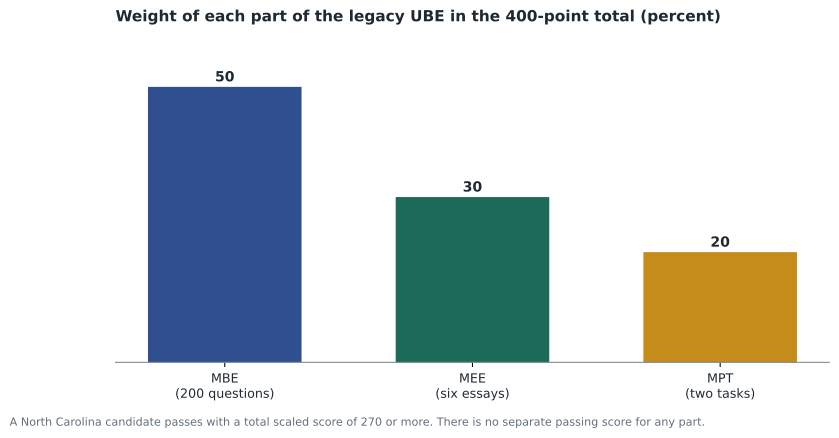
The UBE is scored on a 400-point scale. The MBE counts for 50 percent of the total, the MEE for 30 percent and the MPT for 20 percent. Together the written components, MEE and MPT, are half the score.
The MBE raw score, the number of scored questions answered correctly, is converted to a scaled score through equating. Equating adjusts for differences in difficulty between test forms, so that a given scaled score represents the same level of performance whatever the administration. MBE scaled scores run roughly from 40 to 200 on a 200-point scale.
The written scores are then scaled to the MBE. North Carolina's graders grade each MEE and MPT answer on a raw scale. The jurisdiction's raw written scores for that administration are converted so that their distribution matches the distribution of the same candidates' MBE scaled scores. In practice this means the written component is graded relatively: what matters is how an answer compares with other answers in the same group, and the overall strength of the group is set by its MBE performance. The scaled written score is also on a 200-point scale. The total UBE score is the scaled MBE plus the scaled written score, a number out of 400.
Two consequences follow. First, there is no separate passing score for any component. A candidate passes with a total of 270, however the points are distributed. A strong MBE can carry a weaker written score, and the reverse. Second, the essay and performance test grading is relative, so the goal is not perfection but clear, organized answers that do what the question asks better than most others in the room.
What 270 means
North Carolina's passing score on the legacy UBE is 270 out of 400. NCBE's guide notes a temporary exception for the July 2020 and February 2021 exams, when the minimum was lowered to 268; otherwise the score has been 270 since North Carolina joined the UBE. Among UBE jurisdictions, minimum passing scores have generally run from 260 to 270, so North Carolina sits at the top of the range, alongside states such as Alaska and Colorado.
A useful way to think about 270 is as an average of 135 on each 200-point half. A candidate with a scaled MBE score of 135 and a scaled written score of 135 passes exactly. A candidate with an MBE of 145 needs only a written score of 125. A candidate with an MBE of 128 needs a written score of 142, which is a hard target. Most successful candidates therefore aim for an MBE in the high 130s or above, because MBE improvement is the most predictable lever and because the written component is scaled to it.
| Scaled MBE | Scaled written score needed | Comment |
|---|---|---|
| 125 | 145 | Very difficult; the written score is scaled to a weak MBE |
| 130 | 140 | Possible but risky |
| 135 | 135 | Exactly the passing line |
| 140 | 130 | A comfortable margin |
| 150 | 120 | A strong MBE carries the written score |
Grady's practice score of 112 out of 200 raw was about 56 percent correct. On a released practice exam, a percentage in the mid-50s often corresponds to a scaled MBE in the mid-to-high 120s, though the mapping varies by form. Hollis said that was a normal starting point in November for a February candidate and that the target was the mid-60s percent range by February, which would put him in the 140 area. That improvement typically comes from two sources: fixing recurring errors in the subjects he already knew, and filling gaps in the subjects he did not.
Score reports and results
NCBE and the Board report results after each administration. A candidate who passes receives notice from the Board. A candidate who fails receives a score report showing the scaled MBE score and the scaled written score, which is the information needed to plan a retake. Candidates should keep their score reports: they are needed to transfer a score later and they guide a second attempt.
North Carolina does not limit the number of attempts on the legacy UBE, according to NCBE's guide. A repeat candidate files a supplemental application for the next exam. Because the last legacy exam in North Carolina is February 2028, a candidate who fails in February 2027 has three more legacy administrations, in July 2027, February 2028 and then the NextGen exam from July 2028.
Study planning around the components
Hollis set out a three-part plan for Grady's remaining weeks. First, the MBE: a daily set of timed questions, with every wrong answer logged by subject and by the rule he missed, and a weekly full-length timed session. Second, the MEE: two timed essays a week from released MEE questions in the eight current subjects, compared against NCBE's analyses for structure, not only substance. Third, the MPT: one full task every week from mid-December, with attention to following the task memo's instructions exactly, because a well-organized answer that does what the supervising partner asked earns more than a brilliant answer to a different question.
She also told him what not to do. He should not spend time memorizing North Carolina rules for the February exam, because the UBE will not test them, and he should not let his firm work persuade him that a North Carolina rule is the MBE rule. The North Carolina law in Lessons 7 through 10 is for practice and for the component; the February exam wants the general rule.
What the graders look for
Hollis had graded essays for six years, and she described what makes a written answer score well when grading is relative. Graders read many answers to the same question in a short time, so organization matters as much as knowledge. A strong MEE answer uses the call of the question to set up headings, states each rule accurately and completely before applying it, applies it to the specific facts with the word because, and reaches a conclusion on each issue. A weak answer recites facts without rules, or rules without facts, or argues one side without acknowledging the other.
For the MPT, the graders look first at whether the candidate did the task assigned: the right document, for the right audience, in the right format. A persuasive brief written as an objective memo loses points no matter how good the analysis. Then they look at whether the candidate used the Library's authorities accurately, synthesized rules from several cases where needed, and applied them to the File's facts, including facts that cut against the client.
Using released materials
NCBE publishes released MEE questions with analyses and released MPT tasks with point sheets, as well as practice MBE questions. These are the best preparation materials because they show exactly what the examiners expect. Hollis told Grady to use the MEE analyses as models of structure, not as scripts to memorize, and to grade his own MPT answers against the point sheets before reading her comments. She also warned him that some older released MEE questions test subjects removed from July 2026, such as Trusts and Estates, and that he should set those aside for February.
Worked problem
Reading a score report
Clyde Pender, a hypothetical candidate, receives a North Carolina score report showing a scaled MBE of 131.4 and a scaled written score of 136.1. Did he pass, and what should he focus on for a retake?
Show solution
- Add the two scaled scores: 131.4 plus 136.1 equals 267.5.
- North Carolina's passing score is 270, so Clyde fell 2.5 points short.
- His written score is above the 135 average needed; his MBE is below it.
- Because the written score is scaled to the MBE, raising the MBE helps both halves.
Answer: Clyde did not pass, missing by 2.5 points. His retake plan should focus first on the MBE, while keeping his written practice steady.
Common mistakes
MistakeNorth Carolina has its own essay day on North Carolina law.
InsteadNorth Carolina gives the UBE with no state essay day; the component is a separate requirement.
MistakeA candidate must pass each component separately.
InsteadOnly the total matters: 270 out of 400.
MistakeTrusts and Estates is still an MEE subject.
InsteadIt was removed from the MEE from July 2026, with Conflict of Laws, Family Law and Secured Transactions.
MistakeAll 200 MBE questions are scored.
Instead175 are scored; 25 are unscored pretest questions.
MistakeWritten answers are graded against a fixed standard.
InsteadWritten scores are scaled to the MBE, so grading is relative within the group.
Practice problems
Work each problem on paper first, then reveal the answer to check.
What is North Carolina's passing score on the legacy UBE?
Show answer
270 out of 400.
What weight does the MBE carry?
Show answer
50 percent.
Which four subjects left the MEE from July 2026?
Show answer
Conflict of Laws, Family Law, Trusts and Estates and Secured Transactions.
When did North Carolina first give the UBE?
Show answer
February 2019.
What scaled written score does a candidate with an MBE of 140 need?
Show answer
130.
Summary and key terms
- North Carolina has given the UBE since February 2019, with no state essay day.
- Day 1: two MPT tasks and six MEE essays; Day 2: the 200-question MBE.
- Weights: MBE 50, MEE 30, MPT 20 percent; the written score is scaled to the MBE.
- The passing score is a total of 270, an average of 135 on each half.
- Trusts and Estates left the MEE from July 2026; North Carolina's component now tests that area under North Carolina law.
- MBE
- The Multistate Bar Examination, NCBE's 200-question multiple-choice test.
- MEE
- The Multistate Essay Examination, six 30-minute essays.
- MPT
- The Multistate Performance Test, two 90-minute lawyering tasks.
- equating
- The statistical process that makes scores comparable across test forms.
- scaling
- Converting written raw scores to the MBE's scale.
Lesson quiz · 5 questions
Score 60% or more to complete this lesson.
Create a free account to save your progress, take quizzes and earn a certificate.