
BAR-246 · Lesson 10 of 12 · 19 min
The Vermont Rules of Professional Conduct and attorney regulation
▶ Video coming soon A video version of this lesson is on the way.
Hattie scored well on the MPRE in August 2026, but she nearly missed one question she knew in practice. It asked whether a lawyer may reveal a client's confidential information to prevent the client from committing a fraud that would cause substantial financial loss, using the lawyer's services. Under the ABA Model Rules, the answer is that the lawyer may reveal it. Hattie's instinct, from four years in a Vermont office, was must. 'You were right about Vermont and nearly wrong about the MPRE,' Marchetti told her. 'That is exactly why we study the Model Rules first and the Vermont rules second.'
This lesson covers the Vermont Rules of Professional Conduct, focusing on where they differ from the ABA Model Rules, and the system that licenses and disciplines Vermont lawyers.
The Vermont rules
The Vermont Supreme Court adopted the Vermont Rules of Professional Conduct, based on the ABA Model Rules, in 1999, replacing the older Code of Professional Responsibility. The Court promulgated a comprehensive revision in June 2009, following the ABA's Ethics 2000 revisions of the Model Rules, and it has amended individual rules since then. Most Vermont rules follow the Model Rules closely, often word for word, and Vermont lawyers routinely use ABA and other states' authorities when interpreting them. The differences that do exist are concentrated in a few places, and confidentiality is the most important.
Confidentiality under Vermont Rule 1.6
Vermont Rule 1.6(a) states the same basic rule as the Model Rule: a lawyer shall not reveal information relating to the representation of a client unless the client gives informed consent, the disclosure is impliedly authorized in order to carry out the representation, or the disclosure is required by paragraph (b) or permitted by paragraph (c).
The difference is in what follows. Vermont Rule 1.6(b) makes disclosure mandatory in three situations, to the extent the lawyer reasonably believes necessary. A lawyer must reveal information to prevent a client or another person from committing a criminal act that the lawyer reasonably believes is likely to result in the death of, or substantial bodily harm to, a person other than the actor. A lawyer must also reveal information to prevent the client from committing a crime or fraud that is reasonably certain to result in substantial injury to the financial interests or property of another, where the client has used or is using the lawyer's services to further it. And a lawyer must reveal information to prevent, mitigate or rectify substantial injury to the financial interests or property of another that is reasonably certain to result, or has resulted, from the client's commission of a crime or fraud in furtherance of which the client used the lawyer's services. Paragraph (b) also requires disclosure when other provisions of the Vermont rules require it.
Under the ABA Model Rule, each of those disclosures is permitted rather than required. The Model Rule's exceptions say that a lawyer may reveal information to prevent reasonably certain death or substantial bodily harm, and may reveal information to prevent, mitigate or rectify client crimes or frauds that use the lawyer's services. Vermont converts those permissions into duties.
Vermont Rule 1.6(c) then lists permitted disclosures. A Vermont lawyer may reveal information, even when paragraph (b) does not require it, to the extent the lawyer reasonably believes necessary to prevent the client from committing a crime in circumstances other than those in paragraph (b), or to prevent a person from committing an act likely to result in death or serious bodily harm to the actor; to obtain legal advice about compliance with the rules; to obtain guidance from bar counsel; to establish a claim or defense in a controversy with the client, to defend against a criminal or civil claim based on conduct in which the client was involved, or to respond to allegations about the lawyer's representation; and to detect and resolve conflicts of interest arising from a lawyer's change of employment or changes in a firm's composition, if the information would not compromise privilege or prejudice the client. Rule 1.6(d) requires reasonable efforts to prevent inadvertent disclosure of, or unauthorized access to, client information.
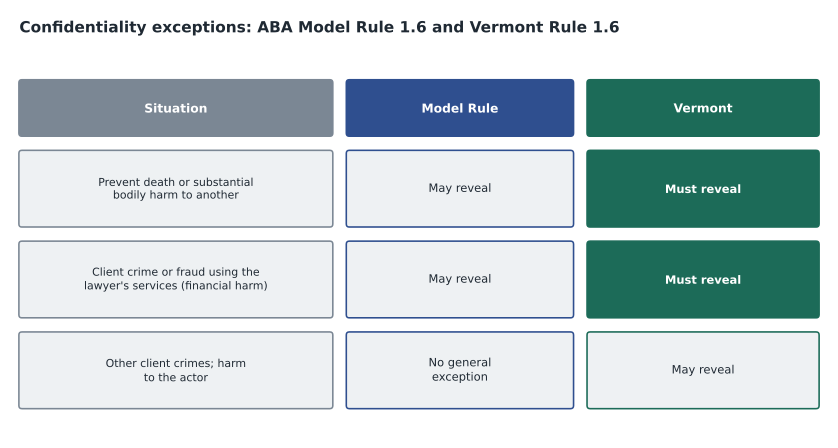
| Situation | ABA Model Rule 1.6 | Vermont Rule 1.6 |
|---|---|---|
| Criminal act likely to cause death or substantial bodily harm to another | May reveal (reasonably certain death or substantial bodily harm) | Must reveal (1.6(b)) |
| Client crime or fraud using the lawyer's services, reasonably certain to cause substantial financial injury | May reveal | Must reveal (1.6(b)) |
| Preventing, mitigating or rectifying such financial injury | May reveal | Must reveal (1.6(b)) |
| Other client crimes; an act likely to harm the actor | No general exception | May reveal (1.6(c)(1)) |
| Guidance from bar counsel | Advice about compliance only | May reveal to bar counsel (1.6(c)(3)) |
Why the difference matters
For the MPRE, the rule is simple: answer under the Model Rules. A question that asks whether a lawyer must disclose a client's planned financial fraud should be answered with the Model Rule's permissive exception. For Vermont practice, the mandatory exceptions change how a lawyer handles a client who reveals a plan to commit a serious crime or to use the lawyer's work in a fraud. The duty is limited: disclosure is required only to the extent the lawyer reasonably believes necessary, and a lawyer should first try to dissuade the client and consider withdrawal under Rule 1.16. But once the conditions are met, silence is not an option in Vermont.
Vermont's bar counsel exception reflects a feature of the state's regulatory system. Bar counsel is a lawyer within the Professional Responsibility Program who provides confidential guidance to lawyers with ethics questions. Rule 1.6(c)(3) makes clear that a lawyer may share client information with bar counsel to obtain that guidance.
Other rules a new Vermont lawyer uses every week
Most of the rules a new Vermont lawyer applies daily follow the Model Rules. Rule 1.1 requires competence, which includes keeping up with changes in law and practice and, as the comments to the Model Rule explain, the benefits and risks of relevant technology. Rule 1.3 requires diligence; Rule 1.4 requires communication with clients. Rule 1.5 governs fees and requires that a contingent fee agreement be in writing, signed by the client, and state the method of calculating the fee. Rule 1.7 and Rule 1.9 govern conflicts with current and former clients, and Rule 1.10 governs imputation within a firm.
Rule 1.15 governs safekeeping of client property. Client funds must be held in a trust account separate from the lawyer's own money, records must be kept, and funds that are nominal in amount or held for a short time go into an interest-bearing trust account whose interest supports civil legal services through Vermont's interest on lawyers' trust accounts program. In a small practice, trust accounting is the area where mistakes are most likely to end a career, and the Vermont Supreme Court treats misuse of client funds as a serious violation.
The Professional Responsibility Program
Discipline of Vermont lawyers is handled through the Professional Responsibility Program, established by the Vermont Supreme Court by administrative order. The Program includes a Professional Responsibility Board, which oversees the system; disciplinary counsel, who investigate and prosecute complaints; bar counsel, who handles inquiries and minor complaints and provides confidential guidance to lawyers; and hearing panels, which hear contested disciplinary cases. The Supreme Court has final authority over discipline and reviews panel decisions.
Sanctions range from private admonition through public reprimand, probation and suspension to disbarment. In deciding sanctions, the Vermont Supreme Court has looked to the ABA Standards for Imposing Lawyer Sanctions, which consider the duty violated, the lawyer's mental state, the actual or potential injury and aggravating and mitigating factors.
Licensing and the bar association
Vermont lawyers are licensed by the Supreme Court through the Office of Attorney Licensing. Each lawyer files a licensing statement and pays a fee to renew the license, and at the end of each two-year continuing legal education reporting period the lawyer certifies compliance with the MCLE requirements on the licensing statement. Lesson 11 covers the CLE requirements.
Vermont does not have a mandatory, integrated state bar. The Vermont Bar Association is a voluntary professional organization that provides CLE programs, practice resources and advisory ethics opinions. Many Vermont lawyers join, and its ethics opinions are a useful resource for interpreting the rules, but membership is not a condition of practice.
Rules the MPRE tests and Vermont practice
Because the MPRE tests the Model Rules, the safest study order is the one Marchetti used with Hattie: master the Model Rules for the MPRE, take the exam, and then study the Vermont differences for practice. After admission, the first-year Vermont CLE requirement usually includes programming on the Vermont rules, and the mentorship gives new lawyers a place to ask how the rules apply in real files.
Worked problem
A client's planned fraud
A Vermont lawyer, Pearl Lathrop, drafted loan documents for a client's business. Before closing, the client tells her that the financial statements he gave her, which she attached to the documents, are false and that he intends to close anyway to obtain 400,000 dollars from the lender. He refuses to correct them. What must Pearl do?
Show solution
- Services used: the client is using Pearl's services to further a fraud reasonably certain to cause substantial financial injury to the lender.
- Vermont Rule 1.6(b): Pearl must reveal information to the extent she reasonably believes necessary to prevent the fraud.
- Other steps: she must not assist the fraud (Rule 1.2(d)), should try to dissuade the client and must withdraw if continuing would assist the fraud (Rule 1.16).
- MPRE contrast: under the Model Rules, disclosure would be permitted, not required.
Answer: Pearl must refuse to proceed, withdraw if necessary and, if the client will not abandon the fraud, reveal information to the extent reasonably necessary to prevent it. On the MPRE, the Model Rule answer would be that disclosure is permitted.
Common mistakes
MistakeVermont's confidentiality rule is identical to the Model Rule.
InsteadVermont Rule 1.6(b) makes several disclosures mandatory that the Model Rule only permits.
MistakeOn the MPRE, a lawyer must disclose a client's planned financial fraud.
InsteadThe MPRE tests the Model Rules, under which disclosure is permitted.
MistakeVermont requires membership in the state bar association.
InsteadThe Vermont Bar Association is voluntary; licensing is through the Supreme Court.
MistakeBar counsel prosecutes serious disciplinary cases.
InsteadDisciplinary counsel prosecutes; bar counsel handles inquiries, minor matters and confidential guidance.
MistakeSmall amounts of client money can be kept in the operating account.
InsteadAll client funds belong in a trust account; nominal or short-term funds go to an interest-bearing trust account.
Getting ethics help
New Vermont lawyers have several sources of help with ethics questions. Bar counsel provides confidential guidance by phone or email, and Rule 1.6(c)(3) protects the lawyer's ability to share client information for that purpose. The Vermont Bar Association publishes advisory ethics opinions on recurring questions. Mentors under the first-year mentorship requirement are expected to discuss professional responsibility with the new lawyer. And the comments to the Vermont rules, many of which follow the ABA comments, explain how the rules are meant to apply.
Quimby's rule for Hattie was simple: when an ethics question makes you uneasy, ask someone before you act, and write down whom you asked and what they said. A lawyer who seeks guidance in good faith and follows it is rarely in serious trouble. A lawyer who guesses and turns out to be wrong often is.
Practice management in a small office
Most Vermont lawyers practice in small firms or alone, and the professional conduct rules that matter most in that setting are the practical ones: keeping a calendar that catches every deadline, running conflict checks before taking a new client, putting fee agreements in writing, reconciling the trust account every month and communicating promptly with clients. Disciplinary complaints in small practices most often arise from neglect and poor communication rather than from dramatic misconduct. A new lawyer who builds good systems in the first year, often with the help of a mentor, avoids most of the problems that lead to complaints.
Summary and key terms
- Vermont adopted Model Rules-based rules in 1999 and revised them comprehensively in June 2009.
- Vermont Rule 1.6(b) requires disclosure to prevent likely death or substantial bodily harm and client crimes or frauds that use the lawyer's services; the Model Rule only permits these.
- Vermont Rule 1.6(c) permits disclosure to prevent other client crimes and to obtain guidance from bar counsel.
- Rule 1.15 requires trust accounts; interest on nominal or short-term funds supports civil legal services.
- The Professional Responsibility Program includes a Board, disciplinary counsel, bar counsel and hearing panels; the Supreme Court decides.
- The Vermont Bar Association is voluntary; licensing and CLE compliance run through the Office of Attorney Licensing.
- 0
- Vermont Rules of Professional Conduct
- 1
- Rule 1.6
- 2
- mandatory disclosure
- 3
- permissive disclosure
- 4
- bar counsel
- 5
- disciplinary counsel
- 6
- Professional Responsibility Program
- 7
- trust account
- 8
- IOLTA
- 9
- Vermont Bar Association
Practice problems
Work each problem on paper first, then reveal the answer to check.
Under Vermont Rule 1.6(b), when must a lawyer reveal information to prevent a crime?
Show answer
When the lawyer reasonably believes it necessary to prevent a criminal act likely to result in death or substantial bodily harm to another person.
How does the ABA Model Rule treat the same situation?
Show answer
It permits, but does not require, disclosure to prevent reasonably certain death or substantial bodily harm.
Who provides confidential ethics guidance to Vermont lawyers?
Show answer
Bar counsel in the Professional Responsibility Program.
Is membership in the Vermont Bar Association required to practice?
Show answer
No. It is a voluntary association.
Lesson quiz · 5 questions
Score 60% or more to complete this lesson.
Create a free account to save your progress, take quizzes and earn a certificate.