
BAR-246 · Lesson 11 of 12 · 19 min
Score transfer, admission without examination and the first year of practice
▶ Video coming soon A video version of this lesson is on the way.
Three members of Marchetti's group expect to practice in Vermont without sitting for the Vermont exam. Ezra Prescott, the New Hampshire candidate, plans to transfer his UBE score if his firm opens a Vermont office. Another member's sister, a lawyer in Maine for four years, wants to move to Brattleboro. And Quimby himself once helped a Massachusetts lawyer with twelve years of practice get admitted without an exam. 'Vermont's front door is the exam,' Quimby told Hattie. 'But it has two side doors, and both have rules.'
This lesson covers admission by transferred UBE score, admission without examination, the legal intern rules and the requirements that apply after admission: the first-year Vermont CLE and mentorship requirements and the ongoing MCLE rules.
Admission by transferred UBE score
Rule 13 allows an applicant who earned a UBE score in another jurisdiction to be admitted in Vermont on that score without retaking the exam. The score must meet Vermont's standard, 270 on the legacy UBE or 620 on the NextGen UBE, and it must come from an administration no more than five years before the date the applicant files the Vermont application. The applicant must also meet Vermont's educational requirements, achieve an MPRE score of at least 80 within the transferred-score window, and satisfy character and fitness review.
Vermont does not accept transferred MBE scores alone; a candidate who took only the MBE in a non-UBE jurisdiction cannot use that score to avoid the Vermont exam. NCBE's listing also confirms that Vermont has no jurisdiction-specific requirement for transferred scores.
Rule 13(c) applies Vermont's four-attempt limit to transferred-score applicants. Under the April 2026 amendments, Vermont accepts transferred NextGen scores even before it gives its own first NextGen exam in July 2027.
| Requirement | Admission by transferred UBE score (Rule 13) |
|---|---|
| Score | 270 legacy or 620 NextGen |
| Score age | From an administration no more than five years before filing |
| Education | Same as for admission by examination |
| MPRE | 80 or higher, taken from five years before to one year after filing |
| Character and fitness | Required |
| MBE-only scores | Not accepted |
Admission without examination
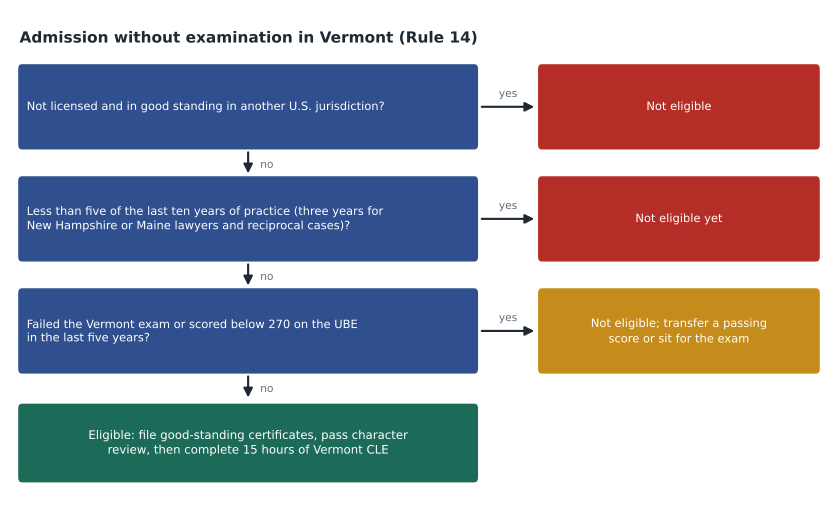
Rule 14 sets the necessary showing for admission without examination. The applicant must hold a current license in another United States jurisdiction, be in good standing, and not be suspended or disbarred anywhere. The applicant must have been actively engaged in the practice of law for at least five of the ten years before filing. The Rules define active practice broadly to include private practice, government work, judicial service and work as in-house corporate counsel, among other roles.
Two exceptions shorten the practice requirement. A lawyer admitted in New Hampshire or Maine needs only three years of practice. And a lawyer whose licensing jurisdiction requires fewer than five years of practice for its own admission on motion needs three of the preceding ten years, which gives reciprocal treatment to lawyers from states with shorter requirements.
The applicant must not have failed the Vermont bar exam, and must not have received a UBE score below 270, within the five years before filing. That rule prevents a lawyer who failed the exam from using admission without examination as a way around it. Rule 14 has no educational prerequisites, because years of practice take the place of the education requirements, but the applicant must file certificates of good standing from every jurisdiction of admission, including federal courts, and must satisfy character and fitness review. Under Rule 15(c), attorney-applicants admitted without examination must complete the first-year Vermont CLE requirement, though not the mentorship.
Worked problem
Admission for a Maine lawyer
Rufus Brigham was admitted in Maine in 2022 and has practiced full time in Portland since. He has never taken the Vermont exam. In December 2026, he wants to apply for admission without examination in Vermont. Does he qualify?
Show solution
- License: he is licensed and in good standing in Maine.
- Practice: as a Maine lawyer, he needs three years of active practice rather than five; he has more than four.
- Prior exams: he has not failed the Vermont exam or scored below 270 on the UBE within five years.
- Other requirements: certificates of good standing from every jurisdiction and federal court, character and fitness review, and, after admission, 15 hours of Vermont CLE.
Answer: Rufus qualifies for admission without examination under the New Hampshire and Maine exception, subject to character and fitness review and the first-year CLE requirement.
Legal interns
Rules 21 through 24 allow law students and LOS participants who meet the eligibility requirements to practice as legal interns under the supervision of a Vermont lawyer. Legal interns may appear in court and perform other legal work in authorized matters, with the supervising lawyer's involvement and responsibility as the rules require. The rules give students and apprentices real experience and help legal aid offices, prosecutors and defenders serve more clients. Hattie worked as a legal intern in her final two LOS years, appearing at arraignments with Quimby beside her.
The first-year requirements
Vermont is unusual in requiring structured training in the first year after admission. Rule 12 contains two requirements.
The first is CLE on Vermont practice. Under Rule 12(a)(1), every new admittee must complete at least 15 hours of continuing legal education on Vermont practice and procedure. At least 9 of the 15 hours must be moderated programming or non-moderated programming with interactivity as a key component, so most of the hours must involve live or interactive learning rather than recorded lectures alone.
The second is a mentorship. Under Rule 12(a)(2), lawyers admitted by examination or by transferred UBE score must complete a mentorship with a Vermont judge or attorney who has been admitted for at least three years. The mentorship must last at least six months and include at least 10 regular meetings and at least 40 hours of activities drawn from a list the Board has approved. The CLE hours completed under Rule 12(a)(1) may count toward the 40 hours.
Rule 12(b) sets the timing. A new lawyer may begin the requirements up to one year before admission and must certify completion within one year after admission. A lawyer who fails to certify is moved to inactive status, which means the lawyer cannot practice until the requirements are met and the license is restored.
| First-year requirement | Who | Details |
|---|---|---|
| Vermont practice and procedure CLE (Rule 12(a)(1)) | All new admittees | At least 15 hours; at least 9 moderated or interactive |
| Mentorship (Rule 12(a)(2)) | Admitted by exam or transferred score | Mentor admitted 3 years; 6 months; 10 meetings; 40 hours |
| Timing (Rule 12(b)) | All | May start up to 1 year before admission; certify within 1 year after |
| Consequence | All | Failure to certify: inactive status |
Hattie plans to start her mentorship with a lawyer other than Quimby, so that she gets a second perspective, and she has already attended a Vermont practice and procedure program that counts toward her 15 hours, since the rule lets her begin up to a year before admission.
Ongoing MCLE
After the first year, Vermont lawyers on active status follow the general Mandatory Continuing Legal Education rules. Each lawyer must complete 24 accredited hours in each two-year reporting period. At least 12 of those hours must be moderated programming or non-moderated programming with interactivity as a key component, and no more than 6 may be non-moderated programming without interactivity. The 24 hours must include at least 2 hours of ethics, at least 1 hour of attorney wellness and at least 1 hour of diversity and inclusion.
Excess hours earned in the second year of a reporting period may be carried forward to the next period. Lawyers certify compliance on the licensing statement filed at the end of each period when renewing their licenses. A lawyer who has not met the requirements files an MCLE makeup plan through the attorney portal with a 50 dollar fee, completes the plan and electronically files a certification of completion by November 15 of the renewal year. Failing to file the certification on time results in administrative suspension. Lawyers on judicial or inactive status are not subject to the MCLE requirements, and lawyers on pro bono emeritus status have a reduced requirement of 8 hours per period, including 1 hour of ethics.
| MCLE element | Requirement |
|---|---|
| Total | 24 hours per two-year period |
| Interactive or moderated | At least 12 hours |
| Non-interactive recorded | No more than 6 hours |
| Ethics | At least 2 hours |
| Attorney wellness | At least 1 hour |
| Diversity and inclusion | At least 1 hour |
| Makeup | Plan with 50 dollar fee; certification by November 15 of the renewal year |
Practicing across the border
Northern New England lawyers often practice in more than one state. Vermont's admission rules make that easier in several ways: the UBE allows score transfer in all directions; Vermont gives New Hampshire and Maine lawyers a three-year path to admission without examination; and New Hampshire gives Vermont lawyers comparable treatment. A lawyer planning a two-state practice should track each state's licensing renewal, CLE and trust account rules separately, because each state's requirements apply independently.
Common mistakes
MistakeA transferred UBE score can be any age if it meets 270.
InsteadThe score must come from an administration no more than five years before filing.
MistakeEvery lawyer needs five years of practice for admission without examination.
InsteadNew Hampshire and Maine lawyers need three years, as do lawyers from jurisdictions that require fewer than five.
MistakeLawyers admitted without examination must complete the mentorship.
InsteadThey must complete the 15-hour Vermont CLE requirement; the mentorship applies to exam and transferred-score admittees.
MistakeFirst-year requirements can only begin after admission.
InsteadThey may begin up to one year before admission.
MistakeVermont MCLE requires 20 hours every two years.
InsteadVermont requires 24 hours per two-year period, with ethics, wellness and diversity hours.
Choosing a mentor
The mentorship works best when the new lawyer chooses a mentor deliberately. A good mentor practices in an area the new lawyer expects to work in, has time to meet regularly and is willing to talk candidly about mistakes, clients, fees and the business of practice. Some new lawyers choose a mentor outside their own firm to get an independent perspective. The Board's list of approved mentorship activities includes observing court proceedings, reviewing practice management systems, discussing professional responsibility and attending bar events, so the 40 hours can be planned around the new lawyer's practice rather than invented at the end of the year.
Keeping records
Because the new lawyer must certify completion within one year, records matter. Hattie keeps a simple log of each mentorship meeting, with the date, the topics discussed and the hours, and a folder of CLE attendance certificates. She plans to file her certification well before the one-year deadline. 'The rule gives you a year,' Quimby told her. 'Use eight months and keep the other four for when life happens.'
Licensing after the first year
After the first year, a Vermont lawyer's obligations settle into a routine: renew the license and pay the licensing fee, complete and certify MCLE hours for each two-year period, maintain a trust account in compliance with Rule 1.15 and keep contact information current with the Office of Attorney Licensing. A lawyer who stops practicing can move to inactive status, which suspends the MCLE requirement, and can later return to active status under the conditions the rules set. Lawyers who retire but want to volunteer can use pro bono emeritus status, with its reduced CLE requirement.
Pro hac vice and temporary practice
A lawyer who is not admitted in Vermont but needs to appear in a single Vermont case can ask the court for permission to appear pro hac vice, usually in association with a Vermont lawyer who remains responsible for the case. The procedure and conditions are set out in the court rules that govern each type of proceeding, and the court has discretion to grant or deny the request. Vermont's version of Rule 5.5 of the professional conduct rules also permits some temporary practice by lawyers admitted elsewhere, such as work reasonably related to a matter in the lawyer's home jurisdiction. Neither route substitutes for admission when a lawyer intends to practice in Vermont on a regular basis.
Which door to choose
For a lawyer who could qualify by more than one route, the choice depends on timing and cost. A lawyer with a recent UBE score of 270 or more may find transfer the quickest path. A lawyer with long experience in another state and an older score, or no UBE score at all, will usually use admission without examination. A lawyer who has a recent failing Vermont result or a UBE score below 270 within five years cannot use admission without examination and must transfer a passing score or sit again. Quimby keeps a one-page chart of the three routes for the lawyers who call him for advice, and he always ends the conversation the same way: 'Then call the Office of Attorney Licensing and ask them, because the rules change and they are the ones who decide.'
Summary and key terms
- Rule 13: transferred UBE scores of 270 (legacy) or 620 (NextGen) from within five years before filing, with education, MPRE 80 and character requirements; no MBE-only transfers.
- Rule 14: admission without examination after five of ten years of practice, or three years for New Hampshire and Maine lawyers and reciprocal cases; no recent Vermont failure or UBE below 270.
- Rules 21 to 24 allow supervised legal interns.
- Rule 12: 15 hours of Vermont practice and procedure CLE (9 interactive) for all new admittees, and a mentorship for exam and transferred-score admittees, certified within one year.
- MCLE: 24 hours per two-year period, including 2 ethics, 1 wellness and 1 diversity and inclusion; makeup certification by November 15.
- 0
- transferred UBE score
- 1
- score age
- 2
- admission without examination
- 3
- active practice
- 4
- certificate of good standing
- 5
- legal intern
- 6
- mentorship
- 7
- Vermont practice and procedure CLE
- 8
- MCLE
- 9
- inactive status
Practice problems
Work each problem on paper first, then reveal the answer to check.
How old can a UBE score be for transfer to Vermont?
Show answer
From an administration no more than five years before the application is filed.
How many years of practice does a New Hampshire lawyer need for admission without examination in Vermont?
Show answer
Three years.
What are the elements of Vermont's mentorship requirement?
Show answer
A mentor admitted at least three years, at least six months, at least 10 meetings and at least 40 hours of approved activities.
How many MCLE hours must an active Vermont lawyer complete every two years?
Show answer
Twenty-four, including at least 2 ethics, 1 attorney wellness and 1 diversity and inclusion hour.
Lesson quiz · 5 questions
Score 60% or more to complete this lesson.
Create a free account to save your progress, take quizzes and earn a certificate.