
BAR-246 · Lesson 6 of 12 · 19 min
What the exam tests and how Vermont law appears
▶ Video coming soon A video version of this lesson is on the way.
Hattie's first timed MEE essay for Marchetti was a real property question about a seller's duty to disclose a defect. Her answer cited a Vermont statute, described how the Environmental Division would treat a permit issue and referred to 'what Abner always tells clients.' Marchetti returned it with a single comment at the top: 'Excellent Vermont lawyering. Wrong exam.' For an LOS candidate who had spent four years learning law in a Vermont office, the hardest adjustment was learning to answer in the general law the UBE tests, not in the Vermont law she used every day.
This lesson explains what law the UBE tests, why Vermont has no state-specific component, where Vermont law does enter the licensing process, and how to keep the two apart.
The law the UBE tests
The UBE tests general principles of law, not the law of any particular state. NCBE's instructions for the MEE state that applicants should answer according to fundamental legal principles rather than local case or statutory law, unless a question says otherwise. The MBE is similar: unless a question states otherwise, the correct answer is the one supported by the generally accepted view of United States law, and certain subjects are tested under specific bodies of law.
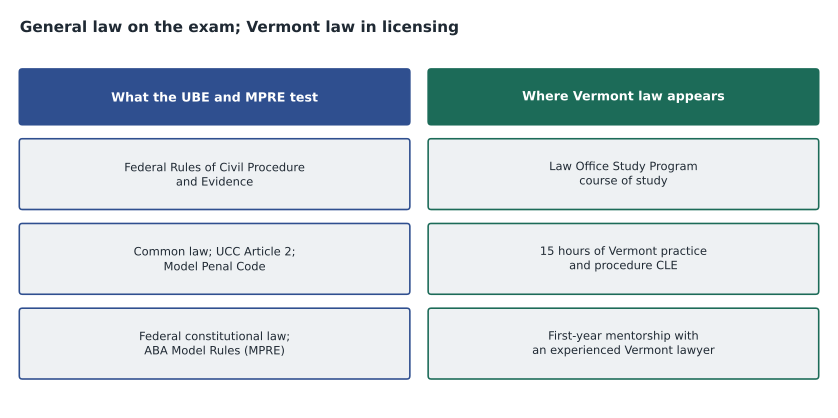
For civil procedure, the UBE tests the Federal Rules of Civil Procedure and federal jurisdiction statutes. For evidence, it tests the Federal Rules of Evidence. For contracts, it tests the common law of contracts and Article 2 of the Uniform Commercial Code for the sale of goods. For criminal law, it tests the common law and the Model Penal Code, with questions specifying which applies where they differ, and constitutional criminal procedure under the federal Constitution. Constitutional law is federal. Real property and torts are tested under generally accepted common law principles.
| Subject | Law the UBE applies |
|---|---|
| Civil procedure | Federal Rules of Civil Procedure; federal jurisdiction and venue statutes |
| Evidence | Federal Rules of Evidence |
| Contracts | Common law; UCC Article 2 for sales of goods |
| Criminal law and procedure | Common law and Model Penal Code; federal constitutional criminal procedure |
| Constitutional law | The United States Constitution and Supreme Court decisions |
| Real property | Generally accepted common law and majority statutory approaches |
| Torts | Generally accepted common law principles |
| Business associations | Generally accepted principles and uniform and model acts |
No Vermont component
Some UBE jurisdictions add a separate requirement on their own law, usually an online course and test that applicants complete before or after the exam. NCBE's listing for Vermont shows no jurisdiction-specific component for either the legacy UBE or NextGen, and none is required to transfer a score to Vermont.
That does not mean Vermont ignores its own law. It simply addresses Vermont law outside the exam, in three places: the Law Office Study Program, which must include Vermont law related to the UBE subjects; the 15-hour post-admission CLE requirement on Vermont practice and procedure; and the mentorship requirement, which pairs each new lawyer with an experienced Vermont practitioner. Lesson 11 covers the CLE and mentorship requirements.
The habit of the general rule
For most candidates, the challenge is the reverse of Hattie's: they learned general law in school and have to learn Vermont law later. For LOS candidates and for candidates who have worked in Vermont offices, the problem is the one Marchetti identified. They know how Vermont does things and instinctively write the Vermont answer. On the exam, that answer can be wrong even when it is a correct statement of Vermont law.
Marchetti teaches a simple habit. Before writing any MEE answer, she asks candidates to write, at the top of their scratch paper, the body of law the question calls for: federal rules, common law, UCC Article 2 or the Model Penal Code. Then she asks them to check every rule statement in the answer against that label.
Where Vermont and the general rule differ
Several areas of Vermont law depart from the rules the UBE tests. Knowing them helps a Vermont candidate avoid importing them into exam answers, and it previews Lessons 7 through 10.
Pleading is the first example. Federal courts apply the plausibility standard of Bell Atlantic Corp. v. Twombly (2007) and Ashcroft v. Iqbal (2009). The Vermont Supreme Court, in Colby v. Umbrella, Inc. (2008), declined to adopt Twombly and kept Vermont's more permissive notice-pleading standard for state court. On the exam, a motion to dismiss for failure to state a claim in a federal case is analyzed under Twombly and Iqbal.
Comparative negligence is the second. The UBE tests the general approaches: contributory negligence in a minority of states, pure comparative negligence and modified comparative negligence. Vermont's statute, 12 V.S.A. section 1036, is a modified comparative negligence rule under which a plaintiff may recover if the plaintiff's negligence was not greater than the defendants' total causal negligence. On the exam, a question that does not specify a jurisdiction's rule should be answered by identifying the approaches, not by applying Vermont's statute as though it were the only one.
Confidentiality is the third. The MPRE and the MBE ethics-related questions test the ABA Model Rules. Vermont's Rule 1.6 requires disclosure in some situations where the Model Rule only permits it. A Vermont candidate who answers an MPRE question with 'must reveal' when the Model Rule says 'may reveal' will miss the question.
Land use is the fourth. Vermont's Act 250 creates a statewide land use permit system that has no equivalent in the UBE's real property subject. Real property questions on zoning test general principles of land use regulation, such as nonconforming uses, variances and takings; Act 250 does not appear.
| Topic | UBE answer | Vermont rule |
|---|---|---|
| Pleading standard | Federal plausibility (Twombly and Iqbal) | State court notice pleading (Colby, 2008) |
| Comparative fault | Identify contributory, pure and modified approaches as the question requires | Modified: plaintiff not more at fault than defendants combined (12 V.S.A. section 1036) |
| Confidentiality | ABA Model Rule 1.6 permissive exceptions | Vermont Rule 1.6(b) mandatory disclosure in some cases |
| Land use | General zoning and takings principles | Act 250 statewide permits plus local zoning |
| Civil procedure | Federal Rules of Civil Procedure | Vermont Rules of Civil Procedure, modeled on the federal rules but with differences |
When Vermont law does help
Not everything Hattie learned in Quimby's office is a liability. Real practice teaches how a deed is structured, how a contract dispute actually unfolds and what a client really asks about. Those instincts help on the MPT, which tests practical skills using a closed universe of facts and law. A candidate who has drafted a client letter or a demand letter in practice often writes a clearer MPT answer than one who has only written law school exams.
Practice experience also helps with the narrative structure of MEE questions. Candidates who have read real files are used to sorting relevant facts from irrelevant ones and spotting the issue a supervising lawyer would care about. The skill is useful as long as the rule applied is the general rule, not the local one.
The MPRE and Vermont rules
The same separation applies to the MPRE. The MPRE tests the ABA Model Rules, the ABA Model Code of Judicial Conduct and generally accepted principles of the law governing lawyers. It does not test the Vermont Rules of Professional Conduct, even though Vermont has adopted most of the Model Rules with modifications. Lesson 10 covers the most important Vermont differences, and candidates should study them after the MPRE, not before, so that the Vermont versions do not crowd out the Model Rule versions the MPRE requires.
A drill for the general rule
Marchetti gave Hattie a short drill to practice the separation. For each MEE subject, Hattie wrote two columns on a page: on the left, the general rule as the MEE would test it; on the right, the Vermont rule she had used in practice, if it was different. For most rules, the right column stayed blank, because Vermont follows the general approach. For a few, such as pleading, comparative negligence and confidentiality, the columns differed, and Hattie marked those rules with a red flag. Before each practice essay, she reviewed the red flags.
Worked problem
Answering in the general rule
An MEE civil procedure question describes a plaintiff who sues in federal district court in Vermont, alleging only that the defendant 'conspired to restrain trade.' The defendant moves to dismiss for failure to state a claim. How should the answer analyze the motion?
Show solution
- Court: the case is in federal court, so the Federal Rules of Civil Procedure apply.
- Standard: under Twombly and Iqbal, a complaint must contain enough factual matter, accepted as true, to state a claim that is plausible on its face; labels and conclusions are not enough.
- Application: a bare allegation of conspiracy, without facts suggesting an agreement, does not meet the plausibility standard.
- Vermont law: the Vermont notice-pleading standard from Colby applies only in Vermont state court and is not relevant to a federal case.
Answer: The answer should apply Twombly and Iqbal and conclude that the complaint is likely to be dismissed, with leave to amend, without mentioning Vermont's state pleading standard.
Summary for the Vermont candidate
The UBE is a national exam, and Vermont has chosen not to add a state component. A Vermont candidate's job on the exam is to answer in the general law, and to save Vermont law for the LOS course of study, the first-year CLE and the mentorship. Lessons 7 through 10 give that Vermont law, so that a new Vermont lawyer knows it when it matters.
Common mistakes
MistakeVermont requires a state law component before or after the UBE.
InsteadVermont has no jurisdiction-specific component; it covers Vermont law through LOS, first-year CLE and mentorship.
MistakeA federal case in Vermont applies Vermont's notice-pleading standard.
InsteadFederal courts apply Twombly and Iqbal; Colby applies in Vermont state court.
MistakeThe MPRE tests Vermont Rule 1.6.
InsteadThe MPRE tests the ABA Model Rules.
MistakeAn MEE property question may require Act 250 analysis.
InsteadThe MEE tests general principles; Act 250 does not appear.
MistakePractice experience is no help on the UBE.
InsteadIt helps on the MPT and with issue spotting, as long as the general rule is applied.
Evidence and criminal procedure
Evidence and criminal procedure are two more areas where Vermont practitioners must keep the general rule in mind. The UBE tests the Federal Rules of Evidence. Vermont has its own Rules of Evidence, modeled on the federal rules but not identical, and a Vermont trial lawyer uses them daily in state court. On the exam, a hearsay question is answered under the Federal Rules, even if the facts take place in a Vermont town.
In criminal procedure, the UBE tests the protections of the United States Constitution, such as the Fourth Amendment's warrant requirement and the Miranda rules. The Vermont Supreme Court has interpreted Chapter I, Article 11 of the Vermont Constitution, Vermont's search and seizure provision, to provide greater protection than the Fourth Amendment in some situations. A Vermont criminal practitioner raises both the federal and the state constitutional claim in every suppression motion. On the exam, the analysis is federal.
Real property in a rural state
Real property is a heavily tested UBE subject, and Vermont practitioners handle a great deal of real estate work. Most of the general principles tested on the exam, such as adverse possession, easements, covenants, recording acts, mortgages and landlord-tenant law, also apply in Vermont in broadly similar form. But details differ, including Vermont's adverse possession period, its marketable title rules and its recording practices in town clerk's offices, where Vermont land records are kept. On the exam, answer with the general rule and any statute the question supplies. In practice, check the Vermont statute and the town records.
Building the red-flag list
By the end of her first month of bar review, Hattie's red-flag list had nine entries: pleading, comparative negligence, confidentiality, Act 250, evidence rules, search and seizure, adverse possession period, the duty to assist strangers and Vermont's family law rules, which are no longer tested on the MEE at all. Next to each, she wrote the general rule in one line. She reviewed the list for two minutes before every timed essay, and by January she no longer needed it.
Summary and key terms
- The UBE tests general law: federal rules for civil procedure and evidence, common law, UCC Article 2, the Model Penal Code and federal constitutional law.
- Vermont has no jurisdiction-specific exam component.
- Vermont law enters licensing through the LOS course of study, first-year Vermont CLE and the mentorship.
- Key differences include notice pleading (Colby), modified comparative negligence (section 1036), mandatory disclosure under Vermont Rule 1.6 and Act 250.
- Write the governing body of law at the top of each essay plan and check every rule against it.
- 0
- general principles of law
- 1
- jurisdiction-specific component
- 2
- notice pleading
- 3
- plausibility standard
- 4
- modified comparative negligence
- 5
- Model Rules
- 6
- Act 250
Practice problems
Work each problem on paper first, then reveal the answer to check.
Does Vermont require a state-specific component for the UBE?
Show answer
No. NCBE lists none, and Vermont addresses its law through LOS, first-year CLE and mentorship.
Which pleading standard applies to a federal case filed in Vermont?
Show answer
The federal plausibility standard of Twombly and Iqbal.
What case kept notice pleading in Vermont state court?
Show answer
Colby v. Umbrella, Inc. (2008).
Which professional conduct rules does the MPRE test?
Show answer
The ABA Model Rules of Professional Conduct and Model Code of Judicial Conduct.
Lesson quiz · 5 questions
Score 60% or more to complete this lesson.
Create a free account to save your progress, take quizzes and earn a certificate.