
BAR-246 · Lesson 3 of 12 · 19 min
Character and fitness and the MPRE
▶ Video coming soon A video version of this lesson is on the way.
Hattie's application asked about everything: every address since she turned 18, every job, every traffic ticket, every court case, every loan in default, every school discipline. She had one item that worried her. During her second LOS year, a credit card account went to collections for several months after a medical bill for her father's tractor accident strained the family's finances. She had paid it off in full. 'Do I really have to list something I already fixed?' she asked the group. Marchetti's answer was immediate. 'You list it, you explain it, and you attach proof that you paid it. The Committee is not looking for people who have never had a hard year. It is looking for people who tell the truth about one.'
This lesson covers Vermont's character and fitness process, from the application through investigation, hearing and appeal, and the MPRE score and timing rules.
The standard
Every applicant for admission in Vermont, by any route, must establish good moral character and fitness to practice law. The burden is on the applicant. The question is not whether the applicant has a perfect past but whether the applicant is likely to meet the obligations of a lawyer: honesty with clients, courts and opposing parties; reliability with deadlines and money; respect for the law; and the ability to handle the responsibility of client matters.
Character and fitness review in Vermont is the work of the Character and Fitness Committee established by Rule 4. The Committee has seven members: one retired justice or an active or retired judge, three attorneys and three members who are not attorneys. The Committee's process is set out in Rules 16 through 19.
The application and investigation
Rule 16 describes the requirements and the investigation. The applicant's filing includes a detailed questionnaire covering residence history, employment, education, financial responsibility, criminal and civil proceedings, prior bar applications and discipline, and other matters. NCBE conducts the character investigation for some types of Vermont applications, gathering information and references and producing a report.
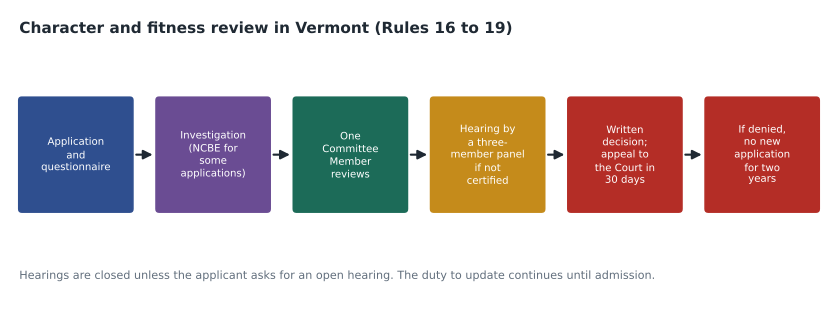
The Vermont process then turns on a single Committee member. One Member of the Committee reviews the applicant's file, investigates as needed and decides whether to certify that the applicant has the required character and fitness. In most cases, the file is complete and unremarkable, and the Member certifies the applicant without further proceedings. If the Member is not prepared to certify, the matter goes to a hearing.
The hearing
Rule 17 governs hearings. A three-member panel of the Committee presides. The applicant may be represented by counsel. The rules of evidence generally apply, and testimony is taken under oath. The hearing is closed to the public unless the applicant asks for it to be open. That default protects applicants, whose hearings often involve personal history such as mental health treatment, family difficulties or old criminal matters.
Under Rule 18, the panel issues a written decision after the hearing. An applicant who disagrees may appeal to the Vermont Supreme Court within 30 days of the decision. Rule 25 provides for appeals to the Court and preserves the Court's original jurisdiction over admission.
Rule 19 limits repeat applications. An applicant who is denied certification may not apply again for two years. The rule gives the denial practical weight and gives the applicant time to address whatever led to it, whether that is completing treatment, resolving debts or building a record of honest conduct.
| Stage | Who | Key rule |
|---|---|---|
| Investigation | A single Committee Member; NCBE for some applications | Rule 16 |
| Certification | The Member, if satisfied | Rule 16 |
| Hearing | Three-member panel; counsel allowed; evidence rules generally apply; closed unless applicant asks | Rule 17 |
| Decision | Written decision by the panel | Rule 18 |
| Appeal | Vermont Supreme Court, within 30 days | Rules 18 and 25 |
| After denial | No new application for two years | Rule 19 |
What the Committee looks at
The categories of conduct that raise questions in Vermont are the same as elsewhere. They include dishonesty in any form, especially in the application itself; criminal conduct, particularly crimes involving dishonesty, violence or substance abuse; academic misconduct; financial irresponsibility, such as unpaid debts, defaults or bankruptcy filed to avoid obligations; neglect of professional or legal obligations; discipline in another profession or another bar; and conduct suggesting that a mental health or substance use condition currently impairs the applicant's ability to practice.
The Committee weighs the conduct against factors that commonly matter in fitness decisions: how long ago it happened, how serious it was, the applicant's age at the time, whether it was a single incident or a pattern, the applicant's candor about it, and evidence of rehabilitation. A single old incident fully disclosed and explained rarely prevents admission. A recent pattern, or any attempt to hide the facts, often does.
Candor is the test
Every bar admissions official says the same thing, and Vermont's are no exception: the worst character problem an applicant can have is one created by the application itself. An applicant who fails to disclose a matter that later surfaces turns a minor issue into a question of honesty, and honesty is the core of fitness to practice. Omission is treated as seriously as a false statement, because the effect is the same.
Hattie listed the collection account, attached a letter from the creditor confirming payment in full and wrote a short explanation describing the medical emergency, her payment plan and the date the debt was satisfied. She also listed a speeding ticket from 2019 that she had nearly forgotten and a small claims case in which she had been a witness, not a party, because the question asked about any involvement.
The continuing duty to update
An application is not frozen on the day it is filed. Applicants have a continuing duty to update their answers until admission. A new traffic ticket, a new lawsuit, a new debt problem or any other change that would alter an answer should be reported promptly. Reporting a new matter voluntarily demonstrates exactly the candor the Committee is looking for; waiting and hoping it will not come up does the opposite.
The MPRE
Rule 11 requires every applicant for admission by examination and by transferred UBE score to achieve a scaled score of at least 80 on the Multistate Professional Responsibility Examination. The MPRE is a two-hour, 60-question multiple-choice exam written by NCBE and given at test centers several times a year. It tests the ABA Model Rules of Professional Conduct, the ABA Model Code of Judicial Conduct and generally accepted principles of law governing lawyers, not Vermont's version of the rules. Lesson 10 covers how Vermont's own professional conduct rules differ.
Scores are reported on a scale from 50 to 150. Vermont's required score of 80 is near the lower end of the range of minimum scores across jurisdictions, which run from 75 to 86. A candidate who expects to practice in a state with a higher requirement, such as 85 or 86, should aim for that higher number from the start, because the MPRE score must meet each jurisdiction's own minimum.
MPRE timing rules
Vermont's timing rules depend on the route of admission. For admission by examination, the MPRE must be taken no earlier than three years before the applicant takes the bar exam and no later than one year after the applicant is notified of passing the UBE. For admission by transferred UBE score, the MPRE must be taken no earlier than five years before, or no later than one year after, the date the application is filed.
Many candidates take the MPRE during law school or, for LOS participants, during the final year of study, so that it is done before bar review begins. Hattie took the MPRE in August 2026 and scored well above 80. Her score is valid for her February 2027 exam because it was earned less than three years before the exam.
Worked problem
Applying the MPRE windows
Otis Grenier took the MPRE in March 2022 and scored 92. He sat for the UBE in New York in July 2023, scored 281, and practiced in New York. In October 2026, he files an application in Vermont for admission by transferred UBE score. Is his MPRE score usable?
Show solution
- Route: admission by transferred UBE score, so the window runs from five years before the filing date to one year after it.
- Filing date: October 2026. Five years before is October 2021.
- MPRE date: March 2022, which is within five years before filing.
- Score: 92 is at least 80. His UBE score is also from an administration within five years before filing.
Answer: Otis's MPRE score of 92 is within the transferred-score window and meets Vermont's minimum, so he does not need to retake the MPRE.
Preparing the MPRE
The MPRE rewards targeted preparation. Most candidates prepare in two to four weeks, using a short commercial course or NCBE's official practice materials, and focus on the rules that are tested most: conflicts of interest, confidentiality, the client-lawyer relationship, fees, candor to the tribunal, and judicial conduct. The trap for candidates who have practiced or worked in law offices, including LOS participants, is that real-world habits do not always match the Model Rules. Hattie found that several Vermont rules she had absorbed in Quimby's office, including Vermont's confidentiality exceptions, were different from the Model Rules the MPRE tests.
Common mistakes
MistakeOld, resolved problems do not need to be disclosed.
InsteadDisclose everything the questions ask about, with explanations and proof of resolution.
MistakeVermont character hearings are public.
InsteadHearings are closed unless the applicant asks for them to be open.
MistakeAn applicant denied certification can reapply at the next exam.
InsteadRule 19 bars a new application for two years.
MistakeAn MPRE score of 75 is enough for Vermont.
InsteadVermont requires a scaled score of 80.
MistakeThe MPRE window is the same for every applicant.
InsteadExam applicants: three years before the exam to one year after notice of passing. Transferred-score applicants: five years before to one year after filing.
Mental health and substance use questions
Many applicants worry about questions concerning mental health and substance use. Bar admission authorities across the country have narrowed those questions in recent years, focusing on current conduct and current impairment rather than on a diagnosis or a history of treatment. The guiding idea is that seeking treatment is a responsible act and should not be discouraged. An applicant should answer exactly the questions Vermont's application asks, in the form it asks them, and should not volunteer more than the question calls for, but should never answer inaccurately. An applicant with a history that may raise questions can ask the Office of Attorney Licensing about the process or consult a lawyer who represents bar applicants.
Rehabilitation and conditional thinking
When an applicant has past conduct that raises concerns, the most persuasive response is evidence of rehabilitation. That evidence can include the passage of time without further problems, completed treatment or counseling, restitution or repayment of debts, steady employment, community service and letters from people who know the applicant well and know about the conduct. Letters are most useful when the writer explains what they know of the past conduct and why they believe the applicant has changed. A general letter praising the applicant's character, written by someone unaware of the issue, carries little weight.
A character file checklist
Before filing, Marchetti asks each candidate to work through a short checklist. Does the residence history run without gaps from age 18? Does every job, including part-time and seasonal work, appear with accurate dates and a supervisor's contact information? Has the candidate pulled a personal credit report and compared it with the financial answers? Has the candidate listed every traffic matter, court case, academic discipline and prior bar application the questions ask about? Is every yes answer explained, labeled by question number and supported by documents?
She also asks candidates to read the finished application aloud, start to finish, a day after completing it. Mistakes that slip past a tired reader at midnight become obvious in daylight. Hattie found two that way: a transposed year in her employment history at a summer creamery job and a former landlord's address listed for the wrong apartment in Burlington.
Character after admission
The values the Committee tests do not end with admission. A lawyer's duty of candor to courts, clients and the disciplinary system continues throughout a career, and Vermont's disciplinary system treats dishonesty seriously, as Lesson 10 shows. Candidates who approach the application as a first exercise in professional candor, rather than as a form to get through, are practicing a habit they will need every day in practice. By late November 2026, the Committee had asked Hattie for nothing further about her collection account. 'That is what a clean file looks like,' Marchetti said. 'Not a perfect history. A complete one.'
Summary and key terms
- Every applicant must establish good moral character and fitness; the burden is on the applicant.
- A single Committee Member investigates and may certify; if not, a three-member panel holds a hearing.
- Hearings allow counsel, generally apply the rules of evidence, take testimony under oath and are closed unless the applicant asks otherwise.
- Appeals go to the Vermont Supreme Court within 30 days; an applicant denied certification may not reapply for two years.
- Candor and the continuing duty to update are central.
- Vermont requires an MPRE score of 80, with windows that differ for exam and transferred-score applicants.
- 0
- character and fitness
- 1
- Character and Fitness Committee
- 2
- certification
- 3
- hearing panel
- 4
- candor
- 5
- duty to update
- 6
- MPRE
- 7
- scaled score
- 8
- rehabilitation
Practice problems
Work each problem on paper first, then reveal the answer to check.
Who first decides whether to certify an applicant's character and fitness in Vermont?
Show answer
A single Member of the Character and Fitness Committee, after investigation.
How long does an applicant have to appeal a panel's decision to the Vermont Supreme Court?
Show answer
Thirty days from the decision.
What MPRE score does Vermont require?
Show answer
A scaled score of at least 80.
For an exam applicant, how early can the MPRE be taken?
Show answer
No earlier than three years before the bar exam.
Lesson quiz · 5 questions
Score 60% or more to complete this lesson.
Create a free account to save your progress, take quizzes and earn a certificate.