
BAR-246 · Lesson 12 of 12 · 17 min
Capstone: Vermont practice questions and an exam-day plan
▶ Video coming soon A video version of this lesson is on the way.
The group's last November session was a rehearsal. Marchetti gave Hattie three tasks: answer ten short questions on Vermont admission and Vermont law without notes, write a memo on an original Vermont practice problem in the time allowed, and walk through her plan for February 23 and 24, 2027, hour by hour. 'This is not the bar exam,' Marchetti said. 'It is a check that you can find your way around Vermont when the exam is over, and that you will arrive in South Burlington ready.'
This capstone lesson follows the same structure. Part one is a set of short questions. Part two is an original practice problem answered in memo form. Part three is an exam-day plan for the February 2027 legacy UBE.
Part one: ten short questions
Try to answer each question before reading the answer.
| Question | Answer |
|---|---|
| 1. What MPRE score does Vermont require? | 80. |
| 2. When must an application for the July 2027 exam be received? | By April 15, 2027; there is no late filing period. |
| 3. What is Vermont's NextGen passing score? | 620, set by the April 7, 2026 order effective July 1, 2026. |
| 4. How long is the Law Office Study Program, and who may supervise? | Four years; a Vermont judge or practicing attorney admitted in Vermont at least three years. |
| 5. Can a Vermont applicant appeal a failing UBE score? | No; NCBE-certified scores are final under Rule 10(c). |
| 6. What are the State's liability caps under the Vermont Tort Claims Act? | 500,000 dollars per person and 2,000,000 dollars per occurrence. |
| 7. A town employee negligently injures someone on the job. Whom does the injured person sue? | The municipality, under 24 V.S.A. section 901a. |
| 8. What is Vermont's no-fault divorce ground? | Living apart for six consecutive months, with resumption not reasonably probable. |
| 9. How does Vermont Rule 1.6(b) differ from the Model Rule? | It makes certain disclosures mandatory, including to prevent client crimes or frauds using the lawyer's services. |
| 10. What must a new admittee complete in the first year? | 15 hours of Vermont practice and procedure CLE and, if admitted by exam or transferred score, a mentorship, certified within one year. |
Hattie answered nine correctly on her first attempt. She missed the third, recalling the NCBE help page that listed Vermont's NextGen score as to be announced. Marchetti used the mistake to make a point she repeats often: when an NCBE summary and Vermont's own rules disagree, the rule controls.
Part two: the Gilson Road problem
Read the facts and draft a memo to a supervising lawyer. The facts are original and fictional, and the problem is about Vermont law, not the general law tested on the UBE.
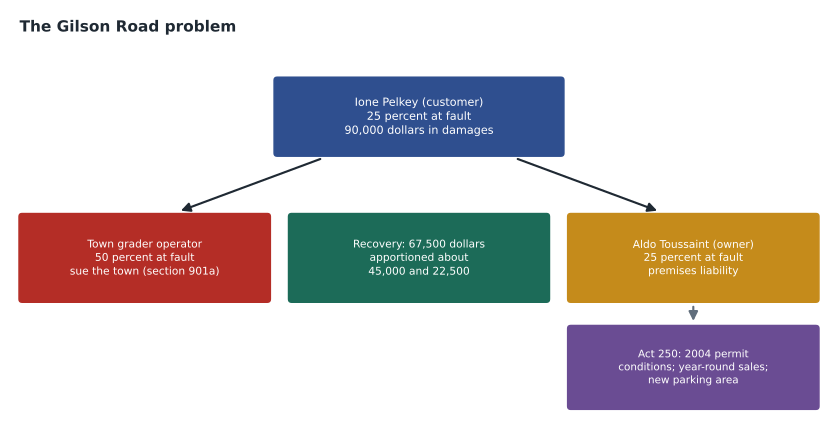
Facts. Aldo Toussaint owns a 60-acre parcel on Gilson Road in a small Addison County town. In 2004, the District Environmental Commission issued an Act 250 permit allowing a small farm stand on the parcel, with a condition limiting the stand to products grown on the property and to operation between May and October. In 2025, Aldo began selling firewood and imported produce year-round and added a gravel parking area. On a February evening in 2026, a town road crew employee, operating a town grader, pushed a large ridge of plowed snow and ice across the entrance to Aldo's parking area and left it there. The next morning, a customer named Ione Pelkey drove into the lot, struck the frozen ridge, lost control and hit a parked truck. Ione suffered a fractured wrist and 90,000 dollars in damages. A jury would likely find Ione 25 percent at fault for driving too fast for the conditions, the town employee 50 percent at fault and Aldo 25 percent at fault for failing to clear the entrance. The town has a liability insurance policy. Ione also wants to know whether she can sue the grader operator personally. Separately, a neighbor has complained to state Act 250 enforcement staff about Aldo's year-round operations.
Assignment. Write a memo analyzing Ione's claims against the town, the grader operator and Aldo, and identify the Act 250 issues Aldo faces.
A model memo
Question presented. Can Ione recover for her injuries, from whom, and in what amount; and what Act 250 exposure does Aldo have?
Brief answer. Ione can likely recover 75 percent of her damages, or about 67,500 dollars, from the town and Aldo, apportioned by their shares of fault. She cannot sue the grader operator personally for negligence within the scope of his employment. Aldo likely needs an Act 250 permit amendment for his year-round sales of products not grown on the property and for the new parking area.
Comparative negligence. Under 12 V.S.A. section 1036, contributory negligence does not bar recovery if the plaintiff's negligence is not greater than the total causal negligence of the defendants. Ione's 25 percent is not greater than the defendants' combined 75 percent. Her damages of 90,000 dollars are reduced by 25 percent, leaving 67,500 dollars. Because recovery is allowed against more than one defendant, section 1036 apportions the award between them according to their shares of the defendants' total negligence. The town's 50 percent is two-thirds of the defendants' 75 percent, or 45,000 dollars, and Aldo's 25 percent is one-third, or 22,500 dollars. The memo should flag that the application of the apportionment rule should be confirmed against current Vermont case law before advising Ione about collection.
The town and the grader operator. Under 24 V.S.A. section 901a, when a municipal employee's act or omission within the scope of employment causes injury, the exclusive right of action is against the municipality, and the employee cannot be sued for it. The grader operator was plowing a town road as part of his job, and there is no indication that his conduct was willful, intentional or outside the scope of his authority. Ione's claim is therefore against the town, and she cannot sue the operator personally. In the substituted action, the town may raise any defense the operator could have raised, but it may not raise municipal sovereign immunity. In addition, the town carries liability insurance, which under Vermont law waives immunity to the extent of coverage. The memo should recommend obtaining the policy to confirm its limits.
Aldo. Aldo owed his business customers a duty of reasonable care to keep the premises, including the entrance to his parking area, reasonably safe. A jury could find that leaving a frozen ridge across the entrance overnight, when customers would arrive in the morning, breached that duty. His 25 percent share supports a judgment against him for 22,500 dollars.
Act 250. Aldo's 2004 permit limits the farm stand to products grown on the property and to operation between May and October. Selling imported produce and firewood year-round appears to violate those conditions, which run with the land. The new gravel parking area may also be a material change to the permitted project. Aldo should seek a jurisdictional opinion or apply for a permit amendment from the District Commission, and his lawyer should check whether Act 181 of 2024 and the 2026 amendments changed jurisdiction or procedure for his parcel's location. He should also check the town's zoning bylaw. The neighbor's complaint may lead to an enforcement action, and voluntary compliance usually improves the outcome.
Recommendations. File suit against the town and Aldo within three years of the February 2026 injury under 12 V.S.A. section 512; do not name the grader operator; obtain the town's insurance policy; and advise Aldo separately, through different counsel because of the conflict, about his Act 250 exposure.
| Issue | Rule | Conclusion |
|---|---|---|
| Ione's fault | 12 V.S.A. section 1036 | 25 percent is not greater than 75 percent; recovers 67,500 dollars |
| Apportionment | Section 1036 | Town about 45,000 dollars; Aldo about 22,500 dollars; confirm case law |
| Grader operator | 24 V.S.A. section 901a | Sue the town, not the employee |
| Town immunity | Section 901a; insurance waiver | Town cannot raise sovereign immunity in the substituted action; insurance also waives it |
| Act 250 | 2004 permit conditions; material change | Seek a jurisdictional opinion or amendment |
| Limitations | 12 V.S.A. section 512 | Three years from the February 2026 injury |
Marchetti's comment on Hattie's draft was brief. 'You represented Ione and then started advising Aldo in the same memo. In real life, those are two clients with adverse interests. Rule 1.7 matters even in a practice problem.' Hattie added the conflict note to her recommendations.
Part three: the exam-day plan
The February 2027 legacy UBE in Vermont is given on Tuesday, February 23, and Wednesday, February 24, 2027, at the Doubletree by Hilton in South Burlington. Hattie built her plan in three parts: the week before, each exam day and the evening between.
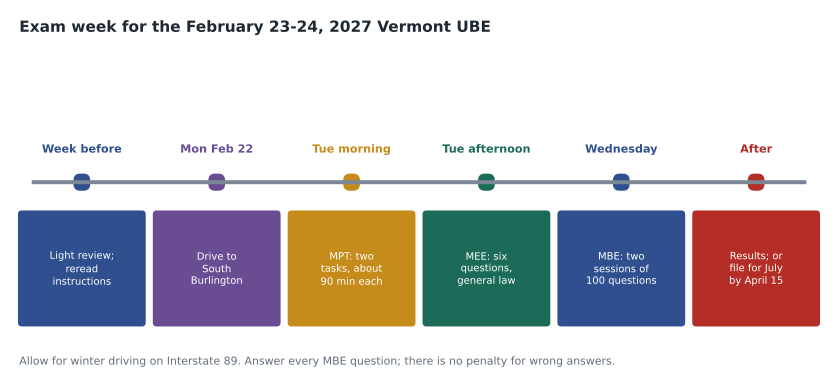
The week before. Light review only: one timed MPT, two MEE essays and a few 25-question MBE sets, then nothing new. Read the Board's exam instructions again. Confirm the admission ticket, identification, laptop software and permitted items. Plan meals and the drive from Montpelier, allowing for winter weather on Interstate 89.
Monday, February 22. Drive to South Burlington in daylight, check in to a nearby hotel, walk to the exam room location if possible and go to bed early. Pack the permitted items in a clear bag the night before.
Tuesday, February 23. Morning: the MPT, two 90-minute tasks in three hours. Read the task memo first, then the library, then the file, and outline before writing. Spend about 90 minutes on each task and move on when time is up. Afternoon: the MEE, six questions in three hours. Spend about 30 minutes on each, with five minutes of outlining, and answer in the general law. Before each answer, write the governing body of law at the top of the scratch paper, as Lesson 6 recommended.
Tuesday evening. Eat, walk and rest. Do not discuss the essays with other candidates. A short set of ten MBE questions can help keep the mind in multiple-choice mode, but more than that is counterproductive.
Wednesday, February 24. The MBE in two three-hour sessions of 100 questions each. Pace at about 1.8 minutes per question, with a check at question 34 and question 67 in each session. Answer every question, since there is no penalty for wrong answers. Drink water at the break and eat something.
After the exam. Drive home carefully. Results come some weeks later from the Board. If Hattie passes, she will finish her mentorship and Vermont CLE, take the oath and join the Vermont bar in time for spring. If she does not, her retake in July 2027 will be on NextGen, and she will need to file by April 15, 2027.
| Time | Plan |
|---|---|
| Week before | Light review; reread instructions; confirm logistics and weather plan |
| Monday, February 22 | Travel to South Burlington; early night |
| Tuesday morning | MPT: two tasks, about 90 minutes each |
| Tuesday afternoon | MEE: six questions, about 30 minutes each, general law |
| Tuesday evening | Rest; no essay post-mortems |
| Wednesday | MBE: two sessions of 100 questions; about 1.8 minutes per question |
| After | Results; first-year requirements; or file for July NextGen by April 15, 2027 |
Closing advice
The group's last exercise was a list. Marchetti asked each candidate to write the three things they would do differently if they had to start preparing again. Hattie wrote: start timed essays sooner, keep a red-flag list of Vermont rules from the first week, and trust the general rule on the exam. Then Marchetti asked for one thing each candidate would keep. Hattie wrote: four years of reading law in a Vermont office. 'Good,' Marchetti said. 'That is the part of your preparation nobody else in this group has. After February, it is the part that will matter most.'
Common mistakes
MistakeA practice memo can advise both the injured customer and the landowner.
InsteadThey are adverse; Rule 1.7 requires separate counsel.
MistakeThe town employee should be named as a co-defendant.
InsteadSection 901a makes the municipality the exclusive defendant for conduct within the scope of employment.
MistakeIone's fault is compared with each defendant separately.
InsteadSection 1036 compares her fault with the defendants' combined fault.
MistakeAct 250 permit conditions lapse when uses change.
InsteadConditions run with the land; changes may require an amendment.
MistakeThe MBE penalizes wrong answers.
InsteadThere is no penalty; answer every question.
Summary and key terms
- Ten short questions review the core admission rules and Vermont law covered in Lessons 1 to 11.
- The Gilson Road problem applies section 1036, section 901a, the insurance waiver and Act 250 permit conditions.
- Ione recovers 75 percent of her damages, apportioned between the town and Aldo; she cannot sue the grader operator personally.
- Aldo faces Act 250 issues from violating permit conditions and adding a parking area.
- The February 23 and 24, 2027 plan covers logistics, timing for the MPT, MEE and MBE, and the path to July NextGen if needed.
- 0
- capstone
- 1
- memo
- 2
- apportionment
- 3
- scope of employment
- 4
- permit condition
- 5
- material change
- 6
- exam-day plan
- 7
- pacing
Practice problems
Work each problem on paper first, then reveal the answer to check.
In the Gilson Road problem, why can Ione recover despite being at fault?
Show answer
Her 25 percent is not greater than the defendants' combined 75 percent under section 1036.
Why can't Ione sue the grader operator personally?
Show answer
Under 24 V.S.A. section 901a, the exclusive right of action for a municipal employee's conduct within the scope of employment is against the municipality.
What Act 250 problem does Aldo have?
Show answer
His year-round sales of products not grown on the property violate permit conditions that run with the land, and the new parking area may be a material change.
What pace should a candidate keep on the MBE?
Show answer
About 1.8 minutes per question, answering every question.
Lesson quiz · 5 questions
Score 60% or more to complete this lesson.
Create a free account to save your progress, take quizzes and earn a certificate.