
BAR-246 · Lesson 4 of 12 · 19 min
The Vermont bar exam: UBE format, scoring and the 270 passing score
▶ Video coming soon A video version of this lesson is on the way.
Hattie's exam is the February 2027 Uniform Bar Examination, given over two days at the Doubletree by Hilton hotel in South Burlington. It will be the last legacy UBE Vermont gives before it switches to the NextGen bar exam in July 2027. 'You are sitting the version of the exam that has the most practice material in existence,' Marchetti told her. 'Every released MEE question, every MPT, years of MBE practice. Use that.'
This lesson explains the format of the UBE as Vermont gives it, how the three components are weighted and scaled, what a 270 means, and the rules on finality, repeat attempts and exam-day logistics.
The two days
The legacy UBE is given over two consecutive days. On the first day, applicants take the Multistate Performance Test in the morning and the Multistate Essay Examination in the afternoon. On the second day, they take the Multistate Bar Examination. Vermont follows the standard UBE schedule, and the Vermont Judiciary's admission page describes the same structure: MPT and MEE on day one, the 200-question MBE on day two.
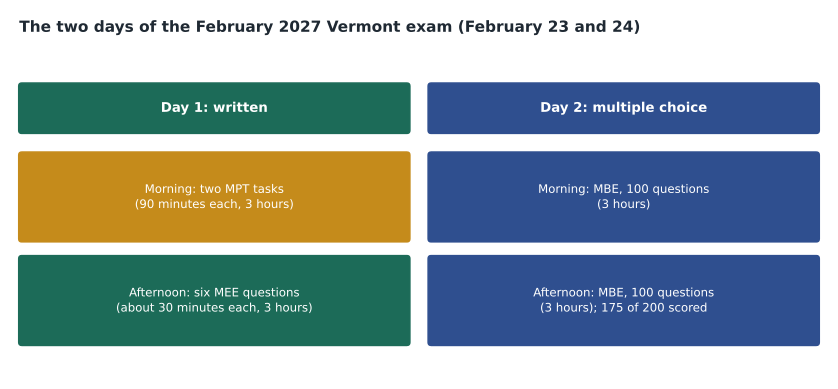
The MPT consists of two 90-minute tasks given together in a three-hour session. Each task presents a file of facts and a library of legal authorities, often from a fictional jurisdiction, and asks the applicant to produce a practical document: a memorandum to a supervising lawyer, a persuasive brief, a client letter, a demand letter, a contract provision or a similar piece of work. The MPT tests lawyering skills rather than memorized law. Everything an applicant needs to know about the law is in the library.
The MEE consists of six 30-minute essay questions given in a three-hour session. Starting with the July 2026 administration, NCBE removed four subjects from the MEE: conflict of laws, family law, trusts and estates, and secured transactions. The subjects that remain are business associations (agency and partnership, and corporations and limited liability companies), civil procedure, constitutional law, contracts (including Article 2 of the Uniform Commercial Code), criminal law and procedure, evidence, real property and torts. Hattie's February 2027 exam uses this shorter list.
The MBE is a 200-question multiple-choice exam given in two three-hour sessions of 100 questions each. Of the 200 questions, 175 are scored and 25 are unscored pretest questions that are indistinguishable from scored ones. The MBE covers seven subjects: civil procedure, constitutional law, contracts, criminal law and procedure, evidence, real property and torts.
| Component | Format | Time | Weight |
|---|---|---|---|
| MPT | Two performance tasks | Three hours (90 minutes each) | 20 percent |
| MEE | Six essay questions | Three hours (30 minutes each) | 30 percent |
| MBE | 200 multiple-choice questions (175 scored) | Six hours in two sessions | 50 percent |
How the components are weighted
Every UBE jurisdiction uses the same weights. The MBE counts for 50 percent of the total score, the MEE for 30 percent and the MPT for 20 percent. Together, the written components, the MEE and the MPT, count for 50 percent. Those fixed weights are part of what makes UBE scores portable: a 270 in Vermont is built the same way as a 270 in New York or Washington.
Scaling and the 400-point scale
UBE scores are reported on a 400-point scale. The MBE produces a scaled score that adjusts for differences in difficulty between exam forms, so that a given scaled score represents the same level of performance from one administration to the next. The written components are graded by each jurisdiction's graders, using NCBE's grading materials and a common relative-grading approach, and the raw written scores are then scaled to the MBE. Scaling the written scores to the MBE means that an applicant's essay and performance test scores are expressed on the same scale as the MBE and benefit from the MBE's stability across administrations.
The final UBE score is the weighted combination of the scaled MBE score and the scaled written score, expressed out of 400. Vermont's passing score on the legacy UBE is 270. That puts Vermont in the middle-to-upper part of the range among UBE jurisdictions, where minimum passing scores run from 260 to 270. A score of 270 is enough to pass in every UBE jurisdiction, which matters for an applicant like Hattie's New Hampshire classmate who may want to transfer a score elsewhere later.
Worked problem
Estimating what a 270 requires
Maude Hutchins is aiming for exactly 270 in Vermont. If her scaled MBE score is 140 on the 200-point MBE scale, roughly what scaled written score, on the same 200-point scale, does she need?
Show solution
- The UBE total is the MBE scaled score plus the written scaled score, each on a 200-point scale, because the MBE and the written portion each count for half.
- Target total: 270.
- MBE scaled score: 140.
- Required written scaled score: 270 minus 140, which is 130.
Answer: Maude needs a scaled written score of about 130. A stronger MBE lowers the written score she needs, and the reverse is also true. This is an approximation of how the halves combine, not an official calculation.
Marchetti uses that kind of arithmetic not to predict outcomes but to show candidates that no single component decides the result. 'A weak essay day can be rescued by a strong MBE,' she said. 'But only if you prepared for both.'
Grading and finality
Rule 10 provides that the Board grades the UBE together with NCBE, under NCBE's procedures, and may use professional assistants. NCBE certifies each applicant's score. Under Rule 10(c), an applicant's UBE score as certified by NCBE is final.
Vermont used to provide a review and appeal process for failing applicants. The Board's notes to the current rules explain that the process was eliminated because a UBE jurisdiction may not offer one. The reason is consistency: if one jurisdiction regraded essays or adjusted scores on appeal, the resulting score would not be a true UBE score that other jurisdictions could accept. An applicant who fails in Vermont therefore cannot challenge the grade; the remedy is to sit again.
Repeat attempts
Rule 9(b)(3) limits repeat attempts. An applicant who has failed the bar examination four times will not be permitted to sit for the UBE in Vermont, although the limit can be waived on a strong showing of substantially improved preparation and good cause. Rule 13(c) applies the same four-attempt limit to applicants seeking admission by transferred score. The Judiciary's admission page also includes a notice about changes to the showing applicants must make about prior failures beginning with the February 2027 exam, so a repeat taker should read the current rule and the Board's notices carefully before filing and ask the Office of Attorney Licensing how the limit applies to them.
An applicant who fails, withdraws or is denied admission must re-file an application to sit again under Rule 9(c)(7). An applicant who passes but is later denied admission, for example on character grounds, can use the passing score for up to five years.
Exam-day logistics
Vermont gives the exam at the Doubletree by Hilton in South Burlington, near Burlington International Airport. Candidates traveling from southern Vermont or out of state usually stay nearby the night before each day. The Judiciary's page notes that courtesy seating is not allowed: an applicant whose UBE score will be used in another jurisdiction cannot sit in Vermont as a courtesy to that jurisdiction. Vermont tests its own applicants.
Candidates receive admission tickets and instructions from the Board before the exam. The instructions cover permitted items, identification, laptop use for the written components and timing rules. Marchetti asks every candidate to read the instructions twice: once when they arrive and once the week before the exam. 'Nobody fails the bar because of a rule about water bottles,' she said. 'But people do lose an hour of concentration to it.'
How Vermont law fits in
The UBE does not test Vermont law. Vermont has no jurisdiction-specific component on the exam itself. Instead, it covers Vermont law through the Law Office Study Program's course of study and through the post-admission CLE requirement, which requires 15 hours on Vermont practice and procedure. Lesson 6 explains how to keep Vermont law out of exam answers, and Lessons 7 through 10 cover the Vermont law a new lawyer needs.
A study plan for February
Most candidates for a February exam begin full-time preparation in early December and study for about ten to twelve weeks. Hattie, who continues to work part-time in Quimby's office, started her bar review course in October and planned a lighter schedule through the holidays before moving to full-time study in January.
| Weeks | Focus |
|---|---|
| 1 to 4 | Learn or relearn the seven MBE subjects; daily mixed MBE sets; outline the MEE subjects |
| 5 to 8 | Timed MEE essays (two or three per day); one or two MPTs per week; MBE review by weakness |
| 9 to 10 | Full simulated exams; timed 100-question MBE blocks; review of weak subjects |
| Final week | Light review, rest, logistics and travel |
Common mistakes
MistakeVermont adds a Vermont law essay to the UBE.
InsteadVermont has no jurisdiction-specific component on the exam.
MistakeFailing applicants can appeal their essay grades.
InsteadUBE scores certified by NCBE are final; Vermont eliminated its review and appeal process.
MistakeThe MEE still tests family law and trusts and estates in February 2027.
InsteadThose subjects, with conflict of laws and secured transactions, left the MEE starting July 2026.
MistakeThe MPT is worth 30 percent.
InsteadThe MPT is 20 percent, the MEE 30 percent and the MBE 50 percent.
MistakeA candidate can sit in Vermont as a courtesy for another jurisdiction.
InsteadCourtesy seating is not allowed in Vermont.
Approaching the MPT
The MPT rewards a disciplined method. Marchetti teaches candidates to read the task memo first, because it states exactly what document to produce, for whom and in what format. Then they read the library, extracting the rules and their elements, and only then the file, sorting facts by the rule element they relate to. A candidate should spend roughly a third of each 90-minute task reading and organizing and the rest writing. The most common MPT mistake is writing the wrong kind of document, such as an objective memo when the task asks for a persuasive brief, or ignoring a formatting instruction in the task memo. Graders follow the task memo closely, and so should candidates.
Approaching the MEE
Each MEE question gives 30 minutes. A good answer identifies the issues raised by the call of the question, states the governing rule accurately, applies the rule to the specific facts and reaches a conclusion. Headings that track the calls of the question help graders find the analysis. Because the written components are graded relatively, an answer is compared with other answers to the same question; a clear, organized answer that spots the main issues often scores well even if it misses a minor point. Leaving a question blank is the worst outcome, since no relative grade can rescue a zero.
Approaching the MBE
The MBE has 100 questions in each three-hour session, about 1.8 minutes per question. Candidates should read the call of the question first, then the facts, and then each answer choice, eliminating wrong choices as they go. Because there is no penalty for wrong answers, every question should be answered. Practice with released NCBE questions is especially valuable, because their style differs from commercial questions in subtle ways. Candidates who track their errors by subject and by type of mistake, such as misreading the call, misremembering a rule or misapplying a rule, improve faster than those who simply count the number correct.
Results and what follows
After the February exam, the Board releases results some weeks later, usually in the spring. An applicant who passes and has completed character and fitness review proceeds to certification and admission. An applicant who fails receives a score report and may file again, subject to the attempt rules. Because February 2027 is Vermont's last legacy administration, a February candidate who must retake will sit for NextGen in July 2027, a point Lesson 5 explores in detail. Hattie wrote that date on an index card and taped it to her monitor. 'Not as a threat,' she explained to the group. 'As a reason to do the February work well.'
Summary and key terms
- The legacy UBE is two days: MPT and MEE on day one, the MBE on day two.
- Weights are MBE 50, MEE 30 and MPT 20 percent; written scores are scaled to the MBE.
- Vermont's legacy UBE passing score is 270 on the 400-point scale.
- Since July 2026, the MEE no longer tests conflict of laws, family law, trusts and estates, or secured transactions.
- Scores certified by NCBE are final; there is no regrading appeal.
- Rule 9(b)(3) limits applicants to four failures, with a waiver for good cause; check the Board's current notices.
- The exam is given in South Burlington; no courtesy seating.
- 0
- Uniform Bar Examination
- 1
- MBE
- 2
- MEE
- 3
- MPT
- 4
- scaled score
- 5
- relative grading
- 6
- 270 passing score
- 7
- finality
- 8
- courtesy seating
Practice problems
Work each problem on paper first, then reveal the answer to check.
What is Vermont's passing score on the legacy UBE?
Show answer
270 on the 400-point scale.
Which four subjects left the MEE starting in July 2026?
Show answer
Conflict of laws, family law, trusts and estates, and secured transactions.
Can a Vermont applicant appeal a failing UBE score?
Show answer
No. Under Rule 10(c), the NCBE-certified score is final.
How many MBE questions are scored?
Show answer
175 of the 200; 25 are unscored pretest questions.
Lesson quiz · 5 questions
Score 60% or more to complete this lesson.
Create a free account to save your progress, take quizzes and earn a certificate.