
CINE-410 · Lesson 1 of 12 · 29 min
Specialty cinematography: planning, risk and the specialist crew
Most of the cinematography program has taught you to work with a camera on legs, a dolly or a shoulder, at ground level, in ordinary weather, recording to a sensor about the size of a frame of 35 mm motion-picture film. Specialty cinematography covers everything outside that envelope: cameras with sensors two or three times larger, film formats that run 70 mm stock sideways through the gate, cameras hung under helicopters or flown on drones, cameras riding cables across canyons, cameras inside waterproof housings at the bottom of a lake and cameras working at minus thirty in a prairie winter. These jobs share a pattern. The images can be extraordinary, the equipment is expensive and scarce, specialist crews do much of the hands-on work, and the risks to people and gear are higher than on an ordinary set. This course teaches you to plan, budget and supervise that work as a director of photography, and to know when the right answer is to hire a specialist rather than improvise.
What counts as specialty work
There is no official list, but the industry treats the following as specialty cinematography, usually with dedicated crew, separate insurance conversations and their own line in the budget.
- Large-format capture: digital cameras with sensors larger than full frame, such as 65 mm digital, and film formats such as 65 mm five-perforation and IMAX 15/70 (Lessons 2 to 4).
- Aerial work: helicopters and fixed-wing aircraft carrying gyro-stabilized camera systems, and drones from small camera drones to heavy-lift cinema platforms and first-person-view (FPV) racing-style craft (Lessons 5 to 7).
- Suspended and extended camera systems: cable cams, wire rigs, telescopic cranes and robotic arms (Lesson 8; motion control was introduced in Course CINE-330).
- Underwater and marine work: housings, surface boats, splash bags and divers (Lesson 9).
- Extreme environments: severe cold and heat, deserts, mountains, rain and dust (Lesson 10).
- Specialty optics and rigs: macro and probe lenses, tilt-shift, periscope and snorkel lenses, split diopters, 360-degree and volumetric capture (Lesson 11).
High-speed cinematography and car work are also specialties, but they were covered in Course CINE-330 and this course only points back to them.
Why productions use specialty capture
Every specialty technique costs time and money, so it needs a story reason. Directors and DPs usually justify specialty work in one of four ways.
- Scale: large formats and aerials show landscapes, cities and crowds with a scale and detail that a standard camera on the ground cannot match.
- Point of view: an underwater camera, a probe lens moving through a miniature or an FPV drone diving down a cliff puts the audience somewhere a person could not easily be.
- Exhibition: premium large-format screens reward capture formats with more resolution and a taller frame, and some releases are marketed on how they were filmed.
- Safety and efficiency: a drone can replace a helicopter for many low-altitude shots, and a cable cam can follow a skier where no vehicle can go, often more safely and cheaply.
The weakest reason is novelty. A drone shot that drifts over a house without purpose wastes a day of a specialist crew. Ask the same question you ask of any shot: what should the audience feel and understand at this moment, and is this the best way to make them feel it?
The specialist crew and the DP's role
On specialty work the DP rarely operates every piece of equipment. Instead, the DP defines the shot and the look, then works through specialist heads of department who hold the training, licenses and insurance.
- Aerial director of photography or aerial coordinator: plans helicopter and plane work, works with the pilot and the aviation company, and often operates the gyro-stabilized head from inside the aircraft.
- Drone pilot and camera operator: on professional cinema drones these are usually two people, one flying and one operating the camera gimbal, plus a visual observer.
- Underwater director of photography and dive team: an underwater camera operator, a dive supervisor, safety divers and a support crew on the surface.
- Technicians for cable cams, cranes and arms: specialist operators and riggers, often supplied by the rental company with the equipment.
- Large-format camera technicians: on film formats, loaders and technicians trained on the specific cameras; on digital large format, a DIT and data team sized for the larger files.
The DP's job is to translate the director's intent into clear shot descriptions, frame sizes, lens choices, speeds and exposure, to check that the specialist plan delivers them, and to make sure the specialty footage matches the rest of the film in look and quality.
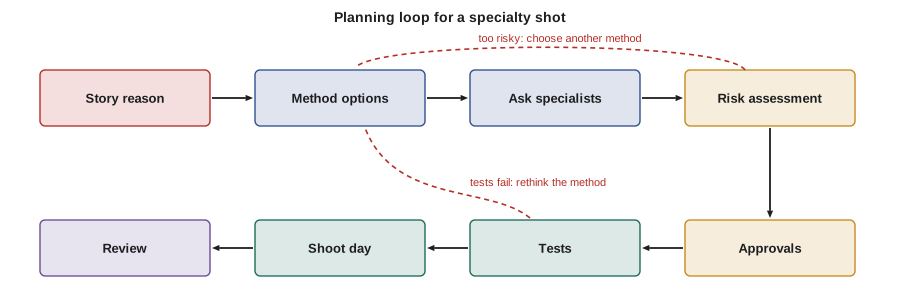
A planning method for specialty shots
Because specialty days are expensive, a small amount of structured planning saves a great deal of money. A simple sequence works for almost every technique in this course.
- Define the shot in plain words: what the camera sees, from where, moving how fast, for how long, with what lens or field of view and in what light.
- List the methods that could achieve it: for a high wide shot of a convoy, that might be a helicopter, a heavy-lift drone, a telescopic crane on a hill or a long lens from a vantage point.
- Consult the specialists early: a ten-minute call with an aerial coordinator or a cable-cam company in development can rule out an impossible plan before money is spent.
- Assess the risks for each method: people on the ground, crew in the air or water, weather, equipment loss, permits and schedule exposure.
- Secure approvals: aviation authorizations, location permits, park permits, marine and dive plans, and insurer sign-off.
- Test and rehearse: camera and lens tests, flight tests, wet tests for housings, and full rehearsals at walking speed before the real move.
- Shoot with clear go and no-go criteria: who can stop the shot, at what wind speed, visibility or water condition.
- Review the material immediately: specialty set-ups are hard to repeat, so check focus, exposure and framing before releasing the crew.
Worked problem
Choosing a method by cost per usable shot
A production needs three high establishing shots of a coastal town at sunrise. Option A is a helicopter with a gyro-stabilized head at an illustrative cost of 14,000 for a half day, including aircraft, pilot, aerial operator and the head, with an estimated five usable shots. Option B is a heavy-lift drone team at 5,500 for the day, but local rules limit how close it can fly to the town and the team expects three usable shots. Which option costs less per usable shot, and what else matters?
Show solution
- Option A: 14,000 ÷ 5 = 2,800 per usable shot.
- Option B: 5,500 ÷ 3 ≈ 1,833 per usable shot.
- On cost alone the drone wins. But compare what each shot looks like: the helicopter can fly higher and faster, cover more coastline in the short sunrise window and carry a larger camera and longer lens.
- Check the constraints: if the drone cannot legally fly over the harbor where people gather at sunrise, the shot it delivers may not be the shot the director wants.
Answer: The drone costs about 1,833 per usable shot against 2,800 for the helicopter, so it is the cheaper choice if its shots meet the brief. The final decision depends on the required altitude, speed, lens, airspace and the sunrise window, not only the price.
Risk assessment for specialty work
Course CINE-340 introduced the hierarchy of controls and the production safety process. Specialty work raises the stakes because failures tend to be severe: an aircraft accident, a falling camera system, a diver in trouble, a cable failure over a crowd. A useful habit is to score each hazard by likelihood and severity on simple scales and to plan controls for anything that scores high, even if it seems unlikely.
| Technique | Main hazards | Typical controls |
|---|---|---|
| Helicopter and plane | Aircraft accident, low flying near people, weather | Experienced aviation company, pilot authority to abort, approved low-flight plans, weather limits, briefings |
| Drones | Loss of control, battery failure, flyaway, collision with people or aircraft | Certified pilots, visual observers, keep-out zones, pre-flight checks, battery management, airspace authorization |
| Cable cams and cranes | Falling equipment, cable failure, crushing, tip-over | Engineered rigging, load ratings with safety factors, exclusion zones, wind limits, qualified operators |
| Underwater | Drowning, decompression illness, hypothermia, entanglement | Qualified divers, dive supervisor, dive plan, safety divers, surface support, depth and time limits |
| Extreme environments | Cold injury, heat illness, altitude sickness, avalanche, flash floods | Medical support, rest and rotation schedules, local guides, weather monitoring, evacuation plans |
The DP is not usually the person who signs the safety plan, but the DP's shot requests drive the risk. Asking a drone pilot to fly lower over a crowd "just this once" or a dive team to stay down "for one more take" puts people in danger and puts the specialist in an impossible position. Respect the specialist's authority to say no.
Budgeting specialty work
Specialty work is budgeted differently from ordinary camera days.
- Equipment is often rented with an operator or technician as a package, priced per day or half day, with minimum calls.
- Travel and positioning days matter: a helicopter may bill flight time from its base to the location; an underwater team may need a rigging day before the shoot day.
- Weather days are common: aerial, marine and mountain shoots often need a weather-hold day or a cancellation policy agreed in advance.
- Insurance can add cost: some insurers require specific approvals, crew qualifications or higher deductibles for aircraft, drones over people, or diving.
- Post costs grow: large-format and high-resolution files need more storage, faster workstations and longer render times (Lesson 4).
Worked problem
Weather risk in the budget
An aerial day costs 18,000. Local records suggest that on the planned date there is about a 30 % chance of weather that would cancel the shoot. The aviation company charges 25 % of the day rate for a weather cancellation on the morning. What is the expected weather cost, and how might the producer plan for it?
Show solution
- Expected cancellation cost: 0.30 × 0.25 × 18,000 = 1,350.
- If canceled, the production must also rebook, so plan a backup date and check the crew's availability on that date.
Answer: The expected weather cost is about 1,350. A careful budget carries a weather contingency and a confirmed backup date rather than assuming the first day will work.
Working with specialists well
Good specialists are in high demand, and productions that treat them well get better results.
- Send clear shot descriptions, references and storyboards early, with the lens, frame size and speed you need.
- Share the schedule, the location details and the expected weather, and ask what they need to be safe and efficient.
- Include them in the tech scout so they can see the terrain, the airspace and the hazards.
- Agree on communication: radio channels, hand signals, who calls "action" and who can call "abort".
- Respect their limits and their judgment; a specialist who says a shot is unsafe is protecting the production as well as the crew.
The US context
The United States has the largest specialty cinematography market in the world, with aerial, underwater, cable cam and large-format specialists based in Los Angeles, Atlanta, New York and elsewhere. Camera crews, including many aerial and underwater operators, are usually represented by IATSE Local 600, the International Cinematographers Guild, while pilots and dive professionals are usually contracted through their own companies and certified under federal rules.
How this course is organized
The course moves from capture formats to camera platforms to environments and optics. Lessons 2 to 4 cover large-format sensors, IMAX and the data workflow. Lessons 5 to 7 cover aerial work: helicopters and planes, drones, and the rules and permits that govern flying. Lesson 8 covers cable cams, wire rigs, cranes and arms. Lesson 9 covers underwater and marine work, Lesson 10 extreme environments and Lesson 11 specialty lenses and capture systems. Lesson 12 is a capstone in which you plan a specialty shoot from story reason to budget.
Common mistakes
MistakeChoosing a specialty technique because it is impressive
InsteadStart from the story reason and choose the simplest method that delivers the shot the director needs
MistakePlanning the shot without the specialist and calling them the week before
InsteadConsult specialists in development or early prep, when their advice can still change the plan
MistakePressuring a pilot, diver or rigger to push past a limit for one more take
InsteadRespect the specialist's authority to stop; their limits protect the crew and the production
MistakeBudgeting a specialty day with no weather or travel allowance
InsteadInclude positioning, minimum calls, weather holds and backup dates in the budget
MistakeForgetting how the specialty footage must match the rest of the film
InsteadPlan lenses, exposure, frame rate and the color pipeline so specialty shots cut with main unit material
Summary and key terms
- Specialty cinematography covers large-format capture, aerial, suspended, underwater, extreme-environment and specialty-optic work.
- Every specialty technique needs a story reason, such as scale, point of view, exhibition or safety and efficiency.
- The DP defines the shot and the look and works through specialist heads of department who hold the training and licenses.
- A structured plan moves from shot definition and method options through consultation, risk assessment, approvals and tests to the shoot.
- Specialty failures tend to be severe, so hazards are scored and controlled, and specialists have the authority to stop.
- Budgets must include packages with operators, positioning, weather holds, insurance and larger post costs.
- Comparing options by cost per usable shot is useful, but airspace, speed, lens and light often decide the method.
- Specialty cinematography
- Camera work outside the normal ground-based envelope, usually needing specialist equipment, crew and approvals
- Large format
- Capture on sensors or film frames larger than full frame, such as 65 mm digital or IMAX 15/70
- Gyro-stabilized head
- A remotely controlled camera head that uses gyroscopes and motors to cancel vibration and movement, used on aircraft and vehicles
- Aerial coordinator
- The specialist who plans and supervises aircraft work on a production with the aviation company
- Visual observer
- A crew member who watches the airspace and the drone and warns the pilot of hazards
- Cable cam
- A camera system that travels along a suspended cable, often over terrain where vehicles cannot go
- Dive supervisor
- The person in charge of an underwater operation who controls the dive plan and diver safety
- Weather hold
- A planned allowance of time or money for days lost to weather
- Cost per usable shot
- A comparison measure dividing the cost of a method by the number of shots it is expected to deliver
- Go and no-go criteria
- Agreed conditions, such as wind speed or visibility, that decide whether a specialty shot can proceed
Practice problems
Work each problem on paper first, then reveal the answer to check.
Name three types of work the industry treats as specialty cinematography.
Show answer
Any three of large-format capture, aerial work, drones, cable cams and cranes, underwater and marine work, extreme environments and specialty optics
Give two story reasons for using specialty capture.
Show answer
Any two of scale, point of view, exhibition and safety or efficiency
Why does the DP usually not operate every specialty system personally?
Show answer
Specialist operators hold the training, licenses and insurance, and the DP's job is to define the shot and keep the look consistent
A method costs 9,000 and is expected to give three usable shots. What is the cost per usable shot?
Show answer
9,000 ÷ 3 = 3,000
What should happen if a drone pilot refuses a shot because it is unsafe?
Show answer
The production should accept the decision and look for another method or position; the specialist's authority to stop must be respected
List the eight steps of the planning method in this lesson.
Show answer
Define the shot, list methods, consult specialists, assess risks, secure approvals, test and rehearse, shoot with go and no-go criteria, and review immediately
A day costs 20,000 with a 20 % chance of cancellation and a 30 % cancellation fee. What is the expected weather cost?
Show answer
0.20 × 0.30 × 20,000 = 1,200
Why do specialty shoots often need a positioning day?
Show answer
Equipment and crew may need to travel, rig or prepare before shooting, and aircraft may bill flight time from their base
Which earlier course covered high-speed cinematography and car work?
Show answer
Course CINE-330
Why should specialty footage be reviewed before releasing the crew?
Show answer
Specialty set-ups are expensive and hard to repeat, so focus, exposure and framing must be confirmed while the crew is still available
Lesson quiz · 5 questions
Score 60% or more to complete this lesson.
Create a free account to save your progress, take quizzes and earn a certificate.