
CINE-410 · Lesson 12 of 12 · 33 min
Capstone: planning a specialty shoot
This capstone brings the course together. You will plan a short specialty sequence that combines large-format capture, aerial work, a drone, a suspended camera, underwater shots and a cold-weather location. The aim is not to master every technique yourself but to show that you can turn a director's intent into a plan that specialists can execute safely, on schedule and on budget, with images that match the rest of the film. Work through each section, then assemble your own plan for a sequence of your choosing using the template at the end.
The brief
The film is a drama about a search-and-rescue volunteer. The climactic sequence, about two and a half minutes on screen, follows her across a frozen mountain lake at first light to reach a person who has fallen through the ice. The director wants the audience to feel the vast, indifferent landscape, then the claustrophobic danger under the ice, then the relief of the rescue. The film is planned for an IMAX release with expanded-ratio sequences, and this sequence will open up to 1.90:1 on IMAX screens.
The location is a lake in the Rocky Mountains of Colorado, at about 9,000 ft (2,700 m), in February, where dawn temperatures are often around −4 °F (−20 °C).
The director's shot list includes: a high aerial over the mountains revealing the lake; a lower drone move that follows the volunteer running across the ice; a fast cable-cam move skimming the surface beside her; underwater shots looking up through the ice at the hole and the struggling person; and close coverage on the ice for the rescue.
Step 1: match methods to shots
| Shot | Story purpose | Method | Why this method |
|---|---|---|---|
| High mountain reveal | Vast, indifferent scale | Helicopter with gyro-stabilized head and large-format camera | Altitude, speed and range in a short dawn window, carrying the main camera family |
| Following the run | Urgency and isolation | Heavy-lift drone with cinema camera | Low, flexible path over the ice, cheaper than the helicopter for low work |
| Skimming beside her | Speed and danger | Point-to-point cable cam along the shore | Repeatable, fast, low over the ice, and safer than a drone close to the actor |
| Under the ice | Claustrophobia | Studio tank with an ice-set ceiling, plus a short open-water ice dive for plates | Control of light, temperature and safety; real ice for authenticity in selected shots |
| Rescue on the ice | Relief and human contact | Main unit handheld and dolly on the ice, large-format camera | Performance-led coverage on a safe, assessed ice surface |
The plan moves the most dangerous underwater work into a controlled tank, using the real lake only for short, supervised plate dives. That is the kind of decision a DP should propose early.
Step 2: format, lenses and matching
- Camera: a 65 mm digital camera for main unit, aerial and drone where payload allows, recording a mode that IMAX accepts for its expanded ratio; a full-frame camera of the same family for the cable cam if weight requires it.
- Lenses: large-format primes for main unit; a lighter large-format zoom or primes for aerial and drone, within payload limits.
- Frame lines: 1.90:1 and 2.39:1 loaded on every camera, with action kept in the common area.
- Exposure and color: one show LUT, the same recording format and the same white balance approach across units; snow exposed brighter than middle gray with highlight detail protected.
- Frame rate and shutter: 24 fps, 180° shutter, with ND filters to hold the shutter in bright snow.
Worked problem
Equivalent lens for the cable cam
The main unit frames the run with a 90 mm lens on a 65 mm sensor 54.1 mm wide. The cable cam can only carry a full-frame camera 36 mm wide. What focal length matches the main unit framing from the same distance?
Show solution
- Ratio: 36 ÷ 54.1 ≈ 0.665.
- Focal length: 90 × 0.665 ≈ 60 mm.
Answer: About 60 mm on the full-frame camera. The DP checks depth of field too: to match T4 on the 65 mm sensor, the full-frame camera would use about T2.8.
Step 3: safety and risk assessment
| Hazard | Likelihood (1 to 5) | Severity (1 to 5) | Score | Main controls |
|---|---|---|---|---|
| Ice failure under crew or equipment | 2 | 5 | 10 | Ice thickness testing by qualified ice safety specialists, load limits, safety lines, rescue team on standby |
| Cold injury to cast and crew | 4 | 3 | 12 | Warm-up shelters, rotations, clothing, medic, short takes for actors |
| Aircraft accident or low-flying risk | 1 | 5 | 5 | Experienced film aviation operator, low-flight approvals, pilot authority, weather limits |
| Drone loss of control near people | 2 | 4 | 8 | Certified pilot and observer, exclusion zones, battery management in cold |
| Cable cam failure | 1 | 5 | 5 | Engineered rig, inspections, exclusion zone under the path, wind limits |
| Diver incident in cold water | 2 | 5 | 10 | Tank for most work, dive supervisor, ice-diving specialists, tethered divers, short dives |
| Avalanche on surrounding slopes | 2 | 5 | 10 | Avalanche specialist assessment, restricted areas, daily forecast checks |
Scores of 10 or more need specific controls approved before work starts. The production safety team, not the DP, owns the plan, but the DP's shot requests shape it, and the DP agrees to keep shots within the controls.
Step 4: equipment and people in the cold
Worked problem
Battery planning for the drone in the cold
The heavy-lift drone uses battery sets that give 15 minutes of flight at 20 °C. At −20 °C, the drone team expects only about 60 % of the flight time, even with warmed batteries. The plan needs 10 flights of useful filming time, each needing 8 minutes. How many flights and battery sets are needed?
Show solution
- Cold flight time: 15 × 0.60 = 9 minutes per set, which barely covers an 8-minute flight with a reserve.
- To keep a safe reserve, plan 6-minute filming segments, so 80 minutes of filming needs 80 ÷ 6 ≈ 14 flights.
- With warming and charging limited on location, plan one set per flight plus spares: about 16 sets, or fewer if a heated charging station can recharge sets during the day.
Answer: About 14 shorter flights and around 16 battery sets, or a heated charging tent with generator power. The cold forces shorter, rehearsed moves.
- Crew: cold-weather clothing standards, warm-up shelters within a short walk, rotation schedules and hot food.
- Cast: a costume plan with hidden warm layers, a warming tent beside the set and limits on time in the cold.
- Equipment: heated battery storage, cold-rated cables, condensation control between set and shelters.
- Altitude: at mountain altitudes the drone's lift and the helicopter's performance fall, so payloads and flight plans are adjusted.
Step 5: schedule
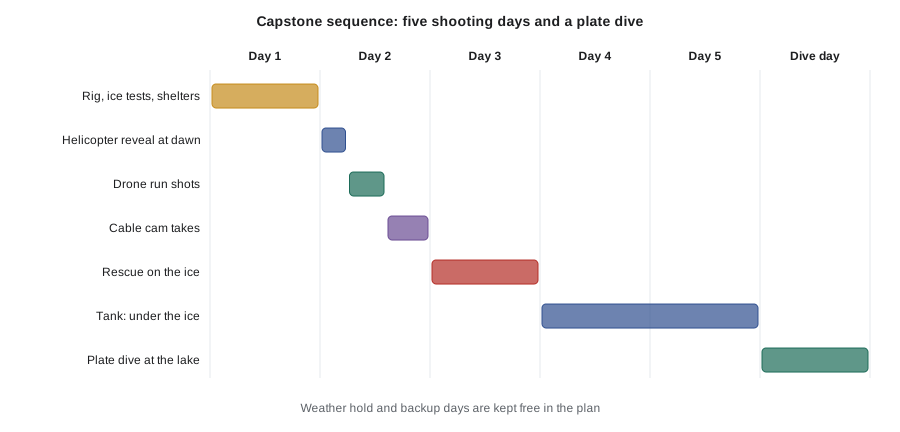
- Day 1: rig the cable cam, test ice, set up shelters and power; drone tests; helicopter positioning.
- Day 2, dawn: helicopter reveal shots in the first 45 minutes of good light, then drone shots; afternoon: cable-cam rehearsals and takes.
- Day 3: main unit rescue coverage on the ice; weather-hold day if needed.
- Days 4 and 5 (studio): tank work under the ice set, with the underwater unit.
- One plate dive day at the lake, scheduled with the ice-diving team, with a backup day.
Worked problem
Light window for the aerial reveal
Sunrise is at 7:45, and the director wants the reveal in the warm, low light from 15 minutes before to 30 minutes after sunrise. Each helicopter pass takes 4 minutes including repositioning. How many passes fit, and how should the schedule protect them?
Show solution
- Window: 7:30 to 8:15, which is 45 minutes.
- Passes: 45 ÷ 4 ≈ 11.
- Pre-flight checks, briefings and positioning must be done before 7:30 so the window is used for filming.
Answer: About 11 passes. The helicopter should be airborne and in position before 7:30, with a backup morning in case of weather.
Step 6: data
Worked problem
Storage for the sequence
Across five shooting days the units expect to record a total of 9 hours of material at about 2.6 TB per hour (uncompressed 65 mm raw), with three copies required. How much storage is needed, and what would change with a 3:1 compressed raw option?
Show solution
- One copy: 9 × 2.6 = 23.4 TB.
- Three copies: 3 × 23.4 = 70.2 TB.
- With 3:1 compression: 70.2 ÷ 3 ≈ 23.4 TB for three copies.
Answer: About 70 TB uncompressed or about 23 TB with 3:1 compressed raw. The DP and post supervisor should test whether compressed raw holds detail in snow and dark water before choosing.
Step 7: budget
| Item | Basis | Cost |
|---|---|---|
| Helicopter, pilot and positioning | 6 flight hours at 3,400 | 20,400 |
| Gyro-stabilized system and aerial operator | 2 days at 7,000 | 14,000 |
| Heavy-lift drone team and equipment | 3 days at 5,500 | 16,500 |
| Cable cam system, crew and rigging day | 2 days at 9,000 plus rigging 6,000 | 24,000 |
| Underwater unit and tank | 2 tank days at 18,000 | 36,000 |
| Ice-diving plate day and safety team | 1 day | 15,000 |
| Ice, avalanche and medical safety specialists | 5 days at 4,500 | 22,500 |
| Cold-weather shelters, heaters, generators | Lump sum | 12,000 |
| Data storage and extra DIT time | 70 TB plus labor | 9,500 |
| Weather contingency | 15 % of the above | 25,485 |
| Total | 195,385 |
Worked problem
Checking the budget arithmetic
Confirm the subtotal before contingency and the 15 % contingency in the table.
Show solution
- Subtotal: 20,400 + 14,000 + 16,500 + 24,000 + 36,000 + 15,000 + 22,500 + 12,000 + 9,500 = 169,900.
- Contingency: 0.15 × 169,900 = 25,485.
- Total: 169,900 + 25,485 = 195,385.
Answer: The subtotal is 169,900, the contingency 25,485 and the total 195,385, all at illustrative rates. A real budget uses quotes from the specialist companies.
Approvals for the US location
- FAA approvals held by the aviation operator, including a certificate of waiver with a motion picture operations manual for low-level filming, and air traffic coordination if any controlled airspace applies.
- Part 107 remote pilot certificates, registered drones with Remote ID, and any waivers or LAANC authorizations needed.
- Permits from the land manager: the US Forest Service or state land agency, or the National Park Service if the lake were in a national park, where drone use would almost certainly not be allowed.
- A commercial diving plan under OSHA's commercial diving standard for the plate dive.
- Consultation with tribal governments if the location includes tribal lands or culturally significant sites.
Presenting the plan
When you present a specialty plan to the director and producers, lead with the story and the experience the audience will have, then show how each method serves it, then the safety plan, schedule and budget. Show references and tests where you have them. Be clear about what could change the plan: weather, ice conditions, approvals or test results. Producers trust a DP who shows they have thought about risk and money as carefully as about images.
Template for your own specialty plan
- The brief: story purpose, screen time, release format and location.
- Shot list with story purpose for each shot.
- Method for each shot and the reason for choosing it.
- Format, lenses, aspect ratios and matching plan.
- Risk assessment with scores and controls.
- Equipment and people plan for the environment.
- Schedule with light windows and weather holds.
- Data estimate and workflow.
- Budget with contingency.
- Approvals and permits for your country and location.
Common mistakes
MistakeChoosing the riskiest method because it looks most authentic
InsteadMove dangerous work into controlled settings where possible and use the real location for selected, supervised shots
MistakePlanning drone flights in the cold with warm-weather flight times
InsteadReduce flight time estimates for cold and altitude and plan shorter, rehearsed segments
MistakeScheduling the helicopter to take off at the start of the light window
InsteadComplete checks, briefings and positioning before the window so it is used for filming
MistakePresenting a specialty plan with no contingency
InsteadInclude weather and risk contingencies and explain what could change the plan
MistakeLeaving approvals until the week before the shoot
InsteadStart aviation, land, diving and community approvals in early prep
Summary and key terms
- A specialty plan starts from the director's story intent and assigns the most suitable method to each shot.
- Format, lenses, aspect ratios, exposure and color are matched across units so specialty shots cut with main unit.
- Risk assessments score hazards and require specific controls for high scores, owned by the production safety team.
- Cold and altitude reduce battery and aircraft performance, shaping flight plans and equipment lists.
- Schedules protect light windows and include weather holds and backup days.
- Data and budgets are estimated from recording hours, copies, quotes and a contingency.
- Approvals for aviation, land, diving and communities must be secured early for the specific country and location.
- Capstone
- A final project that combines the skills of a course
- Light window
- The period of time in which the light suits the planned shots
- Plate
- Footage shot as a background or element for later compositing
- Ice safety specialist
- A professional who tests ice thickness and sets safe load limits and rescue plans
- Common area
- The part of the frame shared by all delivery aspect ratios
- Contingency
- Money or time set aside for problems such as weather
- Risk score
- Likelihood multiplied by severity, used to rank hazards
- Payload limit
- The maximum weight a platform can safely carry
- Backup day
- A scheduled alternative day in case the planned day is lost
- Show LUT
- A shared look-up table applied across units to preview the intended look
Practice problems
Work each problem on paper first, then reveal the answer to check.
A shot on a 65 mm sensor (54.1 mm wide) uses a 75 mm lens. What focal length matches it on full frame (36 mm wide)?
Show answer
75 × 36 ÷ 54.1 ≈ 50 mm
A hazard has likelihood 3 and severity 4. What is its risk score?
Show answer
12
A light window is 40 minutes long and each pass takes 5 minutes. How many passes fit?
Show answer
8
A subtotal of 120,000 carries a 12 % contingency. What is the total?
Show answer
120,000 × 1.12 = 134,400
A drone gives 12 minutes at 20 °C and 65 % of that in the cold. What is the cold flight time?
Show answer
12 × 0.65 ≈ 7.8 minutes
Why move most under-ice work to a tank?
Show answer
A tank gives control of light, temperature, visibility and diver safety, reducing risk
Name three approvals the capstone sequence needs.
Show answer
Any three of aviation low-level approvals, drone pilot and airspace approvals, land or park permits, a diving plan under OHS rules and engagement with Indigenous or tribal governments
Why keep action in the common area on an IMAX expanded-ratio sequence?
Show answer
So it works in both 1.90:1 and 2.39:1 versions
What should lead a specialty plan presentation?
Show answer
The story purpose and the audience experience
Six hours at 2.6 TB per hour with three copies needs how much storage?
Show answer
6 × 2.6 × 3 = 46.8 TB
Lesson quiz · 5 questions
Score 60% or more to complete this lesson.
Create a free account to save your progress, take quizzes and earn a certificate.