
CINE-410 · Lesson 3 of 12 · 26 min
IMAX and premium large formats
IMAX began as a Canadian invention. In the late 1960s a group of Canadian filmmakers and engineers developed a system that ran 70 mm film horizontally through the camera and projector, giving a frame roughly ten times the area of a standard 35 mm frame, projected on screens many stories tall. For decades IMAX meant short documentaries in science centers and museums. Since the 2000s it has also meant Hollywood features, some shot partly or entirely on IMAX film cameras, many shot on IMAX-certified digital cameras and many more converted from standard formats for IMAX release. Other premium large-format (PLF) screens, such as Dolby Cinema and exhibitor-branded large screens, compete for the same audience. This lesson explains the formats, the aspect ratios, the cameras and what they mean for a DP planning a premium release.
The 15/70 film format
The original IMAX film format is called 15/70: 70 mm wide film, running horizontally, with each frame 15 perforations long. In a conventional 35 mm camera the film runs vertically and each frame is 4 perforations tall. Running 70 mm film sideways gives a frame about 70.4 mm wide and 52.6 mm tall, an aspect ratio of about 1.43:1.
| Format | Film direction | Perforations per frame | Frame size | Aspect ratio |
|---|---|---|---|---|
| 35 mm, 4-perf | Vertical | 4 | About 24.9 × 18.7 mm (Super 35 full aperture) | About 1.33:1 |
| VistaVision | Horizontal | 8 | About 37.7 × 25.2 mm | About 1.5:1 |
| 65 mm, 5-perf | Vertical | 5 | About 52.5 × 23.0 mm | About 2.28:1 |
| IMAX 15/70 | Horizontal | 15 | About 70.4 × 52.6 mm | About 1.43:1 |
Camera negatives for these "70 mm" formats are actually 65 mm wide; the extra 5 mm on 70 mm prints carried soundtracks. IMAX cameras shoot 65 mm negative and IMAX film prints are 70 mm.
Footage, magazines and cost
Because each frame is 15 perforations, film runs through an IMAX camera very fast. That has big consequences for magazine changes, noise and the film budget.
At 24 frames per second that is about 337 feet of film per minute, or about 102.6 meters. A 1,000-foot magazine therefore lasts roughly 3 minutes.
Worked problem
Film footage and cost for an IMAX sequence
A sequence will be shot on IMAX 15/70 at 24 fps. The director expects 40 minutes of exposed footage across the shoot days. Using illustrative costs of 1.20 per foot for raw stock and 0.80 per foot for processing and scanning combined, estimate the footage and the film cost. How many 1,000-foot magazine loads is that?
Show solution
- Footage: 40 minutes × 337 ft per minute = 13,480 ft.
- Film cost: 13,480 × (1.20 + 0.80) = 13,480 × 2.00 = 26,960.
- Magazine loads: 13,480 ÷ 1,000 ≈ 13.5, so at least 14 loads, plus short ends and spoilage.
Answer: About 13,500 feet of film, roughly 27,000 in stock and lab costs at these illustrative rates, and at least 14 magazine loads. Real prices vary and must be quoted by the film supplier and laboratory.
Compare this with standard 35 mm 4-perf, which uses 90 feet per minute at 24 fps. IMAX uses about 3.7 times as much film for the same running time, before any difference in the price per foot.
IMAX film cameras
IMAX film cameras have historically been large, heavy and very loud. The noise made dialogue scenes difficult: the camera could be heard on the soundtrack, so filmmakers often switched to quieter 35 mm or digital cameras for dialogue and reserved IMAX film for spectacle. In 2024 IMAX announced it was building a new generation of quieter, lighter film cameras with the involvement of leading directors and cinematographers. In December 2025 IMAX named the new camera "Keighley", after David Keighley, the company's long-serving quality director, and his wife Patricia. Christopher Nolan's The Odyssey, photographed by Hoyte van Hoytema and released in 2026, was described as the first feature shot entirely on IMAX film cameras, made possible by the quieter design. Details such as weight, magazine sizes and how many cameras exist change as the program develops, so check IMAX's current information.
Working with IMAX film cameras requires specialist technicians and loaders trained on the system, careful magazine logistics, and close coordination with the laboratory. Dailies are usually viewed as scans rather than film prints, but the negative is still precious and irreplaceable.
IMAX-certified digital cameras and Filmed for IMAX
Most premium large-format releases today are shot digitally. IMAX runs a program it calls Filmed for IMAX, in which it certifies selected high-end digital cameras and works with productions to frame and finish for its expanded aspect ratio. Certified models have included cameras from ARRI, RED, Sony and Panavision, and in January 2026 Fujifilm announced that its GFX ETERNA 55 had joined the list. The list changes as new cameras are certified, so a DP planning an IMAX release should check the current list with IMAX and confirm the exact recording modes that qualify, since certification usually applies to specific resolutions and sensor areas.
For the DP, Filmed for IMAX means planning framing for two or more aspect ratios, protecting the taller frame on set, working with IMAX's image specialists during post and delivering masters for different screen types.
Aspect ratios for premium screens
Premium large-format releases often change aspect ratio during the film. Scenes are shown in the standard release ratio, typically 2.39:1 or 1.85:1, and selected sequences open up to a taller ratio on IMAX screens.
- 1.43:1: the full height of the 15/70 frame, shown on a limited number of large IMAX screens with laser or film projection that can display it.
- 1.90:1: the IMAX digital expanded ratio, shown on most IMAX digital and laser screens.
- 2.39:1 or 1.85:1: the standard release ratios for other cinemas and home viewing.
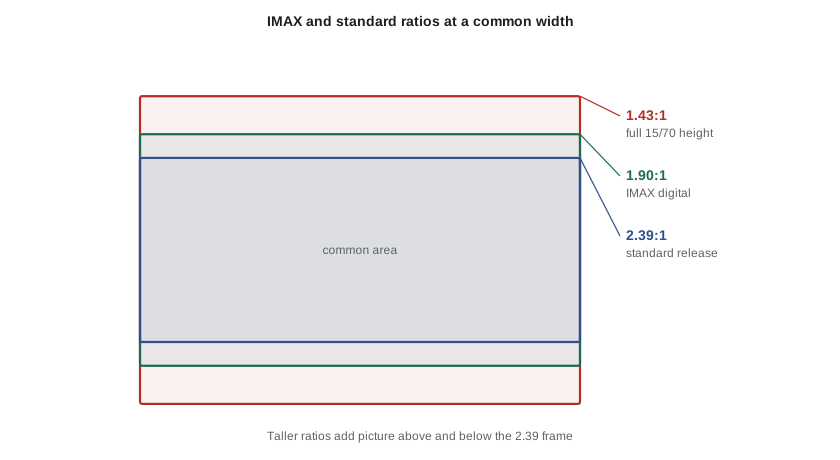
When the width is shared, each taller ratio reveals more picture at the top and bottom. A shot composed only for 2.39:1 may show a microphone, lighting rig or unfinished set at 1.43:1. A shot composed only for 1.43:1 may cut off heads when cropped to 2.39:1.
Worked problem
How much more picture does 1.43:1 show?
A shot is framed with a common width for 2.39:1, 1.90:1 and 1.43:1. Compared with the 2.39:1 height, how much taller are the 1.90:1 and 1.43:1 frames?
Show solution
- For a common width W, height = W ÷ ratio.
- 1.90 frame height relative to 2.39: 2.39 ÷ 1.90 ≈ 1.26, so about 26 % taller.
- 1.43 frame height relative to 2.39: 2.39 ÷ 1.43 ≈ 1.67, so about 67 % taller.
Answer: The 1.90:1 frame is about 26 % taller and the 1.43:1 frame about 67 % taller than the 2.39:1 frame. Set dressing, lighting rigs and visual effects must be planned for the tallest ratio that will be shown.
Framing for multiple ratios on set
Practical habits keep multi-ratio shooting under control.
- Load frame lines for every delivery ratio into the camera and monitors, with different colors or line styles, and agree which ratio is the "hero" for composition.
- Place important action in the common area that appears in every ratio, usually slightly above the center of the tallest frame.
- Brief the art department and grips that ceilings, rigging and top-light units may be visible in the taller frame.
- Agree with visual effects which shots need extra headroom for set extensions.
- Mark which sequences will expand to the taller ratio, so the DP and operator know when to compose for it.
- Record the sensor area that IMAX requires; cropping in post cannot recover picture that was not captured.
Exhibition, laser and premium screens
The audience's experience depends on the screen and projection system.
- IMAX with laser and GT screens: the largest screens, often able to show 1.43:1, with higher brightness and contrast than older xenon projection.
- IMAX digital xenon and smaller laser screens: usually 1.90:1 maximum.
- IMAX 70 mm film projection: a small number of venues can still project 15/70 prints, which became a selling point for some recent releases.
- Dolby Cinema and other PLF screens: high-contrast projection, often with high dynamic range and immersive sound, usually showing the standard ratios.
The DP does not control exhibition, but knowing where the film will play helps decide how much to invest in large-format capture and expanded-ratio sequences.
IMAX and large format in the US
The United States has the largest number of IMAX and PLF screens, and the major studios and streamers plan premium releases closely with IMAX and Dolby. Large-format cameras, IMAX film equipment, specialized technicians and post facilities that can handle large-format workflows are concentrated in Los Angeles, with support available in other production centers. Productions should confirm availability early, as demand for IMAX film cameras and certified digital packages can be high in peak seasons.
Deciding whether to shoot for IMAX
A DP can help the director and producers decide with a few questions.
- Will the film be released on premium screens, and has the distributor agreed to an IMAX release?
- Which sequences benefit from the taller frame and the extra resolution?
- Can the production handle the cost: film stock and processing for 15/70, or certified digital packages, larger data volumes and IMAX post services?
- Will the noise, weight and magazine length of film cameras suit the scenes, or is a certified digital camera better?
- Can the art department, lighting and visual effects support the taller frame?
Answering these early prevents expensive surprises, such as discovering in post that the taller frame shows a rig that cannot be removed.
Common mistakes
MistakeThinking IMAX film runs vertically like 35 mm
InsteadIMAX 15/70 film runs horizontally with 15 perforations per frame
MistakeComposing only for 2.39:1 on a show that expands to 1.43:1
InsteadLoad all frame lines, protect the tallest frame and keep key action in the common area
MistakeBudgeting IMAX film like 35 mm
InsteadIMAX uses about 337 feet per minute at 24 fps, roughly 3.7 times 35 mm 4-perf, before price differences
MistakeAssuming every digital camera mode qualifies for Filmed for IMAX
InsteadCheck IMAX's current certified list and the specific recording modes it accepts
MistakeForgetting that most IMAX venues cannot show 1.43:1
InsteadPlan deliverables for 1.43:1, 1.90:1 and standard ratios, knowing most screens show 1.90:1 or less
Summary and key terms
- IMAX began in Canada and its 15/70 film format runs 70 mm film horizontally, 15 perforations per frame, for a frame about 70 × 53 mm.
- At 24 fps IMAX film runs about 337 feet per minute, so 1,000-foot magazines last about 3 minutes and film costs are high.
- IMAX film cameras have been loud and heavy; a new, quieter generation named Keighley was used for The Odyssey.
- Filmed for IMAX certifies selected digital cameras and modes; the list changes, so check it for each project.
- Premium releases may use 1.43:1, 1.90:1 and standard ratios, so framing must protect the tallest frame.
- With a common width, 1.90:1 is about 26 % taller and 1.43:1 about 67 % taller than 2.39:1.
- Exhibition varies from 1.43:1 laser and film screens to standard PLF screens, which affects how much to invest in capture.
- 15/70
- The IMAX film format: 70 mm film running horizontally with 15 perforations per frame
- Perforation
- One of the sprocket holes along the edge of motion-picture film, used to measure frame length
- Magazine
- The light-tight container that holds film for a camera
- Filmed for IMAX
- IMAX's program that certifies digital cameras and supports productions framing and finishing for IMAX's expanded ratio
- Expanded aspect ratio
- A taller IMAX ratio, such as 1.90:1 or 1.43:1, shown in selected sequences
- Common area
- The part of the frame that appears in every delivery ratio
- Premium large format (PLF)
- Large, high-quality cinema screens marketed as a premium experience, including IMAX and Dolby Cinema
- 65 mm 5-perf
- A vertical-running 65 mm film format with frames about 52.5 × 23 mm, shown as 70 mm prints
- Frame lines
- Guides shown in the viewfinder and monitors marking the edges of each delivery ratio
- Laser projection
- Projection using laser light sources, offering higher brightness and contrast than older xenon lamps
Practice problems
Work each problem on paper first, then reveal the answer to check.
How many perforations long is an IMAX 15/70 frame?
Show answer
15 perforations, with the film running horizontally
About how many feet per minute does IMAX film use at 24 fps?
Show answer
About 337 feet per minute
A sequence will expose 25 minutes of IMAX film. About how many feet is that?
Show answer
25 × 337 ≈ 8,425 ft
For a common width, how much taller is a 1.90:1 frame than a 2.39:1 frame?
Show answer
2.39 ÷ 1.90 ≈ 1.26, about 26 % taller
Why were dialogue scenes historically avoided on IMAX film cameras?
Show answer
The cameras were very loud and the noise was recorded on the soundtrack
Name the IMAX ratio shown on most IMAX digital screens.
Show answer
1.90:1
Why must art departments know about expanded-ratio sequences?
Show answer
Ceilings, rigging and the tops of sets may be visible in the taller frame
What should a DP check before relying on a digital camera for an IMAX release?
Show answer
IMAX's current certified camera list and the specific recording modes and sensor areas that qualify
Roughly how long does a 1,000-foot magazine last on IMAX 15/70 at 24 fps?
Show answer
About 3 minutes (1,000 ÷ 337 ≈ 2.97 minutes)
Where was IMAX invented?
Show answer
In Canada, by Graeme Ferguson, Roman Kroitor, Robert Kerr and William Shaw, first shown at Expo 70
Lesson quiz · 5 questions
Score 60% or more to complete this lesson.
Create a free account to save your progress, take quizzes and earn a certificate.