
CINE-410 · Lesson 11 of 12 · 30 min
Specialty lenses and rigs: macro, probe, tilt-shift, split diopter and 360 capture
Standard prime and zoom lenses cover most of what a DP needs. A smaller set of specialty optics and rigs creates images that ordinary lenses cannot: an insect filling the frame, a camera gliding through a miniature city at ground level, a plane of focus tilted across a street so it looks like a toy model, two faces at very different distances both in focus, or a full 360-degree sphere for virtual reality. These tools are powerful, but each has trade-offs in light, depth of field, distortion and workflow. This lesson introduces the main specialty optics and capture systems, the optics behind them, and how to plan their use. Motion control, often combined with these optics, was covered in Course CINE-330, and macro product photography was introduced in Course PHOT-310.
Macro cinematography
Macro work shows small subjects at or near life size on the sensor. The key measure is magnification.
At 1:1 (m = 1), a subject 25 mm wide fills a 25 mm wide sensor. At close focus, the lens extension increases and less light reaches the sensor. The effective aperture is approximately:
Worked problem
Light loss at life size
A macro lens is set to T4 and focused at 1:1 to film a watch movement. What is the effective stop, and how many stops of light are lost?
Show solution
- N_effective ≈ 4 × (1 + 1) = 8.
- From T4 to T8 is 2 stops.
Answer: The lens behaves like about T8, losing about 2 stops. Combined with the very shallow depth of field at macro distances, which often pushes DPs to T11 or T16, macro scenes need a lot of light, usually from small, cool LED sources so the subject does not heat up.
Depth of field at macro distances is measured in millimeters. Focus is often set by moving the camera on a precision focusing rail rather than turning the lens, and focus stacking, combining several frames focused at different distances, is common in still photography but rarely practical for moving images except in motion-control work.
Probe and periscope lenses
Probe lenses are long, thin lenses that place the front element far from the camera body, often with the optical path folded by mirrors or prisms. They let the camera move through miniatures, food, plants or tight spaces, get within millimeters of a subject and look straight down or sideways.
- Typical features: long barrels, wide angles of view, very close focus and the ability to rotate the image with a built-in prism.
- Light: probe lenses are slow, often around T6 to T8 or slower, so they need a lot of light.
- Depth of field: very wide lenses close to the subject can hold surprising depth of field, which gives the miniature, "bug's-eye" look.
- Support: the long barrel must be supported and protected from knocks; motion control or sliders give smooth, repeatable moves.
Periscope and snorkel lenses are related systems that put the front of the lens low to the ground or into tight spaces while the camera stays above, often with a mirror that allows the lens to pan or tilt independently.
Tilt-shift lenses and the plane of focus
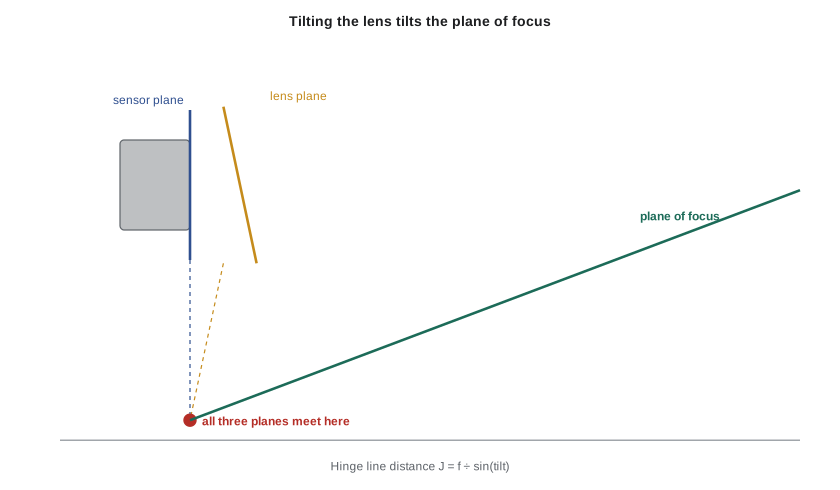
In a normal lens the plane of focus is parallel to the sensor. A tilt-shift lens can tilt the lens relative to the sensor, which tilts the plane of focus, and shift the lens sideways or up and down, which moves the image without tilting the camera.
- Shift keeps vertical lines parallel when looking up at buildings, as in architectural photography (Course PHOT-311).
- Tilt can lay the plane of focus along a road or table to keep it sharp from near to far at a wide stop.
- Reverse tilt narrows the zone of focus to a thin slice, creating the "miniature" or "toy town" effect on real scenes.
The geometry follows the Scheimpflug principle: the sensor plane, the lens plane and the plane of focus meet along a single line. A useful related rule gives the distance J from the lens to the hinge line around which the plane of focus rotates.
Here f is the focal length and α the tilt angle.
Worked problem
Where is the hinge line?
A DP uses a 50 mm tilt lens tilted 3° to lay the plane of focus along a dinner table. How far below the lens is the hinge line?
Show solution
- sin 3° ≈ 0.0523.
- J = 50 ÷ 0.0523 ≈ 956 mm.
Answer: About 0.96 m below the lens. If the camera is about 1 m above the tabletop, the plane of focus will run along the table, and focusing the lens then swings the plane around that hinge line to pick up near and far settings together.
Split diopters and multi-plane focus
A split diopter is a half-moon close-up lens that covers only part of the frame. The half behind the diopter focuses close while the rest of the frame focuses farther away, so a face close to the camera and a face in the background can both be sharp. The seam between the two zones must be hidden along a natural line in the composition, such as a door frame or a dark area.
Worked problem
Choosing a split diopter
The main lens focuses on an actor 6 m away. The DP wants an object about 0.5 m from the lens sharp in the left half of the frame. Approximately what diopter strength is needed?
Show solution
- With the lens near infinity focus, a diopter of strength D focuses at about 1 ÷ D meters.
- For about 0.5 m, D ≈ 1 ÷ 0.5 = 2, so a +2 diopter.
- Because the main lens is at 6 m rather than infinity, the combined close focus will be slightly nearer than 0.5 m, and the DP fine-tunes by adjusting the main focus and checking on the monitor.
Answer: About a +2 diopter. Test the seam position and both focus planes carefully, and remember that camera movement makes the seam harder to hide.
Modern alternatives include tilt lenses, deep-focus lighting at high stops and compositing two focus passes in visual effects. Each has a different look: the split diopter gives an instantly recognizable, slightly artificial depth that some directors use deliberately.
Other specialty optics
- Anamorphic lenses: squeeze a wide image onto the sensor for widescreen formats, with characteristic oval bokeh and flares; covered in Course CINE-330 for stylized work.
- Fisheye lenses: extreme wide angles with strong barrel distortion, used for point-of-view and stylized shots.
- Lensbaby-style and free-lensing: deliberately soft or shifting focus for dreamlike effects.
- Prisms and filters in front of the lens: multiple images, flares and in-camera effects.
- Long telephoto and teleconverters: wildlife and sports, often with very heavy lenses needing special support.
360-degree and VR capture
360-degree cameras capture the whole sphere around the camera, usually with several lenses whose images are stitched into an equirectangular frame, a rectangle twice as wide as it is tall that maps the sphere. Viewers watch in a headset or by panning on a screen.
- No behind the camera: the crew must hide, or be removed in post, because every direction is in frame.
- Stitching: lenses must be close together to reduce parallax errors at the seams, and subjects should not cross seams too close to the camera.
- Height and movement: camera height sets the viewer's eye level; fast movement can cause motion sickness in headsets.
- Resolution: a headset shows only a small part of the sphere at once, so very high resolution is needed for a sharp image.
Worked problem
Is 8K enough for VR?
A 360-degree camera records an equirectangular frame 7680 pixels wide. A headset displays a 100° horizontal field of view across about 2000 pixels per eye. Compare the pixels per degree of the recording and the display.
Show solution
- Recording: 7680 ÷ 360 ≈ 21.3 pixels per degree.
- Display: 2000 ÷ 100 = 20 pixels per degree.
- The recording roughly matches the display, but any compression, stitching softness or need for headroom reduces effective resolution.
Answer: About 21 pixels per degree recorded against about 20 displayed, a close match. For future headsets with higher resolution, capture at 12K or more would be needed for the same sharpness.
Volumetric capture
Volumetric capture records a person or object from many cameras arranged around a stage so that software can rebuild it as a three-dimensional model that can be viewed from any angle. It is used for virtual reality, augmented reality, games and visual effects.
- Stages use dozens or more synchronized cameras, often with depth sensors, and even, carefully controlled lighting.
- Data volumes are very large, and processing into models takes significant time and computing power.
- Performers need to stay within the capture volume, and costumes with fine detail, transparency or reflective surfaces are difficult.
- Rights and consent matter: a volumetric model is a reusable digital likeness, so contracts must state how it can be used (Course CRE-410 discusses digital replicas and consent).
Planning with specialty optics
Specialty optics are often rented for a single scene, so preparation matters.
- Test early: confirm coverage, focus behavior, light loss, flare and how the lens interacts with the camera.
- Plan light: slow probe and macro set-ups can need several times the light of a normal scene.
- Plan support: rails, sliders, motion control or rigid mounts for heavy or long lenses.
- Plan time: specialty set-ups take longer to rig and focus.
- Plan matching: make sure specialty shots match the surrounding coverage in look and color.
Common mistakes
MistakeIgnoring light loss at macro magnification
InsteadUse N(1 + m) to estimate the effective stop and plan enough cool light
MistakeUsing a probe lens without extra light
InsteadProbe lenses are slow; plan lighting for T6 to T8 or slower
MistakePlacing a split diopter seam across a face or detailed area
InsteadHide the seam along a natural line in the composition and test it with movement
MistakeShooting 360 with crew visible "to fix in post"
InsteadPlan hiding places or removal in advance, since every direction is in frame
MistakeTreating volumetric captures like ordinary footage in contracts
InsteadSpecify how digital likenesses can be used, with the performer's informed consent
Summary and key terms
- Macro work is measured by magnification; the effective stop at close focus is about N(1 + m).
- Probe, periscope and snorkel lenses place the front element in tight spaces but are slow and need support and light.
- Tilt-shift lenses tilt the plane of focus by the Scheimpflug principle, with a hinge line at f ÷ sin α.
- Split diopters focus part of the frame close; strength in diopters is about 1 ÷ distance in meters.
- 360-degree capture stitches several lenses into an equirectangular sphere and needs very high resolution.
- Volumetric capture rebuilds subjects in three dimensions and raises data, processing and consent issues.
- Specialty optics need early tests, extra light, rigid support, extra time and careful matching.
- Magnification
- The ratio of image size on the sensor to subject size
- Effective aperture
- The stop a lens behaves like at close focus, accounting for extension
- Probe lens
- A long, thin lens that places its front element far from the camera, often with a folded optical path
- Tilt-shift lens
- A lens that can tilt relative to the sensor and shift sideways or vertically
- Scheimpflug principle
- The rule that the sensor plane, lens plane and plane of focus meet along one line
- Hinge line
- The line around which a tilted plane of focus rotates when focus is adjusted
- Split diopter
- A half close-up lens that focuses part of the frame at a nearer distance
- Equirectangular
- A projection that maps a sphere onto a rectangle twice as wide as it is tall
- Parallax
- The apparent shift of objects between viewpoints, which causes stitching errors
- Volumetric capture
- Recording a subject with many cameras to rebuild it as a 3-D model
Practice problems
Work each problem on paper first, then reveal the answer to check.
A lens at T5.6 is focused at 0.5× magnification. What is the effective stop?
Show answer
5.6 × 1.5 ≈ T8.4, about one stop slower
What tilt angle gives a hinge line 1.5 m below a 90 mm lens?
Show answer
sin α = 90 ÷ 1,500 = 0.06, so α ≈ 3.4°
What diopter strength focuses at about 0.33 m with the lens at infinity?
Show answer
About +3
How many pixels per degree does a 5760-pixel-wide equirectangular frame give?
Show answer
5760 ÷ 360 = 16 pixels per degree
Why do macro scenes often use LED lighting?
Show answer
LEDs give a lot of light with less heat, protecting small subjects
What is the miniature effect, and how is it made?
Show answer
A real scene that looks like a model, made with reverse tilt so only a thin slice is in focus
Why must 360-degree camera lenses be close together?
Show answer
To reduce parallax errors at the stitching seams
Name one alternative to a split diopter for two focus planes.
Show answer
Any one of a tilt lens, a deep stop with more light, or compositing two focus passes
Why are volumetric captures sensitive in contracts?
Show answer
They create reusable digital likenesses, so use must be limited and consented to
Why are probe lenses often used with motion control?
Show answer
For smooth, precise and repeatable moves close to miniatures or small subjects
Lesson quiz · 5 questions
Score 60% or more to complete this lesson.
Create a free account to save your progress, take quizzes and earn a certificate.