
CINE-410 · Lesson 10 of 12 · 30 min
Extreme environments: cold, heat, rain, desert and mountains
Cameras, batteries, lenses and people all have operating limits. On a sound stage those limits rarely matter. On a frozen lake in January, in a desert at 45 °C, on a glacier at 3,000 m or in driving rain, they decide whether you get the shot and whether everyone comes home safely. Canada's winters make cold-weather work a core skill for Canadian crews, and productions everywhere chase dramatic landscapes in harsh conditions. This lesson covers how extreme cold, heat, moisture, dust and altitude affect equipment and people, how to protect both, and how to plan schedules and budgets around the environment.
What the environment does to equipment
| Condition | Main effects | Typical protections |
|---|---|---|
| Severe cold | Reduced battery capacity, stiff cables and lubricants, slow or failed motors, brittle plastics, LCD lag | Warm batteries, cold-rated cables, heater covers, gradual warm-up, insulated cases |
| Moving between cold and warm | Condensation on and inside lenses and electronics | Seal gear in bags before warming, allow slow temperature change |
| Heat and sun | Sensor and processor overheating, shutdowns, noise, warped plastics | Shade, white covers, fans, rest cycles, cooled cases |
| Rain and spray | Water ingress, fogging, droplets on lenses, electrical faults | Rain covers, spinning deflectors, sealed connectors, ground-fault protection |
| Dust and sand | Abrasion of lenses and mounts, dust on sensors, clogged fans | Sealed covers, filters, careful lens changes, air blowers |
| Altitude | Thinner air reduces cooling and drone or helicopter performance; stronger UV | Extra cooling margin, reduced payloads, UV protection for people |
Manufacturers publish operating temperature ranges for cameras and batteries, often around 0 °C to 40 °C for many cameras, though some are rated lower. Working outside these ranges may still be possible with protection, but the risk of failure rises, and warranty and insurance terms may be affected.
Batteries in the cold
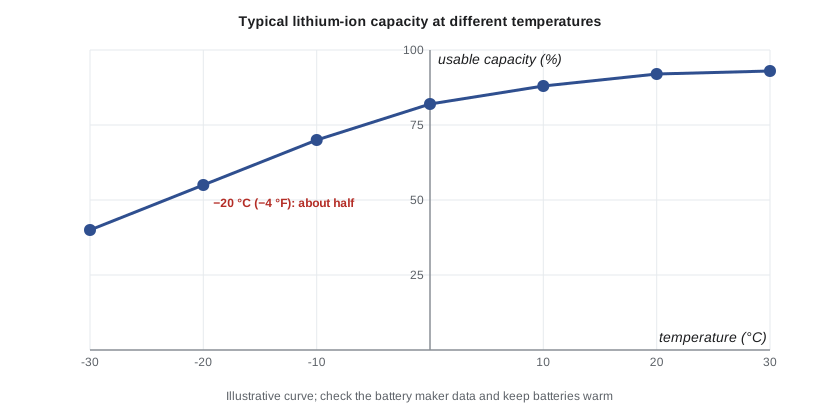
Lithium-ion batteries deliver less energy when cold, because the chemical reactions slow and internal resistance rises. At −20 °C a battery may deliver only around half of its rated capacity, and its voltage may sag under load so the camera shuts down early. The capacity returns when the battery warms, but repeated deep discharges in the cold shorten battery life.
Worked problem
Camera runtime in the cold
A camera draws 60 W. A 98 Wh battery delivers about 90 % of its rating at 20 °C. At −20 °C it delivers about 55 %. Estimate the runtime at each temperature and the number of batteries for a 10-hour day with 6 hours of camera power-on time.
Show solution
- At 20 °C: 98 × 0.90 ÷ 60 ≈ 1.47 h, about 88 minutes.
- At −20 °C: 98 × 0.55 ÷ 60 ≈ 0.90 h, about 54 minutes.
- Batteries for 6 hours at 20 °C: 6 ÷ 1.47 ≈ 4.1, so 5 batteries.
- Batteries for 6 hours at −20 °C: 6 ÷ 0.90 ≈ 6.7, so 7 batteries, plus spares and warm storage.
Answer: About 88 minutes per battery at 20 °C but about 54 minutes at −20 °C, so the cold day needs roughly half as many batteries again. Keep batteries warm in insulated bags or inside jackets until use, and use heated battery plates or external power where possible.
Condensation
When a cold camera or lens comes into a warm, humid room, water condenses on any surface colder than the air's dew point, including inside lenses and on circuit boards. The dew point can be estimated with the Magnus formula.
Here T is the air temperature in °C, RH the relative humidity in percent, a = 17.62 and b = 243.12 °C.
Worked problem
Will the lens fog?
A camera has been outside at −20 °C. It is brought into a trailer at 21 °C and 40 % relative humidity. Will condensation form, and how should the crew handle it?
Show solution
- γ = ln(0.40) + 17.62 × 21 ÷ (243.12 + 21) = −0.916 + 1.401 ≈ 0.485.
- Dew point: T_d = 243.12 × 0.485 ÷ (17.62 − 0.485) ≈ 117.9 ÷ 17.13 ≈ 6.9 °C.
- The camera at −20 °C is far below 6.9 °C, so moisture will condense on it and possibly inside it.
Answer: Yes. The dew point is about 7 °C. Seal the camera and lenses in airtight bags or closed cases before bringing them inside, and let them warm slowly to room temperature before opening, often for an hour or more. Alternatively keep the camera in an unheated vehicle or tent between set-ups so it never crosses the dew point.
Exposure on snow, ice and sand
Snow, ice and bright sand reflect much more light than average scenes. A reflected-light meter or auto-exposure assumes the scene averages a middle gray and will underexpose snow so it looks gray. Expose so snow sits in the bright range of your camera's log curve, typically using false color or a spot meter reading on snow with about one and a half to two stops of extra exposure, while keeping detail in the highlights. Polarizing filters reduce glare on snow and water. Very bright snow also makes faces hard to expose: fill light, reflectors and negative fill (flags and black cloth) help shape them.
Wind chill and cold stress for people
Cold harms people faster than equipment. Wind makes cold air remove heat faster, which wind chill indices express as an equivalent temperature.
In this metric form, T is air temperature in °C and V is wind speed in km/h at 10 m height.
Worked problem
Wind chill on a winter location
On a prairie location the air is −20 °C with a 30 km/h wind. What is the wind chill, and what does it mean for the crew?
Show solution
- V^0.16 = 30^0.16 ≈ 1.723.
- T_wc = 13.12 + 0.6215 × (−20) − 11.37 × 1.723 + 0.3965 × (−20) × 1.723.
- = 13.12 − 12.43 − 19.59 − 13.66 ≈ −32.6.
Answer: The wind chill is about −33, a level at which exposed skin can freeze in minutes. Crews need warm-up shelters, rotation schedules, layered cold-weather clothing, hand and face protection, hot drinks and a medic watching for frostbite and hypothermia. Actors in thin costumes need especially short takes and immediate warming between them.
Forecasts help crews plan for these conditions.
The National Weather Service uses the same wind chill model, expressed in °F and mph, and issues cold weather advisories; check them daily.
Rules for cold and heat at work in the US
OSHA has no specific federal cold-stress standard, but employers must protect workers under the general duty clause and OSHA publishes cold and heat guidance. OSHA proposed a federal heat injury and illness prevention standard in 2024; check its current status. Some states, such as California with its outdoor heat illness prevention standard, have their own heat rules requiring water, shade, rest breaks and training. Productions working in remote deserts and mountains must also plan for medical evacuation and long distances to hospitals.
Heat and sun
Heat affects cameras and people. Camera sensors and processors generate heat, and in direct sun a black camera body can become much hotter than the air.
- Shade the camera with umbrellas, white covers or reflective covers, especially between takes.
- Monitor camera temperature and sensor noise; some cameras show warnings or shut down at high temperatures.
- Keep spare bodies or rest cycles in very hot conditions.
- For people, plan water, shade, rest breaks, cooling stations and acclimatization; watch for heat exhaustion and heat stroke.
- The wet-bulb globe temperature (WBGT), which combines temperature, humidity, radiant heat and wind, is used to set work-rest schedules.
Desert days also have huge temperature swings: hot afternoons and cold nights, with condensation risk at dawn.
Rain, spray and dust
Water and dust are enemies of electronics and optics.
- Rain covers fitted to the camera and lens, with clear windows for the operator.
- Spinning rain deflectors in front of the lens throw off droplets by spinning a clear glass disc rapidly.
- Sealed and protected connectors for power and video, with ground-fault protection on all electrical feeds (Course CINE-340).
- Dust and sand: change lenses inside a vehicle or tent, use protective filters, keep mounts covered and clean with blowers before brushes to avoid scratches.
- Wind and dust storms: stop work when visibility or flying debris becomes dangerous.
Altitude and mountains
At high altitude the air is thinner, colder and drier, and ultraviolet radiation is stronger.
- Equipment: thin air cools electronics less effectively, so cameras and lights run hotter for the same air temperature.
- Drones and helicopters: lift falls with air density, reducing payload and flight time; manufacturers publish altitude limits.
- People: altitude sickness can affect anyone above about 2,500 m, with headaches, nausea and fatigue, and in severe cases life-threatening swelling of the lungs or brain. Plan acclimatization, hydration and descent options.
- Mountain hazards: avalanches, rockfall, crevasses and rapidly changing weather need mountain guides and avalanche safety specialists.
Worked problem
Drone performance at altitude
At 3,000 m the air density is about 74 % of sea level. A drone's propellers produce thrust roughly in proportion to air density at the same rotor speed. If a drone hovers at sea level at 60 % of its maximum thrust, what share of maximum thrust does it need at 3,000 m?
Show solution
- Thrust available at the same rotor speed falls to about 0.74 of sea level.
- To lift the same weight, the drone needs 0.60 ÷ 0.74 ≈ 0.81, about 81 % of its sea-level maximum.
- That leaves much less margin for wind, maneuvers and climbing, and the motors draw more power, shortening flight time.
Answer: About 81 % of maximum thrust just to hover, compared with 60 % at sea level. Reduce the payload, use a drone rated for altitude and plan shorter flights with larger reserves.
Planning for extreme environments
A planning checklist helps.
- Research the conditions: temperatures, wind, precipitation, daylight hours, altitude and access.
- Choose equipment rated for the conditions, and test it in a cold chamber, freezer test or location test.
- Plan power: extra batteries, heated storage, generators and charging.
- Plan people: clothing, shelters, food, water, medics, rotation schedules and evacuation.
- Add time: everything takes longer in cold, heat or remote places, often 20 to 50 % longer.
- Plan contingencies: weather holds, backup locations and equipment spares.
Common mistakes
MistakeBringing a frozen camera straight into a warm trailer
InsteadSeal it in bags or cases and let it warm slowly, or keep it cold between set-ups
MistakePlanning battery needs from warm-weather runtimes
InsteadReduce expected capacity for cold, keep batteries warm and carry extra spares
MistakeExposing snow at the meter's reading
InsteadGive snow about 1.5 to 2 stops more exposure than the meter suggests while protecting highlight detail
MistakeTreating crew cold or heat stress as a schedule issue
InsteadPlan shelters, rotations, water, medics and stop rules, as required by safety law
MistakeFlying the same drone payload at altitude as at sea level
InsteadReduce payload and plan shorter flights because thin air reduces lift and margin
Summary and key terms
- Extreme cold, heat, moisture, dust and altitude all affect cameras, batteries, lenses and people.
- Lithium-ion batteries may deliver only about half their capacity at −20 °C, so warm storage and spares are essential.
- Condensation forms when cold gear meets warmer air above its dew point; seal and warm gear slowly.
- Snow and sand fool meters; expose them brighter than middle gray while protecting highlights.
- Wind chill shows how quickly cold air removes heat; at −33 exposed skin can freeze in minutes.
- Canadian OHS laws and US OSHA guidance and state rules require protection from cold and heat stress.
- At altitude thin air reduces cooling and drone or helicopter lift, and people need acclimatization and mountain safety support.
- Dew point
- The temperature at which air becomes saturated and moisture condenses
- Wind chill
- An index expressing how cold the air feels on exposed skin when wind is taken into account
- Internal resistance
- Resistance inside a battery that rises in the cold and causes voltage to sag under load
- Spinning rain deflector
- A rapidly spinning glass disc in front of the lens that throws off rain and spray
- WBGT
- Wet-bulb globe temperature, a heat stress index combining temperature, humidity, radiant heat and wind
- Acclimatization
- Gradual adaptation of the body to heat or altitude
- Altitude sickness
- Illness caused by low oxygen at high altitude
- False color
- A monitoring display that shows exposure levels as colors
- Negative fill
- Using black flags or cloth to remove light and add contrast
- Operating temperature range
- The temperatures within which a manufacturer rates equipment to work properly
Practice problems
Work each problem on paper first, then reveal the answer to check.
A camera draws 50 W from a 98 Wh battery that delivers 50 % in the cold. How long does it run?
Show answer
98 × 0.5 ÷ 50 ≈ 0.98 h, about 59 minutes
A trailer is at 20 °C and 50 % humidity. Roughly what is the dew point?
Show answer
About 9 °C (γ ≈ −0.693 + 1.339 = 0.646; T_d ≈ 243.12 × 0.646 ÷ 16.97 ≈ 9.3 °C)
Why should cold cameras be sealed in bags before going indoors?
Show answer
So moisture condenses on the bag, not on and inside the camera, while it warms slowly
How much extra exposure does snow usually need compared with a meter reading?
Show answer
About 1.5 to 2 stops
Name two measures to protect people from cold on set.
Show answer
Any two of warm-up shelters, rotation schedules, layered clothing, hot drinks and a medic watching for frostbite and hypothermia
What does a spinning rain deflector do?
Show answer
It spins a glass disc rapidly in front of the lens so rain and spray are thrown off
At 3,000 m the air density is about 74 % of sea level. If a drone needs 50 % thrust at sea level, what does it need there?
Show answer
0.50 ÷ 0.74 ≈ 68 %
Why do cameras run hotter at altitude?
Show answer
Thin air removes heat less effectively
Give two signs of altitude sickness.
Show answer
Any two of headache, nausea, fatigue and dizziness
How much extra time should be allowed for work in extreme environments?
Show answer
Often 20 to 50 % more than normal
Lesson quiz · 5 questions
Score 60% or more to complete this lesson.
Create a free account to save your progress, take quizzes and earn a certificate.