
CINE-410 · Lesson 7 of 12 · 27 min
Drone regulations, permits and safety in the US
Every drone flight on a production is an aviation operation. National aviation authorities treat drones as aircraft, with rules on who may fly, where, how high, how close to people and with what approvals. Productions also need permission from landowners, municipalities and park agencies, and they must manage privacy and safety on the ground. Rules change often: both countries made major changes in 2025 and 2026, and further changes are expected. This lesson explains the framework that applies at the time of writing (October 2026), shows how to plan a compliant drone day and gives you the habits to check the current rules before every job. It is an awareness lesson: it does not replace the official training, examinations and certificates required to fly.
Why drone rules matter on a film set
Film sets concentrate the conditions that make drone flights risky: crowds of crew and extras, actors who are concentrating on performance, vehicles and equipment, tight schedules and pressure to get the shot. A drone weighing 10 kg or more falling from 30 m can kill. Flyaways, battery failures and collisions with structures happen even to experienced pilots. The rules exist to reduce those risks and to keep drones from conflicting with crewed aircraft, emergency operations and the public. On a production, the drone team's compliance also protects the production's insurance, permits and reputation.
The framework in the US
In the United States, the Federal Aviation Administration (FAA) regulates drones, which it calls small unmanned aircraft systems, under 14 CFR Part 107 for commercial operations, including all film and television work. Part 107 applies to drones under 55 lb (about 25 kg). Drones weighing 0.55 lb (250 g) or more must be registered with the FAA and marked with their registration number, and must meet the Remote ID rule, broadcasting their identity and location either from a built-in system or an add-on module.
- Remote pilot certificate: the pilot must hold an FAA Remote Pilot Certificate, earned by passing an aeronautical knowledge test (minimum age 16), and must complete free online recurrent training every 24 calendar months.
- Operating limits: no higher than 400 ft above ground level unless within 400 ft of a structure, within visual line of sight of the pilot or a visual observer, at no more than 100 mph and yielding right of way to crewed aircraft.
- Night operations: allowed for certificated pilots who have completed the current training, with anti-collision lighting visible for at least 3 statute miles.
- Operations over people: allowed in four categories based on the drone's weight, design and declared compliance, from Category 1 for very light drones to Category 4 for drones with an airworthiness certificate; flying over people in moving vehicles has further limits.
- Controlled airspace: needs FAA authorization, often obtained in near real time through the Low Altitude Authorization and Notification Capability (LAANC) or through the FAA's DroneZone.
- Waivers: operations outside Part 107, such as beyond visual line of sight or certain operations over people, need a waiver showing equivalent safety.
- Part 108: a proposed rule for beyond-visual-line-of-sight operations, published in August 2025, sets up permits and certificates for organizations. The final rule was sent for federal review in July 2026 but had not taken effect at the time of writing.
Permissions beyond aviation in the US
Aviation compliance is only the start. Productions also need the following.
- Landowner and location permission for take-off, landing and filming, usually through the location manager and the local film office.
- Municipal and state film permits: cities such as Los Angeles, New York and Atlanta require permits or notifications for drone filming and may limit times and areas.
- National parks: the National Park Service prohibits launching, landing or operating drones in park units without specific authorization, so drone filming in a national park is rarely approved.
- National forests and wilderness: the US Forest Service may require filming permits, and drones may not take off or land in designated wilderness areas.
- Tribal lands: permission from the relevant tribal government.
- Temporary flight restrictions (TFRs): wildfires, stadium events, VIP movements and other events can close airspace at short notice; flying a drone near a wildfire is a federal offense and grounds firefighting aircraft.
Privacy and the public
Drones can capture people who have not agreed to be filmed, often from angles they do not expect. Productions should treat privacy as part of their planning.
- Avoid filming private homes, yards and windows unless the owners have given permission.
- Inform neighbors and the public when drone filming will happen, with signs and notices as required by the film permit.
- Do not record or keep footage of identifiable bystanders unless releases are obtained or the use is lawful and justified.
- Follow the applicable privacy laws and the production's own privacy policies.
Planning a compliant drone day
A practical checklist covers the main steps.
- Confirm the pilot's certificate, the drone's registration and the operator's insurance.
- Check the airspace: controlled or uncontrolled, nearby airports and heliports, temporary restrictions and any special airspace.
- Obtain airspace authorizations and permissions well ahead, with a backup plan if they are delayed.
- Complete a site survey and risk assessment with exclusion zones, take-off and landing areas and emergency procedures.
- Brief cast, crew and any public on the flight plan and safety rules.
- Keep flight logs and incident reports, and report accidents as required by the aviation authority.
Worked problem
Checking distances on a location
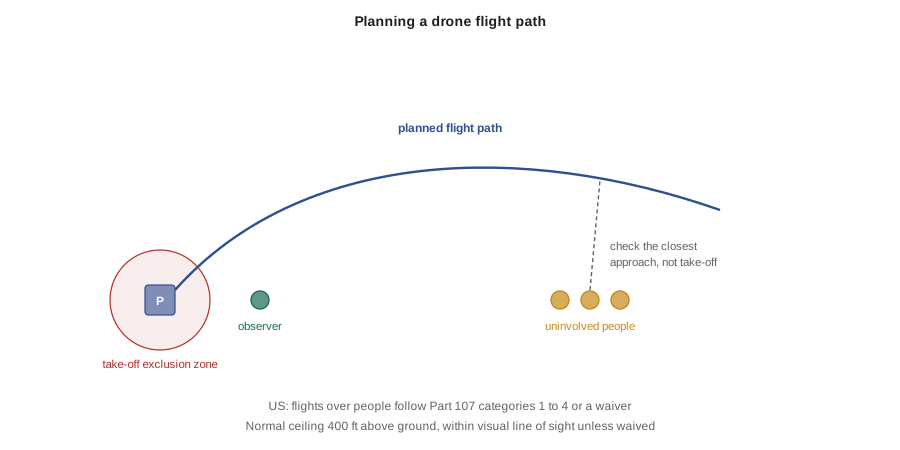
A take-off point is planned 45 m (about 150 ft) from a public sidewalk where uninvolved people walk. The drone will fly along a path that passes within 20 m (about 65 ft) of the sidewalk. What does the team need to consider?
Show solution
- Identify the people involved: crew and cast who have been briefed are not bystanders in the same sense as members of the public on the sidewalk.
- Compare the closest approach (20 m) with the minimum distance allowed for the pilot's certificate and the drone's category under the current rules.
- If the planned path is too close, move the path, close or control the sidewalk with permission, or use a different drone category or pilot qualification that allows the closer approach.
Answer: The closest approach to uninvolved people, not the take-off distance, decides compliance. The team must either keep the path outside the allowed distance or change the controls, approvals or equipment so the closer pass is legal and safe.
Incident response and reporting
Even with good planning, incidents happen.
- Stop flying immediately after any loss of control, collision or injury.
- Secure the scene and give first aid if needed.
- Preserve the aircraft, logs and data for investigation.
- Report to the aviation authority as required (both Canada and the US require reports of serious incidents, such as injuries or damage above set thresholds).
- Notify the production's safety officer and insurer.
- Hold a debrief and update procedures before flying again.
Staying current in the US
The FAA publishes Part 107 rules, guidance, waiver decisions and airspace tools online, and the B4UFLY app and LAANC providers show airspace limits. Pilots must complete recurrent training every 24 calendar months. Because Part 108 and other changes are moving through rulemaking, productions should ask drone teams which rules and authorizations each planned flight uses and check the current requirements at faa.gov before every job.
Drone safety culture on set
Rules set the minimum. A professional drone team adds habits that make every flight safer and every shoot calmer.
- A single voice for flight calls: the pilot or the first AD announces "drone up" and "drone down" on the main radio channel so everyone knows when the aircraft is flying.
- A no-fly decision that nobody questions: if the pilot calls off a flight because of wind, interference, battery condition or people in the area, the production finds another solution rather than pressing.
- Cast and crew briefings: performers who will work near a drone are told where it will fly, how close it will come and what to do if it behaves unexpectedly.
- Protection near people: propeller guards, lighter drones and slower speeds when flights come close to performers, with rehearsals at walking pace first.
- Interference awareness: radio-heavy sets, metal structures and power lines can disturb control links and compasses, so pilots check signal quality and calibrate before flying.
- Weather discipline: wind limits, precipitation limits and temperature limits are agreed in advance and checked with instruments, not guessed.
- Battery discipline: batteries are tracked by number and cycle count, stored at safe charge levels, inspected for swelling and retired on schedule.
- Fatigue limits: pilots and observers get breaks, since concentration falls over a long day of short, intense flights.
Insurance and contracts
Productions usually require drone operators to carry aviation liability insurance at a stated minimum and to name the production as an additional insured. The production's own insurer may require proof of certificates, registration, approvals and a risk assessment before it covers drone work. Contracts should state who is responsible for obtaining aviation approvals, who may cancel a flight for safety reasons without penalty, how weather days are paid and who owns the footage and flight logs.
Worked problem
Checking a drone operator's paperwork
A producer receives a quote from a drone company for two days of filming over a rural property and a short section of public road that will be closed by the production with a municipal permit. List the documents the producer should ask for before booking.
Show solution
- The pilot's current certificate for the category of flight planned, and the visual observer's training.
- Registration of each drone that will fly, and proof that the drones meet the required technical standards for the planned operations.
- Aviation liability insurance with the production named as an additional insured.
- Any airspace authorizations, waivers or special certificates needed for the location.
- A site-specific risk assessment and emergency plan, and the municipal permit for the road closure.
Answer: Certificates, registrations, insurance, airspace approvals, the risk assessment and the permit. Checking these before booking avoids discovering on the day that a flight cannot legally go ahead.
Why the rules keep changing
Drone technology moves faster than regulation. Larger drones, longer flights, beyond-visual-line-of-sight delivery and inspection, and automated "drone in a box" systems all push regulators to create new categories. Canada's 2025 changes and the proposed US Part 108 rule both reflect this shift from case-by-case approvals toward routine rules for lower-risk operations. For filmmakers, the practical result is that options grow every year, but so does the need to check which rules apply on the day of the shoot.
Common mistakes
MistakeAssuming a micro drone needs no planning at all
InsteadEven drones under 250 g must be flown safely, and events, parks and local permits can still apply
MistakeMeasuring compliance from the take-off point only
InsteadCheck the closest approach of the whole flight path to uninvolved people and structures
MistakeAssuming national aviation approval covers all permissions
InsteadAlso obtain landowner, municipal, park and Indigenous or tribal permissions as required
MistakeFilming bystanders' homes from the air without permission
InsteadPlan privacy into the flight path, notify the public and avoid identifiable footage without consent
MistakeRelying on last year's rules
InsteadCheck the current national rules and categories before every job, especially after the 2025 and 2026 changes
Summary and key terms
- Drones are aircraft, and national aviation authorities set rules on pilots, registration, airspace, altitude and distance from people.
- Canada's CARs Part IX and the US Part 107 framework set different categories, certificates and limits.
- Both countries changed drone rules significantly in 2025, and further changes, such as the US Part 108, are in progress.
- Productions also need landowner, municipal, park and Indigenous or tribal permissions.
- Privacy, public notification and respect for bystanders are part of responsible drone filming.
- A compliant drone day checks certificates, registration, airspace, permissions, risk assessment, briefings and logs.
- Incidents must be stopped, secured, reported and reviewed before flying again.
- RPAS
- Remotely piloted aircraft system, the Canadian term for a drone and its control equipment
- Small unmanned aircraft system
- The US term for a drone under 55 lb and its control equipment
- Pilot certificate
- A credential showing a pilot has passed the required knowledge test and, where needed, flight review
- Controlled airspace
- Airspace where air traffic control services operate and drone flights need authorization
- Remote ID
- A US requirement for drones to broadcast identification and location during flight
- Beyond visual line of sight (BVLOS)
- Flying a drone beyond where the pilot or observer can see it directly
- Special flight operations certificate (SFOC)
- A Canadian approval for drone operations outside the standard rules
- Waiver
- A US authorization to operate outside specific Part 107 rules
- Temporary flight restriction (TFR)
- A short-term airspace closure, for example around wildfires or major events
- Bystander
- A person not involved in the drone operation who has not been briefed and accepted the risk
Practice problems
Work each problem on paper first, then reveal the answer to check.
Why are drones treated as aircraft?
Show answer
They share airspace with crewed aircraft and can injure people and damage property, so aviation authorities regulate them
Give two permissions a production may need besides aviation approval.
Show answer
Any two of landowner, municipal film permit, park permit and Indigenous or tribal permission
What decides compliance with distance-from-people rules on a flight path?
Show answer
The closest approach of the flight to uninvolved people
Name two steps after a drone incident.
Show answer
Any two of stopping flights, securing the scene, giving first aid, preserving data, reporting to the authority and insurer, and debriefing
Why are wildfire areas a special concern for drone pilots?
Show answer
Drones can collide with firefighting aircraft and ground them, so flying there is prohibited
Why should productions notify the public before drone filming?
Show answer
To respect privacy, reduce surprise and meet permit requirements
Why should a production check the drone rules before each job?
Show answer
Rules, categories and privileges change, as they did significantly in 2025 and 2026
Who should confirm which certificate and category each flight uses?
Show answer
The drone team, with the production checking that the category matches the planned flight
What are national parks' general positions on drones?
Show answer
Drone use is generally prohibited without specific permission, and filming permits may be refused to protect wildlife and visitors
Name two records a drone team should keep.
Show answer
Any two of flight logs, battery cycles, maintenance records and incident reports
Lesson quiz · 5 questions
Score 60% or more to complete this lesson.
Create a free account to save your progress, take quizzes and earn a certificate.