
CRE-350 · Lesson 1 of 12 · 25 min
The creator's job and why wellbeing matters
Most courses in this stream treat a creator's channel as a business: how to grow an audience, earn money, win brand deals and stay on the right side of advertising law. This course looks at the person behind the channel. Running a public account means working without a fixed schedule, being measured in public every day, depending on algorithms you do not control and sometimes facing hostility from strangers. Those pressures are part of the job, and handling them well is a professional skill, just as editing or pitching is.
The course moves from the inside out. The first lessons look at the job itself, workload and burnout, mental health and comparison, sustainable routines and money stress. The middle lessons cover online harassment, privacy and doxxing, moderation and community defenses, and the legal and reporting options in your country. The last lessons cover physical safety at events, support networks and teams, and a capstone in which you build a personal sustainability and safety plan you can actually use.
If you are worried about your own mental health, talk to your doctor, a counselor or another qualified professional. If you or someone you know is thinking about suicide or is in crisis, call or text 988, the 988 Suicide and Crisis Lifeline, available across the US at any hour, or call 911 if life is in immediate danger.
What the creator job actually involves
From the outside, a creator's job can look like filming fun videos a few times a week. From the inside, it is usually several jobs at once. A solo creator is the on-camera talent, writer, director, camera operator, editor, thumbnail designer, community manager, analyst, salesperson, accountant and customer service desk. Even creators with a small team often keep the most personal parts of the job, such as appearing on camera and replying to their community, because those are what the audience came for.
A typical week might include planning and research, scripting, filming, editing, publishing and promoting across several platforms, answering comments and messages, negotiating and delivering brand deals, invoicing, checking analytics and keeping up with platform changes. Each task is manageable on its own. Together they add up to a workload that often exceeds a full-time job, without the boundaries a workplace usually provides.
| Role | Typical tasks | Why it is draining |
|---|---|---|
| Talent | Appearing on camera, live streams, events | Requires energy and a public face even on bad days |
| Producer | Planning, scripting, filming, editing | Deadline-driven, often late at night |
| Community manager | Comments, messages, moderation | Constant, emotionally loaded contact with strangers |
| Business owner | Deals, invoicing, taxes, contracts | Uncertain income and administrative load |
| Analyst | Watching views, retention and revenue | Invites daily self-judgment by numbers |
Why the pressures are different from a regular job
Many jobs are stressful, so it helps to be precise about what makes this one distinctive. Five features stand out.
- Visibility. Your work, appearance and opinions are judged in public, often by thousands of people, and the feedback is instant and permanent.
- Personal brand. In most creator businesses the product is partly you. Criticism of the work can feel like criticism of the person, and taking a day off can feel like closing the shop.
- Algorithmic dependence. Income and reach depend on recommendation systems that change without notice and that reward frequent, consistent posting.
- Income volatility. Revenue can swing sharply from month to month, and there is usually no paid sick leave, employer pension or employment insurance through an employer.
- Blurred boundaries. Your phone is your office, your home is often your studio and your audience can reach you at any hour.
None of these features is unique to creators. Actors, journalists, athletes and small business owners face some of them. What makes the creator job unusual is that all five tend to arrive together, often for young people with little training and no human resources department.
What the research says
Surveys of creators have consistently found high levels of stress and burnout, although the numbers vary with who is asked and how. In a 2025 survey by the agency Billion Dollar Boy of 1,000 creators and 1,000 senior marketers in the US and UK, 52 % of creators said they had experienced burnout as a direct result of their career, and 37 % said they were actively considering leaving the profession. The top triggers they named were creative fatigue (40 %), demanding workloads (31 %) and constant screen time (27 %), and financial instability was the most severe factor among those who had burned out.
Other surveys over the past several years, run by platforms, agencies and academic researchers, have reported similar patterns: large shares of creators say they feel pressure to post constantly, worry about income and have received hostile or abusive messages. Treat any single figure with care. Industry surveys are often online panels rather than random samples, definitions of burnout vary and some surveys are partly marketing. The consistent message across them, however, is that wellbeing problems are common in the creator economy and are not a sign of individual weakness.
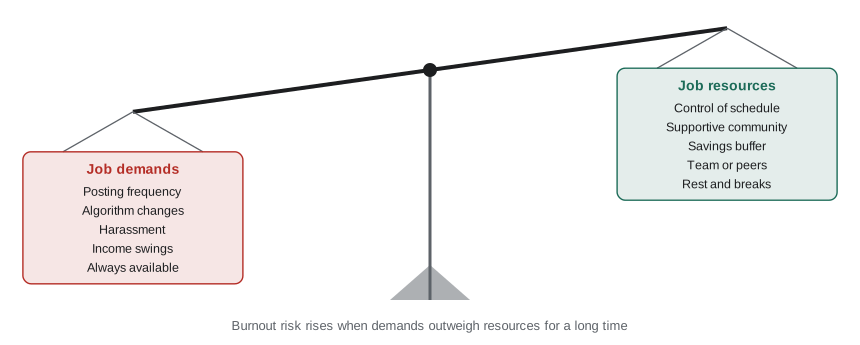
A framework for this course: demands and resources
Psychologists who study work often use the job demands-resources model. Job demands are the parts of work that require sustained effort and therefore cost energy: workload, time pressure, emotional demands and conflict. Job resources are the parts that help you achieve goals, reduce the cost of demands or support growth: control over how you work, support from others, feedback, recognition and time to recover. When demands stay high and resources stay low for a long time, people tend to become exhausted and disengaged, which is the core of burnout. When resources are strong, people can handle high demands and even find the work energizing.
The model is useful because it points to two kinds of action. You can reduce demands, for example by posting less often, batching tasks or filtering comments. You can also build resources, for example by saving an emergency fund, finding peers, hiring help or protecting time off. Most of the practical tools in this course fit one of those two categories. As you work through it, keep asking which demands you could reduce and which resources you could add.
Wellbeing as a business asset
It is tempting to treat wellbeing as something to think about after the channel succeeds. In practice, the person is the business's most important and least replaceable asset. A creator who burns out may stop posting for months, lose sponsorships, miss deadlines or leave altogether. Exhaustion also shows up in the work: ideas get repetitive, editing gets sloppy and reactions to criticism get sharper. Brands increasingly look for creators who can deliver reliably over long partnerships, and reliability depends on sustainable working habits.
Thinking of wellbeing as part of the business plan also makes it easier to justify spending on it. Paying an editor, buying a better microphone so you need fewer retakes, setting aside money for a planned break or paying for counseling can all be treated as investments in keeping the business running. In later lessons you will see how to budget for these choices.
Worked problem
Auditing a week of creator work
A creator who posts three long videos a week records their time for one week: planning and research 6 hours, scripting 5, filming 7, editing 15, thumbnails and titles 3, publishing and short clips 4, comments and messages 7, brand deals and email 4, analytics 3, and administration 2. How many hours did they work, and what share went to editing?
Show solution
- Add the hours: 6 + 5 + 7 + 15 + 3 + 4 + 7 + 4 + 3 + 2 = 56 hours.
- Editing share: 15 ÷ 56 ≈ 0.27, or about 27 %.
- Compare with a standard full-time week of about 37.5 to 40 hours: this week is roughly 40 % longer.
- Note that comments and messages took 7 hours, an easily overlooked task that is also emotionally demanding.
Answer: About 56 hours, with editing taking about 27 % of the time, which makes editing an obvious candidate for batching, templates or outsourcing.
A time audit like this is the first practical tool in the course. Most creators underestimate their hours because the work is spread across the day and night in small pieces. Writing it down for one or two typical weeks shows where the time goes and gives you numbers to work with when you plan changes.
Who this course is for
The course is written for working creators and people who manage, support or hire them: managers, editors, agency staff and brand partners. A manager who understands burnout and harassment can set realistic schedules, plan for breaks and respond well when something goes wrong. A brand that understands creator wellbeing writes fairer briefs, avoids last-minute changes that wreck a weekend and is ready to support a partner who is being targeted online.
It is also written for creators at every size. A creator with 2,000 followers may not face mass harassment, but they can still burn out from trying to post daily on top of a job or studies. A creator with millions of followers may have a team but face far more intense scrutiny and safety risks. The tools scale: the same principles of reducing demands and building resources apply at both ends.
A note on young creators
Many creators start in their teens, and some children appear in family content from infancy. Young people can be especially vulnerable to the pressures in this course: comparison, harassment, privacy loss and the effect of public mistakes that never disappear. If you are under 18, involve a trusted adult in decisions about what you share, who you talk to and what you do if something goes wrong. Lesson 11 looks briefly at the laws some places have passed to protect children who appear in monetized content.
How to use this course
Each lesson ends with mistakes to avoid, a summary, key terms and practice questions. Many lessons include worked examples with real numbers, such as calculating an emergency fund or estimating how many hostile comments a filter will catch. The capstone asks you to bring these pieces together into a plan. You will get more from the course if you apply each lesson to your own situation as you go, even if only in rough notes.
Finally, be gentle with yourself while working through it. Some topics, such as harassment and mental health, can bring up difficult memories. It is fine to take breaks, skip a section for now or talk to someone you trust. The goal is not to make you anxious about everything that could go wrong. It is to help you build a creative life you can sustain.
Common mistakes
MistakeTreating burnout as a personal failing rather than a predictable response to high demands and low resources.
InsteadUse the demands-resources lens: look for demands to cut and resources to add.
MistakeAssuming wellbeing can wait until the channel succeeds.
InsteadTreat your health as the business's core asset and plan for it from the start.
MistakeGuessing how many hours you work.
InsteadTrack a typical week or two and plan from the real numbers.
MistakeQuoting a single survey figure as fact.
InsteadNote who ran the survey, how and when, and focus on consistent patterns.
MistakeWaiting for a crisis before learning where to get help.
InsteadKnow your crisis line and who you would call before you need them.
Summary and key terms
- A solo creator often holds many roles at once: talent, producer, community manager, business owner and analyst.
- Visibility, personal branding, algorithmic dependence, income volatility and blurred boundaries tend to arrive together.
- Industry surveys report high levels of burnout among creators; one 2025 survey found 52 % had experienced it.
- The job demands-resources model explains burnout as long periods of high demands with low resources.
- Practical tools either reduce demands or build resources.
- Wellbeing is a business asset that affects reliability, quality and long-term income.
- Burnout
- A state of exhaustion, cynicism and reduced effectiveness caused by chronic work stress that has not been managed.
- Job demands
- Parts of work that require sustained effort and use energy.
- Job resources
- Parts of work that help achieve goals, reduce demands or support growth.
- Personal brand
- The public identity a creator builds, which is often part of the product.
- Algorithmic dependence
- Reliance on platform recommendation systems for reach and income.
- Time audit
- A record of how working hours are actually spent over a typical period.
- Income volatility
- Large, unpredictable swings in earnings from period to period.
- Crisis line
- A free service people can call or text for immediate support in a mental health crisis.
- Wellbeing
- A broad state of physical, mental and social health and the ability to cope with normal stresses.
- Sustainability
- The ability to keep working at a pace and in a way that can last.
Practice problems
Work each problem on paper first, then reveal the answer to check.
List five roles a solo creator often holds.
Show answer
Talent, producer, community manager, business owner and analyst (others: editor, salesperson, accountant).
Name the five features that make creator work distinctive.
Show answer
Visibility, personal brand, algorithmic dependence, income volatility and blurred boundaries.
In the job demands-resources model, what raises burnout risk?
Show answer
High demands combined with low resources over a long period.
Give two examples of job resources a creator could build.
Show answer
Savings, peer support, an editor, control over schedule, protected time off.
A creator logs 8, 12, 6, 4, 9 and 3 hours across six task types. Total hours?
Show answer
42 hours.
In that week, what share was the 12-hour task?
Show answer
12 ÷ 42 ≈ 29 %.
Why should survey figures on creator burnout be treated with care?
Show answer
Samples, definitions and methods vary, and some surveys are partly marketing.
Why is wellbeing a business asset?
Show answer
The creator is the least replaceable part of the business; burnout harms reliability, quality and income.
Who besides creators can benefit from this course?
Show answer
Managers, editors, agencies and brand partners.
What should you do if someone is thinking about suicide?
Show answer
Encourage them to call or text 988, or call 911 if life is in immediate danger.
Lesson quiz · 5 questions
Score 60% or more to complete this lesson.
Create a free account to save your progress, take quizzes and earn a certificate.