
CRE-350 · Lesson 9 of 12 · 24 min
Legal options and reporting in the US
Most harassment is handled through blocking, filtering and platform reporting. Some behavior, however, is serious enough that the law can help: threats, stalking, extortion, sharing intimate images, hate and false statements that damage your reputation. This lesson gives an overview of the criminal, civil and platform options in your country, how to report and how to prepare evidence. Laws change and differ between provinces or states, so treat this as a starting point.
For advice about your situation, contact a lawyer, a legal clinic or a victim services organization. If you are in immediate danger, call 911.
Three routes: criminal, civil and platform
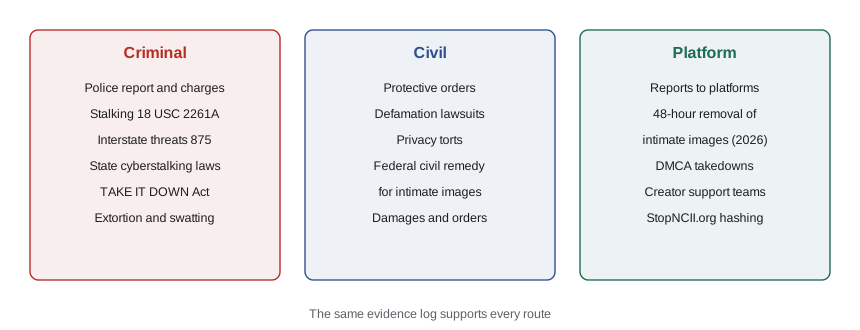
There are three main routes for dealing with serious online harassment. Criminal law deals with offenses against society, investigated by police and prosecuted by the state; the goal is to stop and punish the offender. Civil law lets you sue someone, or apply for an order, to stop the behavior or get compensation; you or your lawyer bring the case. Platform processes apply the platform's own rules, removing content or accounts; they can act quickly but cannot punish offline behavior. Many cases use more than one route at once.
Criminal law
In the US, both federal and state governments have criminal laws that can apply to online harassment. Most cases are handled under state law, but federal law applies to some conduct that crosses state lines or uses interstate communications.
- Stalking (18 U.S.C. § 2261A): using the mail, internet or other interstate communications to engage in a course of conduct that places someone in reasonable fear of death or serious injury, or causes or would reasonably be expected to cause substantial emotional distress. Every state also has its own stalking or cyberstalking law.
- Threats (18 U.S.C. § 875): transmitting threats to injure someone in interstate communications, including online. States also criminalize threats and harassment, with definitions that vary.
- Non-consensual intimate images: nearly every state criminalizes sharing intimate images without consent. The federal TAKE IT DOWN Act, signed in May 2025, made it a federal crime to knowingly publish non-consensual intimate images, including AI-generated digital forgeries, and to threaten to do so.
- Extortion: federal and state laws criminalize extortion, including sextortion, and the FBI treats sextortion of minors as a priority.
- Swatting and false reports: many states have specific laws against swatting, and federal charges can apply to false emergency reports and the threats involved.
- Identity theft and impersonation: some states make online impersonation with intent to harm, defraud or intimidate a crime.
Police can investigate, gather information from platforms through legal processes, lay charges and, in urgent cases, act quickly to protect someone. Police responses to online harassment vary: some services have specialized cybercrime or hate crime units, while others are less experienced. A clear, organized evidence package makes it much easier for police to understand and act.
Civil options
Civil law in the US is mostly state law, so options vary by state. Common civil routes include:
- Protective orders: most states allow people to apply for civil protection or restraining orders against stalking or harassment, which can require no contact and carry criminal penalties if broken.
- Defamation: suing for false statements of fact that damage your reputation. Because of the First Amendment and New York Times v. Sullivan, public figures must prove actual malice, and many creators may count as public or limited-purpose public figures. Many states have anti-SLAPP laws that allow early dismissal of suits targeting protected speech.
- Privacy torts: many states recognize intrusion upon seclusion, public disclosure of private facts and false light, and some have right-of-publicity laws that protect against unauthorized commercial use of a person's name or likeness.
- Federal civil remedy: since 2022, federal law (15 U.S.C. § 6851) lets people sue for disclosure of their intimate images without consent, and many states provide similar civil remedies.
Platforms and intermediaries
Under Section 230 of the Communications Decency Act, platforms generally cannot be held liable as the publisher of content posted by users, which limits lawsuits against them. Platforms still remove content under their own rules. The TAKE IT DOWN Act added a specific duty: from May 19, 2026, covered platforms must have a process for people to request removal of non-consensual intimate images and must remove reported images, and known copies, within 48 hours. The Federal Trade Commission enforces this duty.
Copyright tools can help in some situations. If someone reposts your videos or photos on impersonation accounts, or uses your content without permission, you may be able to file a copyright takedown notice with the platform, which is often faster than an impersonation report.
In the US, the Digital Millennium Copyright Act sets out a notice-and-takedown process that most platforms follow.
Image abuse and young people
If an intimate image of anyone under 18 is involved, report it to the National Center for Missing and Exploited Children's CyberTipline and to police. NCMEC's free Take It Down service helps young people get images removed. For adults, the free StopNCII.org tool lets people create digital fingerprints of intimate images so participating platforms can block them without the images being shared. Sextortion can also be reported to the FBI.
If you are being sextorted, do not pay and do not send more images. Paying rarely stops the threats. Stop responding, keep the messages, report the account and get support from a trusted adult or a support service.
Preparing to report
Whether you go to the platform, police or a lawyer, a well-organized evidence package makes a big difference. It should include:
- A short summary: who is involved (usernames, real names if known), what happened, when it started and how it has escalated.
- A timeline in date order, drawn from your evidence log.
- Screenshots showing content, usernames, dates, times and URLs, with original files kept safe.
- Links to posts and profiles, noting where content has been deleted.
- Records of reports made to platforms and their responses.
- A description of the impact on you, such as fear, changes to your routine, lost income or costs.
Worked problem
Building a timeline for police
A creator has 47 logged incidents from one account and its replacements over 9 weeks: 30 insulting comments, 12 direct messages, 3 posts revealing their neighborhood and 2 messages saying "see you soon" after the creator posted from a local event. Which incidents should lead the summary, and what is the average number of incidents a week?
Show solution
- Average per week: 47 ÷ 9 ≈ 5.2 incidents.
- Most serious: the 2 implied threats, linked to the creator's real location.
- Next: the 3 posts revealing the neighborhood, which show escalation toward doxxing.
- Context: the 30 comments and 12 messages show a repeated course of conduct.
Answer: Lead with the 2 implied threats and 3 location posts, then show the pattern of about 5 incidents a week over 9 weeks as evidence of repeated, escalating conduct.
Ask the police for a report or incident number and the name of the officer. If you are not satisfied with the response, you can ask to speak to a supervisor or a specialized unit. Victim services organizations can help you understand the process and support you through it.
Many states and cities have victim services programs and free or low-cost legal aid. State bar associations run lawyer referral services that can arrange an initial consultation.
Weighing the options
Legal action can be powerful but also slow, expensive and stressful. Before choosing a route, think about what you want to achieve: safety, removal of content, an apology, compensation, accountability or deterrence. Criminal reports cost nothing but leave decisions to police and prosecutors. Civil suits give you more control but cost money and time. Platform processes are fast but limited. For threats and stalking, safety comes first: report to police and plan for physical safety, covered in Lesson 10.
Hate and identity-based harassment
When harassment targets someone because of race, religion, gender, sexual orientation, disability or another protected characteristic, more options may apply. Federal and state hate crime laws can increase penalties when a crime such as threats or stalking is motivated by bias, although hateful speech that is not a true threat or harassment is generally protected by the First Amendment. Many police departments and the FBI track bias-motivated incidents, and civil rights organizations offer support and reporting services.
Even when a hateful message does not meet the threshold for a crime, reporting it to the platform and logging it creates a record that may matter if the behavior escalates.
Anonymous harassers
Many harassers use anonymous or throwaway accounts. That does not always mean nothing can be done. Police can ask platforms for account information through legal processes, and in civil cases courts can order platforms or internet providers to disclose information about an anonymous user. These processes take time and may involve cooperation across borders, since many platforms are based in other countries. Your evidence log, with exact usernames, URLs and timestamps, is what makes such requests possible.
Looking after yourself during legal processes
Legal processes can be long and emotionally draining. You may need to retell what happened several times, review abusive material and wait months for outcomes. Ask a trusted person to help with paperwork and meetings, use victim services where available and keep up the support routines from Lesson 11. It is also fine to decide that a legal route is not worth the cost to your wellbeing; choosing not to pursue a case is a legitimate decision.
Crossing borders
Online harassment often crosses borders. The harasser, the platform and the target may all be in different countries, each with its own laws. Police in your country can usually investigate offenses that affect you there, but obtaining information from foreign platforms or acting against people abroad can be slow and sometimes impossible. Platforms' own rules apply worldwide, which is one reason platform reporting remains important even when legal options exist. If you work across Canada and the US, be aware that what is legal speech in one country may be an offense in the other, and get advice from a lawyer in the relevant place when stakes are high.
Keep copies of everything you send to platforms, police and lawyers, along with their replies and reference numbers. A single folder with the evidence log, the summary, the timeline and all correspondence makes it easier to follow up, change lawyers or escalate a case later.
Whatever route you choose, focus first on safety and on stopping the harm, and then on accountability. The two often go together, but when they conflict, safety should come first.
Common mistakes
MistakeAssuming nothing can be done about online harassment.
InsteadLearn the criminal, civil and platform options for serious conduct.
MistakeGoing to police with scattered screenshots.
InsteadBring a summary, timeline and organized evidence.
MistakePaying a sextortionist to make the threats stop.
InsteadDo not pay; stop responding, keep evidence and report.
MistakeSuing for defamation without weighing the cost and publicity.
InsteadGet legal advice and consider your goals first.
MistakeRelying only on platform reports for threats.
InsteadReport threats, stalking and image abuse to police as well.
Summary and key terms
- Serious harassment can be handled through criminal, civil and platform routes, often together.
- Federal and state laws cover stalking, threats, intimate images, extortion and swatting.
- Civil options include protective orders, defamation, privacy torts and the federal civil remedy for intimate images.
- Section 230 limits platform liability, but the TAKE IT DOWN Act requires 48-hour removal of reported intimate images.
- Report images of minors to the NCMEC CyberTipline; adults can use StopNCII.org.
- Never pay sextortionists; keep evidence and report.
- An organized evidence package with a summary and timeline helps police, platforms and lawyers act.
- Criminal law
- Law dealing with offenses prosecuted by the state.
- Civil law
- Law allowing individuals to sue or seek orders against others.
- Course of conduct
- A pattern of repeated actions, central to harassment and stalking offenses.
- Peace bond or protective order
- A court order requiring someone to stay away or avoid contact.
- Defamation
- A false statement that damages someone's reputation.
- Anti-SLAPP law
- A law allowing early dismissal of lawsuits that target protected expression.
- Intrusion upon seclusion
- A privacy tort for intentional, highly offensive invasion of private affairs.
- Digital forgery
- An AI-generated or manipulated image made to look real.
- StopNCII.org
- A free tool that hashes intimate images so platforms can block them.
- Evidence package
- An organized set of summary, timeline and records for a report.
Practice problems
Work each problem on paper first, then reveal the answer to check.
Name the three routes for serious harassment.
Show answer
Criminal, civil and platform.
Which federal law covers interstate online stalking?
Show answer
18 U.S.C. § 2261A.
Which 2025 federal law covers intimate images and digital forgeries?
Show answer
The TAKE IT DOWN Act.
How quickly must platforms remove reported intimate images under the TAKE IT DOWN Act?
Show answer
Within 48 hours.
What should you do if sextorted?
Show answer
Do not pay or send more; stop responding, keep evidence and report.
Name four items in an evidence package.
Show answer
Summary, timeline, screenshots, links, platform reports, impact statement.
60 incidents over 12 weeks is how many a week on average?
Show answer
Five.
Where should images of minors be reported?
Show answer
The NCMEC CyberTipline and police.
Why might a copyright notice help with impersonation?
Show answer
It can remove reposted content faster than an impersonation report.
What should you ask police for after reporting?
Show answer
An incident or report number and the officer's name.
Lesson quiz · 5 questions
Score 60% or more to complete this lesson.
Create a free account to save your progress, take quizzes and earn a certificate.